

What this blog includes
- An honest definition of self-care, including what it is not.
- Why self-care is not selfish, especially if you grew up in an Indian family.
- 60 self care activities across 10 real categories, from 2-minute moves to deeper ones.
- A simple method to build a routine of 3 habits that will actually hold.
- A line on when self-care is not enough and a therapist is a better fit.
There is a kind of tired no amount of sleep touches. The week ends. You have ticked everything off. The mind still feels like a browser with 40 tabs open.
If this is the week you Googled self care activities at 11 pm, you are not being dramatic. You are on a page read by many of the 500K+ people who come to GoodLives. They want something small, specific and real. Not another list of candles and bath salts.
Why does self-care feel like something you have to earn?
Because the Indian day was never built for it. The nine-hour workday. The WhatsApp family group. The Zomato order running late. None of it leaves room for the quiet 15 minutes your nervous system actually needs. Self-care feels like earning because the week keeps spending you first, every single day, every single week.
You feel it in the body first. A tightness that shows up on Sunday evening. A short temper at your mother’s third phone call. A late-night scroll that goes until 2 am because you cannot bear to end a day where nothing was yours.
The WHO defines self-care as the ability to promote your own health and cope with illness, with or without a health worker (WHO self-care fact sheet).
It is less yoga studio, more small daily upkeep. Think of it as the brushing-of-teeth of your emotional life.
In short: self-care is not a reward you earn after being productive. It is the small upkeep that lets productivity happen in the first place.
Rest is not selfish, especially if you grew up in an Indian family
Because keeping yourself well is how you stay someone the people around you can lean on. A tired person is a short-tempered person. A short-tempered person is a worse partner, worse daughter, worse colleague. The guilt you feel for taking an hour on a Sunday is often a conditioning, not a conscience.
Many of us grew up watching our mothers eat last and serve one more plate before sitting down. The sanskaari daughter script. The quiet fear of what the neighbours will say. The daughter-in-law standard. These forces taught a whole generation that rest is something to be apologised for.
You do not have to earn tomorrow’s quiet by finishing today’s list. You might be worried that one hour on a Sunday means you are falling behind. You are not.
The Mental Healthcare Act 2017 recognises every Indian’s right to mental healthcare (Mental Healthcare Act 2017). Taking care of your mind is a right the law already gave you.
For the inner-critic side of this story, we have a longer piece on how to practice self-love that goes deeper.
In short: rest is not stolen from the people who need you. It is what makes you worth needing.
A plain-English definition of self-care
Self-care is anything you do, on purpose, to keep yourself well in body, mind and feeling. It is often small. It is sometimes boring. It is almost never what Instagram sells. The goal is a slightly steadier tonight, not a reel. If the activity needs an audience, it is probably not self-care.
A useful test for any activity is simple. Does this leave me a little steadier tonight than I was this morning? If yes, it counts. If it only leaves you poorer, more tired, or performing well-being for a reel, it was not self-care.
In short: self-care is a quiet upkeep habit. If the activity needs an audience, it is probably something else.
60 self care activities, in 10 real categories
You have probably seen a hundred lists of self care ideas. This one is grouped by what each kind of activity is actually for. Pick five minutes, not an afternoon. Pick a weekday, not a Sunday. Pick one habit from each of three categories, not all ten of them at once.

Physical body (your base layer)
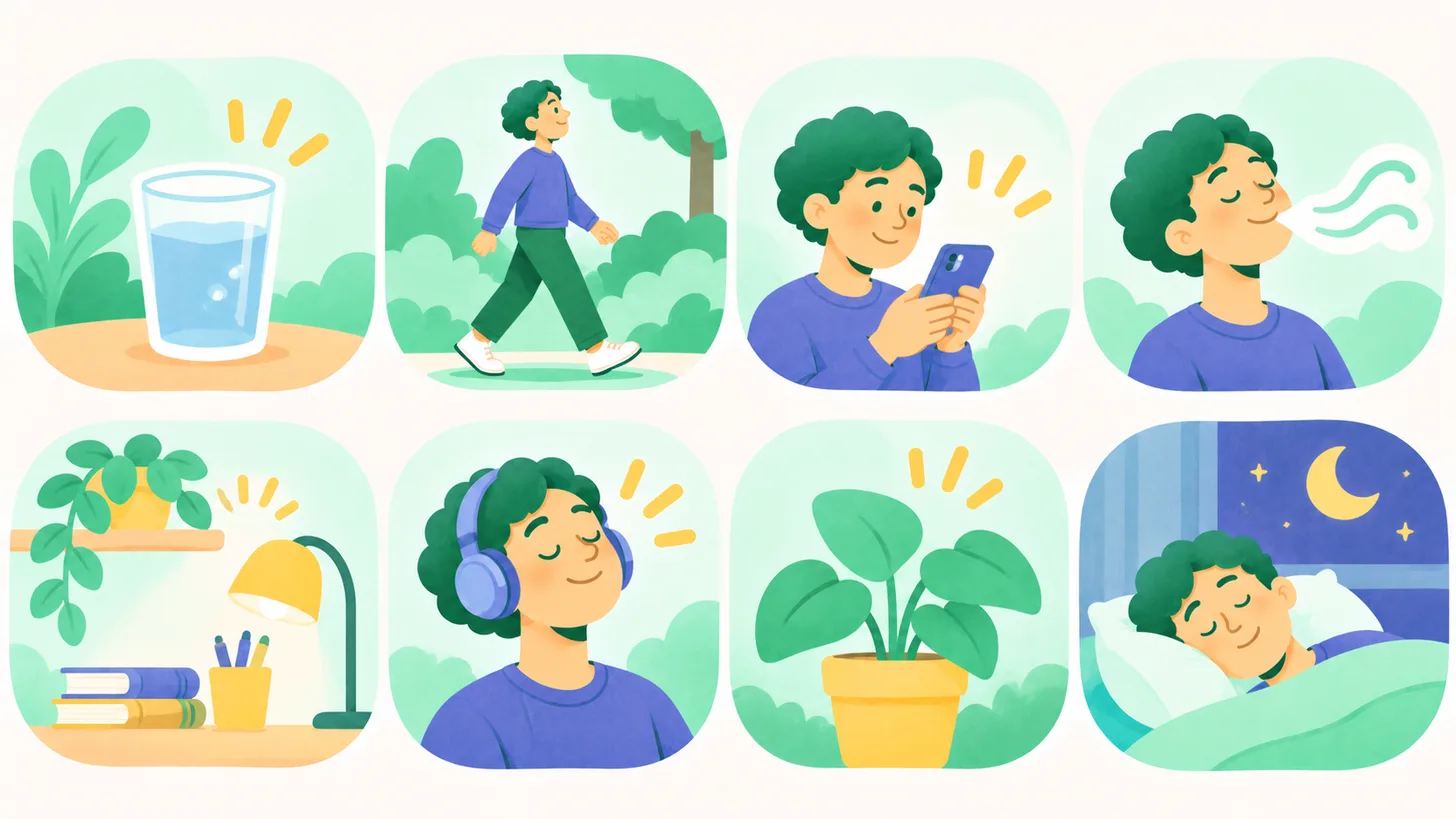
- Drink one full glass of water before coffee.
- Put your feet up on the wall for 5 minutes after work.
- Take a 10-minute walk after dinner, no phone.
- Stretch for 2 minutes before bed, neck and shoulders only.
- Eat one meal a day sitting down, not at your desk.
- Sleep by 11.30 pm three nights a week to start.
Mind and attention
- Keep your phone out of the bedroom one night this week.
- Delete one app that leaves you lower than it found you.
- Read 10 pages of a paper book before sleep.
- Pick one task to finish, close the other tabs.
- Set a 25-minute timer, work only on that.
- Write tomorrow’s three must-dos on paper tonight.
Emotional
- Name the feeling before you name the reason for it.
- Message one friend about something true, not an update.
- Cry when it comes, in the shower if you need the privacy.
- Say “I am not okay today” to one safe person.
- Keep a small list of three things that went right today.
- Let yourself be bored for ten minutes without reaching for a screen.
If you want, write three good things from today here before you read on.
Even on hard days, a few small things hold up.
Let's find three. It takes about a minute, and it never leaves your device.
Three good things
Take them one at a time. Small really counts here. If a prompt doesn't fit, swap it for another.
Your good list for today
Noticing good things doesn't cancel the hard parts. It just gives them some company.
Come back tomorrow and add three more.
This stays on your device. Nothing is saved or sent.
Social and connection
- Call one person this week, do not just text them.
- Say no to one plan that is a maybe, not a yes.
- Have one meal with a family member with no phones on the table.
- Thank one person in detail, not a one-word reply.
- Ask one honest question in a group chat, not a sticker.
- Spend 20 minutes with a pet, a neighbour’s child, or a grandparent.
Spiritual and reflective
- Sit quietly for 2 minutes before you start the day.
- Light a diya or a candle at a fixed time, no reason needed.
- Walk slowly around one neighbourhood block, counting four breaths in and six out.
- Journal for 5 minutes, no editing, no reader.
- Read one page of a thinker you trust, not a scroll.
- Take ten minutes of silence a week, phone face down.
For the quiet-mind practice, our piece on how to meditate walks through the simplest version to begin with.
Sensory
- Open one window for ten minutes of outside air.
- Put on a song you loved in college, start to finish.
- Light an incense stick or make a cup of good chai slowly.
- Keep one soft piece of fabric at your desk you can touch.
- Step outside for one minute of real sunlight before 10 am.
- Take a warm shower with the lights slightly dimmed.
Creative and play
- Draw one bad doodle on a Post-it, do not finish it.
- Cook one dish from your grandmother’s kitchen on a Sunday.
- Write a line of nonsense on a Google Doc nobody will read.
- Learn one small thing on YouTube, 7 minutes, no more.
- Play a mobile game for 15 minutes without guilt.
- Dance in your room with the door shut, three songs.
For the writing side of this, we have a short read on the benefits of journaling if a notebook feels like a place to start.
Environmental (your space)
- Make the bed before you leave the room, five seconds.
- Clear one surface completely before bed.
- Add one plant to the room you spend most hours in.
- Change the sheets on a Friday, not a weekend.
- Fix one small thing that has been breaking for a month.
- Keep a cold water bottle on the desk, refill it twice.
Financial
- Set an auto-transfer to savings on salary day, any amount.
- Unsubscribe from one shopping app for a week.
- Read one bank statement, note the three biggest spends.
- Pack lunch three days a week to begin with.
- Delete one saved card from a shopping site.
- Make one call about a bill you have been avoiding.
Boundaries
- Say “I will get back to you” instead of a reflex yes.
- Put WhatsApp on silent after 10 pm, three nights to start.
- Decline one weekend plan that is not a real yes.
- End one conversation that is going nowhere, kindly.
- Set an out-of-office for one leave day, keep it strict.
- Tell your family the time you will call, so they stop checking.
In short: sixty is a map, not a to-do list. Pick three for this week and let the rest wait.
How to build a routine you will actually keep
Pick three self care activities, one from any three categories, and attach each to a thing you already do. Walk after dinner. Journal after brushing teeth. Phone out of the bedroom after setting the morning alarm. Stacking a new habit onto an old one is the oldest trick in behaviour change and it works.
Give the routine a two-week trial, not a lifetime vow. On day fifteen, keep what helped. Drop what felt like homework. The honest answer is that some weeks the routine holds. Some weeks it falls apart. That is normal, not failure.
A self care routine is not a 30-step morning ritual. If a routine needs a bullet journal, a 5 am alarm and a matcha whisk, it is a performance, not an upkeep. The goal is to make the next hard week slightly more bearable. Not to look like a wellness poster.
For the quieter version of this, we have a longer piece on effective ways to find inner peace that pairs well with any three-habit plan.
In short: three habits, two weeks, one honest review. That is the whole method.
What to do when the routine stops helping
Sometimes the walks, journals and clean sheets do not touch the heaviness. The chest stays tight. That dil ka boj, the weight on your heart, comes back even in the weeks you did everything right. That is often the line between tiredness and burnout.
Burnout is deep exhaustion plus a quiet loss of meaning. It builds over months, not days. Self care activities help you stay afloat. They rarely drain the pool. This routine will not fix the thing that is making the week this heavy.
When the routine stops helping, it is not that you failed the routine. It is that the load is bigger than one person’s upkeep can carry.
In short: if the week keeps winning after three honest habits for a fortnight, the problem is probably not your routine.
When a therapist fits better than another checklist
A gratitude list helps you spot what is good in a day. A therapist can help you look at the pattern underneath the tiredness. The habits give you small wins to lean on. The conversation shows you why finding the good is this hard right now. Two different tools, both useful in a hard season.

Self care activities are useful. They are not a replacement for professional support in anxiety, depression, trauma, grief, or burnout that has outlasted a season. If what you need right now is to sleep ten hours tonight, a therapy session on Friday is not the fastest tool. Go to bed. On Friday, consider a conversation.
If the heaviness has been there for more than two weeks, or you keep crying without a reason you can name, that is a signal. Not a weakness.
If you want to see what the online option actually looks like first, our page on online therapy in India walks through how it works end to end.
In short: self care activities and therapy are two different tools. Use the one that fits the week you are in.
How to talk about this at home without making it a fight
Lead with the behaviour, not the term. The word “self-care” lands strangely in a lot of Indian homes. “I am going for a walk after dinner” lands better than “I am prioritising my self-care”. Pick the simplest sentence that gives you the hour you need.
If a family member reads your rest as laziness, explain the trade. “I take an hour on Sunday, and I am a better daughter on Tuesday.” Most Indian families negotiate better in that currency than in the language of wellbeing.
It is okay to not win this conversation on the first try. It is okay to come back next Sunday with the same calm sentence and try again.
In short: rename the activity, trade the hour, and give the conversation more than one Sunday.
FAQ
What are some fun self care activities?
What are 5 self care activities a beginner can start with?
What are 10 self care practices worth building a routine around?
What are the 7 types of self-care?
Is self-care the same as being lazy?
How do I know if I need a therapist or just a better routine?
Can self care activities stand in for therapy or medication for anxiety or depression?
One thing to try tonight
Pick one activity from the list before the clock hits midnight. Any one. Do it badly, half-heartedly, with a tired body and a tired mind. Then put the phone face down and go to bed. Tomorrow is a longer conversation. Nothing has to be perfect to count as a start.
In short: tonight is not for building a routine. Tonight is for picking one small thing and showing up for it, so tomorrow has a thread to pull.
This post is for information only and is not a substitute for professional care. If you are struggling, please speak to a qualified mental health professional.



Share your thoughts