
What this blog includes
- What a gratitude journal is and what research actually shows it does
- The toxic positivity trap, and how an honest practice looks different
- A simple start, ten real prompts, and when a brain dump works better
- The trauma caveat you rarely hear, and when a therapist is the right next step
You open the Notes app at 11 pm because your head is loud. You have read the lists. “Just write three things you are grateful for.” You try. The pen stops. The chest tightness is still there.
That is where most gratitude journal advice ends. It’s also where it should start. The page can be useful; it’s also easy to do in a way that quietly makes a tired reader feel worse.
This post walks through both sides honestly. You might be worried the practice will feel forced. We will show you how to start without pretending. We will cover a page that respects what you actually feel, and when a brain dump is the honest tool instead.
Trusted by 500K+ people with a 5 Google rating, GoodLives has sat with a lot of readers at this exact 11 pm moment.
What a gratitude journal actually is, and what it is not
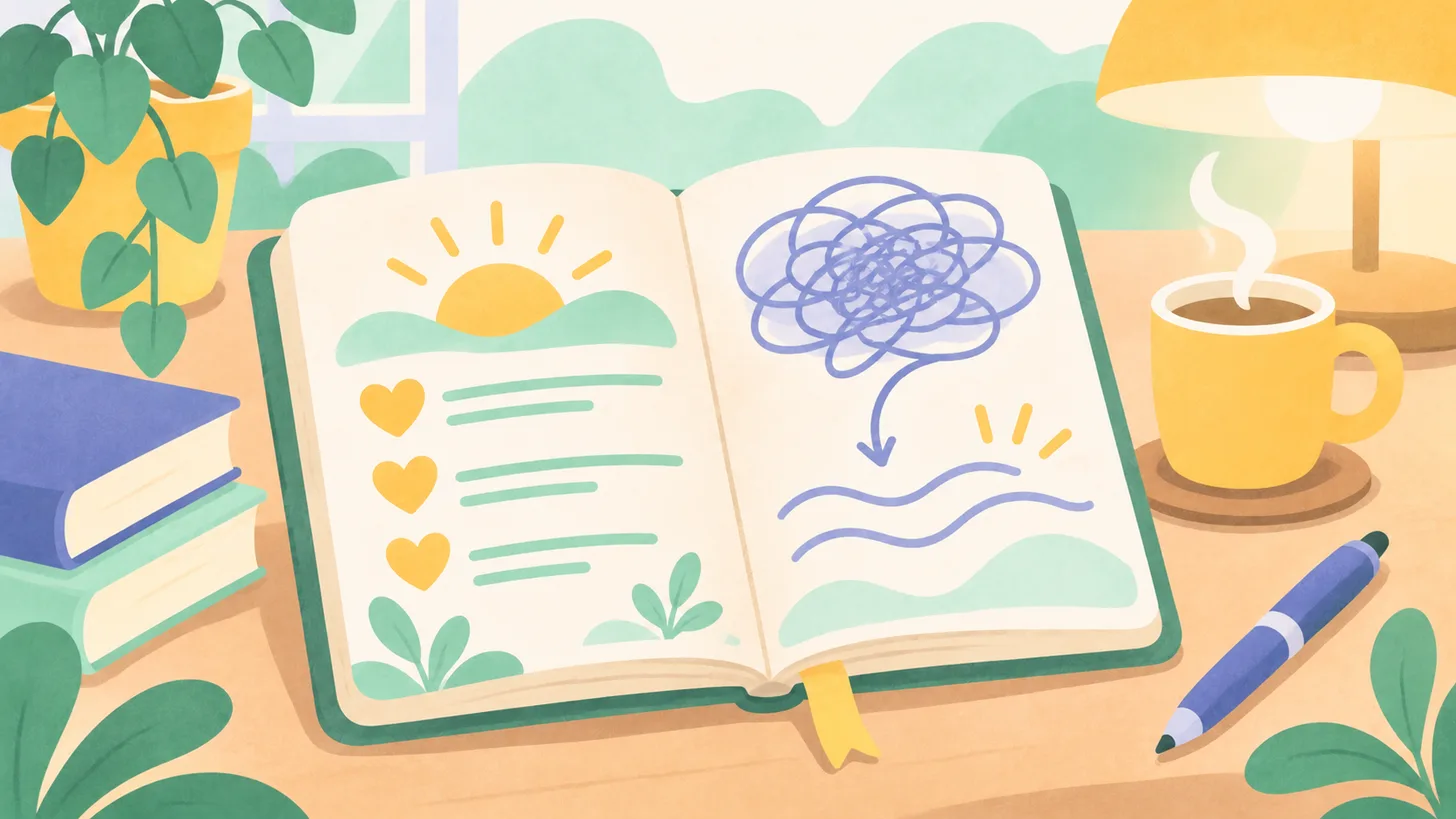
A gratitude journal is a short page you write once a day or once a week. On it you note specific things you noticed, received, or felt grateful for. That is it. It is not a mood board. It is not a vision statement. It is not a way to argue your bad day away.
What is a gratitude journal, really? A page with two to five specific lines. Your own. Private.
The founding research is Robert Emmons and Michael McCullough’s 2003 study in the Journal of Personality and Social Psychology. It was called “Counting Blessings vs Burdens”.
People wrote down things they were grateful for each week. Others logged hassles or neutral events. The gratitude group had better mood and better sleep over ten weeks. That is the whole base of the modern practice.
In short: a gratitude journal is a specific page, not a general feeling. If it reads like a motivational poster, it will not do the work.
What the research says this practice does for your mind
A 2020 systematic review in BMJ Open by Boggiss and colleagues pooled 64 trials of gratitude interventions. They found small but real improvements in anxiety and depression symptoms. The strongest effects were in people who were already distressed.
The context matters in India too. NIMHANS estimates one in seven Indians lives with a mental-health condition. That is why we treat background tools and treatment as different jobs.
The reviewers were careful. The effects are real, modest, and not a replacement for treatment. A separate 2016 review by Davis and colleagues looked at 38 trials and reached a similar verdict.
If you prefer a quieter practice alongside the page, the breath still helps. Our note on how to meditate covers two tools that pair well.
In short: the effect is real but small. It is a background tool, not the whole plan.
The toxic positivity trap and why forced gratitude backfires
This is the part the Instagram infographics skip. Say you write “I am grateful for my family” when your family is the reason you cannot sleep. Your brain hears the lie. The loop gets louder. Forced gratitude is a tax on an already tired system.
Honest practice looks different. You name a specific thing you noticed, even if it is tiny. The chai someone made you. A friend who replied in two minutes. One email that did not need a reply.
You don’t have to be in a good mood to keep a journal. You don’t need to be in crisis to see a therapist either. You may have already tried gratitude lists that felt like a chore. That is a signal, not a failure. If today is hard, write one line and close the book. That still counts.
For a broader read on kindness towards yourself, see our note on how to practice self love.
In short: the page records what you noticed, not what you are supposed to feel. One honest line beats five performative ones.
How to start a gratitude journal in five minutes a night
Pick a time your phone is already in your hand, like the ten minutes before you sleep. Open any notebook or notes app. Write the date. Write two or three specific things, each a full sentence. Do not edit. Close the book.
That is the whole method. Specificity is the part that matters. The brain remembers specific things. It glazes over general ones. “I am grateful for coffee” is a weaker entry than “the second sip of filter coffee at 7:40 am before Monday’s call.”
Three friendly rules:
- Write for yourself, not for an audience, so no screenshotting
- Keep each entry to one sentence, which stops the editing voice
- Skip days when it feels fake, and come back later
If a self-help plan tells you to be perfect for 21 days, close it. A page that works is one you keep returning to, not one you complete. Most of us have quit a 30-day plan by day four; this one isn’t a plan.

In short: small, specific, and skippable. Not daily perfection.
Ten honest prompts you can try tonight
Prompts help on the nights your head is blank. That is more nights than most of us admit. The ten gratitude journal prompts below are specific and gentle. Most ask you to notice, not to feel. Noticing is an easier door for a tired mind.
- What went slightly better than you expected today
- A person who was kind to you in the last week, and the exact kind thing they did
- A small sensory pleasure you had today, like a smell, a sound, or a texture
- Something your body did for you today without being asked
- A hard thing you got through, even if the day is not over
- A small thing you did for yourself today
- A piece of music or writing that reached you this week
- A view from a window you looked at for more than ten seconds
- Someone you were kind to, and what it cost you if anything
- One thing you no longer have to worry about
Pick one, not all. If none of them land tonight, write “nothing landed tonight” and close the book. That is also an honest entry.
If you want, take two minutes with the widget below before you read on.
Even on hard days, a few small things hold up.
Let's find three. It takes about a minute, and it never leaves your device.
Three good things
Take them one at a time. Small really counts here. If a prompt doesn't fit, swap it for another.
Your good list for today
Noticing good things doesn't cancel the hard parts. It just gives them some company.
Come back tomorrow and add three more.
This stays on your device. Nothing is saved or sent.
In short: the prompt is a doorway, not a quota. Use one.
What a brain dump journal is, and why it quiets anxious thoughts
A brain dump journal is the opposite of a gratitude page. You open it and write everything in your head for a set time. No editing. No ordering. No worrying about grammar. The point is to move thoughts out of the loop and onto the page. The loop quiets.
The underlying research is James Pennebaker’s expressive writing work from the 1980s. It is now a large body of literature summarised by the American Psychological Association.
People wrote for 15 to 20 minutes about difficult experiences. They showed small gains in mood, immune markers, and sleep. The method works best when the writing is honest and private.
A brain dump is a lighter cousin. It is shorter and less structured. People use it daily, not just for one difficult event. Many find it is the only thing that lets them sleep when the mind is racing. Hindi has a word for this feeling: bechaini, a restlessness that will not sit still.
In short: a brain dump moves the loop from your head to a page. It does not solve the thing. It makes room.

Doing your first ten minute page unedited
Set a timer for ten minutes. Open a page. Write every thought in your head without stopping. If the pen stops, write “I don’t know what to write” until the next thought arrives. Do not re-read. Do not edit. When the timer ends, close the book or tear the page.
Here is what usually happens. For the first three minutes you write surface things. The laundry. The Monday call. The WhatsApp you haven’t replied to. From minute four, the real stuff arrives. The fight you didn’t resolve. The fear you haven’t named. That is the point.
If reading your own writing afterward would make tonight worse, do not read it. You can tear the page. The writing was the medicine, not the record.
In short: ten minutes, no editing, and no re-reading if that would hurt. The point is to clear the queue, not to curate it.
Why two to three times a week often works better than daily
Daily is not the goal here. That surprises most readers. A 2005 paper by Sonja Lyubomirsky and colleagues found a plateau. People who wrote gratitude lists once a week felt better than those who wrote three times a week.
The brain stops noticing a daily ritual. It still notices a less frequent one. Benefits plateau for most people at two or three times a week.
Many researchers now suggest two to three sessions a week. For an anxious week, three to five short brain dumps work for most readers. The honest answer is that a practice you keep is better than a daily plan you quit.
Journaling fits inside a wider weekly rhythm. See our note on a self-care routine you can actually keep for the other pieces.
You can start, see how it feels for two weeks, pause, and come back. The page is not a commitment.
In short: daily is not the goal. A rhythm you actually keep is.
When journaling can hurt: the trauma caveat you rarely hear
Here is the part most self-help posts leave out. Unguided writing about trauma can, for some people, make things worse. Pennebaker’s later work and clinical guidance from the APA on expressive writing name a specific risk.
Writing in detail about a traumatic memory, alone, with no support, can intensify distress in the days that follow. The risk is highest in the first weeks after the event. It is also high when the memory is still raw.
The signals that mean “stop and talk to a therapist, not a page”:
- You feel worse for several hours after you write, not just during
- You dissociate while writing (feel unreal, lose time, go numb)
- The writing drags you into memories you cannot pull yourself out of
- Your sleep gets worse in the days after you write about it
A journal is a mirror. For a stable mind, mirrors help. For a mind holding a lot of raw memory, a mirror alone isn’t enough. A trauma-informed therapist is the right room. If a session feels too far, online therapy in India is the lowest-friction way to meet one from home.
In short: writing about trauma without support can re-traumatise. If your journaling leaves you more frozen than freed, stop and route to a therapist.
Journaling for mental health is not a replacement for therapy
Journaling for mental health is a useful habit. More Indian readers than ever are picking up a notebook before bed. It’s the Panadol of self-help: cheap, easy, and good for smaller aches. It isn’t the diagnosis. It isn’t the treatment.
Say your anxiety has been loud for weeks. Sleep has gone. You can feel the loop in your chest in the Uber on a Tuesday. A page will not fix that. It helps for ten minutes. A therapist helps for ten weeks. If what you need right now is to sleep tonight, journaling is not the fastest tool.
A gratitude page helps you notice what is working. A brain dump helps you move the queue. A therapist, over time, helps you change the thing underneath. The three are not substitutes. For a wider read, our hub on finding inner peace walks through the pieces.
If you are reading this between tabs at 11 pm, this is the sentence. Tonight, close the laptop with one honest page. Tomorrow is a longer conversation.

In short: a page clears the queue; a therapist changes the baseline. They work together.
FAQ
What is in a gratitude journal?
What should I write in my gratitude journal?
How often should I write in a gratitude journal?
How do you make a gratitude journal?
What is the most popular gratitude journal?
Can a gratitude journal help with anxiety and depression?
Is brain dump journaling the same as free writing?
This post is for information only and is not a substitute for professional care.



Share your thoughts