
What this blog includes
- What play therapy for children is, and why play is used, not talk
- Who it fits, who it does not fit on its own, and what the research says
- How a session really runs, and what a stocked playroom contains
- Fees in India in 2026, how to find a trained therapist, and your role as a parent
You searched for play therapy for children because something at home is not sitting right. Maybe your eight-year-old has started wetting the bed again after a stable year. Maybe your five-year-old has gone quiet since the move. Maybe nobody in the family knows how to talk about the thing everyone is thinking about.
You don’t have to be sure your child “needs therapy” to read this. It is okay to want to understand it first. GoodLives is trusted by 500K+ people in India, and parents searching this phrase are among the most careful readers we meet. Here is what play therapy for children is, told plainly.
What is play therapy, really?
Play therapy is a form of psychotherapy for children, in which a trained therapist uses play as the main way the child communicates. Children aged roughly 3 to 12 do not yet have the vocabulary adults do. Toys, art, sand and story become the way they show what hurts.
The field has three names a parent will meet. Virginia Axline, in her 1947 book Play Therapy, laid out the non-directive, child-centred approach that is still the base of most training.
Garry Landreth at the University of North Texas Center for Play Therapy carried that forward and built Child-Parent Relationship Therapy (CPRT), where parents are trained to use play-therapy skills with their own child.
Theraplay, developed by Ann Jernberg and Phyllis Booth, is an attachment-based play approach that includes the parent in the room.
In short: it is therapy for children, in the language children already speak, done by a therapist trained specifically in it.
Why play, and not talk?
A child’s mind does not work like an adult’s. A child who has lost a grandparent, or whose parents have separated, often cannot sit across a desk and name feelings. They will show you.
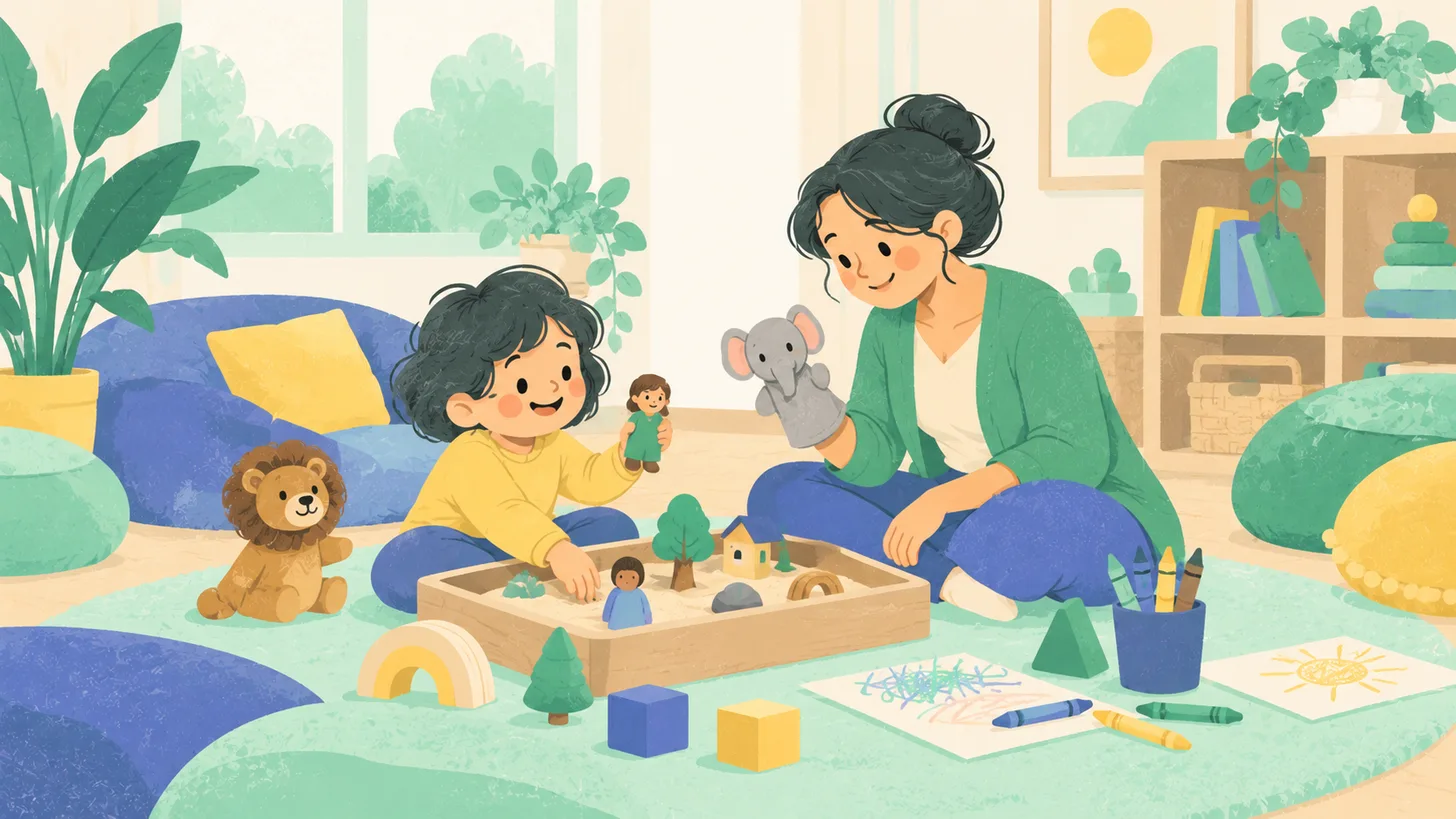
In a playroom, a child might line up miniature family figures and quietly move one away. They might bury a toy in sand and dig it back up for weeks. They might punch a Bobo doll (a weighted, bouncing figure made for exactly this) and watch the therapist stay calm.
A trained therapist reads these as communication, not play for play’s sake. The therapist mirrors the feeling, names it, and holds the room safe. Over sessions, the child’s play changes. The miniatures stop being moved away. The buried toy stays visible. The anger slowly has a shape.
In short: play is the language. The therapist is the trained listener. The playroom is the page.
Who does play therapy fit well?
Honestly, it fits many children, but not every child, and not every presentation. The honest-fit list:
- Anxious children, including school refusal and separation anxiety
- Children of divorce or separation, learning to hold two homes
- Trauma survivors, including after an accident, loss or medical procedure
- Grief, including a sibling’s or grandparent’s death
- Children with ADHD and emotional dysregulation, as an adjunct to the main plan; our ADHD overview has the wider map
- Selective mutism, where a child speaks at home but not at school
- Hospitalised children and children with chronic illness
- Attachment challenges, including after adoption or long caregiver changes
- Children struggling after a sibling’s birth, or after a stressful move or school change
In short: if your child’s behaviour has changed in ways that worry you, and words are not reaching them, this is the therapy built for them.
Who does it not fit on its own?
A fair guide names its limits.
- Severe autism with significant communication needs: a structured intervention (often ABA or a speech-and-language-led plan) is usually the main work. Play therapy may come in as an adjunct, not the lead.
- Active self-harm in older children: a CBT-based plan with family involvement, led by a psychiatrist and clinical psychologist together, is the safer first step.
- Psychiatric emergencies: severe mood swings, psychosis or acute suicidality in a child need an immediate psychiatric assessment. If this is where you are tonight, please read our who to see for anxiety guide and call for an appointment this week.
- Children who need medication for ADHD, severe anxiety or mood: a psychiatrist leads; a play therapist may support alongside.
In short: play therapy is powerful for many children, not every child. A trained therapist will say so on the intake call.
What does the research actually say?
The strongest piece of evidence most Indian clinicians cite is the Bratton, Ray, Rhine and Jones meta-analysis (2005), which pooled 93 play-therapy outcome studies and found large average effect sizes across diverse presentations. It is one of the reasons play therapy has a real seat at the table in child mental health today.
Beyond that, the Association for Play Therapy in the United States sets training standards and tracks outcome research. Theraplay has its own published evidence base for attachment-focused work.
The literature is honest about its gaps. The strongest effects are in child-centred, non-directive work with parent involvement. The research is thinner for severe autism and complex trauma without a wider team.
In short: real evidence, including a large meta-analysis, with the strongest results when parents are part of the plan.
Match Me with a Therapist
> If you want help deciding whether play therapy is right for your child, tell us one thing that is worrying you. We will suggest two child specialists in your language, free. No pressure, no sign-up. > > button: Match Me with a Therapist
What are the main types of play therapy?
A trained play therapist usually works in one of these forms, and a good one tells you which, and why.
- Non-directive, child-centred play therapy (the Axline and Landreth tradition). The child leads. The therapist reflects feelings and holds limits.
- Directive play therapy. The therapist structures certain activities for a specific issue.
- Filial therapy and Child-Parent Relationship Therapy (CPRT). You, the parent, are coached to run short play sessions at home.
- Group play therapy. Several children in the room; useful for social anxiety.
- Theraplay. Attachment-based, with you in the room. Often used after adoption or long separations.
In short: ask the therapist which form they practise, and why.
How does a session actually run?
A session is usually 45 to 50 minutes, once a week, in a specially stocked playroom. The toys are not for entertainment. They are chosen for emotional expression:
- Miniature family figures, animals, cars, houses
- A sandtray with small objects for symbolic play
- Art materials, paints, clay, crayons, paper
- Puppets, dolls and dress-up
- A Bobo doll or boxing bag, for safe anger
Your child goes in alone (younger children with a settling-in protocol). You wait outside. Every four to six sessions, the therapist meets you for a parent-feedback session: themes they are seeing, how you can support at home, where things are tender.
The content of your child’s play stays private between child and therapist. Themes and progress come to you. If a child senses you will be told everything, they close the door.
In short: 45 to 50 minutes a week in a stocked playroom, with parent-feedback meetings every month to six weeks. The child’s privacy is held.
How many sessions does play therapy take?
Honestly, more than parents often expect. Play therapy is a slower therapy, because the child has to feel safe enough to let the real material rise.
- A short course (specific issue, stable child, strong parent involvement): 10 to 20 sessions.
- A typical course (anxiety, divorce, grief, school refusal): 20 to 40 sessions, over roughly six months to a year.
- A longer course (trauma, attachment work, complex family picture): a year or more, with reviews.
A good therapist will give you an honest sense of range after the first three or four sessions. If a practitioner promises a fixed, short cure, that is a red flag.
In short: 20 to 40 sessions is a normal plan. If someone tells you five will fix it, read carefully.
How much does play therapy cost in India?
Honest fees as of October 2026, from Indian practitioner websites and listings. Play therapy sits a little higher per hour than adult therapy, because of the specialised playroom and the parent-feedback meetings.
- One-to-one session: INR 2,500 to 5,000. Senior clinical psychologists with APT or EDI play-therapy training in metros sit at the upper end; associates sit lower.
- Theraplay or CPRT programmes are often sold as a block of 6 to 10 sessions.
- Parent-feedback sessions are sometimes billed separately. Ask on the intake call.
Insurance in India rarely covers play therapy today. The Mental Healthcare Act 2017 is slowly shifting coverage. Ask your insurer in writing before you book. For GoodLives’s own fees, see our pricing page.
In short: INR 2,500 to 5,000 a session, 20 to 40 sessions, with parent-feedback meetings in the plan.
Where do I find a trained play therapist in India?
Credentials to look for, in order:
- A clinical psychologist (M.Phil or Ph.D.) registered with the Rehabilitation Council of India (RCI), with added training in play therapy.
- An MA / M.Phil psychologist with APT International (Association for Play Therapy) certification, or EDI (Expressive and Creative Arts) play-therapy training.
- A clear specialism in children. Child work needs child training. A good generalist will refer rather than stretch into child therapy they are not trained for.
Credible centres and practices sit in Bengaluru, Chennai, Mumbai, Delhi, Pune and Hyderabad; the pool is smaller than for adult therapists, so a waitlist is common. Many practices offer a short online intake even when the therapy itself needs to be in person.
Red flags: a practitioner who promises a cure, who cannot describe their training route, who refuses to meet you for parent-feedback sessions, or who shares specific session content without the child’s consent. See our types of counselling guide for the wider map of options.
In short: RCI registration, child-specific training, parent-feedback meetings, honest talk about pacing. Check all four.
When should I think about play therapy for my child?
Some signs are everyday child-growing-up. Some are quieter signals that one more adult in the room might help. Watch for a pattern, not a single bad week.
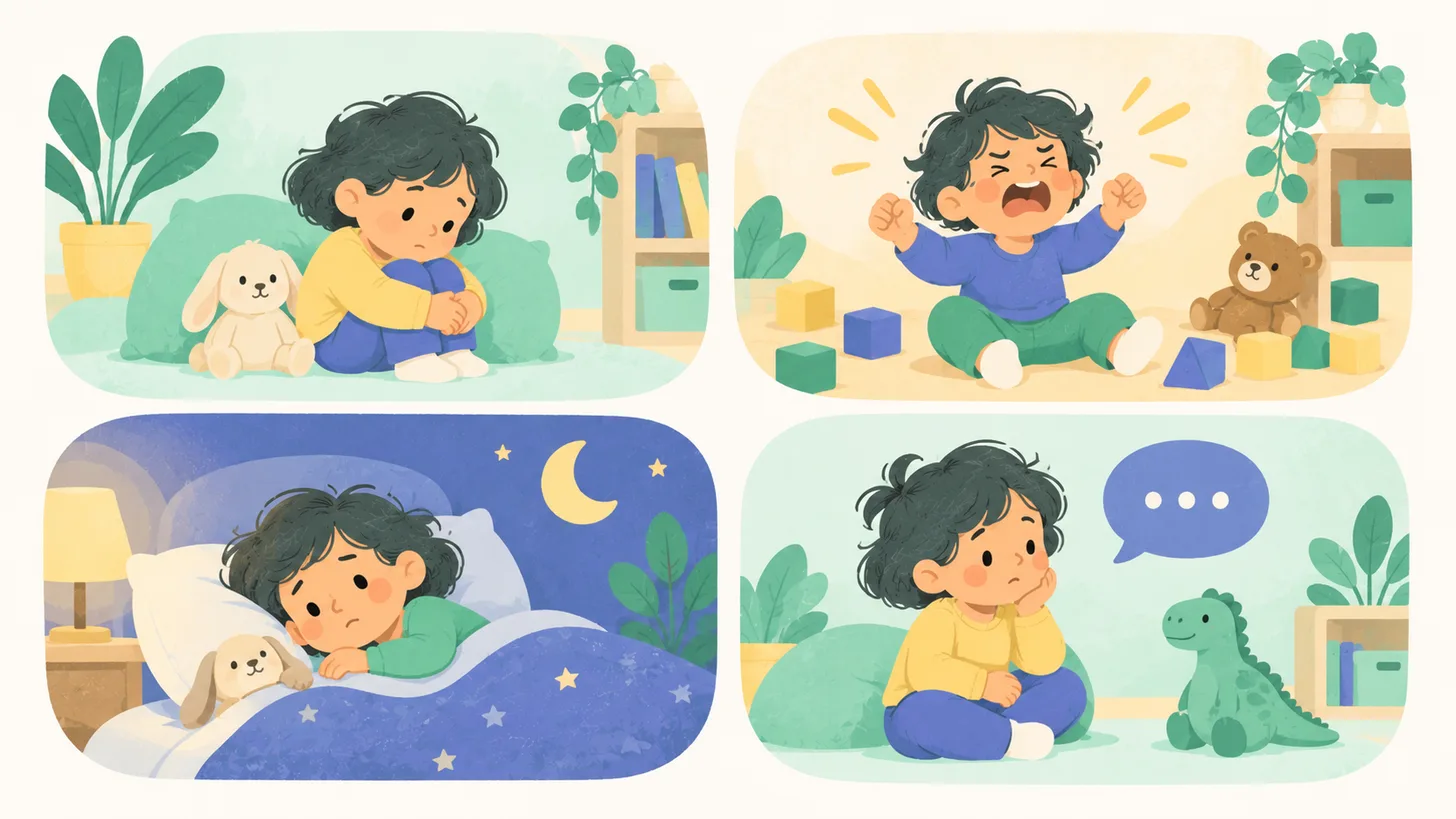
- Regressive behaviour (bedwetting, thumb-sucking, baby-talk) after a milestone that had settled
- Persistent irritability or short fuse, lasting several weeks
- Nightmares or trouble sleeping that keeps returning
- School refusal, or long resistance to going
- Aggression at home or school that is new, or far above the age norm
- Withdrawal, where your usually chatty child goes quiet
- An inability to describe feelings in words, where you used to get at least a little from them
- A big change in the family: a loss, a move, a separation, a new sibling, a parent’s illness
If you are seeing two or three of these for more than four to six weeks, a trained therapist can help you decide whether play therapy is the right first step, or whether a paediatrician check comes first.
In short: patterns over a month, not a single hard day. If several of these are showing up, it is reasonable to ask for help.
How can parents support the work at home?
Honestly, your role is bigger than you may think. Children who do best in play therapy have parents who do the quiet work alongside.
- Protect the appointment. Treat the weekly session like the dentist, not like a thing to cancel.
- Hold the ride home gently. Do not ask “what did you tell the therapist today?” Try “it looked like a long session. Would you like a snack?” The child shares what they want to share.
- Trust the pace. Change is monthly, not weekly. You will see quiet shifts in sleep, appetite and school stories first.
- Keep routines steady at home. Sleep, meals and screen time hold a child doing hard emotional work.
- Attend every parent-feedback session. This is the single biggest thing in your control.
In short: steady routines, protected sessions, no interrogations, show up for the parent meetings.
When to see a psychiatrist alongside
Play therapy is not a replacement for a psychiatric assessment when one is needed. The two work best together for some children.
Consider adding a psychiatrist when:
- Your child has a working diagnosis of ADHD and the daily picture is unmanageable
- There is severe anxiety or OCD interfering with school and sleep
- There is significant mood dysregulation, including persistent sadness
- A paediatrician has already flagged a possible mood or developmental concern
A psychiatrist does not take the place of a play therapist. They work in parallel. See our effects of bullying guide if the stressor your child is working through is at school.
In short: play therapy and psychiatry are not either-or. For many children, both doors are open.
This post is for information only and is not a substitute for professional care.



Share your thoughts