

What this blog includes
- What a life coach actually is (and is not)
- Life coach vs therapist, side by side
- Why life coaching is unregulated in India, and what that means for you
- When a coach is the right call
- When you need a therapist, not a coach
- Red flags when choosing a coach
- How to check a coach’s credentials honestly
- A simple way to decide: do I need a life coach or a therapist?
What is a life coach?
A life coach is someone you hire to help you move forward on a specific goal. The work is forward-looking. You arrive with a thing you want (a career shift, a business, a habit, a target), and the coach helps you clarify it, break it down, and keep going. The life coach meaning, in plain words, is a goal-and-action partner. It is not therapy.
A good coach can do real work. They ask sharper questions than your friends do. They hold you to what you said last week. They help you see where you are blocking yourself on the surface of a decision.
What a life coach is not is a mental health professional. Coaches do not diagnose. Coaches do not treat anxiety, depression, OCD, trauma or any clinical condition. Most coaches have no required training. In India, nothing stops anyone from printing the title on a visiting card tomorrow.
If you are nodding along because you have been scrolling through coach reels on Instagram and wondering whether this is what you need, the confusion is fair. The category is genuinely messy. Let us pull it apart.
In short: a life coach helps you move forward on a goal. The role is unregulated and is not therapy.
Life coach vs therapist, side by side
The honest life coach vs therapist question is less “which is better” and more “which one fits what you are actually facing”.
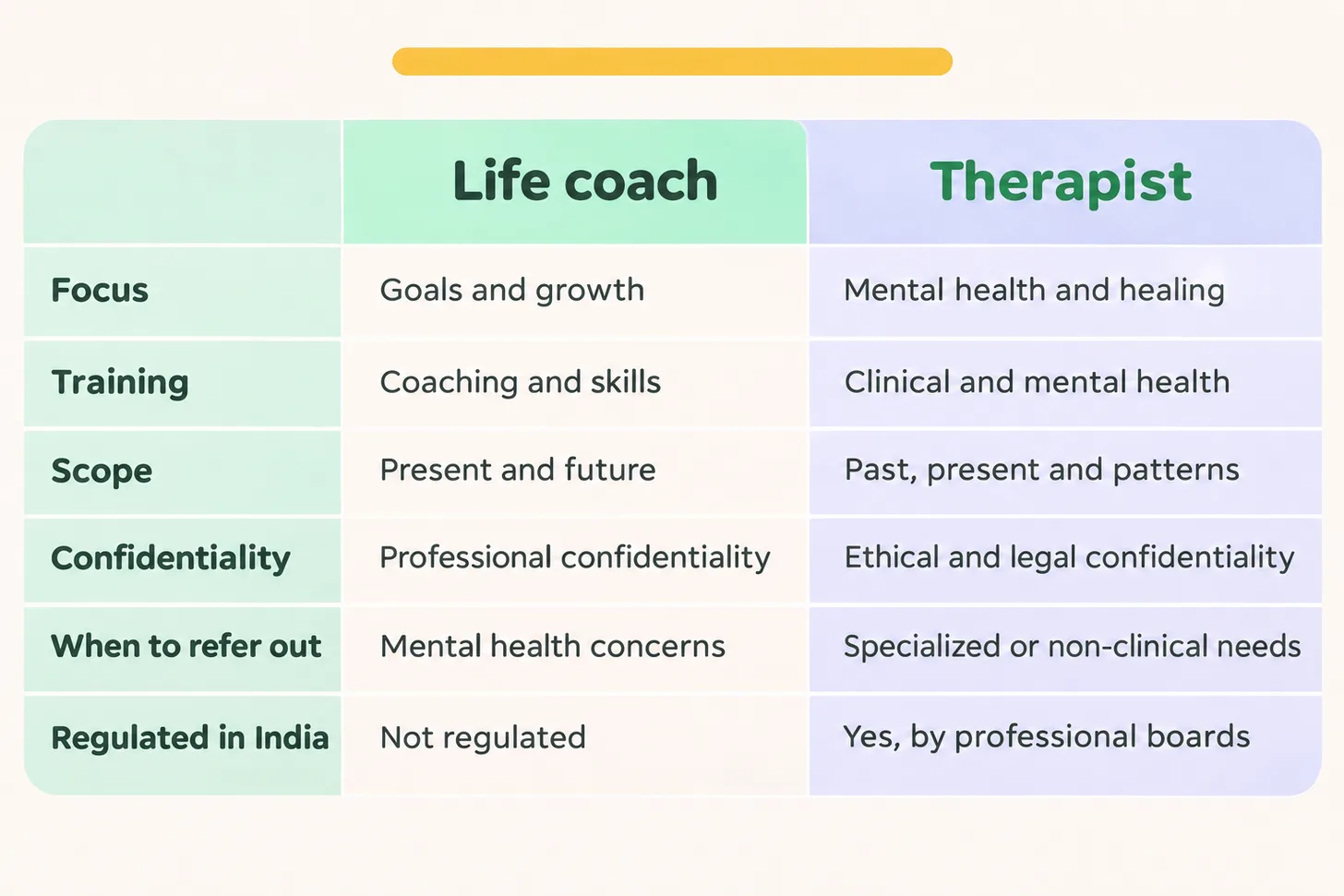
A life coach works on the future. A therapist works on your inner life, including the parts that are shaping your future without you knowing. A coach assumes you are mentally well and want to perform better or build something. A therapist is trained for the moments when you are not well, or when a pattern keeps repeating no matter how good your plan is.
Here is the simple contrast:
- Focus. Coach: goals, actions, outcomes. Therapist: feelings, patterns, healing.
- Training. Coach: no legal requirement in India. Therapist: a psychology degree plus RCI registration for a clinical psychologist, or an MD for a psychiatrist.
- Scope. Coach: performance and goal work only. Therapist: mental health conditions, grief, trauma, relationships, identity.
- Confidentiality. Coach: depends on the person. Therapist: a legal duty under the Mental Healthcare Act 2017.
- When to refer out. A good coach refers you to a therapist the moment the work turns clinical. A therapist may suggest coaching once the clinical work is stable.
If you want help with mental health, you need the second column.
In short: coach works on goals, therapist works on mental health, and only one of the two is regulated.
If you want a quick walkthrough of who sees whom in India, our hub which doctor should I see for mental health in India covers psychologists, psychiatrists and counsellors in plain words.
Life coaching is unregulated in India. Here is what that means for you.
In India, “life coach” is not a licensed profession. There is no governing body. No exam. No required training. No ethics board you can complain to. The Rehabilitation Council of India (RCI) regulates clinical psychologists. The Medical Council regulates psychiatrists. Life coaches sit outside both.
That does not mean every coach is a problem. Many are serious, trained, and genuinely useful. It does mean the burden of checking is on you, the reader. There is no system doing it for you.
The practical consequence: price does not signal quality. Instagram following does not signal quality. A nicely edited website does not signal quality. You have to ask the questions.
In short: anyone can call themselves a life coach in India. Check before you pay.
When a coach can genuinely help
A coach is the right call when you are mentally okay and you want help getting to a specific destination. If a friend who happens to be an excellent planner is what you wish you had, a coach is close to that.
Coaching fits when:
- You know what you want, roughly, and need help getting there.
- Your goal is specific (a job change, a business launch, a habit, a public-speaking skill).
- You want external accountability, not just advice.
- There is no mental health concern sitting underneath the goal.
- You are stable enough to use feedback and act on it between sessions.
Common fits in India: career transitions, first-time founders, finance habits (with a finance-trained coach), fitness goals (with a fitness coach), leadership skills for mid-career professionals. In those lanes, a thoughtful coach can save you months.
If this is you, and you want to talk to someone first before deciding between coaching and therapy, you can book a session with a GoodLives psychologist and ask them which fits. Many of our therapists will tell you honestly if coaching is a better match for what you are facing.
In short: coaching fits when the goal is forward, specific, and nothing clinical is in the way.
When you need a therapist, not a coach
If any of this is familiar, the honest answer is therapy, not coaching:
- You feel anxious, low or empty, and it is not shifting.
- A pattern keeps repeating in your relationships, work, or self-image.
- You are grieving a loss, a relationship, or a version of yourself.
- Something from your past still shapes how you react today.
- You feel stuck in a way that goal-setting does not touch.
- You want to understand yourself, not just do more.
- Any thought of self-harm, however small or passing.
This is the part the industry sometimes blurs. If a coach has told you they can “fix your anxiety” or “clear your trauma” in six sessions, step away. You deserve actual care, not a workaround. Our guide to online therapy in India walks through how therapy actually works, what to expect, and how to get started.
In short: anything clinical is for a therapist, not a coach. A life coach cannot help with depression.
Red flags when choosing a life coach
Because the field is unregulated, the vetting lives with you. Here are the specific signs to walk away from.
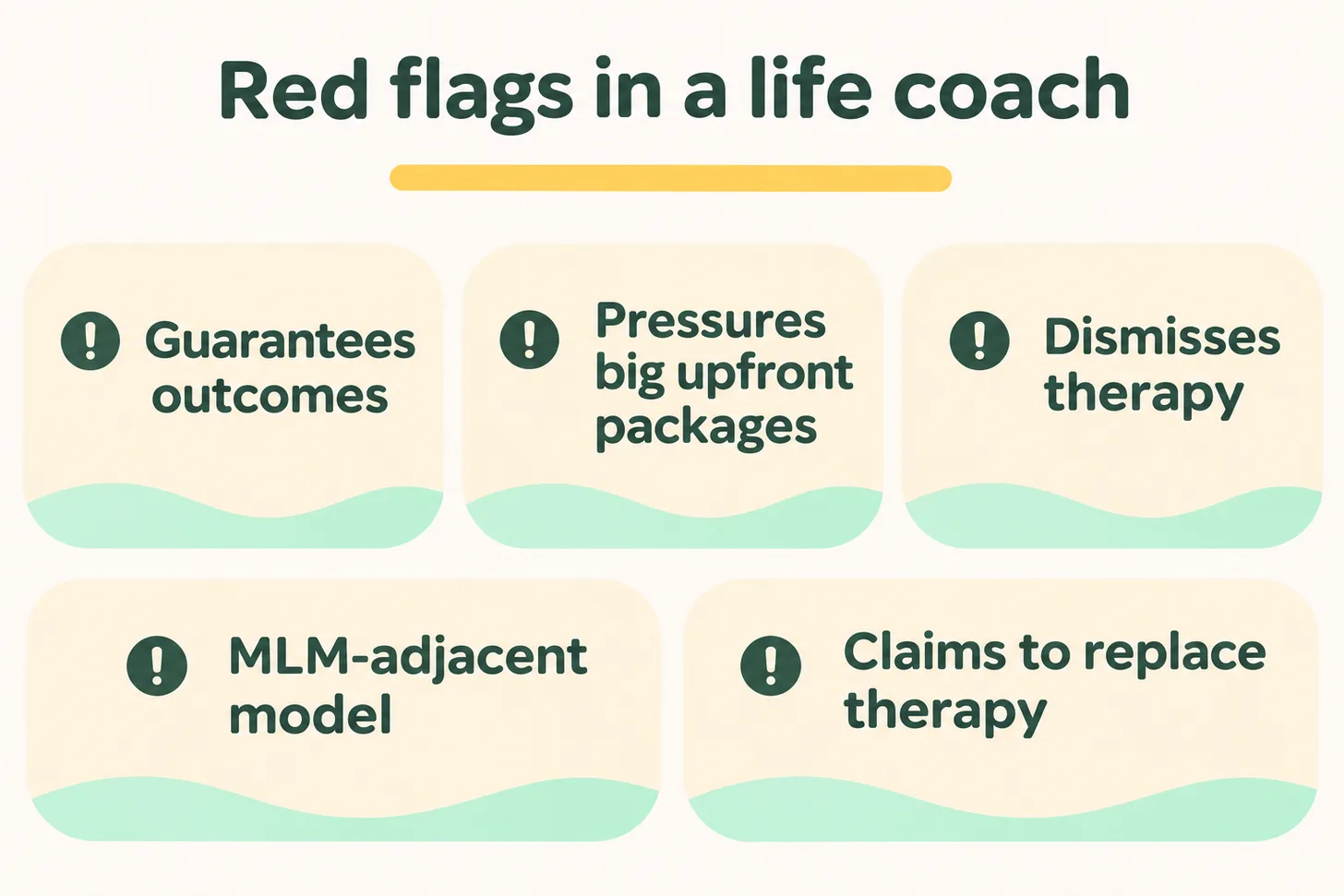
- They guarantee outcomes. No honest professional, coach or therapist, guarantees a result. If you are promised a job, a partner, a transformation or a specific income, that is marketing, not coaching.
- They pressure you into expensive long-term packages upfront. A trial session, a short package, a monthly plan: fine. Thirty lakhs locked in on day one, with urgency and limited slots: not fine.
- They dismiss the idea of therapy. A coach who says “you do not need therapy, I can handle this” when you describe anxiety, depression or trauma is a serious red flag. A good coach refers you out.
- The business looks MLM-adjacent. If becoming a coach is part of the pitch, or recruiting other coaches is how they make money, that is not a coaching practice.
- They claim to replace therapy. Phrases like “coaching is the new therapy” or “therapy is slow, I do it faster” tell you where they stand. Therapy is a licensed profession for a reason.
- They have no verifiable training. A big Instagram following is not training. Being a certain kind of personality is not training. A specific course, a specific school, a specific accreditation: that is training.
- They will not say what they cannot do. Any professional with real training can name the limits of their work. If every question gets a yes, that is a problem.
In short: guarantees, pressure, dismissing therapy, MLM-adjacent models and refusing to name limits are the five patterns to walk away from.
How to check a coach’s credentials honestly
Ask three things before you pay a coach.
Training. What specific coaching programme did you complete, and when? “International Coaching Federation (ICF)” accreditation (ACC, PCC or MCC) is a credible international standard. It is not the only one, but it is a real reference point. Ask for the certificate number if the coach lists it.
Experience in your specific lane. A business coach is not a career coach is not a fitness coach is not a relationship coach. Ask how many clients they have worked with on the thing you want help with.
Boundaries. Ask: “What is outside what you work on, and when would you refer me to a therapist?” A good coach has a clear answer. A problematic one gets defensive. If you want a quick primer on who does what in Indian mental health, our guide on psychiatrist vs psychologist vs neurologist is a useful read before you decide.
In short: training, lane and limits. Three questions, every time.
Can a coach and a therapist work together?
Yes, and sometimes this is the right setup. A therapist holds the clinical work. A coach holds the goal work. The two roles stay in their lanes.
A common sequence in India:
- You start therapy for anxiety or burnout.
- Once the symptoms steady, you still want a specific career move.
- You add a coach for the career piece while the therapist stays in the background.
Both professionals knowing you are seeing the other is helpful. Our overview of the main types of counselling explains the therapy side if you are new to it.
In short: both can run together, with the therapist as the clinical anchor.
Do I need a life coach or a therapist?
If this is the question in your head right now, here is a simple way through it.
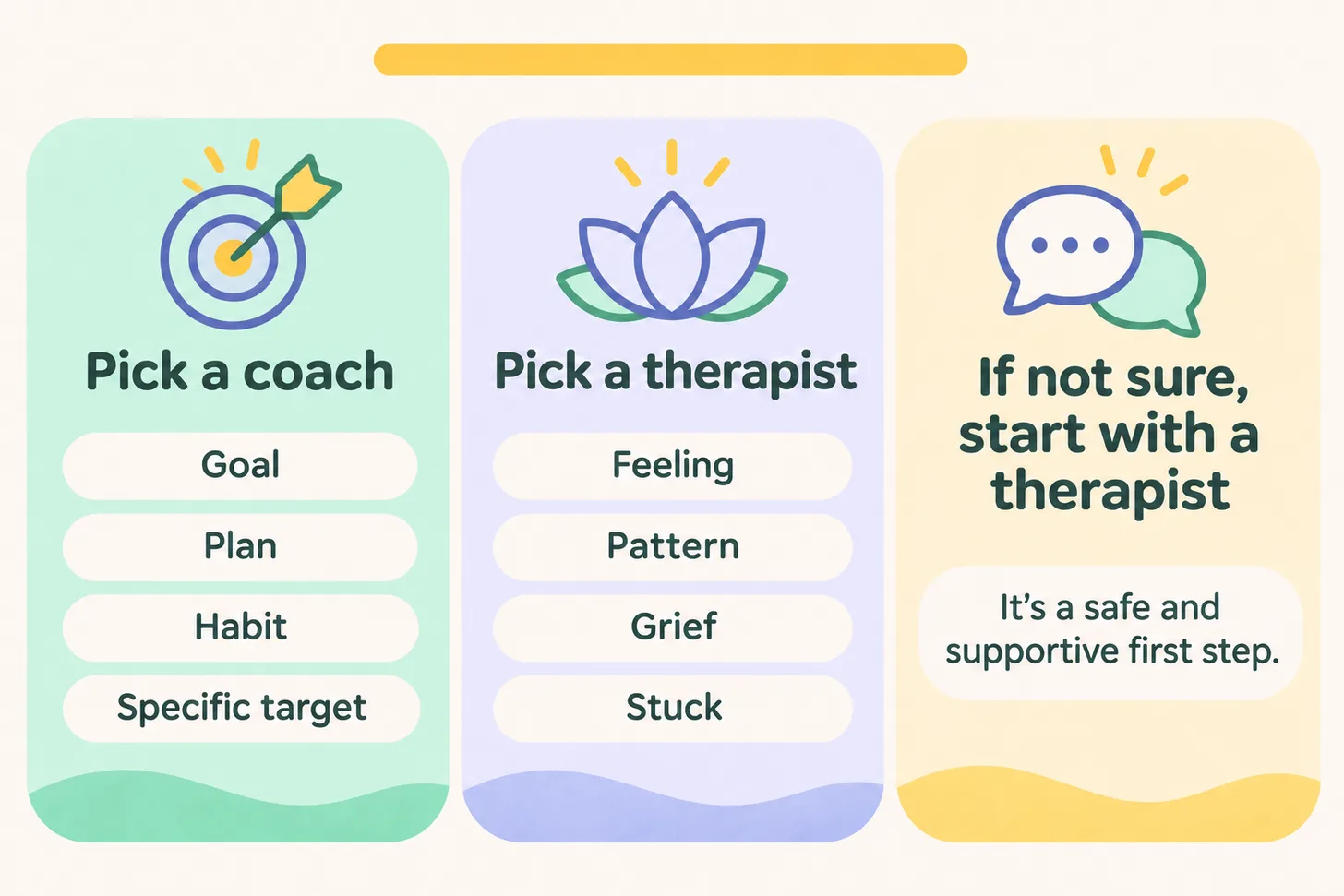
Ask yourself one line: what is actually in the way?
- If it is a plan, a habit, a decision, a specific external goal, and you feel mentally okay: a coach.
- If it is a feeling, a pattern, a relationship, a memory, a mood you cannot shake, or a sense of being stuck in yourself: a therapist.
- If you cannot tell, start with a therapist. A good therapist will tell you honestly, often in the first session, whether coaching alone would do the job.
You do not have to figure this out alone. If you want a human to think it through with you, book a session with a GoodLives psychologist and ask them which fits. We would rather you spend a session finding out than a year on the wrong kind of help.
In short: goal in the way, pick a coach. Feeling or pattern in the way, pick a therapist. Not sure, start with a therapist.
Not sure which one you need?
You do not have to decide alone. In a first session with a GoodLives psychologist, you can describe what is going on and get an honest read on whether therapy, coaching, or a mix is right for you.
- A 50-minute first session with a verified Indian psychologist.
- An honest conversation about what you actually need.
- Available in English, Hindi and more Indian languages.
- See our pricing page for the current fee.




Share your thoughts