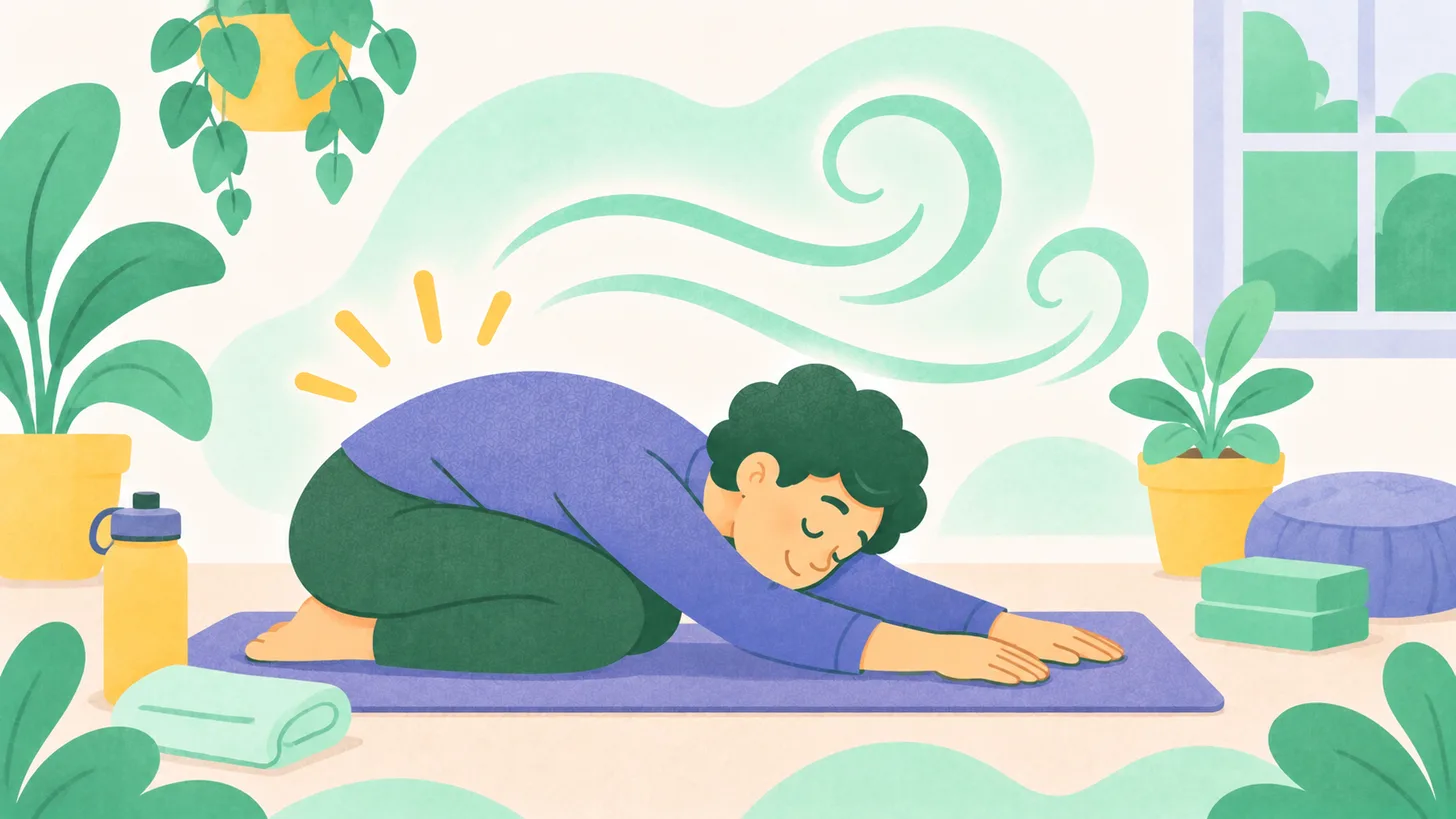

What this blog includes
- Eight gentle yoga poses to try at home, with safe starters.
- Four pranayama practices that calm the breath.
- An honest look at what yoga cannot replace, and when to see a therapist.
- Red flags during practice, and when pregnancy or injury should pause you.
If you are reading this at the end of a loud day, your shoulders know it before your mind does. Many of us call that tight, restless feeling by its older name at home. Bechaini — unease that will not sit still.
Yoga for anxiety is one of the oldest answers we have to it. The right poses and the right breathing can help you climb down from a spike. They cannot rebuild a nervous system worn thin for months.
This blog walks through eight gentle poses and four breathing practices. It also names where yoga stops and a therapist’s work begins. Trusted by 500K+ people, GoodLives sits in that second half. The first half, we hand to the mat.
What yoga for anxiety actually does for your body
Yoga works on the body first. Slow movement and long exhales nudge the body out of alarm. Reviews say it can ease daily anxiety signs. The best signals come from trials run in India. For a diagnosed anxiety disorder, the proof is thinner.
A 2024 Harvard Health piece on yoga and mental health links steady practice to lower anxiety and depression signs. Slow breath cuts heart rate. It quiets the stress response.
The US NCCIH is more careful. Yoga helps with anxiety signs in many groups. The proof for a diagnosed anxiety disorder is still thin.
That gap matters. A hard few weeks after an exam? A steady practice can take the edge off. Months of waking at 4 am? Your body needs more than a mat.
In short: Yoga calms the body in the moment. For diagnosed anxiety, it is a support, not a treatment.
Eight gentle poses to try when anxiety is loud
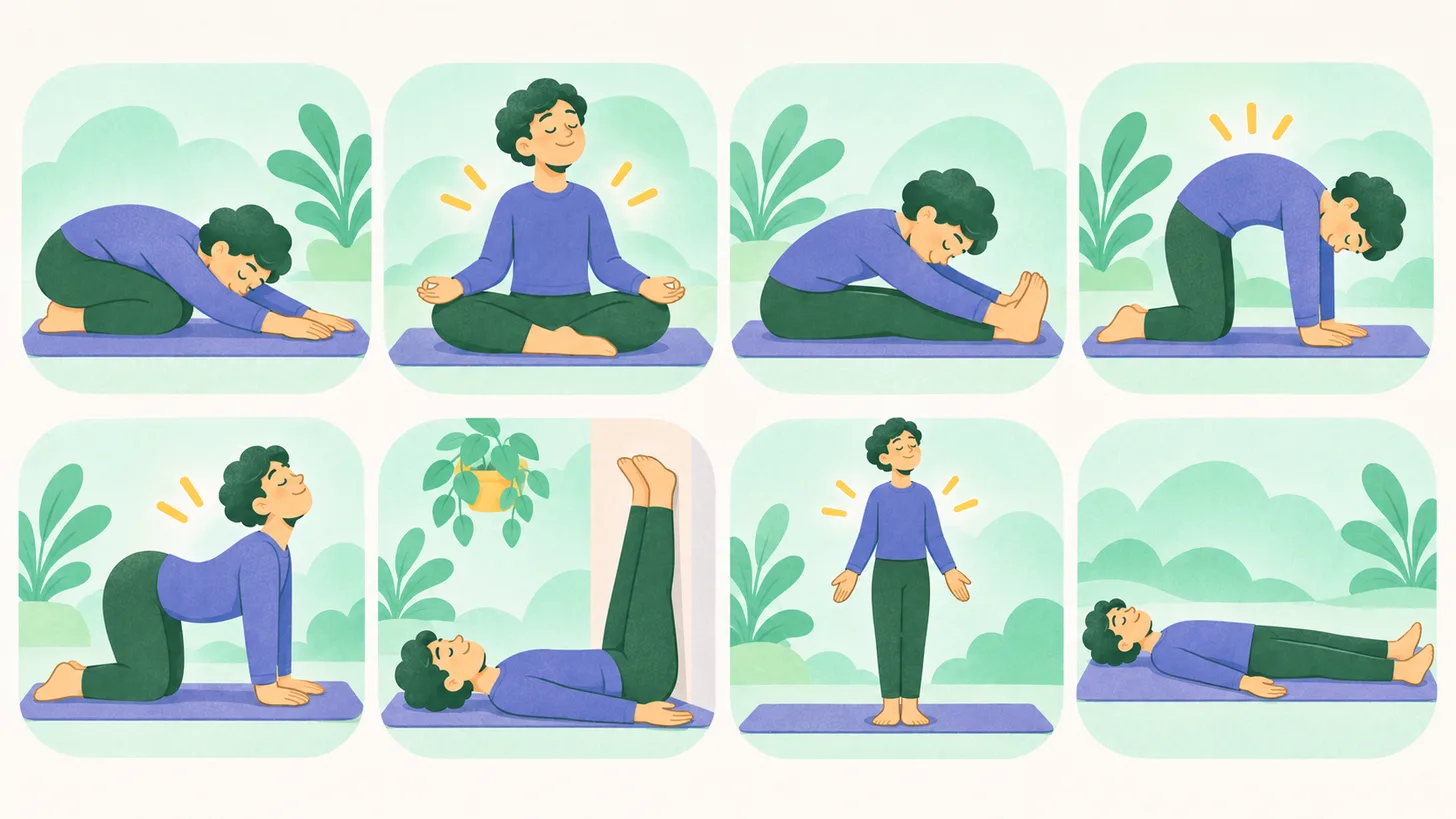
These eight asanas are safe for most beginners. They are kind on knees and lower backs. They suit a quiet corner at home. Hold each pose for five to ten slow breaths. Nothing here should hurt. If a pose pinches, back out and move on.
- Balasana (child’s pose). Fold over your knees. Forehead on the mat.
- Marjaryasana-Bitilasana (cat-cow). Round the back on an exhale. Arch on an inhale.
- Uttanasana (standing forward fold). Stand with soft knees. Let the upper body hang.
- Setu Bandhasana (bridge pose). Lie back, knees bent, hips lifted. Many of us hold tension in the chest after a long day on a phone. This opens it.
- Sukhasana (easy seated pose). Sit cross-legged, hands on knees. The baseline for breath work.
- Baddha Konasana (butterfly). Soles together, knees falling open.
- Viparita Karani (legs up the wall). Lie back, legs resting up a wall.
- Savasana with a body scan. Lie flat, eyes closed. Move slow attention from head to toes. Let tight spots be.
Example: Picture a 27-year-old in Bengaluru after a long call-day. Three minutes in child’s pose. Two in legs-up-the-wall. The body knows the day is done.
In short: Eight poses, held slowly, in a safe sequence. The point is to give the body a chance to come down.
Four pranayama practices for anxiety and overthinking
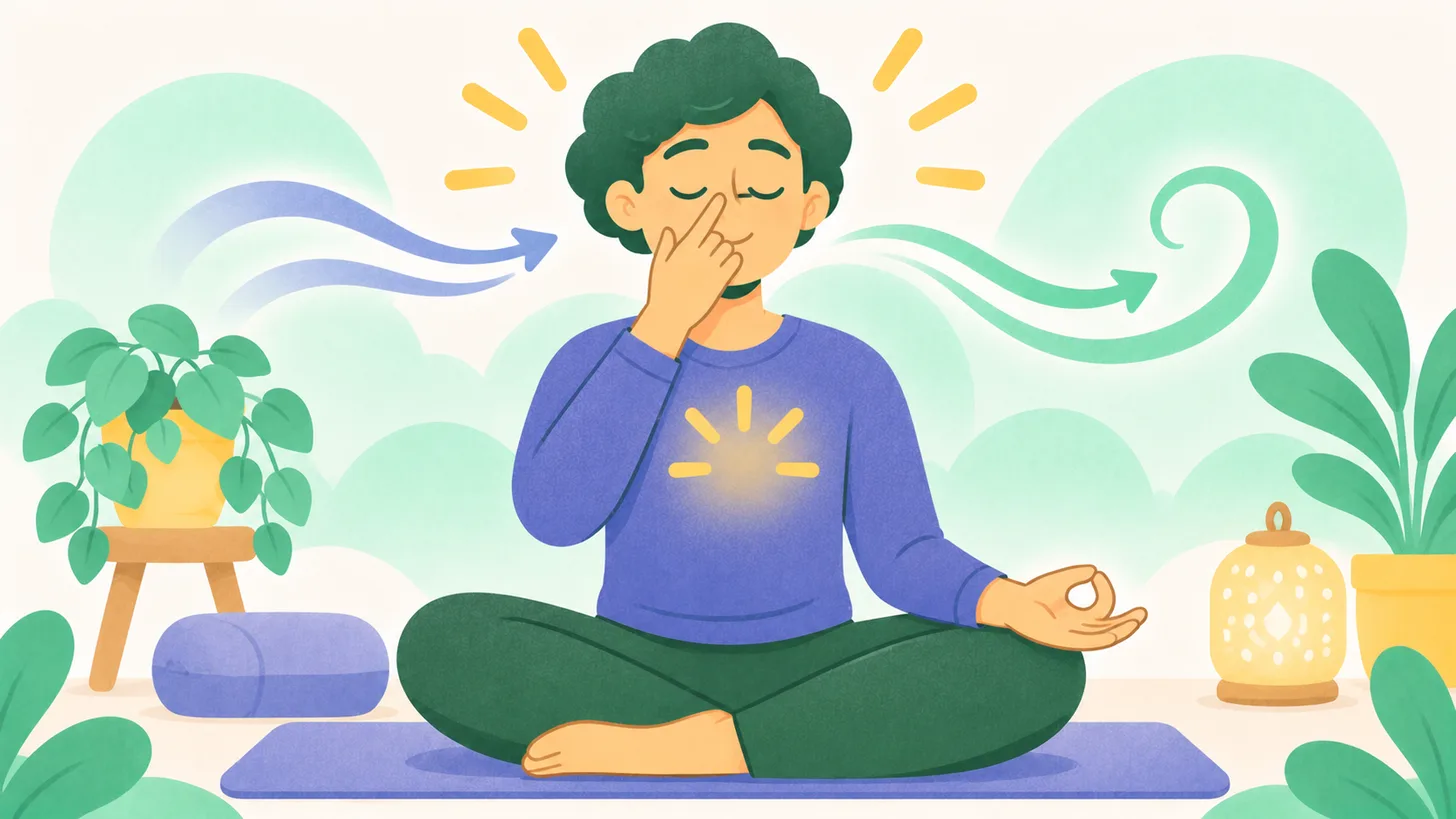
Pranayama for anxiety is the shortest route from a racing mind to a slower body. Each one does something a bit different. Pick the one that fits today: alternate nostril for a jittery morning. Bee breath for an anxious evening. Cooling breath for anger. Extended exhale when sleep will not come.
- Nadi Shodhana (alternate nostril). Close one nostril, breathe through the other, then swap. Steadies the mind before a hard talk or an exam.
- Bhramari (bee breath). Close your ears softly. Inhale, then hum long on the exhale. The hum quiets the inner noise.
- Sheetali (cooling breath). Curl your tongue or purse your lips. Inhale through the mouth. Exhale through the nose. Cools the heat frustration leaves behind.
- Extended exhale. Inhale for four counts. Exhale for six or eight. This tells the body it is safe.
You might be worried you are doing this wrong. You are not. You do not need a mat, a candle, or a quiet room. You need one minute of honest attention.
If you want, take one slow minute with the box-breathing widget before you read on.
A moment to breathe
Follow the circle. Breathe in, hold, breathe out, then hold. Four counts each. Stay as long as you like.
In short: Four breaths, four jobs. Try two. Keep the one your body answers to.
How to build a 15-minute routine you will keep
Ten to fifteen minutes a day beats one long session a week. Build the routine where it is easy to show up. A corner of your bedroom. A mat near your bed. No music, no phone. Perfect weeks are rare for most of us; start again tomorrow if a day slips.
A sample 15-minute flow:
- 2 min: Sukhasana with five rounds of Nadi Shodhana.
- 6 min: cat-cow, Uttanasana, Baddha Konasana, Setu Bandhasana (six breaths each).
- 3 min: Viparita Karani against a quiet wall.
- 2 min: Savasana with a soft exhale focus.
- 2 min: three rounds of Bhramari before you get up.
A few small rules:
- Practise before dinner, not right after a heavy meal.
- Keep water nearby, not your phone.
- If you have a shoulder, knee, or wrist injury, skip anything that loads it.
In short: A short daily routine does more for anxiety than a long occasional one. Fifteen minutes, same corner, most days.
What yoga cannot replace
Yoga is a quieting practice. It is not a treatment for an anxiety disorder, panic disorder, OCD, PTSD, severe depression, or the weeks after a major loss. If you have been pulling back from life for weeks, if sleep is gone, if the thoughts are intrusive, yoga is a support, not the main response.
- Severe anxiety that will not settle. Talk to a psychologist registered with the Rehabilitation Council of India (RCI). Online counselling brings one into your home.
- Panic disorder. A long exhale can help in the moment. Repeated panic attacks respond best to Cognitive Behavioural Therapy (CBT), a short, structured therapy that teaches you to spot the loop and ride it out.
- OCD. The main treatment is Exposure and Response Prevention (ERP), delivered by a trained therapist. No pose replaces it.
- PTSD or trauma. Trauma-informed therapy is the main response. A trauma-trained therapist chooses which body-based practices are safe.
- Severe depression. A clinical check comes first. Movement helps, but it is not primary care.
- Life stress with no exit. A toxic workplace, an unsafe home, a money squeeze. These need a direct answer, not a longer practice.
- The block at the end lists them.
Not every anxiety needs therapy either. Some seasons walk through you, and a mat and a few close friends are enough. The honest answer is: watch the pattern, not the week.
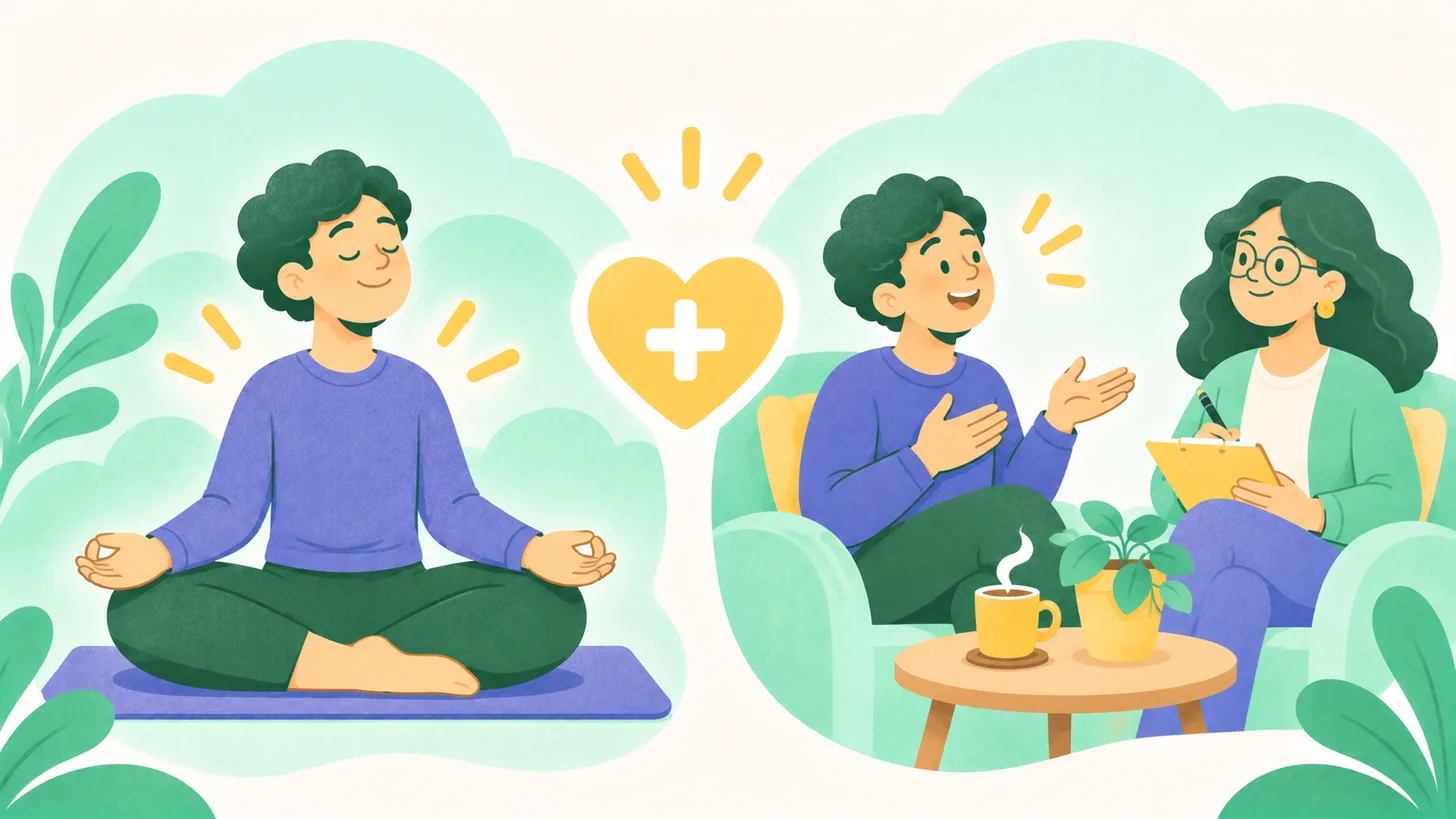
In short: Yoga has limits. If anxiety has been loud for months, add therapy and keep the practice.
Safety, pregnancy and when to pause
Yoga is gentle, but it is still a body practice. A few red flags mean you pause. Pregnancy and recent surgery each have their own rules. So do high blood pressure that is not controlled, and panic that worsens with strong breath work. When in doubt, ask your doctor.
Pause the session right away if:
- Feeling faint lasts more than one breath.
- Any sharp pain shows up, mostly in a joint or the lower back.
- A panic spike gets worse with strong breath work.
- You cannot catch your breath between poses.
If you are pregnant, do not start a new practice without a check-in with your doctor. Pre-natal yoga exists for a reason. Skip deep twists, closed inversions, strong belly work, and lying flat on your back after the first trimester.
In short: A gentle practice should feel steadying, not jarring. If your body says no to a pose, your body is right.
Yoga teacher and qualified therapist: know the difference
A yoga teacher is trained to guide movement and breath. A qualified therapist is trained to work with the thoughts, memories and ties that drive anxiety. The two are not the same. A 200-hour yoga teacher cannot assess, treat, or hold space for trauma the way a clinical psychologist can.
A yoga teacher can
- Guide a safe sequence of poses and breath work.
- Modify poses for your body or pregnancy.
- Teach breath practices like bhramari and extended exhale.
- Hold a steady, warm class.
A qualified therapist can
- Assess if you have anxiety, trauma, or something else.
- Use CBT, DBT, or trauma-informed care.
- Work with the stories your anxiety is tied to.
- Coordinate with a psychiatrist if medicine is needed.
In short: Yoga and therapy work together with different training behind them. One looks after the breath. The other looks after the story.
FAQ
How does yoga reduce anxiety?
What is the 3-3-3 rule for anxiety?
Which asana is best for anxiety?
Is pranayama a cure for anxiety?
How long does yoga take to work for anxiety?
Is yoga safe during pregnancy?
What are the best supplements for anxiety?
This post is for information only and is not a substitute for professional care.

Share your thoughts