

What this blog includes
- What overthinking actually means, and how rumination differs from worry
- The honest cost of the loop on your sleep, decisions and body
- What research-backed tools help, from scheduled worry time to self-compassion
- When overthinking has crossed into a disorder, and what to do about it
You know this one. It is 11.47 pm, the room is quiet, and your mind is loud. The meeting you had on Tuesday is playing on repeat. The reply you sent at 4 pm is being re-written. Tomorrow has not even started and you are already losing an argument with it.
This is overthinking, and if you have Googled how to stop it tonight, you are not being dramatic. The loop has a name, a shape and tools that help. We will walk through them in plain words. GoodLives is trusted by 500K+ people in India, and the posts here are written by people who have sat in that loop too.
What is overthinking, really?
Overthinking is chronic unproductive mental activity, the kind that spins without ever reaching a decision or an action. It wears two main costumes.
One is rumination, which looks backward: “why did I say that, why does this keep happening to me”. The other is worry, which looks forward: “what if the appraisal goes badly, what if the test is positive”.
Problem-solving converges on a step. Overthinking does not. You can tell the two apart by asking one question: am I any closer to a decision than I was ten minutes ago? If yes, you are thinking. If no, you are looping.
The psychologist Susan Nolen-Hoeksema spent twenty years studying rumination. Her Response Styles Theory found that people who ruminate on their low moods have a two-to-four times higher risk of a major depressive episode within a year, compared with people who distract or problem-solve.
Her follow-up work found women ruminate more than men on average, which she linked to how girls are socialised to turn inward with distress rather than take action.
In short: overthinking is not a personality quirk. It is a style of thinking that has been measured, and it feeds anxiety and low mood.
Why your mind gets stuck in the loop
The brain evolved to scan for threat. For most of human history, a few extra seconds of worry about the sound in the grass kept you alive.
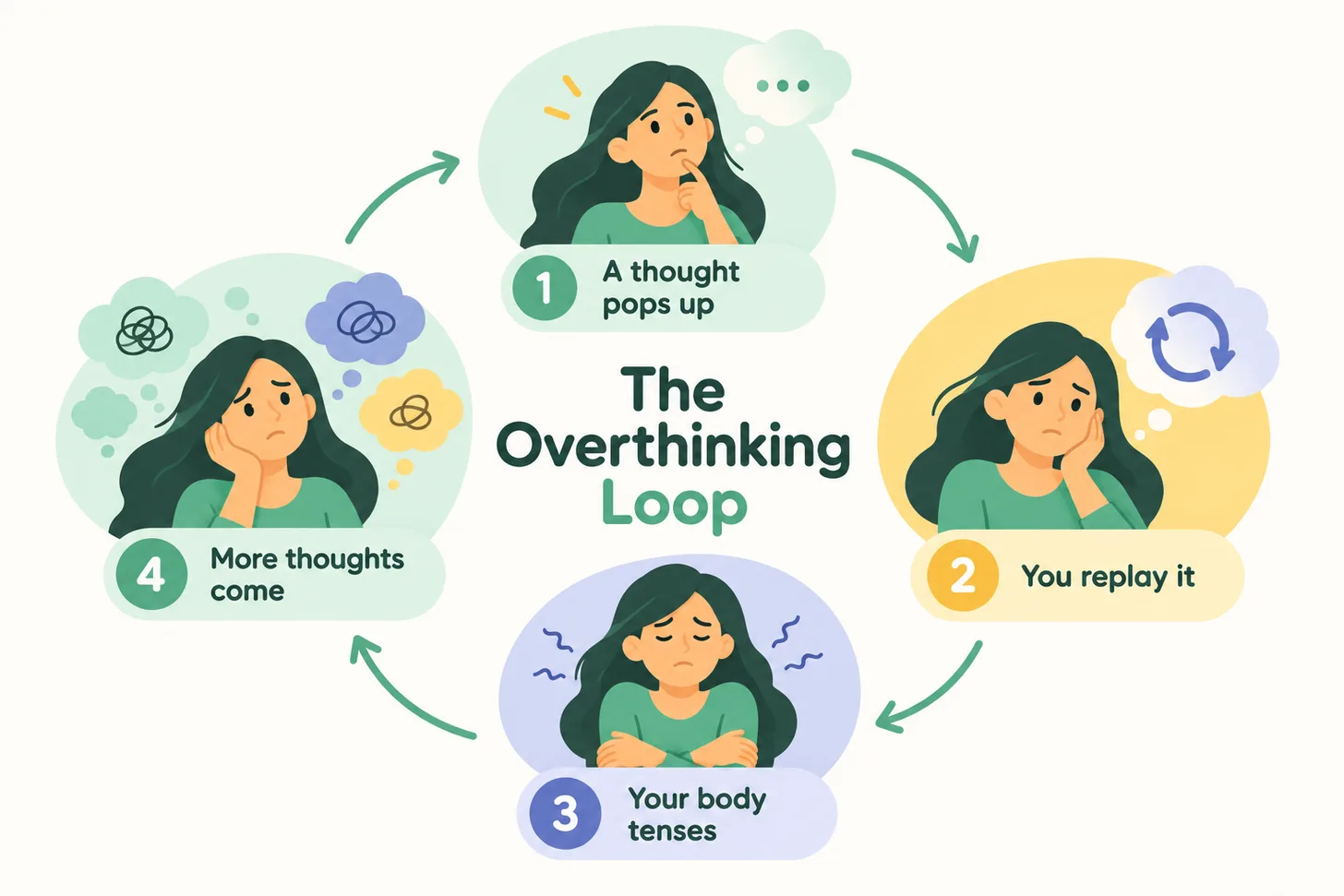
The modern problem is that the same system now scans your inbox, your WhatsApp read receipts, the look on your boss’s face in Monday’s meeting. The threat is social and ambiguous, which the brain cannot resolve, so it keeps looking.
There is a cultural layer in India that makes this louder. If you grew up around log kya kahenge, which means “what will people say”, you learned to anticipate everyone else’s reaction before you spoke.
If you prepared for JEE, NEET or UPSC, you learned to analyse one question for 20 minutes to find the trick. These are useful skills in a classroom.
In your own living room at 11 pm, the same wiring turns on your own week. For readers in that specific stage, we have written a longer piece on academic stress in India.
You might be worried that overthinking says something about your intelligence or your sensitivity. It does not. It is a habit of attention, built by what you were rewarded for noticing. Habits of attention can change.
If the restless unease you feel has a Hindi word for it, you can read our note on anxiety meaning in Hindi alongside this piece.
In short: the loop is a scan that no longer helps. It is loud because it was once useful, not because it is right.
The honest cost of overthinking
The loop takes something, every time. Research on rumination links it with disturbed sleep onset and poor sleep quality, which is why you can be exhausted and still awake.
Decisions get harder because every choice spawns a sub-choice; a 2-minute order on Zomato becomes a 20-minute scroll. Relationships strain, because the replay of a small comment becomes a quiet grudge your partner cannot see.
The body keeps score too. Muscle tension in the jaw and shoulders, tension headaches by evening, an upset stomach before meetings, a flat kind of tiredness after a day in which, on paper, nothing happened. You slowly stop trusting your own choices, which makes the next decision slower still.
In short: overthinking looks free, but it is paid for in sleep, decisions, relationships and the quiet erosion of self-trust.
What actually works to stop overthinking
There is no switch. There are tools, each with a specific job, used often enough to retrain the loop. These are drawn from decades of clinical research, not life hacks.
Scheduled worry time. The psychologist Thomas Borkovec tested a protocol where chronic worriers set aside a fixed 20 or 30 minutes a day, same time, same place, and worry on purpose. Outside that window, they wrote the worry on a notepad and told it to wait.
The study found a measurable drop in daily worry within two weeks. The point is not to crush worry; it is to teach your brain that worry has a place, and it is not your pillow.
Cognitive defusion. This comes from Acceptance and Commitment Therapy (ACT). Instead of fighting a thought, you label it as a thought. “I am a failure” becomes “I notice I am having the thought that I am a failure.” That tiny gap, between you and the sentence, is where you get your breath back.
Behavioural activation. Depression research is clear on one thing: action usually precedes motivation, not the other way around.
If you wait to feel like replying to the email, you will not. If you reply for two minutes and then stop, the motivation often shows up at minute three. For overthinking, this means doing before deciding: walk around the block, send one message, open the laptop and type one line.
If you want, take one minute now to pin down the thought you have been replaying.
Catch the thought
What thought is weighing on you right now? Write it down just as it sounds in your head.
Name the trap
Does your thought fall into one of these common patterns? Pick any that fit. This part is optional.
Look again
Use these as nudges, not rules. Then write one line back to yourself.
Your reframe
Thoughts are not facts. You just practised stepping back.
This stays on your device. Nothing is saved or sent.
Attention retraining. Adrian Wells’s metacognitive therapy teaches a skill called detached mindfulness: watching a thought arrive and pass without engaging with it, the way you watch a bus you are not catching.
His randomised trials in people with generalised anxiety found this specific skill moves the dial more than general relaxation.
Self-compassion. Kristin Neff’s research is counter-intuitive here. People assume self-criticism is what keeps us sharp. In studies, it is the fuel for rumination.
Self-compassion, spoken to yourself the way you would speak to a friend, reduces rumination even when the facts of the day do not change.
Body first, mind later. When the loop is loud, your head cannot think its way out of itself. A twenty-minute brisk walk, cold water on the face, four slow exhales longer than your inhales: these move the loop through your nervous system, not through your reasoning. It is not a cure. It takes the edge off so a better thought can land.
A therapist can help you see which of these your particular loop needs most, and in what order, and what the loop is actually about. Self-help gives you the toolbox; therapy helps you pick the right tool for a Wednesday evening in October 2026, which is the one you are in.
If overthinking has mostly turned into daily dread, our anxiety guide for India sits next door to this one.
What does not work (even though you keep trying it)
The internet is full of advice that makes overthinking worse. Three of them do most of the damage.
When is overthinking a disorder, not a habit?
Most overthinking is a bad habit of a tired brain. Sometimes it has crossed into something that needs clinical care. A rough rule: see a therapist when four or more of these are true for more than six months.
- The loop is daily and you cannot switch it off even in sleep
- Physical symptoms are showing up: headaches, GI upset, muscle tension, chest tightness
- You are using alcohol, cannabis or sleep medication to quieten the mind
- Decisions are stuck; small ones take hours, big ones months
- The loop has a theme (contamination, harm, “did I lock the door”) and you check it over and over
- You feel low or empty for most of the day, most days
Overthinking is a core feature of generalised anxiety disorder, major depression, obsessive-compulsive disorder, ADHD and post-traumatic stress. Each is treated differently, which is why a careful assessment matters.
If any of the signs above are familiar, you do not have to wait for a worse week to ask for help.
In short: a six-month daily loop, with sleep, body or substance costs, is a medical conversation, not a willpower project.




Share your thoughts