
What this blog includes
- Who online counselling for students helps, and when it is not the right next step
- How confidentiality works, and what parents can and cannot see
- Consent, booking and privacy for students under 18
- Evening and weekend slots that fit around school, college and coaching
- Fees, student-friendly options, and how to book in under five minutes
If your chest feels tight before every unit test, if the hostel room is loud but your head is louder, if you keep sitting at your desk for four hours and finishing nothing, you are not being dramatic. A lot of students in India are reading something like this tonight.
Online counselling for students is one option alongside sleep, a kind friend and your college counsellor. It is a 50-minute conversation with a trained psychologist on your phone or laptop, in your language, from a locked room if you want one.
Globally, about 1 in 7 adolescents aged 10 to 19 lives with a mental health condition (WHO, 2024), so if you are feeling the weight, you are far from alone.
On GoodLives, that session is confidential, and over 500K+ people have come to us for therapy, workshops and community so far.
This blog is for a student reading at 11 pm after a long day, and for a parent who clicked the same link because they are worried. Both of you are welcome.
We will walk through what a session looks like, how consent and privacy work for a minor, how fees compare to a tuition class, and what to do tonight if the loop is loud.
For the bigger picture on where this pressure comes from, our hub on academic and exam stress in India sits alongside this page.
Who online counselling for students is for
Online counselling for students fits a wide band: school students handling boards or bullying, college students handling hostel loneliness or a hard breakup, and coaching-institute students in Kota or Delhi who have not slept in three days. If you are reading this because something feels off and you cannot name it, that counts.
Common reasons students book a session on GoodLives:
- Exam stress that will not switch off, even after the paper is over
- Low mood, no interest in things you used to like, trouble getting out of bed
- Panic attacks before a test, viva or interview
- Family pressure about marks, course choice or marriage talks
- Bullying, body image worries, or feeling left out in a hostel or classroom
- A breakup, friendship fallout or a crush that is weighing on you
- Thoughts you cannot say out loud, including thoughts of harming yourself
In short: if a feeling is costing you sleep, grades or friendships for more than two weeks, a session is a reasonable next step. It is also fine to book earlier.
What a student counselling session actually covers
A first session is a conversation, not a test. The counsellor asks what has been weighing on you, how long it has been that way, and what a slightly better week would look like.
You talk, they listen, they ask questions back. Nothing is prescribed and nothing is diagnosed on day one. If medication becomes a question later, that is a separate conversation with a psychiatrist.
Over the first three to four sessions, a student counsellor will usually help you:
- Name what is happening (exam anxiety, low mood, loneliness, a reaction to bullying)
- Build one or two tools that work in your week (a wind-down for sleep, a reframe for the “I will fail” loop, a plan for a hard conversation at home)
- Decide if the issue is a season to walk through, or if it needs longer work
You keep the pace. You can book once, see how it feels and stop. You can also book weekly for a term. You decide when to end.
In short: the first session is for the counsellor to understand you, and for you to see if this person is someone you can keep talking to. A good counsellor says “come back if it helps” and means it.
Can my parents see what I tell the counsellor?
Short answer: no, not in the way you might be scared of. Confidentiality in therapy is a legal right in India. The Mental Healthcare Act 2017 says every person receiving mental healthcare has a right to confidentiality about what they share in sessions.
A counsellor on GoodLives follows that law and the Rehabilitation Council of India (RCI) ethics code.
What that means in practice for a student:
- Your parent cannot ask the counsellor “what did my child say?” and get a transcript
- Your session is one-to-one, not screen-shared with your parents
- Session notes are kept private and are not sent to your school or college
There is one honest limit a counsellor must tell you about on day one. If a student says they plan to seriously hurt themselves, hurt someone else, or if a child is being abused, the counsellor may need to tell a parent or an authority to keep that child safe.
That is not a trap. It is a safety floor, and it is explained to you before the session starts, in plain words. Everything else, your family talk at dinner, your crush, your late-night ghabrahat (that chest-tight, restless unease), stays between you and your counsellor.
In short: your parents booking the session does not give them access to the session. The counsellor’s loyalty, within the law, is to you.
If a student is under 18, how consent and booking work
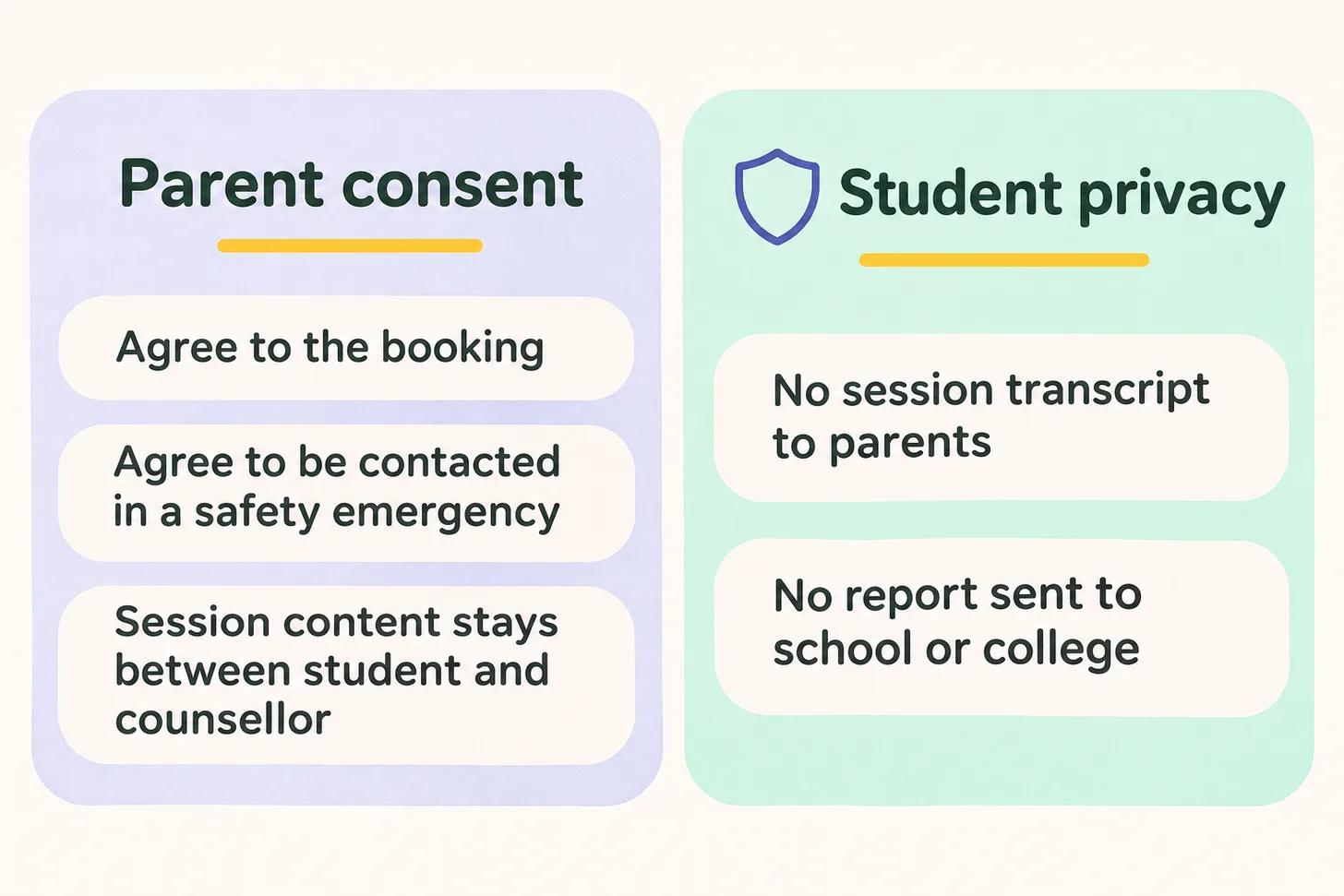
In India, a parent or guardian signs the consent for a minor’s therapy. That is the law, not a GoodLives rule, and it is standard for any kind of medical or psychological care under 18. For a session on GoodLives, we ask the parent or guardian to confirm consent at the time of booking, and to be reachable in case of a safety concern.
Here is what the parent is agreeing to when they book online counselling for students, and what they are not:
- Yes: they agree that their child is receiving online counselling and that fees will be paid for sessions booked
- Yes: they agree to be contacted in a safety emergency
- No: they are not agreeing to see or hear what their child says in session
- No: they are not sitting in on the session unless the student has asked for a joint session
Many parents ask us “will I get a progress report after each session?”. The honest answer is no, not a word-for-word report.
A counsellor may offer a general check-in with the parent every few weeks if the student agrees, and sometimes a parent is invited into one session to work on a specific family pattern. The student always knows about it, and often chooses whether to join.
In short: parental consent gets the booking through. The student’s words stay the student’s.
Privacy at home, in a hostel or a PG
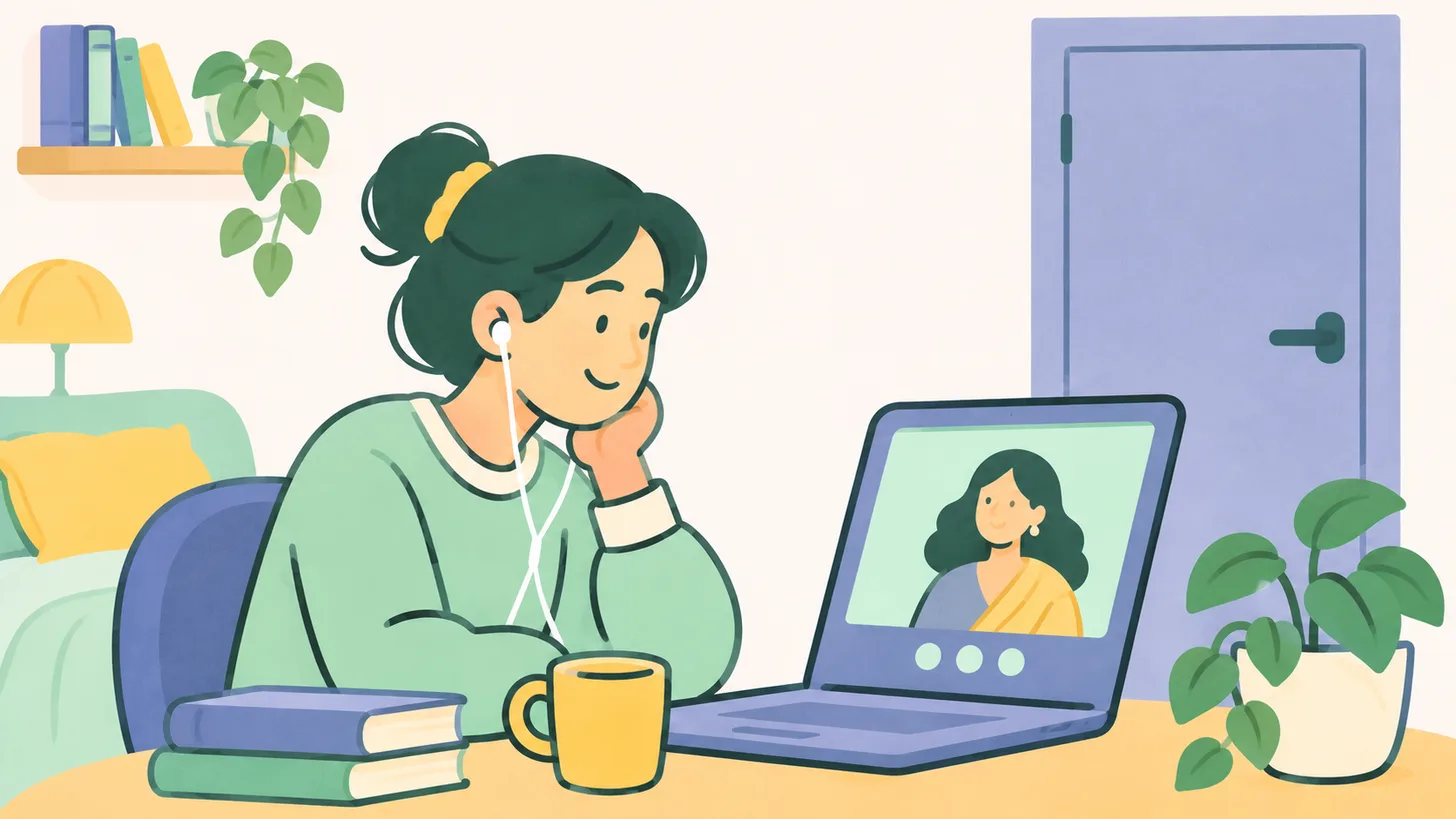
A counselling session needs a door, 50 quiet minutes, and a reasonable internet connection. In a joint family house, a boys’ hostel, a PG with three roommates or a coaching-institute dorm in Kota, that can be the hardest part. A few things that work:
- Use earphones, not the phone speaker. Your end of the conversation is heard; the counsellor’s voice is not broadcast to the room.
- Lock the door. If the door does not lock, book a slot when a parent or roommate is at work or in class. Say you have a Google Meet with a professor.
- Use mobile data if home wifi is monitored, especially if a family router logs activity. A single 50-minute video session is roughly 500 MB on a standard plan.
- Pay from your personal UPI if you are 18 or over and do not want a parent to see the bank statement. If you are under 18, a parent paying is part of the consent step, so that visibility is expected.
- Clear your browser history and recent apps if you share a device. The GoodLives app does not send a loud notification on your home screen.
- Pick a time nobody will knock: early morning before the household wakes up, late evening after dinner, or a weekend afternoon when parents are out.
If your situation genuinely does not allow any of this, say so during the first booking call. We will suggest a slot that fits, or route you to a free helpline you can call from a locked bathroom.
In short: privacy is a solvable problem for most students. Earphones, a locked door and a parent’s work schedule are usually enough.
Evening slots, timings and language
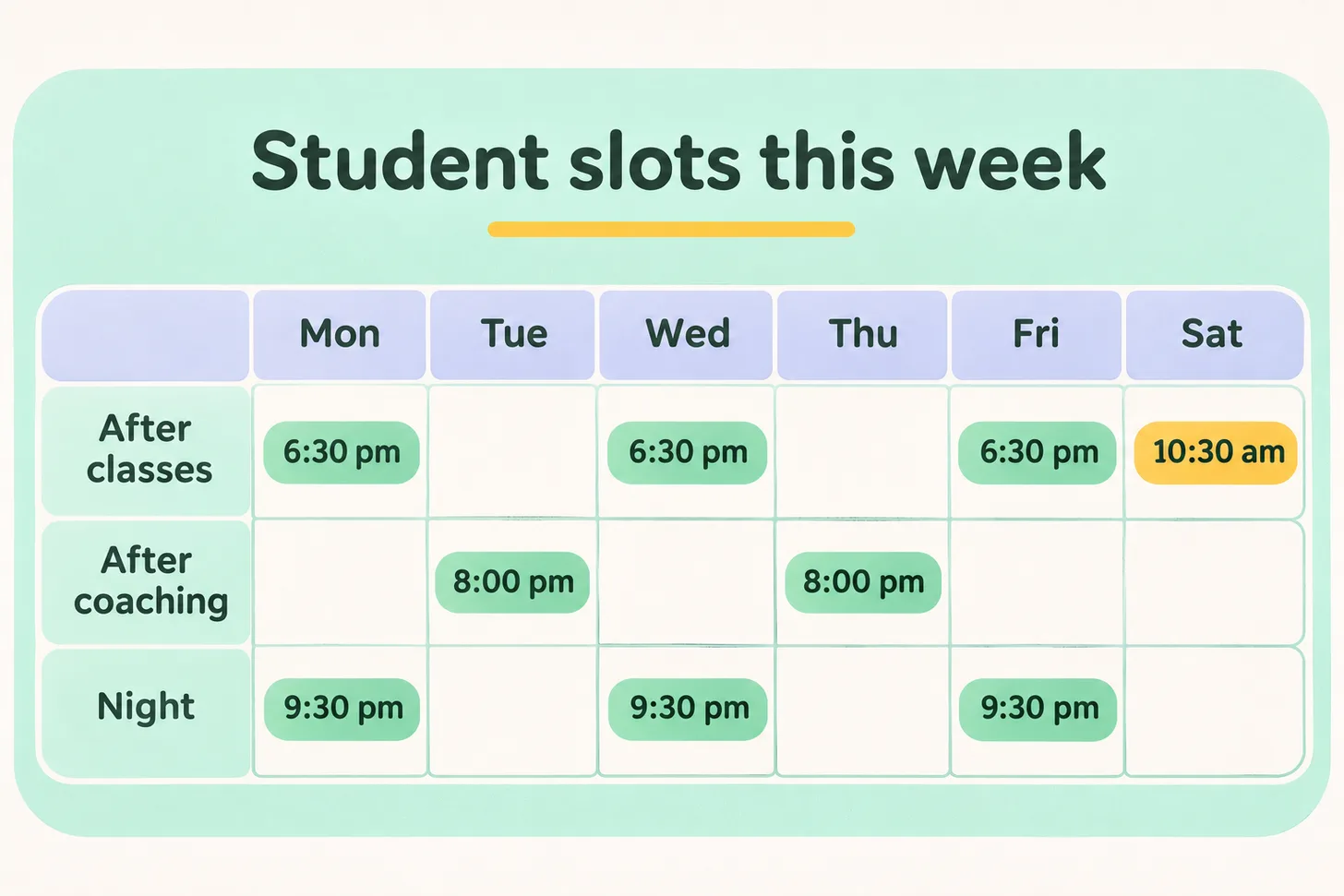
Students need slots after classes end, after coaching ends, or on weekends. The default GoodLives slot bank for online counselling for students includes evenings between 6 pm and 10 pm on weekdays, and full-day weekend options.
If you are in a different time zone (an Indian student abroad, parents based in the Gulf), you can book an India-time slot that is daytime for you.
Sessions run in English, Hindi, Hinglish or another Indian language you prefer. Say so at booking.
A counsellor who speaks your mother tongue often lands better in the first conversation, especially when the words for a feeling do not translate well into English. The restless, chest-tight kind of worry is ghabrahat (that word covers what English does not quite reach). You can say either and your counsellor will understand.
In short: pick a time when nobody will knock, and a language where you can say the hard sentence.
Fees and what you get for the money
GoodLives does not publish a per-session price in blogs, because the right price for you depends on the counsellor you match with and the plan you choose. See our pricing page for the current ranges, including student-friendly options and session packs that bring the per-session cost down.
What a session fee for online counselling for students covers:
- A 50-minute one-to-one video session with a verified psychologist
- Secure video, confidential notes and the right to switch counsellors if the fit is wrong
- Session-related messaging through the app, so you can send a quick question between sessions
- Guided meditations and self-help exercises inside the app, for use between sessions
- Access to the GoodLives Support Circle community, moderated, anonymous
If your college has a free counselling cell, use it first; many colleges in India have one and students under-use it. Free college counselling online is also available through government helplines, which we list at the end of this page.
If your parents’ corporate health plan or EAP includes therapy credits (common at IT services, consulting firms and some PSUs), ask HR; they often cover a few sessions a year for dependants.
Ready to talk to someone? When you are ready, book a 50-minute session with a verified psychologist on GoodLives. English, Hindi and more Indian languages. Book a Session.
In short: a session is less than most students’ monthly data pack. A free college counsellor or an EAP is a reasonable first stop. Pay for a GoodLives counsellor when you want privacy, choice of counsellor and continuity.
What helps right now if you feel panicked before an exam
If the exam is tomorrow and your chest is tight tonight, the counselling session on Friday is not the fastest tool. The fastest tool is a 90-second reset you can do with the door closed and earphones in. Box breathing lowers your heart rate; it does not change the paper, but it changes what you bring to the paper.
If you want, take one slow minute with this before you read on.
A moment to breathe
Follow the circle. Breathe in, hold, breathe out, then hold. Four counts each. Stay as long as you like.
That drop in heart rate is real, and it is temporary. It will not fix the hard chapter you did not finish, and it will not make a difficult parent kinder tonight.
What it does is give you two or three minutes of a steadier body, which is often enough to open the book again, or to sleep. A counsellor over four weeks works on the baseline underneath, so these moments are smaller and less frequent.
For a longer plan around a board or entrance exam, read our walkthrough on how to handle exam stress.
In short: breath work takes the edge off tonight. Therapy lowers how often tonight happens.
When online counselling is not enough tonight
Online counselling for students is a strong first option. It is not the right one for every situation, and we would rather tell you honestly than sell you a session you do not need right now.
- You are thinking about hurting yourself or ending your life, right now
- You are being hurt at home, in school or in a hostel, right now
- You are so overwhelmed you cannot answer the booking questions
A trained counsellor picks up in minutes and will stay with you. These are not failures to use. They are the right tool.
Online counselling also works less well when a child is under 10, when the issue is active psychosis or a severe eating disorder, or when a court order is involved. In those cases a parent should contact the nearest psychiatry OPD at a government hospital, or NIMHANS Bengaluru for an assessment.
In short: a therapist is for the longer conversation. A helpline is for tonight. A hospital psychiatrist is for a medical emergency.
How to book, a student path and a parent path
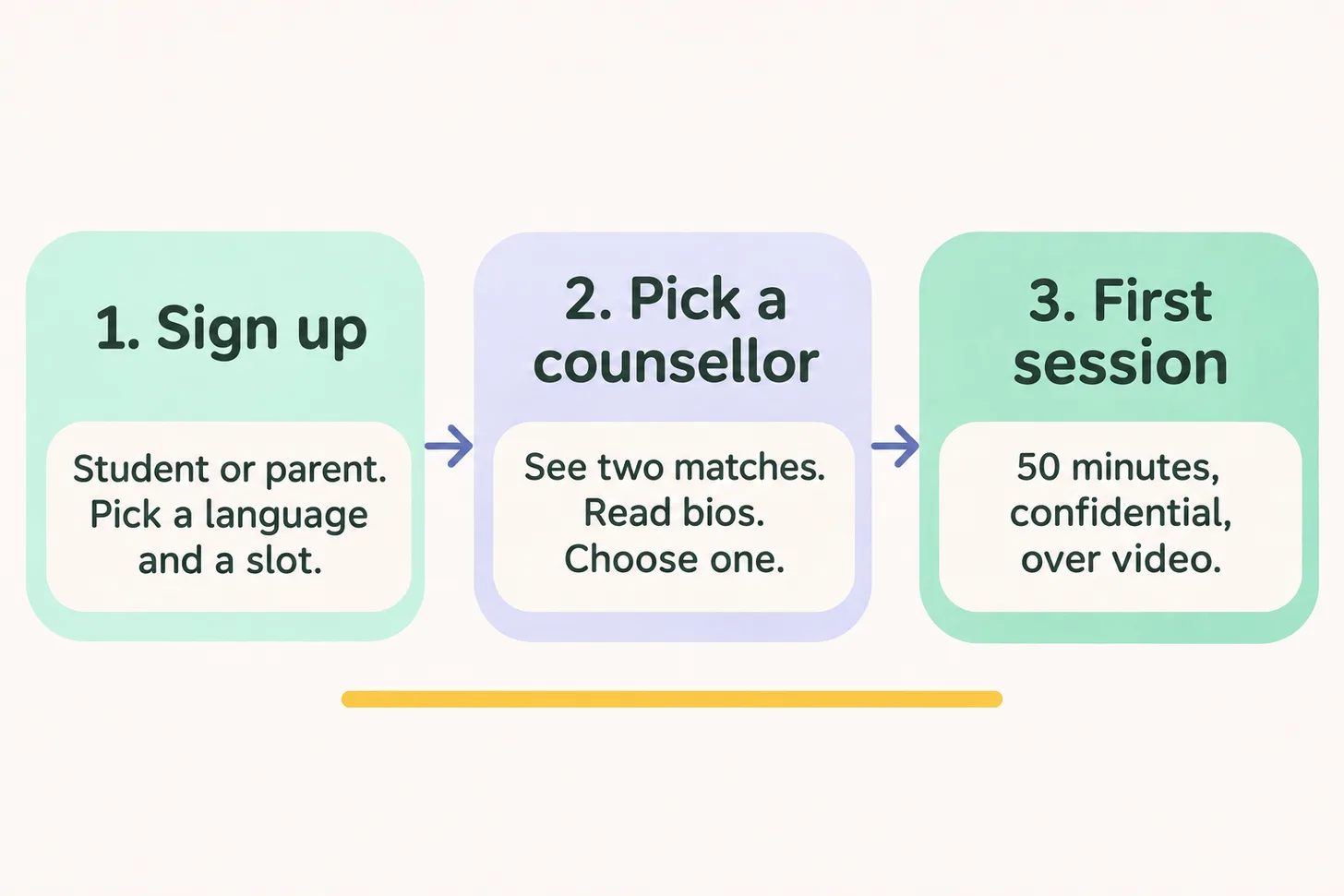
If you are a student, 18 or over, open the GoodLives signup, pick a language and a slot that fits around your week, and answer six short intake questions. You will see two or three counsellor matches. Pick one. Pay from your UPI or card. Your first session is usually within 24 to 48 hours.
If you are a parent of a student under 18, open the same signup, choose “Booking for my child”, confirm consent, and share a short note on what you have noticed (sleep, mood, appetite, grades, friendships). Our team contacts you within one working day with two counsellors who work with teenagers. You pick one, we schedule the session with your child, and the first session goes ahead.
If you are a parent and your child is 18 or over, the honest answer is that we need the student to make the booking themselves, or at least to agree to it in writing. A session nobody wants to be in rarely works. We can send them a short, non-pushy note from you if that helps start the conversation at home.
Not sure yet? Explore Therapists on GoodLives and read ten bios before you decide. No sign-up required, no pressure.
In short: booking takes less than five minutes. Agreeing to the booking is usually the hard part, for both student and parent.
FAQ
Can I get free counselling online in India?
Is online counselling for students confidential from parents?
What is the best online counselling platform for college students in India?
Can a student under 18 book online counselling without parents knowing?
How much does online student counselling cost?
Is online counselling as effective as in-person for a teenager?
Can I study counselling online or is this about receiving counselling?
This post is for information only and is not a substitute for professional care.



Share your thoughts