

What this blog includes
- What grounding actually is, in plain words
- Why it works on an anxious nervous system
- Eight grounding techniques, starting with the two that help most
- Where Indian pranayama and yoga already do this honestly
- When grounding is not enough, and what to try next
You know the moment. Your chest is tight, your thoughts are three steps ahead of you, and the room feels like it is slightly further away than usual. Google says to breathe. You already tried.
Grounding is the plain-English name for the handful of moves that get you back into the body you are in, right now.
Trusted by 500K+ people, GoodLives has sat with first-time therapy clients across India. Readers who come looking for grounding techniques for anxiety almost always want the same thing: something they can do in the next three minutes that works.
What are grounding techniques for anxiety?
Grounding techniques for anxiety are small sensory, cognitive or physical actions that interrupt an anxiety spiral by anchoring your attention in the present. They are first-aid, not therapy. They do not solve the thing that made you anxious; they give your nervous system a chance to catch up with reality.
Most anxiety is not about now. It is pulled forward by worry (the pitch tomorrow, the test result next week) or pulled back by rumination (the thing you said in that meeting). Grounding pulls you into now, where, in this exact second, there is usually no threat.
In short: Grounding is a tool to come back to the room. The problem keeps for later. Your body gets a minute to breathe.
Why do grounding techniques work?
Grounding works because it gives an alarmed nervous system a different, honest signal. When anxiety is loud, your sympathetic nervous system is on, your heart rate is up, and your breath is high in the chest. The body behaves like something is wrong, even when the thought that triggered it has already passed.
Two mechanisms do most of the work. The first is the vagus nerve, a long two-way nerve that connects your brain and gut. Slow breathing, humming and cold on the face all nudge the vagus nerve to switch the parasympathetic brake on.
The second is the dive reflex: when cold water hits your face, your body drops your heart rate within seconds, the same way it would if you dived into a cold lake. The nervous system is older than your worry, and it listens to these signals faster than it listens to reassurance.
The World Health Organization’s Doing What Matters in Times of Stress (2020) names grounding as a core evidence-informed stress-management skill.
In short: Grounding is not willpower. It is a shortcut your body already knows, and you are just using it on purpose.
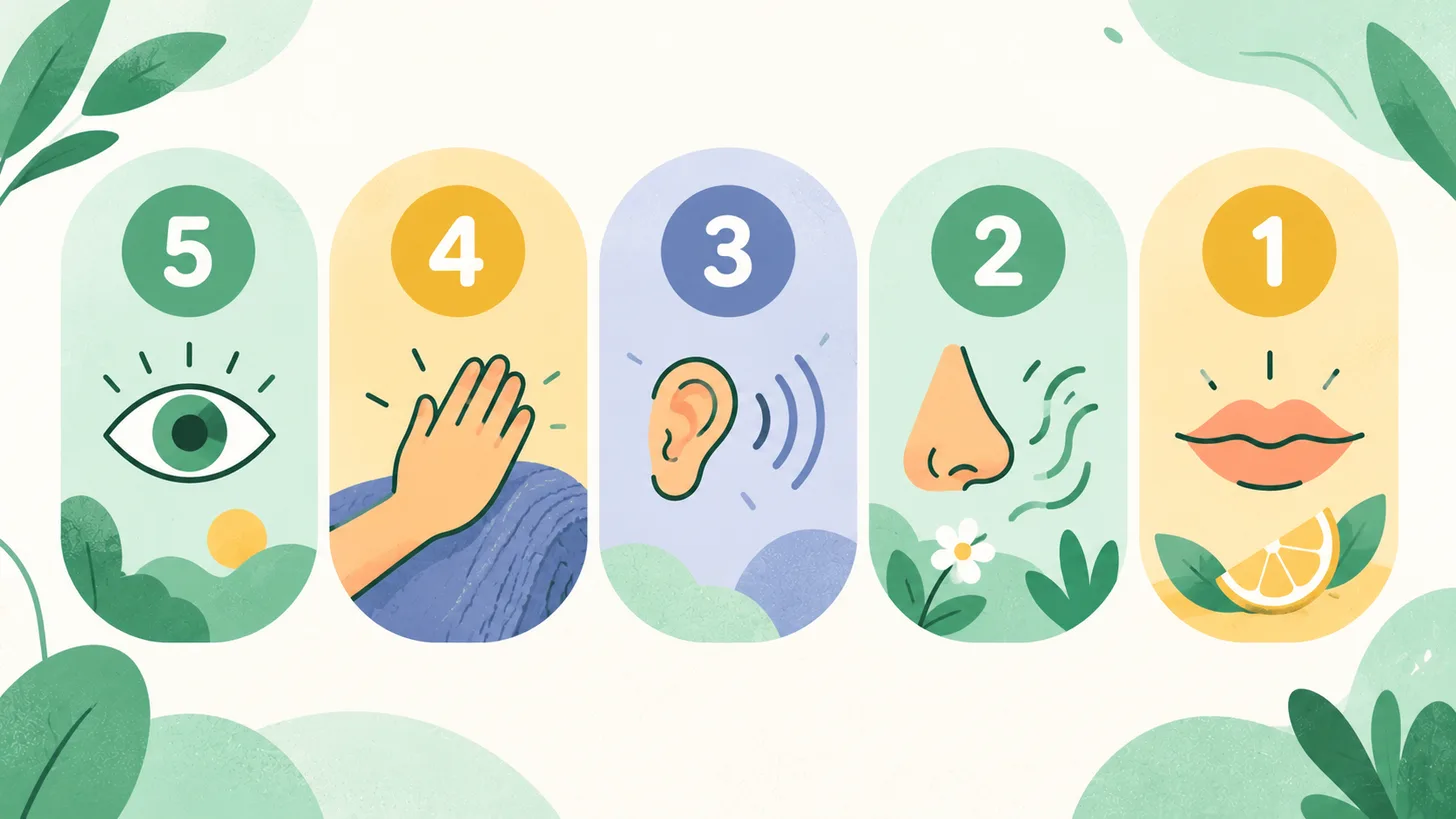
1. The 5-4-3-2-1 grounding technique
The 5-4-3-2-1 grounding technique uses your five senses to override the loop. It is the most quoted grounding exercise in therapy rooms, and the one most readers come looking for.
Here is the whole thing:
- Name 5 things you can see
- Name 4 things you can hear
- Name 3 things you can touch (and touch them)
- Name 2 things you can smell
- Name 1 thing you can taste
Say them out loud if you can. The point is not neat answers; the point is that your attention has to leave the loop to notice the ceiling fan, the dog two floors down and the aftertaste of chai.
If you want, do a slow pass of this before you read on.
Best for: panic spikes, a feeling that the room has gone slightly unreal (dissociation), early-morning anxiety where your head starts before your eyes do.
In short: Five senses, five seconds each, one minute total. It does not look like much. It works.
2. Box breathing (the slow square breath)
Box breathing is the slow, square-shaped breath used by the US Navy, Indian NCC cadets and plenty of exam-stressed students: in for four, hold for four, out for four, hold for four. Repeat for a minute or two.
The slow exhale does the real work. A longer out-breath activates the vagal brake and tells your heart rate it is safe to slow down. If four counts feels tight, start at three. If you want more, try 4-7-8 breathing: in for four, hold for seven, out for eight, three rounds.
Best for: build-up anxiety (before a meeting, a difficult call, a flight), the first fifteen minutes of a panic attack, a loud morning you cannot shake.
In short: Make the out-breath longer than the in-breath. The rest is detail.
3. Cold water on the face (or an ice cube in your hand)
Splash cold water on your face twice, or hold an ice cube in your hand for 30 to 60 seconds. The dive reflex drops your heart rate within seconds. It is the fastest tool on this list.
In Dialectical Behaviour Therapy (DBT), this move sits inside the TIP skill (Temperature, Intense exercise, Paced breathing, Progressive relaxation). It is used for the kind of distress where a thought-based tool will not catch you in time.
If you can lean over a basin and splash cold water, or press a cold water bottle to your forehead for a minute, you have used the DBT TIP skill without needing a therapy room. Our DBT therapy guide walks through where this fits in treatment.
Best for: a panic spike that is already loud, dissociation, a thought spiral your head cannot think its way out of.
In short: When thinking is not working, cold water will.
Not a crisis, just a loud week? A 50-minute session with a verified psychologist on GoodLives. English, Hindi and more Indian languages. Book a Session Trusted by 500K+ people.
Five more grounding techniques worth knowing
Beyond the three above, five tools are worth having in your kit. Pick the one that fits the kind of anxiety you have today.
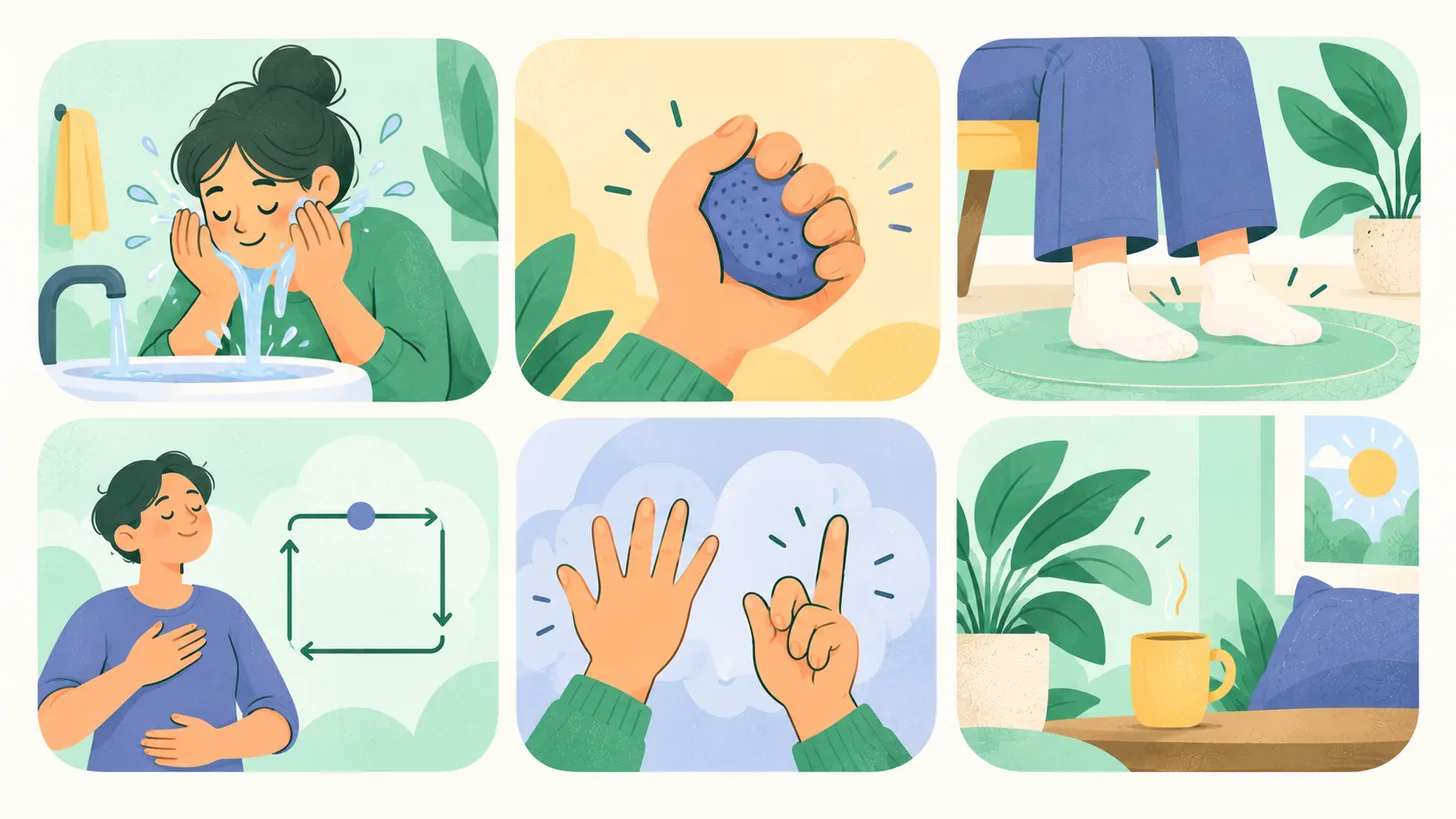
4. Progressive muscle relaxation (PMR). Tense a muscle for five seconds, then release. Move from toes to calves to thighs to fists to shoulders to face. Developed by Edmund Jacobson in the 1930s. The release is the point: the nervous system reads the drop as safety. Best for night-time anxiety and sleep-onset difficulty.
5. Feet on the floor and slow body-scan. Press both feet flat, feel the heel, the ball and the toes, then move your attention slowly up the body for a minute. Useful in a meeting, a cab or an exam hall where you cannot leave or make a scene.
6. Naming where and when you are. Say to yourself, out loud or in your head: “I am in my room. Today is Saturday, November 2026. I am safe right now.” Boring on purpose. Gives the brain a factual present to lean on when the body is reporting an old alarm. Useful for flashbacks and intrusive memories.
7. Movement grounding. Walk for ten minutes. Pace the balcony. Tap each foot ten times. Shake your hands out. Dance to one song. Anxiety is an energised state; a short physical outlet gives that energy somewhere to go.
8. Weighted blanket or self-hug (deep pressure). Pull a weighted blanket over your lap, or cross your arms, place each hand on the opposite shoulder, and squeeze gently for a minute. Some therapists call this the butterfly hug and use it in EMDR. Firm, even pressure sends a signal of safety, like a long hug.
In short: Match the tool to the moment. A loud panic spike needs cold water; a restless Sunday needs movement; a sleepless night needs PMR.
Where Indian traditions already do this (honestly)
A lot of these techniques will feel familiar if you grew up around yoga, pranayama or any Indian meditation practice. That is not a coincidence, and it is not borrowing.
- Anulom-vilom (alternate-nostril breathing) and box breathing both slow the exhale and nudge the vagal brake.
- Bhramari (humming bee breath) uses low humming, which stimulates the vagus nerve the same way a long “om” does.
- Grounding through the feet, breath awareness and body scans all appear in various yoga and mindfulness traditions.
Honest line: these overlaps are useful, not identical. Pranayama is a spiritual practice with its own goals; grounding is a nervous-system tool borrowed from clinical research.
If a pranayama you already know helps you breathe through a panic spike, use it. If a teacher tells you pranayama can replace therapy for severe anxiety, PTSD or trauma, that is not clinical consensus, and worth a second opinion.
In short: The body uses what works. Call it what you like, as long as the thing that catches you is honest.
When grounding is not enough
Grounding is first-aid. If you are using it most days just to get through the hour, something underneath is asking for more than first-aid.
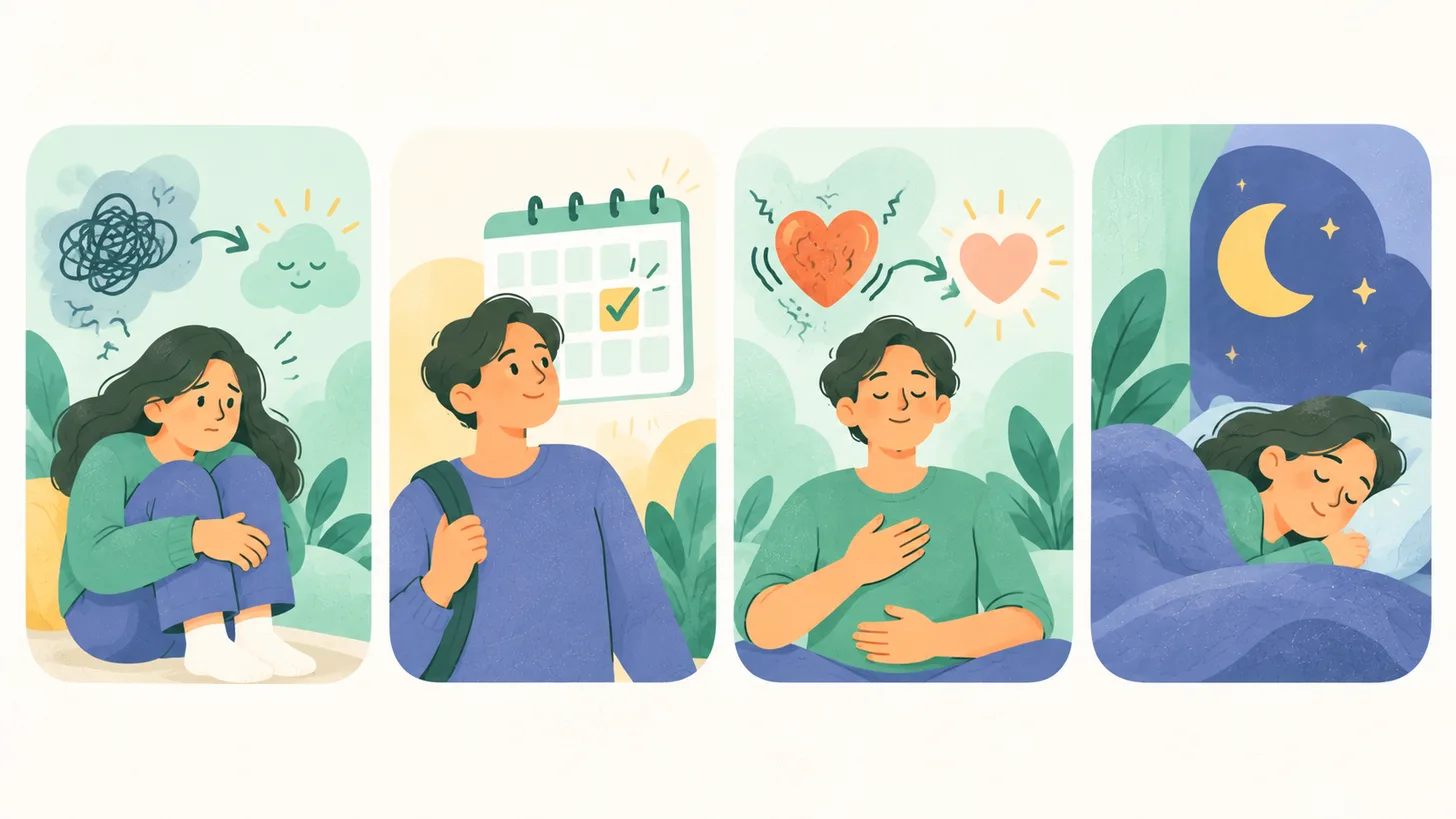
Watch for these patterns:
- You are grounding most days for more than four weeks
- Panic attacks are not easing with the techniques above
- You feel detached, unreal or outside your body often
- Trauma memories or flashbacks keep arriving uninvited
- The loop ends in thoughts of harming yourself or giving up
If any of these fit, the next step is a mental health professional, not a sharper grounding routine.
The 5-4-3-2-1 grounding is a useful tool. A therapist is the person who helps you figure out why your nervous system keeps hitting the alarm in the first place.
Honest line: not every anxious week needs therapy. Some weeks are loud, and sleep plus one honest conversation and a few of these tools will do the work. If the pattern is daily and has been for a month, that is reason enough to speak to someone.
In short: Grounding keeps you upright in the storm. Therapy helps you figure out why the storms keep coming.




Share your thoughts