

What this blog includes
- The real training behind each title in India
- A side-by-side table of what each one does
- Who to see first for anxiety, depression, panic and sleep
- Honest cost ranges, and how to check if someone is registered
Most of us search “psychologist vs psychiatrist” at an awkward hour. A friend says “see a psychiatrist”. Your cousin says “no, start with a psychologist”. The internet is split. The words sound close, the degrees sound close, and in India the roles blur more than they should.
The honest answer is simple once you know what each person is trained to do. We will walk through it with you. GoodLives is trusted by 500K+ people in India for online therapy with verified psychologists, and this is the question we hear most on first calls.
What a psychologist does, and does not do
A psychologist is a trained mental-health worker who sees you for talk therapy. In India, a clinical psychologist has done an M.Phil in Clinical Psychology after an MA.
They are listed with the Rehabilitation Council of India (RCI). A psychologist is not a medical doctor and cannot write a prescription.
What a psychologist does with you, week to week:
- Listens, builds a case, and names what is going on in plain words
- Uses proven talk therapy (CBT, DBT, trauma therapy, family therapy)
- Gives you tools, homework and a plan you can track
- Works with a psychiatrist when medicines come in
What a psychologist does not do:
- Prescribe medicine of any kind
- Order brain scans or blood tests
- Admit you to a hospital
If your pain is “I cannot stop overthinking”, “my relationship is on edge”, or “work is hollowing me out”, a psychologist is usually the right first door. You can read more on what a clinical psychologist is and why the M.Phil matters in India.
In short: a psychologist uses talk therapy to help you understand and change patterns. No prescriptions, no scans.
What a psychiatrist does, and does not do
A psychiatrist is a medical doctor who treats mental illness. The training is MBBS, then an MD or DNB in Psychiatry. That is eight to ten years in all.
Psychiatrists are listed with the National Medical Commission (NMC) and the state medical council. A psychiatrist can name the illness, give medicine, and admit a patient when needed.
What a psychiatrist does in a session:
- Takes a full medical and family history, often in 30 to 45 minutes
- Names the illness using the ICD-11 or DSM-5
- Prescribes medicine where it fits, and tracks the dose and side effects
- Orders blood tests or scans to rule out physical causes (thyroid, low iron, seizures)
- Sends you to a psychologist for the therapy work the medicine does not do
What a psychiatrist usually does not do:
- Weekly, hour-long talk therapy (some do; most do shorter follow-ups)
- Long-term family or couples work
- Deep behaviour checks the way a clinical psychologist runs them
When medicine may be needed, a psychiatrist is the right person to decide, not us. If someone around you says “skip the psychiatrist, do yoga”, that is not safe advice for severe depression, bipolar, psychosis, severe OCD or PTSD.
See a psychiatrist where medicines may be needed. See a psychologist for the therapy that goes with them. For a slower read, our therapy vs medication piece sits next to this one.
In short: a psychiatrist is the medical doctor for mental illness. They diagnose, prescribe and co-ordinate care.
Psychologist vs psychiatrist: the differences at a glance
The quickest way to see the difference between a psychologist and a psychiatrist is a table. These are the honest, verifiable facts for India.
| Attribute | Clinical psychologist | Psychiatrist |
|---|---|---|
| Degree in India | M.Phil in Clinical Psychology (after MA Psychology) | MBBS + MD or DNB in Psychiatry |
| Medical doctor | No | Yes |
| Registered with | Rehabilitation Council of India (RCI) | National Medical Commission (NMC) and state medical council |
| Diagnoses | Yes, behavioural and psychological | Yes, including medical and psychiatric |
| Prescribes medicine | No | Yes |
| Orders blood tests or scans | No | Yes |
| Does talk therapy | Yes, mostly | Sometimes, often brief |
| Typical session length | 50 to 60 minutes | 20 to 45 minutes for a follow-up |
| Typical frequency | Weekly or fortnightly for months | Monthly follow-ups once the medicine is stable |
| India fee range per session | ₹1,000 to ₹3,500 online or in person | ₹500 to ₹2,500 (government clinics less) |
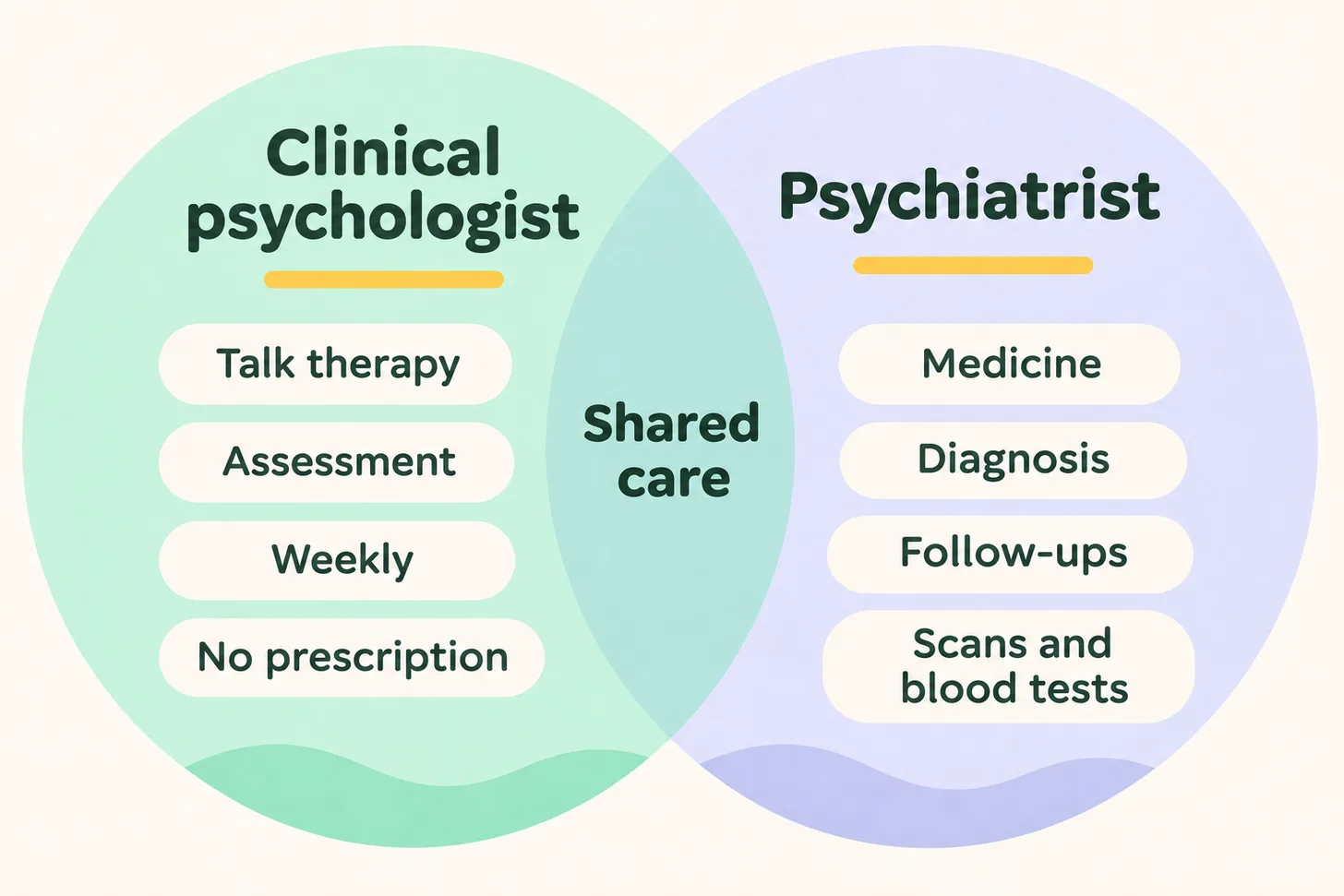
Source line: fee ranges are typical city-market observations across private clinics and online platforms in India as of October 2026. Your actual quote will depend on the person, the city and the setting.
A short way to hold it in your head: a psychologist listens so you can rewire. A psychiatrist prescribes so your brain can get to the therapy. Many people need both, in that order or the other way around.
In short: in the psychologist vs psychiatrist choice, training, prescribing and session shape are the real differences. The rest follows from those three.
Therapist, counsellor or psychotherapist: what the word means in India
“Therapist” is the loosest word in this family, and that is where confusion builds. In India, “therapist” and “counsellor” are used for a range of trainings. Some are a two-year Master’s. Some are a short course. “Psychotherapist” is not a protected title here. This is honestly messy, and you should know before you spend money.
A kinder way to think about it:
- A counselling psychologist usually holds a Master’s in Counselling Psychology or Applied Psychology. Many work under RCI’s newer counsellor route. They help with day-to-day emotional pain: stress, grief, relationships, mild to moderate anxiety and low mood.
- A psychotherapist in India is anyone offering talk therapy. The quality varies. Ask for the training by name, and ask if it is RCI listed.
- A clinical psychologist does the longer, hospital-based M.Phil and is RCI listed. They can check and work with more severe cases.
If you want the full picture of who is a therapist, who is a coach, and who you should not confuse with either, see life coach vs therapist.
The one line we always share: ask for the degree, ask for the registration number, and ask what approach they use (CBT, DBT, psychodynamic). A real professional will answer in one email.
In short: “therapist” is a bucket. “Clinical psychologist” and “counselling psychologist” are the trained roles inside it. Ask the degree, ask the registration.
Where does a neurologist fit in?
Neurology vs psychiatry is a mix-up we see on first calls. A neurologist is also a medical doctor (MBBS, then MD Medicine, then DM Neurology or DNB). They treat the physical brain and nerves: strokes, epilepsy, migraines, Parkinson’s, multiple sclerosis, nerve pain, some kinds of dementia.
They are registered under the NMC like psychiatrists, but they are not the person to see first for anxiety, depression or everyday emotional pain.
When a neurologist is the right first stop:
- Sudden, severe headaches that are new for you
- Seizures, fainting, numbness or weakness on one side
- Memory loss that is getting worse, in an older parent
- Shaking, tremor, or trouble walking
When a psychiatrist is the right first stop:
- Low mood, loss of interest, or thoughts of suicide
- Panic attacks, severe anxiety, or intrusive thoughts
- Mood swings that are not situational
- Hearing or seeing things others do not
There is some overlap. Dementia, for example, is often shared between a neurologist and a psychiatrist. If you are not sure which, start with a family doctor for a note, or with a psychiatrist. A psychiatrist can rule out the mental-health side quickly and send you on.
In short: neurologists treat the hardware. Psychiatrists treat the software when it needs medicine. Psychologists work on the software through talk therapy.
Counselling psychology vs clinical psychology: the training difference
Counselling vs clinical psychology is a question MA students ask. It matters to you too, because it decides what the person across the room is trained for.
- Counselling psychology focuses on day-to-day emotional pain: adjusting, grief, relationships, work stress, mild to moderate anxiety and low mood. The India training is an MA in Counselling Psychology.
- Clinical psychology goes deeper into checks and work with moderate to severe cases. The gold standard is a two-year M.Phil in Clinical Psychology from an RCI-listed institute, done after an MA.
Both are real options. Both can be what you need. For a first bout of work stress and sleep trouble, a counselling psychologist is a comfortable fit. For a long-running pattern of panic, OCD, trauma or a mood problem that has been with you for years, a clinical psychologist’s extra training is worth asking for.
In short: counselling psychology handles everyday emotional difficulty. Clinical psychology handles more severe or complex presentations.
Which one should you see first?
The honest answer to “psychologist vs psychiatrist, first?” is: it depends on what you are living with. We will keep it practical.
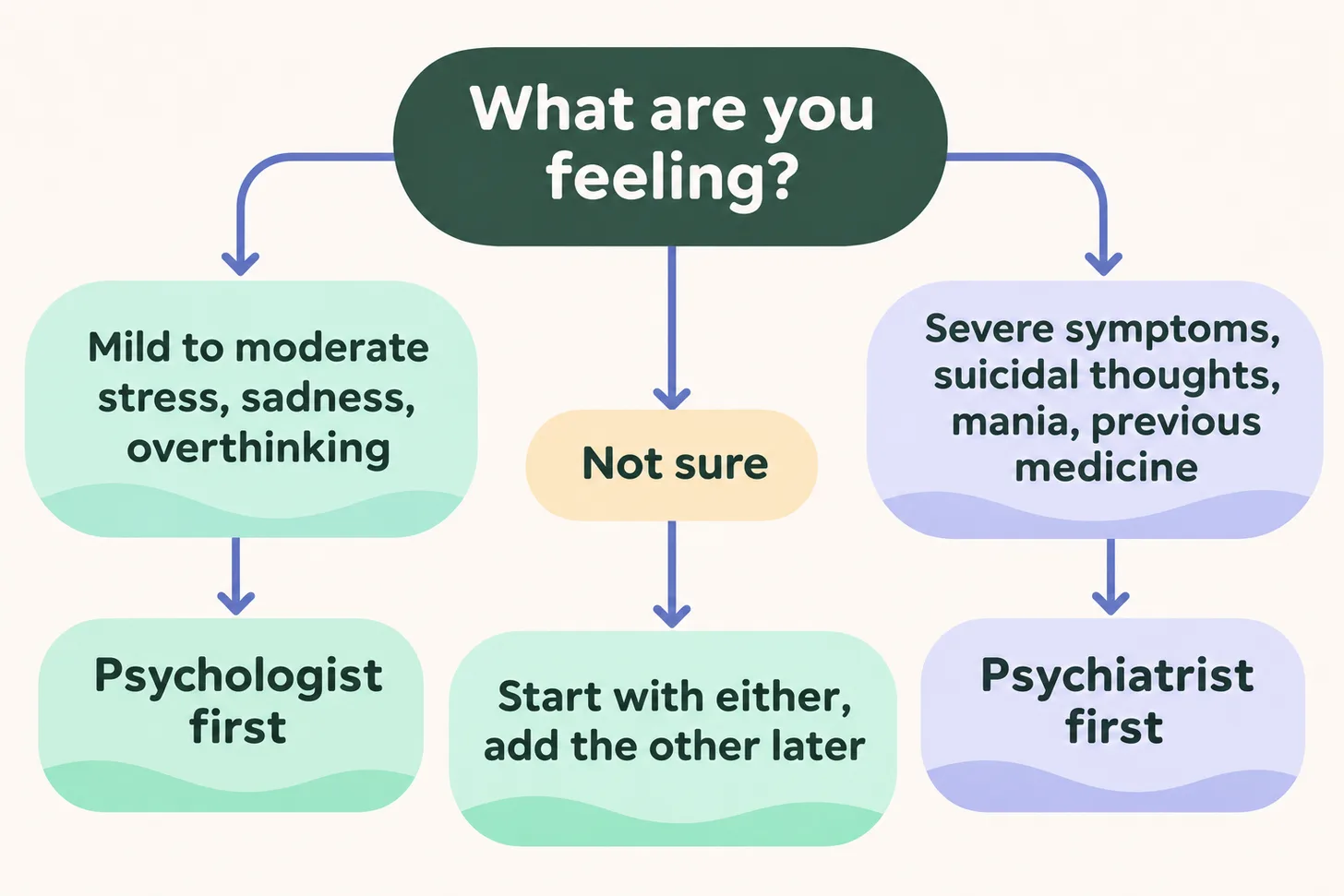
In short: for ongoing emotional support and skill-building, start with a psychologist. For severe, dangerous or clearly medical-feeling symptoms, start with a psychiatrist. You can always add the other later.
Psychologist vs psychiatrist for depression and anxiety
For mild to moderate depression and anxiety, the research is clear. Talk therapy (especially CBT) and medicine both work. For moderate cases, they often work best together.
NIMHANS and the National Mental Health Survey 2015-16 have been clear that getting care in India is the bigger problem, not what works.
If you want to start somewhere today:
- Mild anxiety or low mood: a psychologist. Six to twelve weekly sessions of CBT give most people real relief.
- Moderate depression or anxiety with sleep loss: both. A psychiatrist for a review of whether medicine fits, a psychologist for the weekly work.
- Severe depression, suicidal thoughts, panic that stops you leaving the house: a psychiatrist first, now. The psychologist comes in once you are more stable.
This is not us pushing medicine. It is honest sequencing. Medicine is not a cure, and therapy is not a shortcut. They are two different levers.
In short: both work for depression and anxiety. Severity sets the order. A psychiatrist for severe, a psychologist for mild to moderate, and often both for the middle.
When you need both: how they work together
Shared care is the standard way severe mental illness is treated. A good psychiatrist writes to your psychologist, and the psychologist writes back. You are the hinge in between, and you decide what is shared.
A real pattern looks like this. Someone with moderate depression starts an SSRI (a common type of antidepressant) with a psychiatrist. The first four to six weeks are a flat waiting room while the medicine builds up.
In that time, a psychologist helps with sleep, routine, and the thought loops that keep the low mood going. By month three, the medicine is doing its job and therapy is doing the deeper work. By month nine, the psychiatrist may taper the medicine, and the psychologist helps you close.
The two do not compete. They do different jobs for the same person. If a therapist tells you to stop seeing your psychiatrist, that is a flag. If a psychiatrist tells you to stop therapy, that is a flag too. Both should be fine with the other.
In short: medicine and therapy are a pair, not rivals. The psychiatrist stabilises; the psychologist does the week-to-week work.
What a session costs in India (rough ranges)
Prices change by city, by years of training, and by setting. These are typical ranges we see in October 2026, in INR, per session:
- Government hospital OPD (AIIMS, NIMHANS, state hospitals): ₹10 to ₹100 for a registration-based consult. Medicines are often subsidised or free. Long waits.
- Private psychiatrist consult: ₹800 to ₹2,500 for a first visit; ₹500 to ₹1,500 for follow-ups.
- Clinical psychologist session (private or online): ₹1,500 to ₹3,500 for 50 to 60 minutes.
- Counselling psychologist session: ₹1,000 to ₹2,500 for 50 minutes.
- GoodLives therapist session: See our pricing page on goodlives.in. We work hard to keep sessions reachable, and the exact fee depends on the therapist you match with.
Health insurance in India must cover mental illness the same as physical illness under the Mental Healthcare Act 2017 and IRDAI rules. In practice, cover for outpatient visits is still limited. Cover for inpatient care is fuller. Ring your insurer before you book.
In short: government care is cheapest and slowest. Private psychiatry is cheaper per visit than private psychology, but you see a psychologist more often, so the monthly spend can be similar.
How to find a verified professional in India
A real credential can be checked. Please check before you book, especially for a child, a parent or anyone at risk.

Three places to verify a professional in India:
- The Rehabilitation Council of India Central Rehabilitation Register, for clinical psychologists and counsellors.
- The National Medical Commission Indian Medical Register, for psychiatrists and neurologists.
- Your state medical council register, for doctors in that state.
GoodLives matches you with verified psychologists for one-on-one therapy and workshops. If what you need is medicine, a psychiatrist is the right first stop, and your psychologist can work with them. Our which doctor for mental health in India guide covers how to pick by symptom.
In short: verify the registration, ask for the degree, listen for a plan. If any of these is missing, keep looking.
The honest bit: why psychiatry gets delayed in India
There is a stigma problem. For many Indian families, a therapist is “someone to talk to”, which is socially okay. A psychiatrist is “for mad people”, which is not. That belief delays serious care and costs lives.
We are naming it here because the delay is the real risk, not the medicine. If your parent is scared, a line that often helps is: “a psychiatrist is a doctor like a cardiologist, for a part of the body most of us ignore.”
You do not have to convince everyone. You have to get the person who needs care, to care. If the family will not budge, see a psychiatrist on your own first, and bring back a plan.
For context on how families and workplaces can respond, online therapy in India is one way to start without a visible waiting room.
In short: stigma is the biggest reason psychiatry is delayed in India. If you suspect severe illness, do not wait for family agreement to see a psychiatrist.
This post is for information only and is not a substitute for professional care. If you are struggling, please speak to a qualified mental health professional.




Share your thoughts