

What this blog includes
- The simple meaning and where the idea came from
- Signs that separate it from a bad week or ordinary self-doubt
- Where it often starts in Indian life, honestly named
- Why success sometimes makes it louder
- Practical ways to build self-worth, and when a therapist helps
You walk out of a room. You replay the whole chat. You are sure everyone else was smarter. You are not being dramatic. What you are describing has a name.
Millions of us carry it quietly. GoodLives is an Indian online therapy platform, trusted by 500K+ people. If this sounds like you, our piece on self-image issues is a close companion to this one.
What does an inferiority complex mean?
An inferiority complex is a steady inner belief that you are less than other people, even when the facts do not back it up. The idea came from Austrian doctor Alfred Adler. He saw how a child’s small feelings can grow into an adult pattern.
The plain-English meaning: it is not sadness. It is not brief self-doubt. It is a self-image that says “I am less”. A compliment feels like politeness. A promotion feels like a mistake someone will spot.
Adler said small feelings of being less are normal. They can push a person to grow. It becomes a problem when the feeling is the lens, not the moment.
In Hindi, people call it na-kaafi hona (not being enough). Having the word helps. It is not a weakness in you.
In short: a stuck self-image, not a mood. Naming it is the first move.
How do you know if it is this and not just a hard week?
A hard week passes. This pattern stays. The same quiet beliefs show up. In different rooms. Across years. If three of the signals below sound familiar to you, and they have been with you for a while, it is worth a closer look.
Common signals a clinician in India will listen for:
- A steady “not enough” feeling, even after a win.
- Dismissing your own wins: “they were being kind”, “the paper was easy”.
- Impostor feelings when you are praised, waiting to be found out.
- Over-comparison: Instagram, cousins’ weddings, a colleague’s bonus.
- You shrink in one room and take over the next.
- A loud mask: boasting, correcting, name-dropping. A thin shell over the wound.
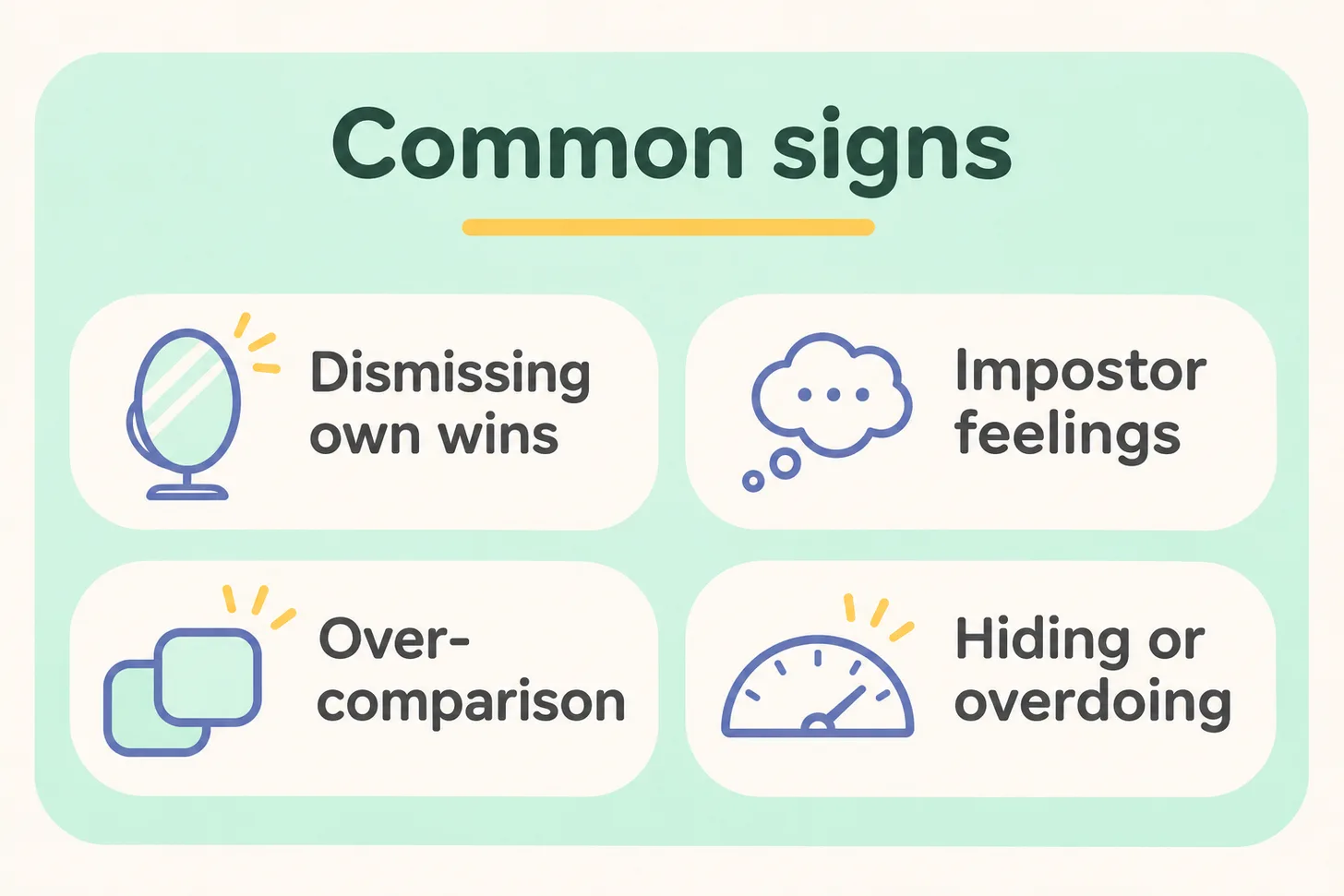
If any sound familiar, our piece on self-doubt and the one on impostor syndrome are the two closest cousins.
In short: steady, cross-situational, and loud under praise. That is what separates it from a passing low week.
What are the causes, especially in India?
The causes of inferiority complex are almost never one thing. It is a slow build-up of small messages a child hears for years, until the messages become the inner voice. In India, several are specific to where we live, and rarely named.
You might be worried that this means you are weak. You are not. You did not choose the family you grew up in, the colour of your skin, the school you went to, or the language you were corrected for.
Honest roots a therapist in India often hears about:
- Comparison at home. Sharma ji ka beta is a joke until you were the child being compared every evening. Parents often did not know what the comparison was doing.
- Rank-based schooling. A single number out of 500 became a verdict. One bad board exam shaped a decade.
- Caste and class. Dinner-table slurs, hostel jokes, “general category” entitlement. If you grew up on the receiving end, early self-worth took hits you did not deserve.
- Skin colour. Fairness creams in the bathroom cabinet, aunties commenting at weddings. Our post on body image issues looks at this closely.
- Language and accent. Being laughed at in an English-medium classroom. Being talked over in a Mumbai meeting.
- Family favouritism. The sibling who was the “bright one”. Children know which role they were handed, early.
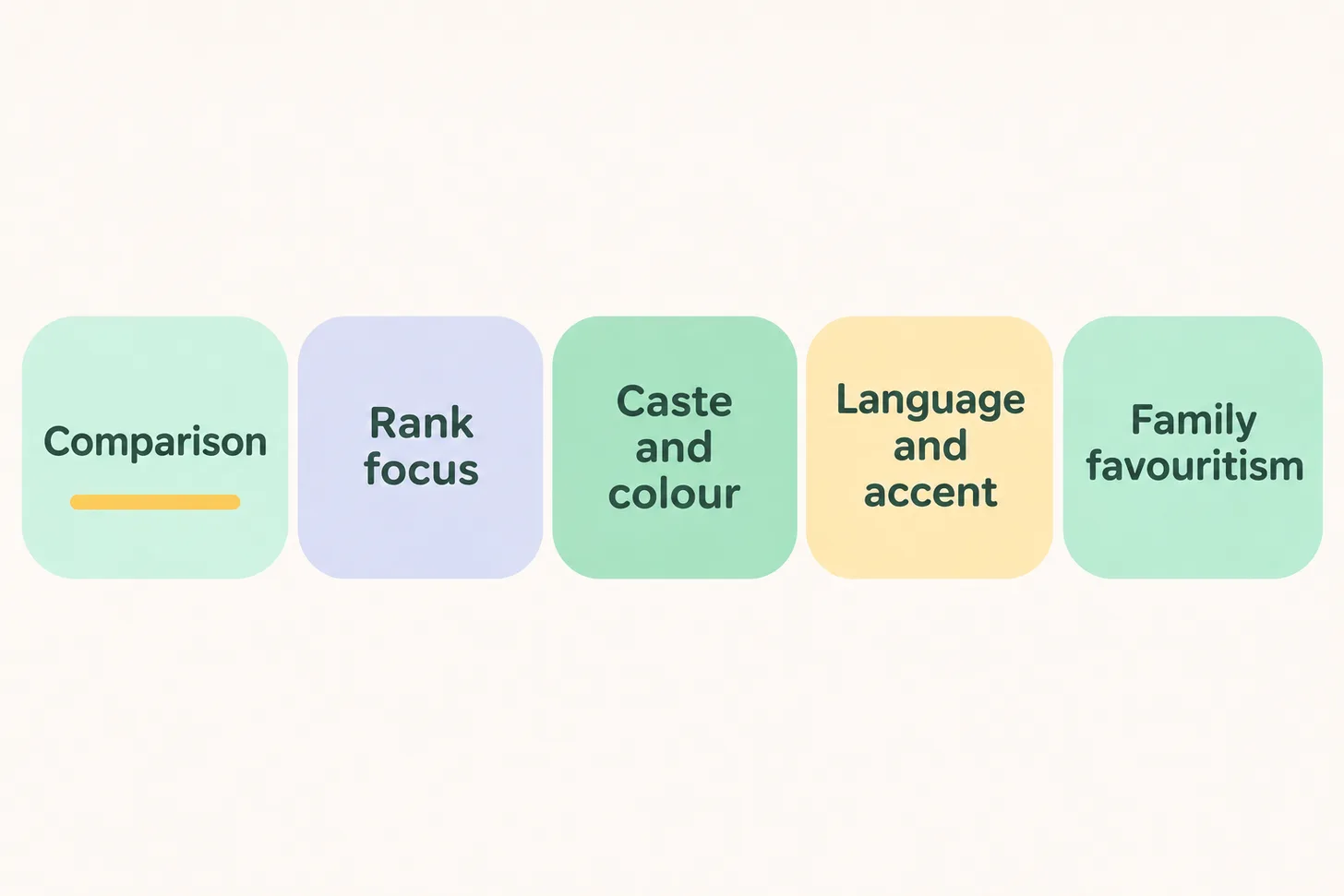
Researchers at NIMHANS in Bengaluru have long written about how family systems shape adult mental health in India.
In short: this often started as someone else’s story about you. You are allowed to put that story down.
Why does success sometimes make it louder?
This surprises people. A top rank. A job offer. A visa. A flat in your own name. You might think any of these will quiet the voice. For many of us, it does not. It gets louder. The stakes feel higher.
Here is what often happens. You reach the thing. The voice shifts. From “I am not enough” to “they will find out”. Some weeks it works. Some weeks it does not. Wins do not reach the place the feeling lives.
That is impostor syndrome. A close cousin, not a cure. Our longer piece on impostor syndrome and how to overcome it goes deeper.
The pattern lives inside, not outside. You do not have a facts problem. You have a reading problem.
In short: this is not a results problem. It is a reading problem, and the reading can be learned.
How can you build self-worth day by day?
Self-worth is a stack of small daily choices. Over months, they slowly change what feels true about you. Self-help on its own will not fix the root. It can soften the edges, though, and some days that is the whole point.
- Catch the compliment, do not dodge it. Say thank you. Write it down the same evening.
- Keep a done list, not a to-do list. At the end of each day, record three things you did.
- Narrow your comparison window. Compare your Monday to your last Monday, not a stranger’s highlight reel.
- Name the inner voice as a voice. “That is the critic talking” opens a small gap between you and the thought.
- Pick one skill and give it ninety days. Progress on your own terms is the fastest antidote to borrowed shame.
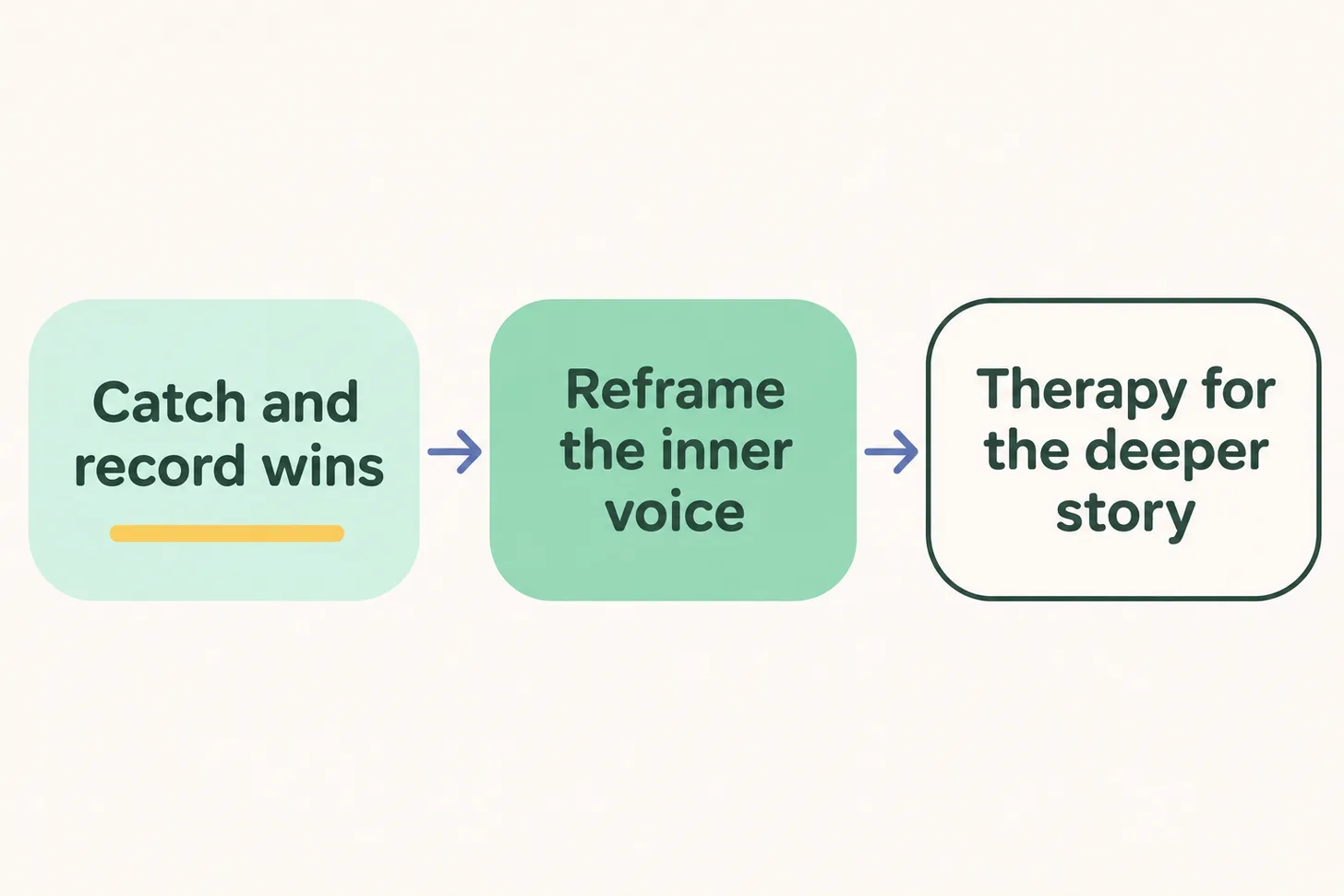
If you want, try one small reframe now.
Catch the thought
What thought is weighing on you right now? Write it down just as it sounds in your head.
Name the trap
Does your thought fall into one of these common patterns? Pick any that fit. This part is optional.
Look again
Use these as nudges, not rules. Then write one line back to yourself.
Your reframe
Thoughts are not facts. You just practised stepping back.
This stays on your device. Nothing is saved or sent.
Our piece on practising self-love goes further.
In short: build evidence a week at a time. A quieter inner voice is downstream of a hundred small kept promises.
When is therapy the right next step?
Most of us can carry some low self-worth. We can still live a decent life. There is a point, though. The pattern starts costing you money, chances, friendships, sleep. That is a good signal to talk to someone trained for it.
You might be worried that one therapy session will reveal something you cannot handle. In practice, a first session is a calm chat. You bring the feeling. The therapist brings the tools.
Think about therapy when the voice is loud on most days. When self-help has not shifted things in a few months. When your sleep and appetite have slipped.
A therapist helps you see the first place the “I am less” story was handed to you. In a safe room. CBT is a short, structured approach that spots and reframes these thoughts. Group therapy, when available, lets you hear your own patterns in other people’s voices.
If what you need right now is to sleep well first, that is enough. Not every inferiority complex needs therapy. The option will still be there on Monday.
The Mental Healthcare Act 2017 sets out your right to confidential care. Our primer on what online therapy is like is a fair first door when you are ready.
In short: when the pattern starts to cost you, a trained second opinion is a kindness, not a verdict.
FAQ
What is having an inferiority complex?
Is an inferiority complex good or bad?
Why do I always feel inferior to other people?
What is the difference between an inferiority complex and insecurity?
Is an inferiority complex a mental disorder?
Will therapy for low self-worth take years?
Ready to talk to someone?
A 50-minute session with a verified psychologist on GoodLives, in English, Hindi, and more Indian languages. Start when you are ready. button: Book a Session




Share your thoughts