
What this blog includes
- A plain definition, and where the word came from
- Signs a friendship is genuinely platonic, and signs the line is blurring
- The India question: cross-gender friends and your partner
- One line to carry around: you do not need permission, you do owe openness
If you are reading this at 11 pm about one friend, you are not being dramatic. Most of us have had this doubt. On GoodLives, Trusted by 500K+ people, this question comes up often. Platonic friendship has a quiet meaning and a few clean signals.

What does a platonic friendship actually mean?
A platonic friendship is a close, warm bond. No romance, no sex. The care is real. The warmth is real. What is missing is the quiet pull of “I want this to become something else”. The friendship holds its shape when life gets heavy.
The word platonic comes from Plato, a Greek philosopher. In the Symposium, he wrote of a love that moves past the body toward care. Today the meaning is simpler. A bond that is warm, deep and non-romantic. The APA Dictionary of Psychology uses a similar meaning.
In short: a platonic friendship is love without the ask. You care, you show up, and nothing in you is waiting for it to turn into something more.
The quiet signs it is still just friendship
You do not have to run a mental audit on every friend. For most people, the body already knows. These are the quiet signals that tend to be there when a friendship is genuinely platonic.
- You are glad for them when they are seeing someone else, not uneasy.
- The friendship holds its shape when you are both single, and when you are not.
- There is nothing you would need to hide from your partner, your best friend or your sibling.
- You do not feel a drop or a lift based on their marital status.
- You can be in the same room without the air changing.
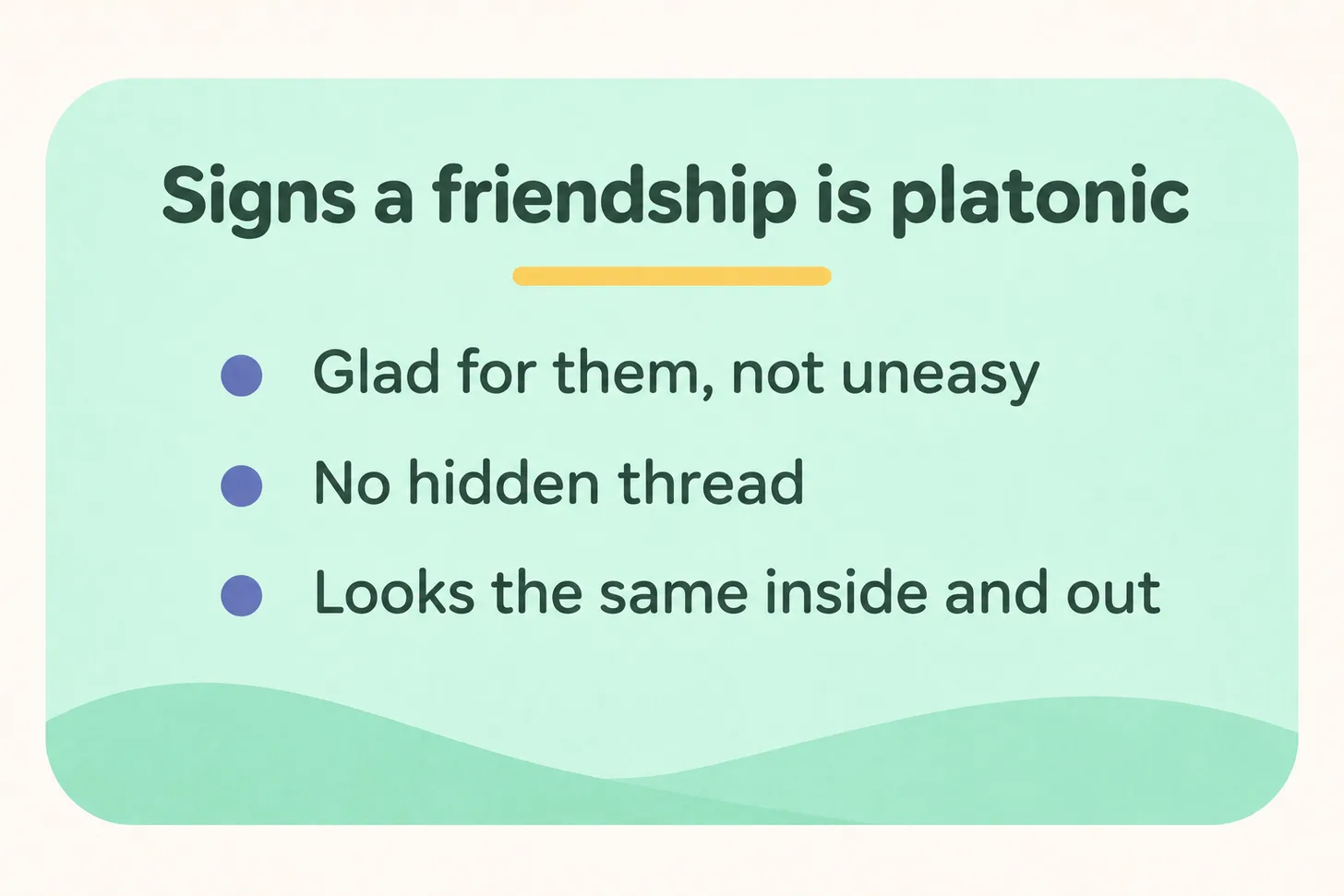
In short: a healthy platonic friendship looks the same from the inside as from the outside. There is no second track running underneath.
Where the line can begin to blur
A friendship can begin platonic and quietly become more. The honest answer is that most lines cross in small signs, not big ones. Catching them early saves pain.
A few quiet signs the line is moving:
- You look forward to their messages more than your partner’s.
- You find yourself keeping the contact quieter than your other friendships.
- A thought has appeared, even once: “if we were both single…”
- Their news hits you harder than you expected.
- You bring your emotional weight to them, not to the person you share a life with.
If one or two fit, you are not a bad person. The friendship is not necessarily wrong. You might be worried that saying any of this out loud will end it; often, hiding is what ends it.
In short: a friendship stops being purely platonic when a second thread runs underneath. Noticing it is the first step, not a verdict.
If you want one slow minute with a thought from the list, this short reframe can help.
Catch the thought
What thought is weighing on you right now? Write it down just as it sounds in your head.
Name the trap
Does your thought fall into one of these common patterns? Pick any that fit. This part is optional.
Look again
Use these as nudges, not rules. Then write one line back to yourself.
Your reframe
Thoughts are not facts. You just practised stepping back.
This stays on your device. Nothing is saved or sent.
No permission, yes openness
This is the line worth saving. You do not need permission for a close friendship. You do owe openness about the ones that matter.
Permission means asking a partner or family for the right to be friends with someone. Adult life does not run on permission. Openness is different. It means being honest with the person who shares your life.
A friendship your partner knows about is different from one you keep hidden. On the outside, the behaviour can look the same. On the inside, hiding is where the trouble begins.
In short: adult friendship does not need approval. It does ask for honesty.
When your partner is uneasy: two very different conversations
If your partner has said something, slow down. Two different situations hide under the same words. They sound alike at first. They lead to very different next steps.
The India question: cross-gender friends and family
In many Indian homes, a close friendship across gender gets questioned. An aunt or a parent asks, “What is going on there?” If this has been thrown at you, you are not being dramatic for finding it tiring.
A partner’s unease is not always controlling. Sometimes it is a signal that the bond needs more sunlight, not that it has to end. The honest middle is harder than either extreme.
A note on same-gender friendships. In India these are read as platonic by default. For queer readers, this cover can protect. It can also hide what the bond is. You get to name it in your own time.
In short: you do not need permission for a friendship, and you do owe openness to the people it touches.
When this becomes a therapy conversation
Not every friendship question needs therapy. A reframe will not fix the real question; it only takes the edge off. Most of this is work you do on a walk, in a chat with your sister. A session is for the questions that will not leave you alone.
Therapy becomes useful when one of these is true:
- You have been carrying the thought on your own for weeks and it is affecting your sleep.
- You and your partner have had the same conversation three times and it is going in circles.
- There has been a specific breach of honesty and you need help putting it down.
- A friendship is ending or shifting and you do not have a place to grieve it.
If what you need right now is to call a friend and sleep well, do that. A session can be tomorrow. A GoodLives counsellor can help with the loop. Our therapists are RCI-registered psychologists (RCI). The Hindi word fits here too, dil ka boj (a weight on your heart). Let the feeling have a name.
In short: a platonic friendship rarely needs therapy on its own. The feelings around it sometimes do.
FAQ
What is the difference between a platonic friendship and a platonic relationship?
Can men and women be just friends in India?
Is it normal to feel attracted to a platonic friend sometimes?
My partner is uneasy about my opposite-gender friendship. What do I do?
Can a platonic friendship turn into love later?
Can you really be friends with an ex?
Is it okay to feel grief when a close friendship ends?
This post is for information only and is not a substitute for professional care.
Ready to talk to someone? A 50-minute session with a verified psychologist on GoodLives. English, Hindi and more Indian languages. button: Book a Session Subline: Trusted by 500K+ people



Share your thoughts