

What this blog includes
- What the research says about movement and the mind
- How much exercise you need in plain minutes
- Which types of movement help with what
- How to start on a day you do not feel like it
- When exercise is not the right next step
Most of us have Googled this on a 2 am kind of night. You read that walking helps, yoga helps, running helped someone’s cousin. Then you close the tab. None of it tells you where to start when your legs feel like lead.
The benefits of exercise on mental health are real. The honest answer is less tidy than a listicle, and a lot more useful.
GoodLives is India’s online therapy platform, trusted by 500K+ people, with a 5 Google rating. We think a lot about where self-help ends and therapy begins. This post stays on the self-help side. It has one honest signpost over to the other.
What are the benefits of exercise on mental health?
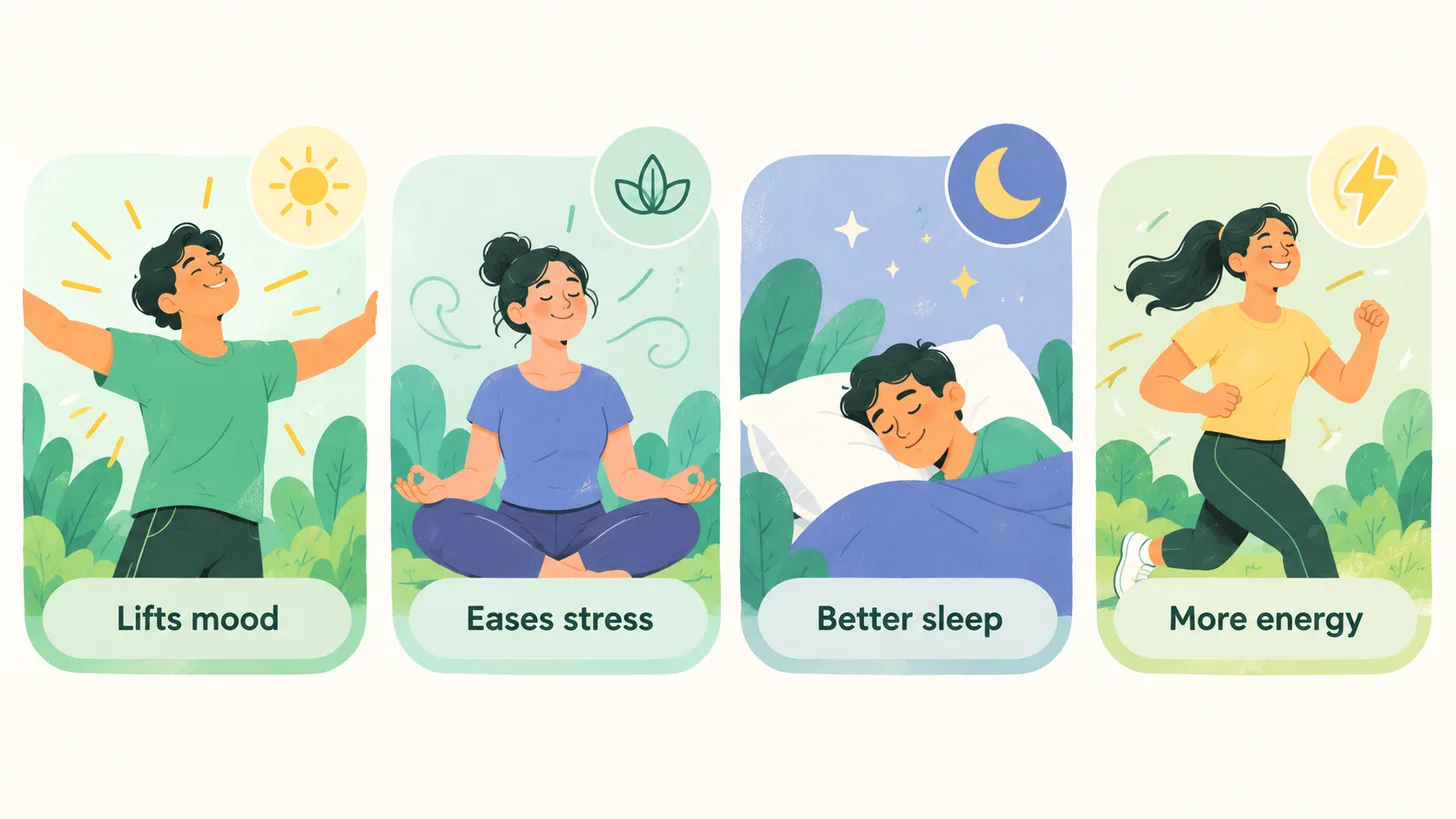
The benefits of exercise on mental health are mood lift, lower stress, better sleep and a calmer baseline. You also get a quiet sense of being able to do things. Each benefit sits on a different mechanism. Together they explain why most of us feel a little better on the days we move.
Here are the main ones, in plain words.
- A natural chemical lift. A moderate burst of movement releases endorphins, which lift mood for about an hour.
- BDNF (brain-derived neurotrophic factor). Aerobic exercise raises this protein, which helps brain cells that handle learning and mood.
- A calmer stress system. Movement trains the body’s cortisol-making system (the HPA-axis) to react less sharply.
- Better sleep. People who exercise fall asleep faster and spend more time in deep sleep. See how to fall asleep fast if sleep is where your week falls apart.
- A break from the loop. Twenty minutes outside breaks the thinking loop without you forcing it.
- A small win, often. Finishing a short walk is a tiny sense of mastery; on low-mood days that one win does more than the walk.
- Company. Team sports and a morning walking circle give you people without a social script.
Two meta-analyses are the strongest anchors. Schuch and colleagues (2016, Journal of Psychiatric Research 77, 42 to 51) pooled 25 trials of exercise for depression and found a large effect.
Stubbs and colleagues (2017, Psychiatry Research 249, 102 to 108) pooled trials of exercise for anxiety and found a moderate effect. These are averages across small trials. They are not promises for one person. They are enough to take movement seriously.
In short: exercise does not mute your feelings. It changes the body those feelings run through.
How much movement does your mind actually need?
The WHO’s 2020 physical activity guideline sets 150 to 300 minutes of moderate activity a week for adults. Or 75 to 150 minutes of hard activity. Plus muscle work on two days. For most of us, that works out to about 25 minutes of brisk walking on five days.
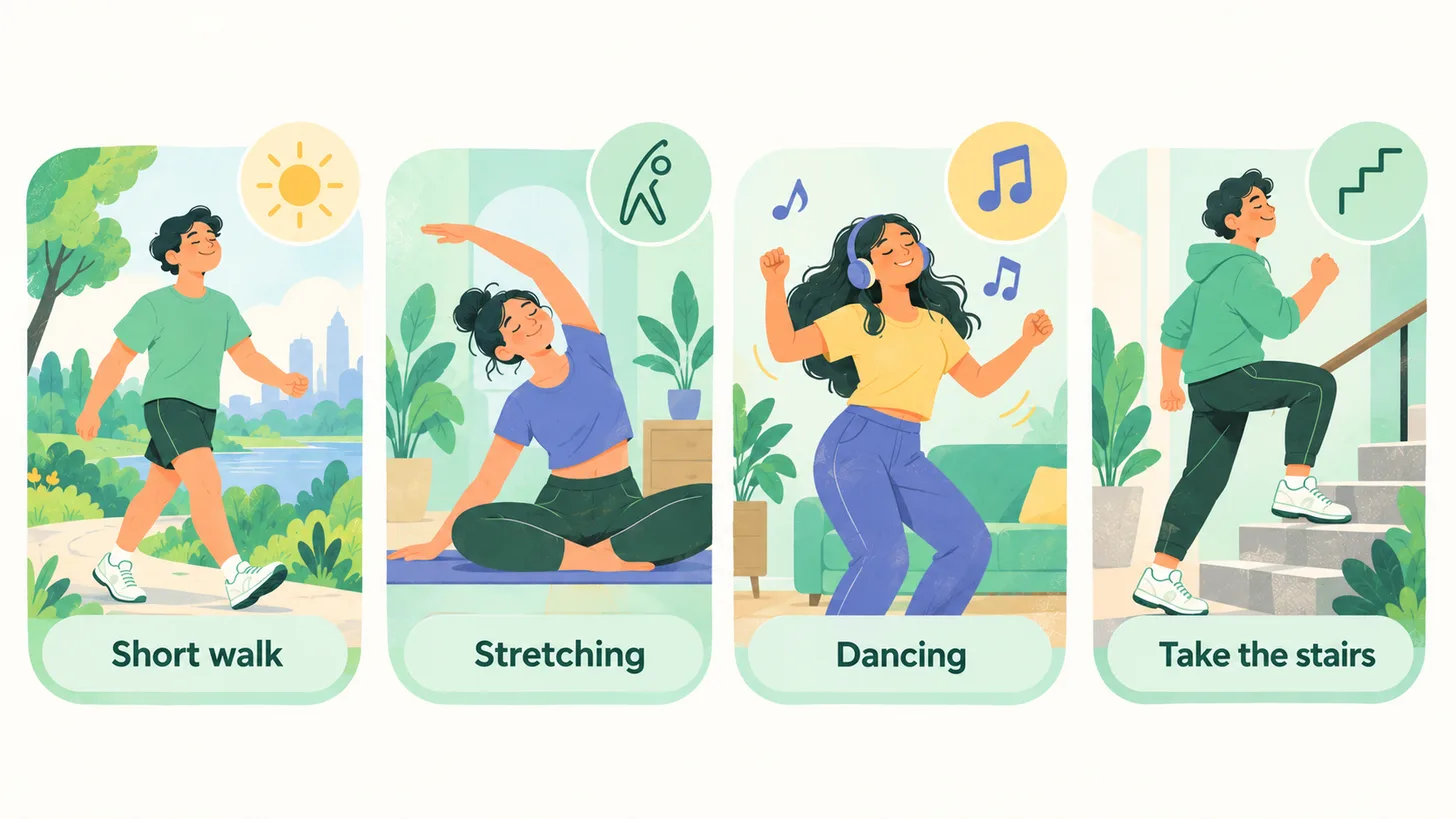
If 150 minutes feels out of reach this week, start smaller. Research shows that even 10 minutes of brisk walking can lift mood for the next hour. Something is not the enemy of enough. Something is where enough begins.
You might be worried that only sweaty, planned exercise counts. It does not. Climbing stairs, carrying groceries, dancing while you cook. All of it adds up.
In short: aim for 150 minutes a week on your own schedule, one short walk at a time.
Types of movement for mental health, and what each does best
The best types of movement for mental health are the ones you will actually do. That line sounds glib, so here is the longer version. Different kinds of movement work on slightly different parts of you. Knowing which you need this week makes picking easier.
Morning exercise benefits, is sunrise really better?
Morning exercise has real benefits, though not for the reason the internet gives. Early movement sets your body clock, which helps night-time sleep. It also uses your morning cortisol peak, so the push feels easier. The biggest edge, honestly, is that fewer things interrupt a 6 am plan than a 7 pm one.
What the research does not say is that morning is better for the mind than evening. Studies that compare times of day are small and mixed. The pattern you actually keep beats the one you prefer in theory. If your knees are stiff before 9 am or the house is loud before 10, do not force a sunrise jog.
A morning habit does help with keeping it up, which is where most of the mental-health gain lives. Three evenings a week you keep is better than seven mornings you quit.
In short: morning is a strong default if your schedule allows it. Showing up is the whole game.
Exercise for anxiety: how to start when motivation is empty
If you want to use exercise for anxiety or low mood, the first move is not fitness. It is a 10-minute walk, outside, with nothing in your ears for the first five minutes. That is small enough that your brain cannot talk you out of it, and large enough that the body registers it.
Three things to know before you start.
- Action precedes motivation. Waiting to feel like exercising on a low-mood day is like waiting to feel like showering during flu. You do it, then the feeling catches up.
- Bad days are not failed days. Some weeks it works. Some weeks it does not. That is normal.
- It will feel pointless at minute two. The lift lands between minute six and ten, not at the door.
A short starter for the next two weeks.
- Day one: 10-minute walk, flat route, no phone goal.
- Day two: 10-minute walk, same route, notice three things you missed on day one.
- Day three: rest, with one chore that moves you around the house.
- Day four: 15-minute walk, slightly brisker. Finish before you want to.
- Keep this cadence for two weeks. Nothing fancy.
You do not have to call it exercise if that word is weighted for you. Call it “my ten minutes”.
That restless unease in the chest, what Hindi calls bechaini (restlessness), responds well to slow outdoor walks. A ten-minute walk will not fix what made this week heavy. It will give you ten better minutes while you look for what will.
In short: start small, go outside, let the first ten minutes be ugly.
What movement cannot do
Exercise is a floor, not a ceiling. It raises your baseline. It buys you better days. It does not treat everything. If what you need right now is to sleep tonight, a plan to run on Friday is the wrong tool.
A short, honest list of what exercise cannot handle on its own.
- Severe depression. When getting out of bed is the ceiling, a therapist needs to be in the loop. Movement helps once you are getting care.
- Trauma and PTSD. Running does not reprocess what happened to you. A trauma-informed therapist does.
- Eating disorders. This is the important caveat. For anorexia, bulimia or compulsive-exercise patterns, more movement can make things worse. The honest answer is a specialist, sometimes with a medical team. India’s NIMHANS has an eating-disorder clinic.
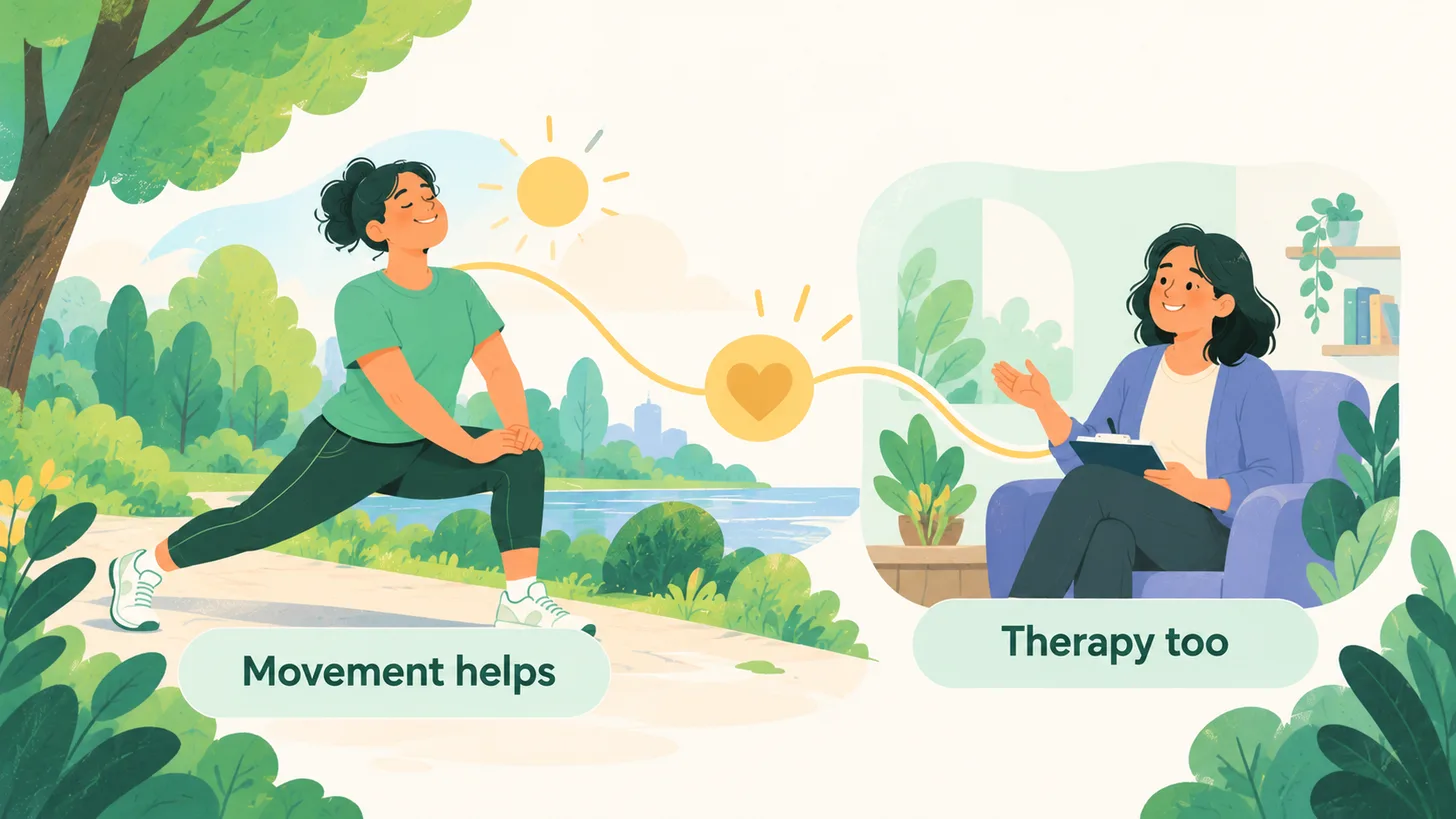
A short honest line about therapy. Exercise can lift your week. A therapist can help you figure out why the week keeps needing a lift. If you have been thinking about it, online therapy in India is one of the more flexible ways to start.
In short: movement is powerful, and it is one tool. If the problem is bigger than one tool, do not try to solve it with more reps.
Making it stick in Indian life: heat, pollution, safety, home options
The Indian version of a movement plan has to deal with things most Western guides skip. The heat. The air. The way certain hours feel safer than others. The fact that half the days you planned to walk, you will be at a wedding instead. Here is the honest layer.
- Heat. From April to early July in north and central India, the only sane outdoor window is before 7 am or after 7 pm. Housework and stair walks count on 44 degree days.
- Pollution. On high-AQI days in Delhi, Gurugram, Noida, parts of Mumbai or Lucknow, outdoor cardio can do real lung damage. Switch to a mat routine when AQI crosses 200.
- Safety for women runners. Not every colony feels safe at every hour, and that is not the runner’s problem to solve. A friend to meet, a well-lit society loop, a daytime run, a weekday class at a nearby gym all work.
- Home options. A 20-minute YouTube yoga session, a bodyweight circuit (10 squats, 10 push-ups, 10 lunges, three rounds), stairs in your block, a Zumba video. All of these take zero rupees.
A reader in a Bengaluru WhatsApp group once asked whether a walk around the colony really counts. It does. Being kind to the version of exercise that fits your life is also self-love in practice, and a slower path to inner peace than the influencer kind.
In short: the best plan is the one your week, your city and your body can hold.
FAQ
How does exercise reduce stress hormones?
What are the five mental benefits of exercise?
Can exercise replace therapy for anxiety or depression?
What is the best time of day to exercise for mental health?
Are there negative effects of exercise on mental health?
How quickly do you feel the mental benefits of exercise?
What type of exercise is best if I have anxiety?
This post is for information only and is not a substitute for professional care.



Share your thoughts