
What this blog includes
- Why heartbreak feels physical, and what the brain is actually doing
- 12 steps you can take at your own pace to move on
- What no-contact looks like when you share a city, a workplace or a family
- An honest answer to the question “how long will this take?”
- Signs that moving on is more than a breakup, and when a therapist helps
Googling “how to forget someone” at 1 am is not weakness. The ache you feel is your mind doing what minds do with people who mattered. Breakups touch the brain’s attachment and reward systems, which is why they feel physical, like a weight on your chest you cannot put down.
At GoodLives, trusted by 500K+ people with a 5 Google rating, we’ve sat with people after breakups, long partnerships ending, divorces, and quiet one-sided loves that lasted years. You are not being dramatic. What you’re feeling has a name, and most of us have been there.
Here is what this page will not do. It won’t promise you a fixed timeline. It won’t tell you to date someone else by Friday. And it won’t pretend heartbreak is a project with a deadline.
It will walk you through 12 gentle steps you can take at your own pace, show you what no-contact looks like in Indian life, and tell you honestly when forgetting feels so impossible that a therapist is the right next step.
If reading in Hindi lands softer tonight, we also have a Hindi guide to forgetting someone.
Why forgetting someone you love hurts, and why it is not weakness
Forgetting someone you love hurts because the brain treats separation from an attachment figure like a wound. The pain is real and measurable, not a motivation problem. Here is what is actually happening inside you, and why the Indian cultural silence around heartbreak can make the ache feel louder than it already is.
In a 2010 study on romantic rejection, Helen Fisher and colleagues at Rutgers University found that looking at a photo of a recent ex activated the same reward and craving regions as cocaine withdrawal, per the Journal of Neurophysiology.
That is why you crave their messages the way a smoker craves a cigarette on day two. You are not weak. You are in withdrawal from someone your nervous system had learned to depend on.
The Indian context adds another layer. Many of us grew up without permission to feel heartbreak out loud. Parents say “yeh toh phase hai”. Friends say “move on, yaar”. Among college students, it is often brushed off as “love failure”, a dismissive term for a real event. The silence makes the ache louder, not smaller.
That heavy dil ka boj, the weight on your heart, needs to be felt before it can shift. If the person never actually loved you back and you are reading this after a long one-sided love, the grief is slightly different and we’ve written about it here.
In short: heartbreak is a real neurochemical event, not a weakness of character. The first kindness is to stop asking yourself why you are still not over it.
How to forget someone you love in 12 gentle steps
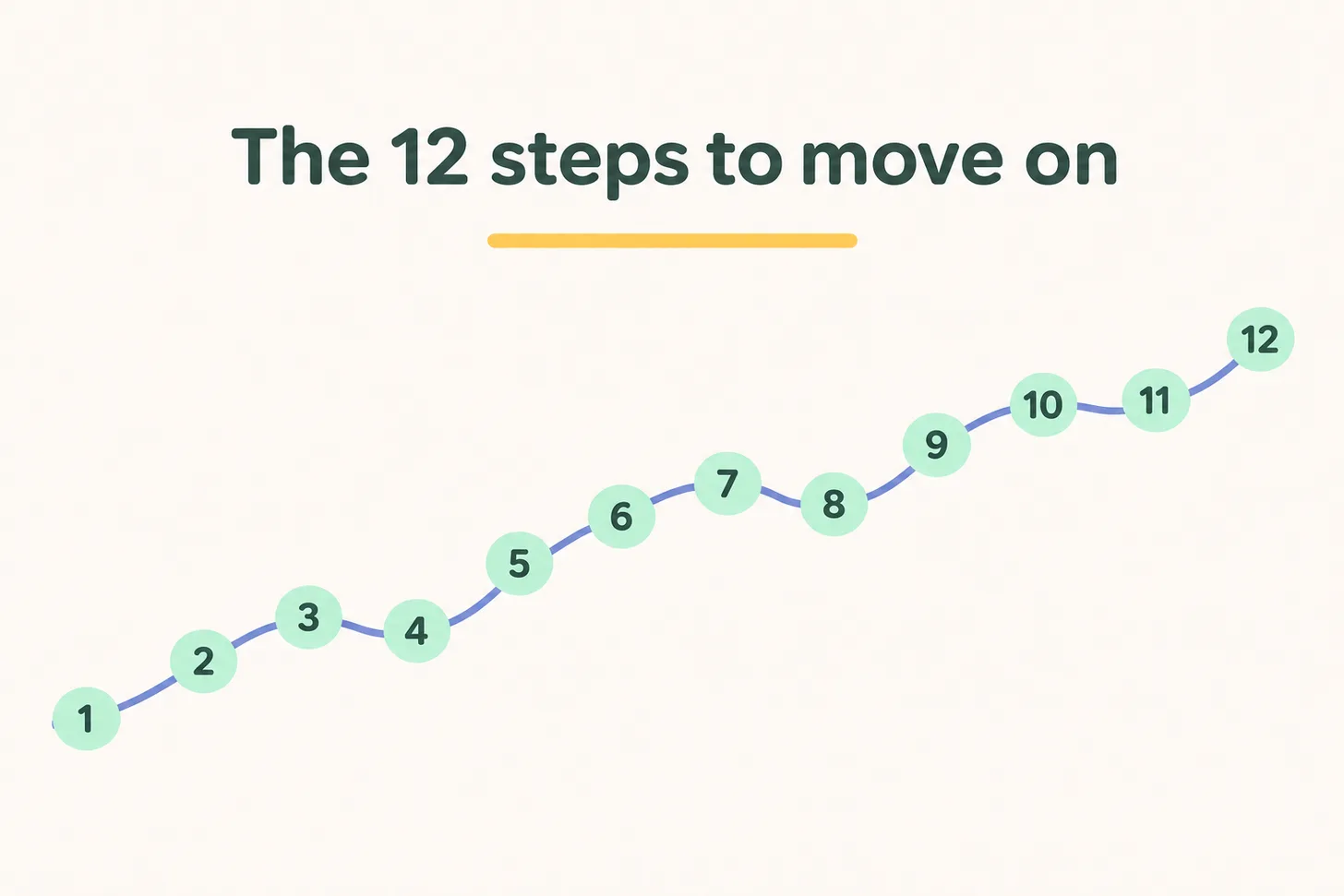
These 12 steps are a loose sequence, not a strict plan. Whether you came looking for how to forget a person who hurt you, or how to move on from someone you still love, the steps are the same. Some take an afternoon. Some take months. Skip the ones that do not fit this week.
1. Let yourself grieve first, before you try to move on. The culture rushes you to a highlight-reel comeback. The brain does not work that way. Set aside time to feel bad, maybe 20 minutes a day, without problem-solving. Grief that is allowed in moves faster than grief that is pushed down.
2. Name what you actually lost. It is not just the person. It is the Sunday routine, the inside jokes, the version of your future that had them in it, the version of yourself that felt loved by them. Writing down what you miss, specifically, makes the hole smaller than “everything”.
3. Create distance before you try deletion. Hiding chats, muting their stories, leaving the shared group are small reversible moves. They give you quiet without the finality of blocking. For most people, quiet is what heals, not drama.
4. Mute rather than block, if blocking feels dramatic. Blocking is sometimes necessary. If you are not there yet, mute them on Instagram, archive the WhatsApp chat, remove their location pin on Find My. The point is to stop the small daily hits of their life, not to perform a breakup.
5. Clean the digital residue in small sweeps. Photos, saved memes, their playlist, that one Spotify song that always gets you. Do it in 15-minute sessions. Move things to a hidden folder first, delete later. You get to decide how final each step feels.
6. Keep a “letter to send never” journal. When a thought loop will not quit, write it to them as a letter. Do not send. The relief comes from being heard, which you can do for yourself. A plain notebook, or a notes-app file, is enough.
7. Replace the time slot, not the person. Thursday evenings used to be theirs. Fill that slot with something small and non-romantic. A pottery class. A walk with a friend. A weekly call with your sister. The slot gets a new association, so the old one has less to grab onto.
8. Move your body daily, even for ten minutes. The chemicals that help you heal, like serotonin and endorphins, respond to movement more than to sleep or food. A brisk walk, kitchen dancing, cycling, a short yoga flow at home. The goal is not fitness. It is biology.
9. Protect your sleep like it is your job. Heartbreak messes with cortisol, which messes with sleep, which messes with everything. Fixed sleep and wake times, phone out of bed, less caffeine after lunch. If sleep does not return in two to three weeks, that is a sign to get help, not to push through.
10. Tell two people what is really going on. Not the sanitised version, the actual one. One can be a friend. One can be a sibling, a cousin, an aunt, or a therapist. Loneliness is not the absence of people in the room. It is the absence of being known in it.
11. Catch the memory loop with “then what?”. Your mind will replay the fight, the last message, the Diwali where you first knew it was ending. When you notice it, ask yourself “then what?”. Follow the imagined outcome one step at a time until the loop runs out of fuel. Loops shrink when you walk through them, not when you push them away.
12. Give yourself permission to feel better before you feel fully over it. You do not have to be fully done to laugh at a joke. You do not have to earn your next good day with more suffering. If a Tuesday feels okay, let it. You will still have hard days. Both are allowed.
A gentle warning on this last step. Dating someone new too fast can tip into a rebound relationship, which often extends the grief rather than easing it.
For more practical, moment-by-moment questions, we have a shorter companion piece on handling a breakup day to day.
In short: these 12 steps are a toolkit, not a timeline. Move through them in the order your week allows, and come back to the ones that help.
What no-contact looks like when you share a city, job or family
No-contact does not always mean “block and never speak”. That version works if you were strangers before and can be strangers after. In India, many of us share a workplace, a family group chat, or a child. In those cases, aim for healthy distance instead.
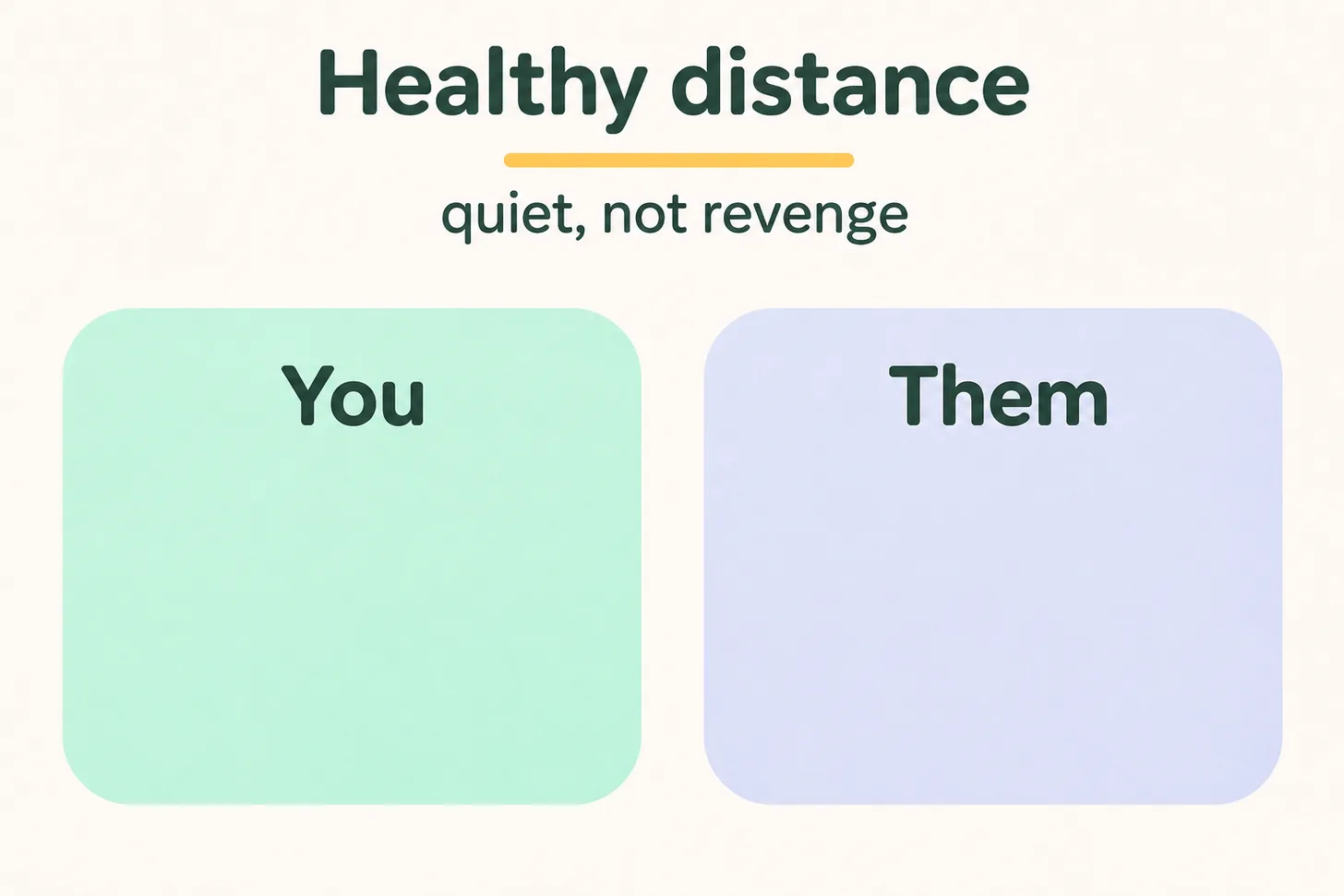
Healthy distance looks like three agreements with yourself. First, no “accidental” check-ins (their last seen, their Instagram story, their sister’s new post). Second, logistics only when you must talk, no feelings, no updates about your week. Third, no revenge posting on close-friends.
You are not performing the breakup for their benefit. You are getting your evenings back for yourself.
If a shared child, a parent-in-law or an office is in the picture, write a short script you can use. Something like “I’ll reply only about the meeting tomorrow”, or “Please message about this on the family calendar”. Scripts make it harder for a hard moment to turn into a long call you regret at 2 am.
In short: no-contact is a direction, not a wall. The goal is to stop the small daily hits of them while real life keeps running.
How long does it take to forget someone you love?
The honest answer is longer than you want, and probably less long than you fear. Research on romantic grief suggests the sharpest acute phase, when you are barely functioning, usually eases within about three months. The quiet aftershocks, the song, the smell, the Diwali light, can last a year or two. Both are normal.
Some factors slow it down. A relationship that ended without clarity. A breakup where you were blindsided. A loss that stacks on top of other losses this year. If any of those are true for you, be gentler on your own timeline.
In short: three months for the sharpest edge, up to a year or two for the quiet aftershocks. If you are still fully not functioning after four to six months, that is worth a conversation with a therapist.
When it is more than a breakup: signs to talk to a therapist
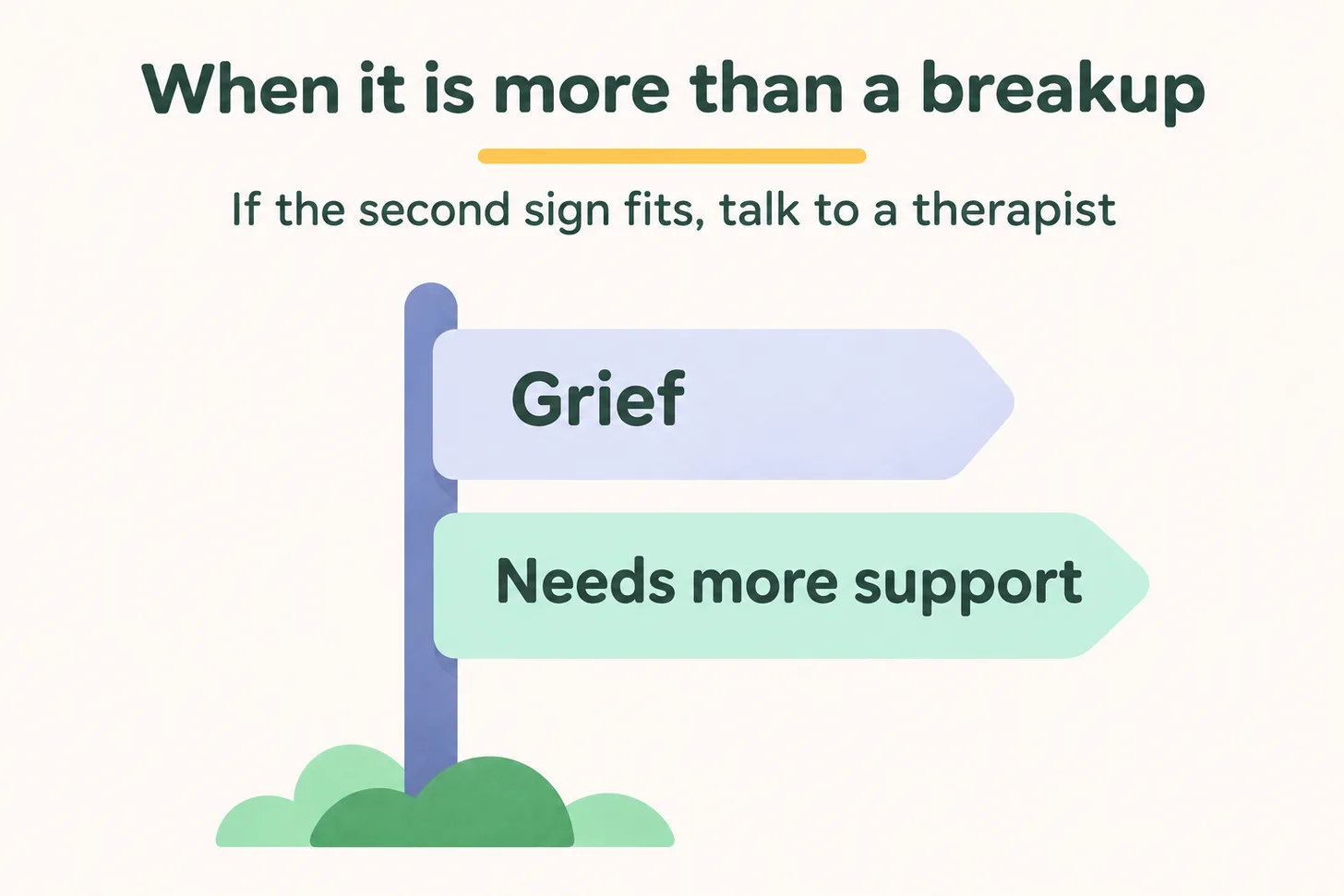
Grief is not depression, but a breakup can tip into something that needs more support. The signs below are not markers of failure. They are your body telling you that what started as heartbreak has moved into territory a trained person is better equipped to walk with you through.
- You cannot sleep, or you are sleeping all day, for more than two weeks
- You’ve lost interest in things that normally bring you some comfort
- Your appetite has changed sharply, up or down, for weeks
- Alcohol, substances, or binge-eating have crept in as the main way to cope
- Thoughts of self-harm, or thoughts that your family would be better off without you
These are the people trained for exactly this.
For the rest, therapy is one of several good options. A therapist cannot make the person come back and will not try. What a therapist does is sit with the parts of the story you cannot say out loud yet, help you spot the loops, and walk the first few weeks with you.
The Mental Healthcare Act 2017 protects your right to confidential mental-health care in India.
If you want to book one when you are ready, GoodLives offers online breakup and heartbreak counselling with verified psychologists in English, Hindi and more Indian languages.
In short: if two weeks have passed and your week is not slowly returning, a therapist is a reasonable next person to talk to.
If forgetting feels impossible tonight: a small gratitude practice
Not every bad evening needs a plan. Some evenings need you to put the phone down and notice three small things that are not hurting right now. The practice below is for one of those evenings. It will not fix the breakup. It will take the edge off, so you can sleep.
If you want, try this before you move on to the FAQ.
Even on hard days, a few small things hold up.
Let's find three. It takes about a minute, and it never leaves your device.
Three good things
Take them one at a time. Small really counts here. If a prompt doesn't fit, swap it for another.
Your good list for today
Noticing good things doesn't cancel the hard parts. It just gives them some company.
Come back tomorrow and add three more.
This stays on your device. Nothing is saved or sent.
In short: gratitude is not denial. It is a small way of reminding your brain that it still has a working day, even on a day that otherwise feels broken.
Free and low-cost help if you cannot book a therapist right now
Therapy is one path. If this week is not the week for it, these three trained lines in India will take your call tonight. They are built for people exactly like you, by professionals who are not trying to sell you anything. Use them without hesitation.
If you have a friend or a sibling you can call, call them. If not, these numbers will pick up. It is okay to be heard tonight without paying for a session.
In short: three free, trained, confidential lines in India will take the call. Being heard tonight does not require any payment.
This post is for information only and is not a substitute for professional care.
Visual creation prompts (internal, remove before publishing)
Visual 1: person releasing a balloon, letting go Where to add: featured image slot, above the H1 (no body marker)
Prompt to generate image: Illustration, landscape 16:9 (2240 × 1260 px). Warm off-white background (#FFFCF8). Centred: a single human figure drawn in a calm, unspecific style, standing with their arms gently raised, releasing a round balloon into the air. The figure outlined in sage-green (#394B42) as the primary line, with soft clothing in a muted sage-green fill. The balloon in a thin pink-coral gradient (#FF7F7F to #FF7FB7), rising upward with a soft trailing shadow. A thin pink-coral gradient accent bar below the figure, 4px thick, 80px wide. No face detail, no stock imagery, no 3D render, no neon, no dense background. Headings area left clear for Brandon Grotesque 500 type. Body text clear in Quicksand. GoodLives wordmark small, sage-green, bottom right. White space generous on all sides.
Size: 2240 × 1260 px, WebP under 250 KB File name: how-to-forget-someone-you-love-01.webp Alt text: A person releasing a balloon, a gentle image of letting go and forgetting someone you love
Visual 2: 12-step move-on plan roadmap Where to add: inside the “How to forget someone you love in 12 gentle steps” H2, after the opening paragraph and before step 1 (marker in the body)
Prompt to generate image: Illustration, landscape 3:2 (746 × 500 px). Warm off-white background (#FFFCF8). A horizontal winding path with 12 small round nodes connected by a thin soft-indigo (#6A7BCC) line. Each node is a 16px-radius rounded circle in sage-green (#394B42) at 20% opacity, with a tiny number (1 to 12) inside in Quicksand 600 sage-green. The path curves gently so the first node sits lower-left and the twelfth sits upper-right, suggesting a slow climb rather than a sprint. Above the path, the heading “The 12 steps to move on” in Brandon Grotesque 500 sage-green. A thin pink-coral gradient (#FF7F7F to #FF7FB7) accent bar below the heading, 4px, 60px wide. No people, no stock imagery, no 3D. White space generous.
Size: 746 × 500 px, WebP under 150 KB File name: how-to-forget-someone-you-love-02.webp Alt text: Roadmap of a twelve step plan on how to forget someone and move on
Visual 3: no-contact / healthy-distance concept Where to add: inside the “What no-contact looks like when you share a city, job or family” H2, after the opening paragraph and before the three agreements paragraph (marker in the body)
Prompt to generate image: Illustration, landscape 3:2 (746 × 500 px). Warm off-white background (#FFFCF8). Two softly rounded cards (16px radius) side by side with a wide gentle gap between them. Left card tinted mint (#95DBD1) at 30% opacity, labelled “You” in Quicksand 600 sage-green (#394B42) at the top. Right card tinted periwinkle (#B7C3FF) at 30% opacity, labelled “Them” in the same style. Between the two cards, pure background colour, no line, no arrow, no bridge. Above both cards, in Brandon Grotesque 500 sage-green: “Healthy distance”. Below in Quicksand 400 sage-green: “quiet, not revenge”. A thin pink-coral gradient (#FF7F7F to #FF7FB7) accent bar below the main heading, 4px, 60px wide. No people, no stock imagery, no 3D. White space generous.
Size: 746 × 500 px, WebP under 150 KB File name: how-to-forget-someone-you-love-03.webp Alt text: Concept of no contact and healthy distance to help you forget someone you love
Visual 4: when-it-is-more-than-a-breakup signpost to therapy Where to add: inside the “When it is more than a breakup: signs to talk to a therapist” H2, directly under the H2 heading and before the opening paragraph (marker in the body)
Prompt to generate image: Illustration, landscape 3:2 (746 × 500 px). Warm off-white background (#FFFCF8). Centre: a simple rounded signpost (16px radius) with two directional labels extending softly to the right. Top label in a periwinkle (#B7C3FF) rounded pill, Quicksand 600 sage-green (#394B42), reading “Grief”. Bottom label in a mint (#95DBD1) rounded pill, same style, reading “Needs more support”. A thin soft-indigo (#6A7BCC) vertical post joining the two labels. Above the signpost, in Brandon Grotesque 500 sage-green: “When it is more than a breakup”. Below, in Quicksand 400 muted (#4F4F4F): “If the second sign fits, talk to a therapist”. A thin pink-coral gradient (#FF7F7F to #FF7FB7) accent bar below the heading, 4px, 60px wide. No people, no stock imagery, no 3D, no neon. White space generous.
Size: 746 × 500 px, WebP under 150 KB File name: how-to-forget-someone-you-love-04.webp Alt text: Signpost for when moving on is more than a breakup and therapy may help




Share your thoughts