
A breakup does not stop when the phone call ends. It keeps showing up in small things. The Tuesday song. The Sunday evening quiet. The half-typed message you deleted at 2 am.
If you have googled “breakup counselling” twice this week, you are not being dramatic. What you feel has a name.
Breakup and love counselling online is one honest hour with a verified psychologist, from your room. GoodLives is India’s trusted online therapy platform. We carry a 5 Google rating and are trusted by 500K+ people.
This page is a map, not a sales pitch. It names what counselling for a breakup actually is, when it helps, when it does not, and what it costs in India in 2026.

Why does a breakup hurt this much?
Your brain treats a breakup as a loss, so it fires the same alarms it would for grief. Sleep goes patchy. Appetite shifts. The mind loops on what you said and did not say. Grief has stages, and a breakup carries most of them in a smaller shape, and sometimes a louder one.
A relationship is a daily set of plans and a shared vocabulary. It is the person who knew where you kept the painkillers. When it ends, the scaffolding comes down at once.
The body does not understand the reason. It only hears the sudden quiet. In Hindi there is a phrase for this exact feeling, dil ka boj (the weight on your heart). It is a useful name because it points at where the hurt sits.
You might be worried that you are overreacting. You are not. You are grieving, and the body does not know the difference between the end of a marriage and the end of a situationship it had learned to count on.
Time is not a treatment on its own. Time plus a few decisions is. Sleep, one honest friend, less alcohol, and some structure to the day do the heavy work in weeks one to four. Counselling is for when those are not enough.
In short: A breakup is a loss event your body treats like grief. Give it a plan, not just the passage of weeks.
What is love counselling, and what happens in a session?
Love counselling is a weekly 50-minute conversation with a registered psychologist about one thing: your breakup, how it is sitting in your body, and what you want on the other side. It is not advice. It is a trained person helping you make sense of it.
In a first session, the counsellor spends most of the hour listening. They ask about the shape of the relationship, how it ended, how you are sleeping, who you have told, and what you hope the hour will do.
Most counsellors who work with breakups use cognitive behavioural therapy (a short, structured method that teaches you to spot and reframe a looping thought) and talk therapy (a slower method where the point is to be understood).
They may use trauma-informed care if the ending involved cheating, control or abuse. You do not need to know the method to use it. The counsellor names what they are doing when it helps.
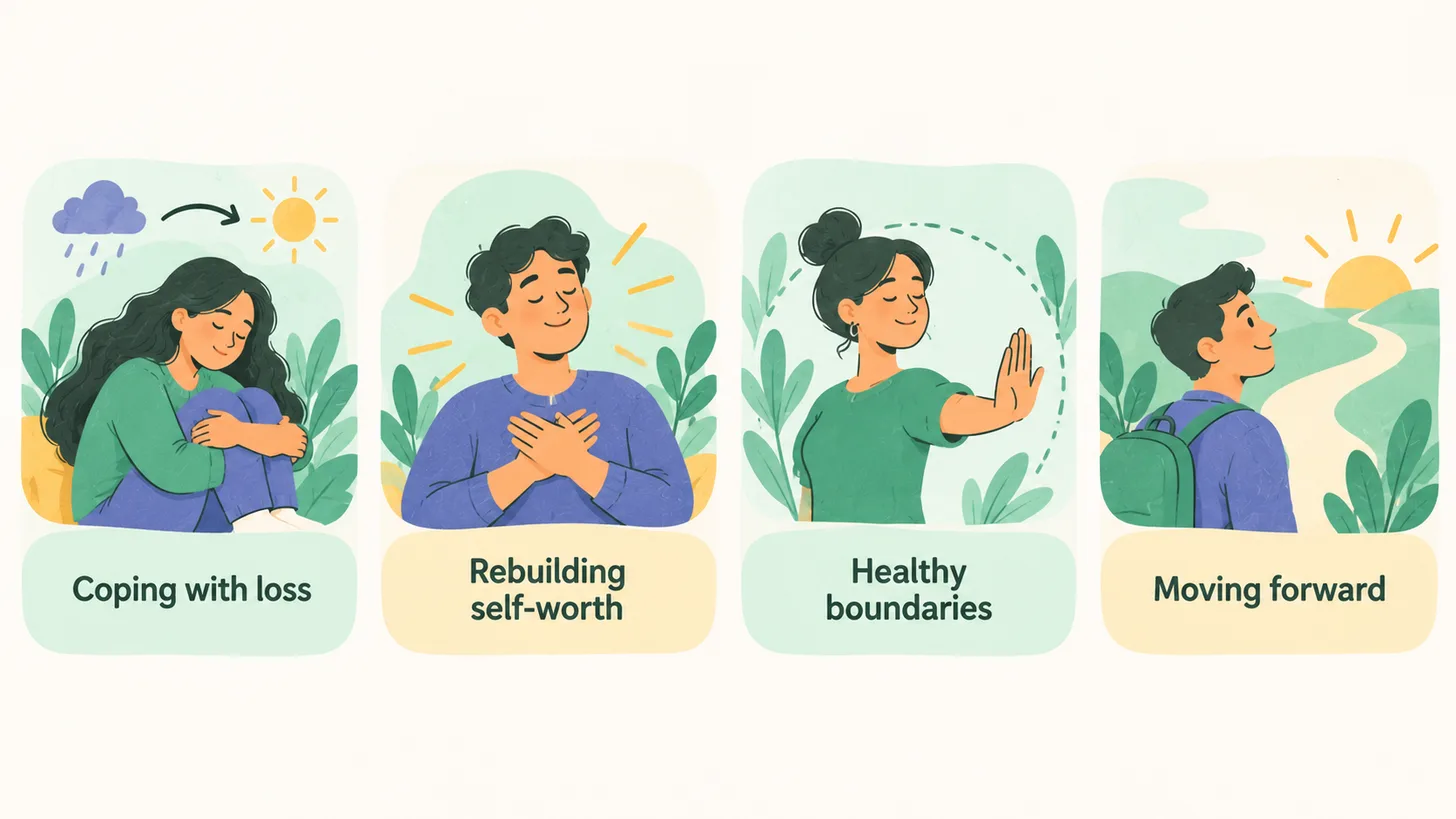
Across six to twelve sessions, counselling covers three things: the ending itself, the shape your mind takes when it loops, and what the next version of your life looks like with the ex at a smaller size inside it.
Nobody promises a timeline. The honest answer is that most readers feel the loop quieten in three to eight sessions, and some take longer.
In short: One hour, a counsellor, your breakup as the only topic. Methods behind it, your own sense in front of it.
How do you know when self-help is no longer enough?
If you had a short relationship, a clear ending, and a friend you can call at 2 am, you may not need therapy yet. You have probably already tried breathing and journaling. Self-help is the floor, not the ceiling, and knowing where you are on it is the question.
Self-help may be enough
- The relationship was short and the ending was clear
- You can still sleep most nights of the week
- You have one friend you trust with the full story
- You are not using alcohol or doomscrolling to get through
- Three weeks in, the loop is already quieter
Counselling earns its place
- Sleep is broken most nights for two weeks or more
- You cannot name what you feel most days
- You are drinking or scrolling late into the night
- One memory keeps returning on a tight loop
- Thoughts of hurting yourself have come, even in passing
Catch the thought
What thought is weighing on you right now? Write it down just as it sounds in your head.
Name the trap
Does your thought fall into one of these common patterns? Pick any that fit. This part is optional.
Look again
Use these as nudges, not rules. Then write one line back to yourself.
Your reframe
Thoughts are not facts. You just practised stepping back.
This stays on your device. Nothing is saved or sent.
Free national helplines are not a weaker version of counselling. They are a different tool. Tele-MANAS (14416, 24/7, 20 languages) and iCall (9152987821, Mon to Sat 8am to 8pm) will take a call for an hour and will not sell you anything.
Call them first if the day is loud. Book a counsellor when you want the same person every week.
In short: A counsellor is not better than a helpline. Self-help is not weaker than therapy. The question is which one you need this week.
Online or in-person: which fits your breakup?
Online counselling is not a lesser version of in-person therapy for most breakups. The method is the same. The therapist is the same tier. Research since 2020 shows similar outcomes for grief and relationship loss, and the real question is which fits your week.
Online counselling fits when
- Evenings are the only private time you have
- Your home is full and privacy is scarce
- You want a counsellor who speaks your home language
- You moved cities and your city has few options
- The breakup involves someone from your workplace
In-person counselling fits when
- You freeze in front of a screen and talk to a person better
- You need a room outside your home to feel the feelings
- Home is a trigger (shared with the ex or with family who disapprove)
- You want body-based or somatic work
- You have the clinic time and the travel budget
In short: Online wins on privacy, time and language fit. In-person wins when a room outside the house is itself the medicine.
Who you will talk to on GoodLives
The counsellors on GoodLives are psychologists registered with the Rehabilitation Council of India (RCI) or hold a master’s qualification in counselling or clinical psychology. They work in English, Hindi and more Indian languages, and your match prioritises language fit first.
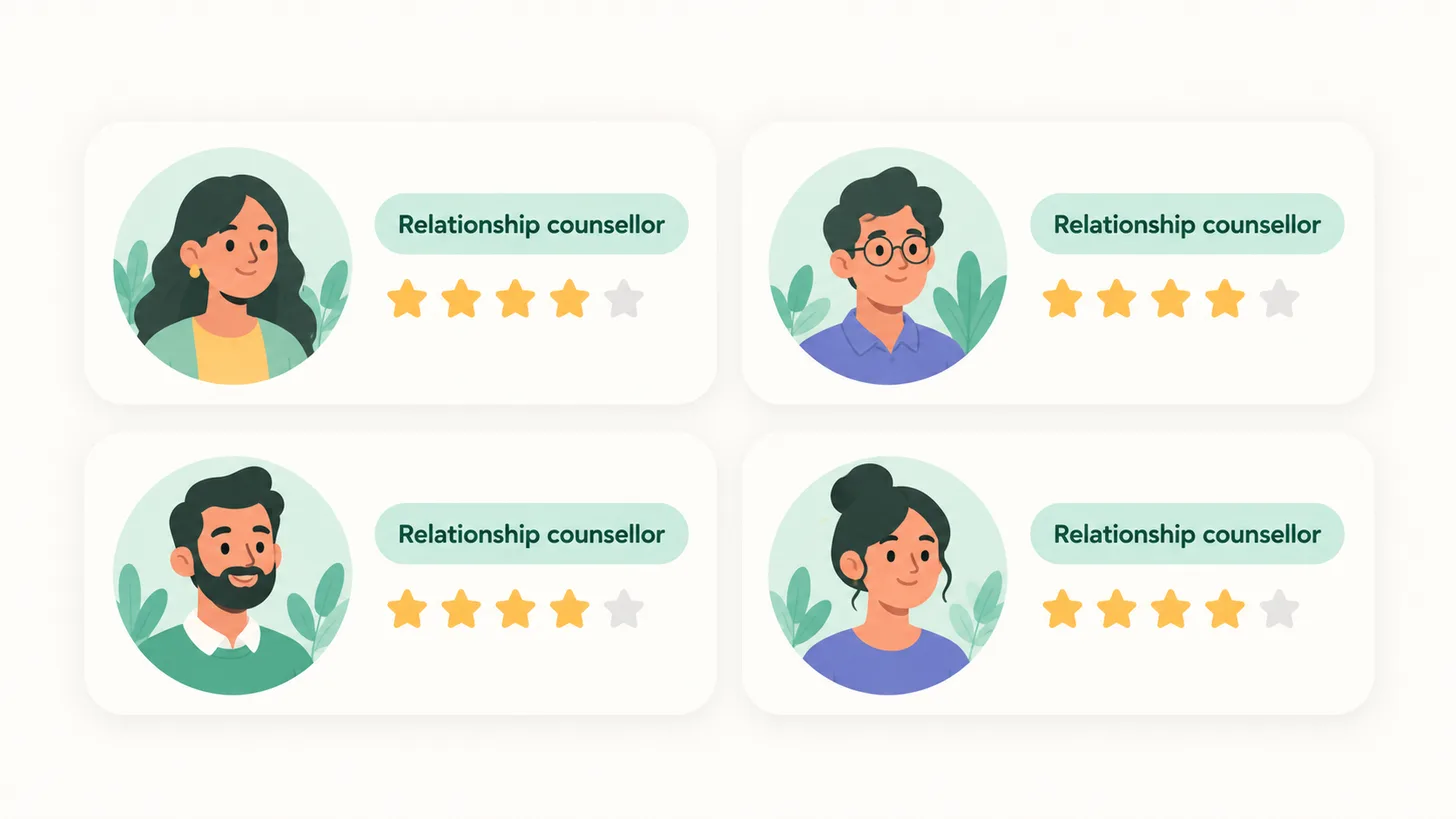
For a breakup, most readers end up with a counsellor who has worked with endings before. Unmarried couples. Long-term partners. People whose family said no. People who did the ending themselves and are not sure how to feel.
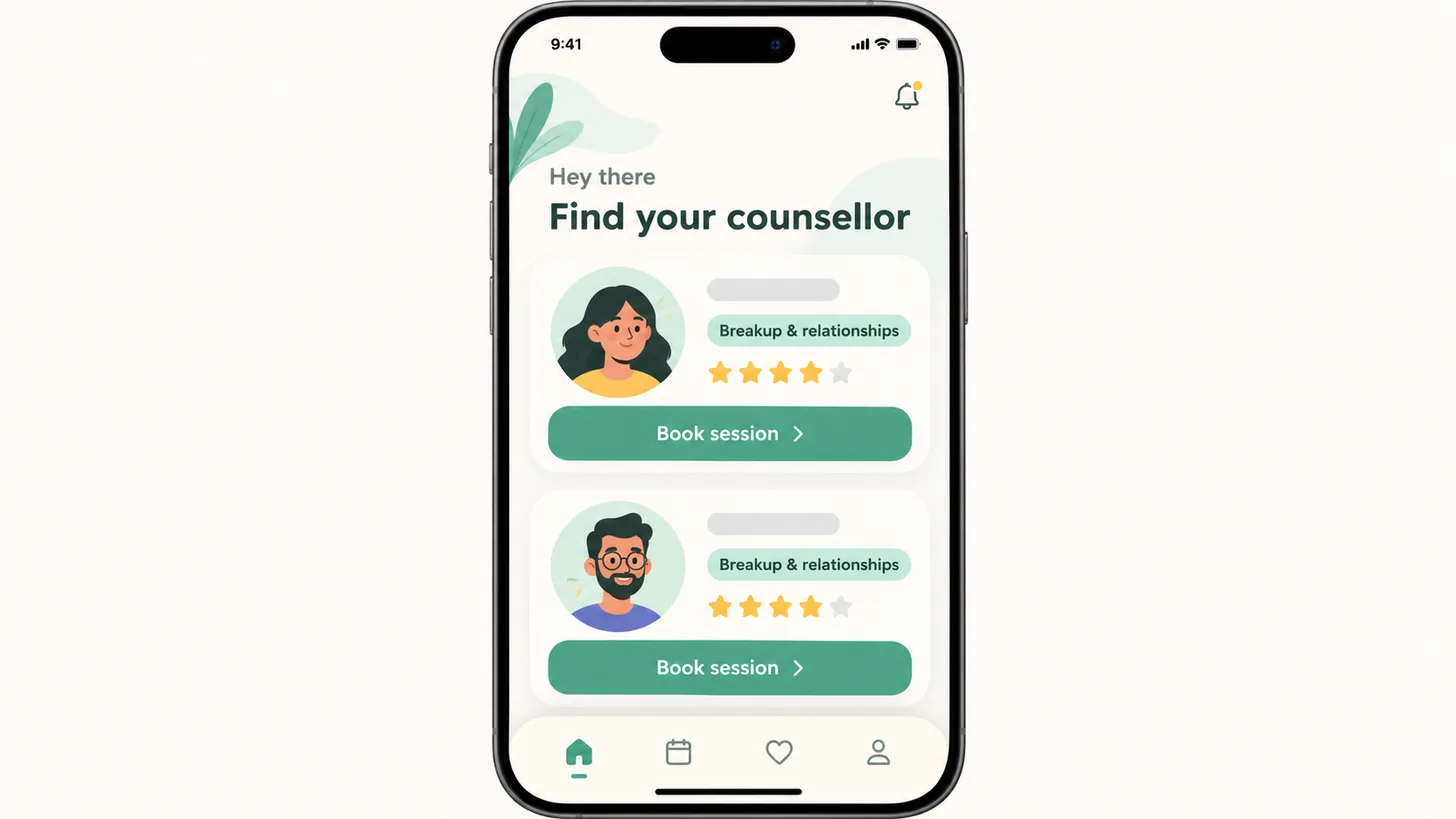
A good match asks about the shape of your relationship before asking what you want to do about it. You can read ten bios before you book one. There is no sign-up to browse, and no counsellor sees your profile until you choose.
“It was a pretty good session. The therapist was understanding and personal and it felt like talking to a friend.”
In short: You pick who talks to you. Language, experience with endings, and tone are the three filters worth using first.
What breakup counselling costs in India in 2026
Prices in India in 2026 sit in four honest bands, set by the counsellor’s training. The band matters because what a counsellor can do with you is shaped by what they trained for. Picking by price alone is how most readers end up switching therapists in month two.
In short: Pick a tier by what the ending did to you, not by what an ad promised. Start free if you must.
7 questions to ask on your first intake call
A 15-minute intake call is free on most Indian platforms, GoodLives included. Use it. The point is not to prove you are okay enough for therapy; it is to find out if this counsellor is one you can keep showing up to. Seven questions do that in a quarter of an hour.
In short: The intake call vets the counsellor, not you. Seven questions, fifteen minutes, no sign-up pressure.
How booking works, in three discreet steps
Booking a counsellor on GoodLives takes about ten minutes. Nobody at home sees the screen unless you show them. You can start, see how the first session feels, and stop at any point. A first session is not a commitment, and a short pause between sessions is fine too.
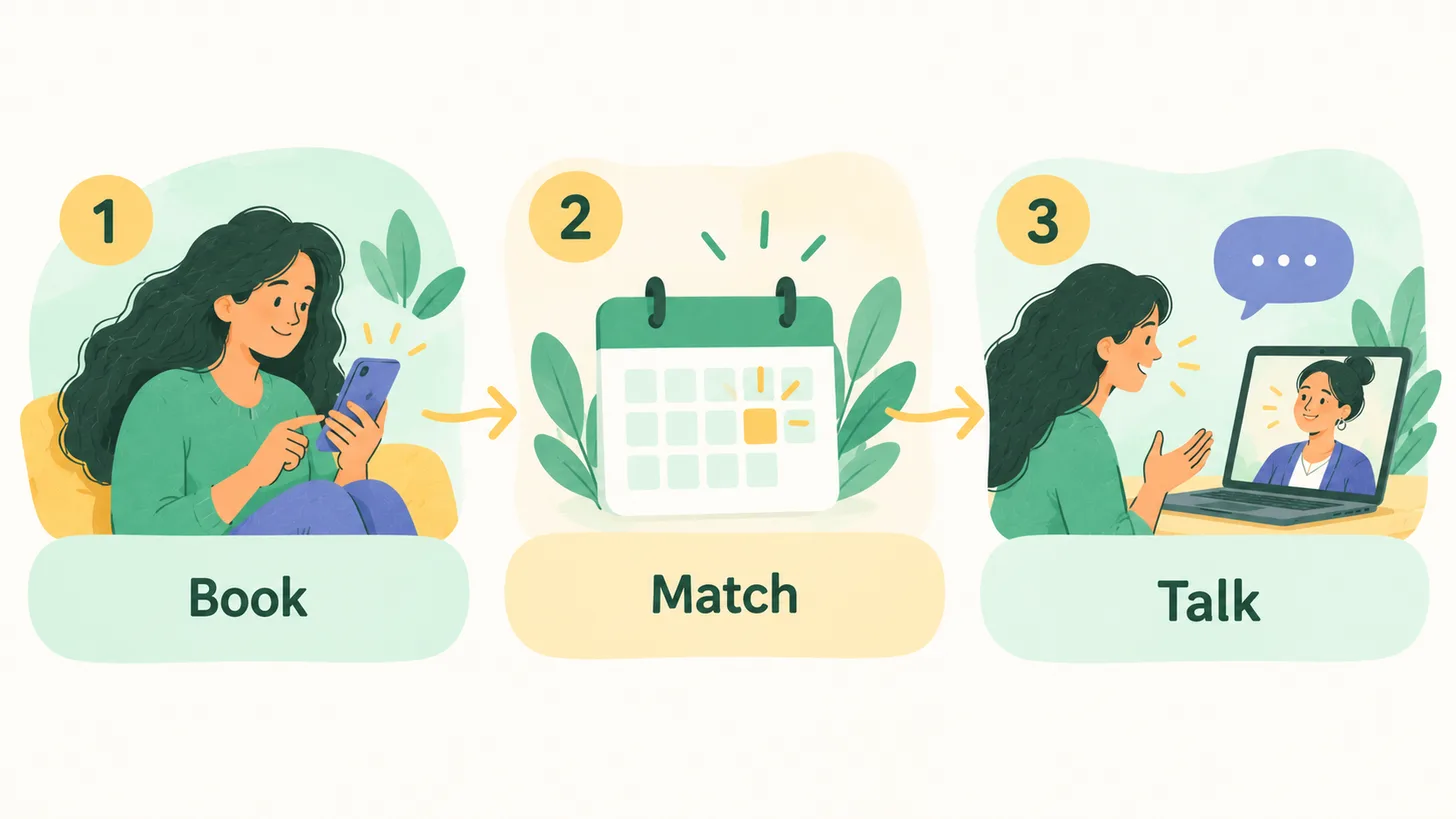
- Share one thing. Write one line on the matching page about the breakup and what you want from the hour. We suggest two counsellors who have worked with endings like it.
- Read before you pick. Open both bios. Read the languages, training and the one line each counsellor writes about how they work. Pick the one whose tone sounds like someone you could keep talking to.
- Book your session. Choose a slot that fits your evening. A secure link arrives ten minutes before. The counsellor opens the hour by asking how your week has been.
A page like this gives you a map. A counsellor walks it with you.
In short: Three steps. No public profile. No pressure to book the second one.
FAQ
Where can I find free online counselling in India?
Yes. Tele-MANAS (14416, 24/7, 20 languages, Government of India) and iCall (9152987821, Mon to Sat 8am to 8pm, run by TISS Mumbai) are free. Vandrevala Foundation (1860 266 2345) is open 24/7. All three take breakup calls.
What does breakup counselling cost in India in 2026?
Across Indian online therapy platforms, sessions sit between ₹400 and ₹3,500 depending on the counsellor’s training. Supervised sessions sit at the lower end, M.Phil clinical psychologists at the upper. See the price tier section above for how to pick.
How many sessions will I need to feel better after a breakup?
Most readers feel the loop quieten in three to eight sessions and finish in six to twelve. Nobody honest will promise a number. A good counsellor names a review point around session four, where you decide together whether to continue.
What is the 5-5-5 rule in couples therapy?
It is a conversation tool from couples work, not a breakup fix. Each partner speaks for 5 minutes while the other listens, then 5 minutes to respond, then 5 minutes to agree on one next step. It is a couples tool, not a solo one.
Is online therapy as helpful as in-person for a breakup?
For most breakups, yes. Research reviewed by the APA since 2020 shows similar outcomes for grief and relationship loss. In-person wins when privacy is impossible, when you freeze on a screen, or when the ending involves abuse.
Can I do breakup counselling without my family finding out?
Yes. You can book, pay and attend on your phone with headphones. Your session is confidential under the Mental Healthcare Act 2017. Pick a slot when the house is busy, use a locked door, and nobody has to know.
Who is the best relationship counsellor in Delhi?
We do not rank individuals. The best counsellor for you is the one whose tone you can keep showing up to. Use the 7-question script above, book free calls with two counsellors in Delhi, and choose on fit.
How to pick your first session
Reading a page like this is often the first move after a hard week. The second is a free intake call, which tells you more than any ad or review ever will. A counsellor who answers you in plain English, without rushing, is already most of what you need.
In short: Book when a counsellor’s tone feels safe to you, not when the headline convinces you.


Share your thoughts