

What this blog includes
- The honest phobia meaning, in one line
- How fear becomes a phobia
- The main types of phobia, with Indian examples
- What CBT and the fear-ladder plan look like
- A short A to Z of rarer phobias
If you have quietly rerouted your life around one fear, you are not being dramatic. Many of us have. GoodLives is trusted by 500K+ people. We write for the reader who Googled this twice tonight. You are not alone. By the end of this page, you will have the plain phobia meaning.
Phobia meaning: what is a phobia, really?
A phobia is a strong fear. It fires at full force to a trigger that is safe. The plain phobia meaning: a fear that has outgrown its reason. Fear is the alarm your body uses to keep you safe. A phobia is the same alarm, stuck on.
The NHS calls a phobia “an anxiety condition usually caused by a particular object or situation” (NHS: Phobias overview). Doctors ask three things. Is the fear far bigger than the real risk? Do you avoid the trigger, or sit through it in distress? Has this gone on for six months? If yes, you have a phobia. Not a quirk.
In short: a phobia is a learned, over-sized fear of one thing. Learned patterns can be unlearned.
Fear or phobia: when does normal fear stop being normal?
Fear belongs in the body. It helps you jump back from a scooter in a Mumbai gully. A phobia takes that same wiring and points it at a safe thing. Picture Priya in Gurgaon. She is 26. She has not taken a lift in two years.

The lift is not the issue. Her body telling her the lift is a trap, is.
Three signs that fear has slipped into phobia territory:
- You rearrange your day to avoid the trigger, more than once a week.
- Your body reacts before your mind catches up: racing heart, dry mouth, that ghabrahat in the chest.
- Thinking about the trigger ruins the hour before you meet it.
In short: fear keeps you safe from real danger. A phobia costs you time, sleep, and the thing on the other side of it.
What are the main types of phobia?
Doctors group phobias by what sets them off. The therapy plan looks similar within a group, which makes this map useful. The DSM-5 lists five types of phobia. Two related anxiety conditions sit next to them. Pick the one that fits what you avoid most often.
- Animal phobias. Dogs, cats, lizards, snakes, pigeons. Common in Indian cities.
- Natural environment phobias. Heights, water, storms, the dark. This includes acrophobia (fear of heights) and thalassophobia (fear of deep water).
- Situational phobias. Enclosed spaces, flying, driving, bridges, lifts, the Mumbai local at 9 a.m. Claustrophobia lives here.
- Blood injection injury phobias. Needles, blood draws, dentist chairs. People sometimes faint, because the body’s response is a bit different.
- Other specific phobias. Vomiting, choking, loud sounds, germs (mysophobia).
Two anxiety conditions that are not specific phobias, but often sit beside them:
- Social anxiety disorder. Fear of being watched or judged in social and performance settings.
- Agoraphobia. Fear of settings where escape or help feels hard. The National Mental Health Survey of India 2015 to 2016 found agoraphobia to be the most common anxiety disorder in the country, at 1.6% of adults (Indian Journal of Psychiatry, NMHS analysis).
In short: types of phobia map to triggers, not personalities. The treatment that works for one often works for the others.
How does a phobia show up in your body?
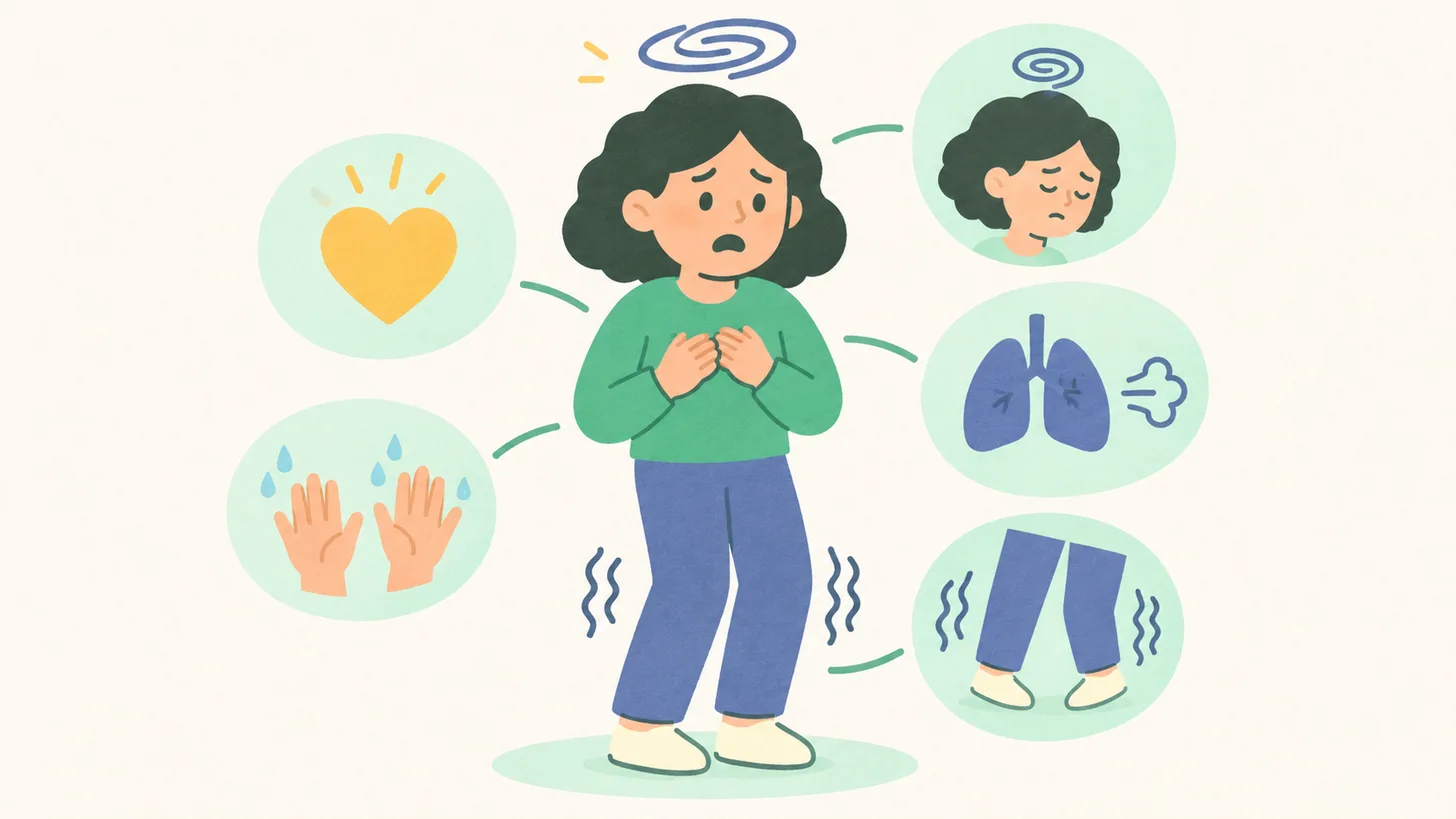
A phobia is loud in the body before it is loud in your head. The moment you spot the trigger, your body swings into fight or flight. The signs show up in seconds. Most are physical. You might feel like something is wrong with your heart. Nothing is. It is a false alarm.

Common signs:
- A sudden pounding heart, often before you notice the trigger.
- Short, shallow breathing. A dry mouth. Cold or sweaty hands.
- A knot in the stomach, nausea, needing the bathroom.
- A loud mental loop: “I need to leave, I need to leave.”
Many readers describe one more thing: shame. The fear feels silly. It is not. Your brain learned to flinch. Without asking you first.
In short: a phobia reaction is a false alarm with real body signs. The signs are honest. The risk is not.
In the next ten minutes: what helps right now
A phobia reaction lasts about ten minutes. The goal is not to fix the fear. The goal is to help you ride out the next ten minutes without feeding it. Two tools do most of the work tonight. One is slow breath. The other is grounding.
A long out-breath tells your body the danger has passed. Four counts in. Six counts out. One minute. If you want, try grounding first.
Grounding will not fix what set the fear off. It helps you ride out the next ten minutes while your heart rate drops. A therapist walks you up a fear ladder over weeks. If what you need tonight is sleep, that is a fair answer.
In short: in the next ten minutes, slow your out-breath and name five things in the room.
How does therapy treat phobias?
Phobias respond to therapy faster than most anxiety conditions. Two methods do the heavy work, together. One works on the body. The other works on the thought that keeps the fear alive. Four to ten sessions is a common course.
Exposure therapy has the strongest evidence for a specific phobia. It walks you up a fear ladder, step by step. Your body learns the trigger is safe through practice. HelpGuide notes this therapy “has a great track record,” with results sometimes visible in “as little as one to four sessions” (HelpGuide: Phobias and Irrational Fears).
Cognitive behavioural therapy (CBT) is the broader frame your counsellor uses with it. CBT teaches you to spot the thought (“the lift will get stuck”) and reframe it with evidence. The two methods travel together. Many Indian therapists call this a step-ladder plan.
A plan runs four to ten weeks. It takes longer when the phobia sits with trauma, panic or OCD. Some therapists use virtual reality in the first few sessions. All of it is agreed with you.
In short: the ladder teaches your body. CBT names the thinking trap. Together they are the first-line treatment.
When should you see a therapist for a phobia?
Not every phobia needs therapy. If your fear of pigeons stays on the balcony, you can live well with it. The honest answer is this: a phobia becomes a therapy question when the fear takes up more space in your week than the trigger does in real life.
See a therapist when any of these is true:
- You have changed jobs, routes, or holidays to avoid the trigger.
- You have had a panic attack in the last six months.
- You lose sleep the night before you expect to meet it.
- The avoidance is spreading, as when lifts turn into stairs turn into no high-rises at all.
- You are starting to drink, oversleep or scroll to blunt the dread.
You might be worried that pills are the first offer. They are not. For severe phobias with panic attacks, a psychiatrist may add short-term medicine. Talk therapy is first-line. A safe start is to find a Rehabilitation Council of India (RCI) registered therapist (Rehabilitation Council of India). You can also try online therapy for anxiety.
In short: a phobia becomes a therapy question the moment your calendar bends around it.
A short A to Z of rarer phobias
Phobias make strange-sounding words. Here is a list of rare phobias people often type after they stop laughing at the name. Each one is real. Each one responds to the same treatment that works for the common ones. Browse by trigger.
- Agoraphobia: fear of settings where escape feels hard.
- Astraphobia: fear of thunderstorms. Loud in monsoon months.
- Atelophobia: the fear of imperfection.
- Automatonophobia: fear of human-like figures, like mannequins and dolls.
- Emetophobia: fear of vomiting, in yourself or others.
- Ergophobia: fear of work, often tied to burnout, not laziness.
- Nomophobia: fear of being without your phone or signal.
- Nyctophobia: fear of the dark.
- Trypanophobia: fear of injections and needles.
- Thanatophobia: fear of death or dying.
If a name is not on this list, your psychologist will treat it the same way. Name it, map it, walk you up the ladder.
In short: the Greek word is not the problem. Avoidance is.
FAQ
What is the true meaning of phobia?
What are the 20 types of phobias?
Is phobia a mental disease?
What causes phobia?
Can phobias be cured completely?
How many therapy sessions does a phobia take?
Are pills needed for a phobia?
This post is for information only and is not a substitute for professional care. If you are struggling, please speak to a qualified mental health professional.



Share your thoughts