
If you Googled atelophobia at midnight, you probably know the feeling. The deck is ready, but you cannot press send. A kind word from your manager slides off. One line of feedback stays for weeks.
What you are feeling has a name, and plenty of us have been there. On GoodLives, trusted by 500K+ people, this is one of the quieter patterns we see every week.

What does atelophobia actually mean?
Atelophobia is a strong fear of being imperfect or not good enough. You will not find it in the DSM-5 or the ICD-11. In India, a therapist will treat it as perfectionism tied up with anxiety. That is where the care comes from.
The word is popular online because it names a feeling people had, but could not spell. In a therapy room, you will rarely hear “you have atelophobia.” You will hear “we are looking at perfectionism, with anxious thoughts around failure.” Both say the same thing.
The American Psychological Association has a plain note on perfectionism and its link to anxiety on its perfectionism topic page. The word gives shape to a known fear. The care is for the pattern under it.
In short: a Greek label is useful, but the help is for perfectionism and anxiety.
What is atelophobia meaning in Hindi?
In Hindi, atelophobia maps most closely to अपूर्णता का भय (apoornta ka bhay), the fear of being lacking or incomplete. People also describe it in everyday phrases like “kuch kam reh jaane ka darr” and “kafi acha na hone ka darr.” A quieter word many of us carry is adhoora (incomplete).
If you grew up in a house where praise was conditional on marks, the feeling is older than any English name for it. Approval arrived after achievement. The body learned to brace against anything less than best.
The Hindi phrasing often lands closer to home. That is why so many people search in both languages.
In short: no one Hindi word says it all, which is why both languages carry pieces of the feeling.
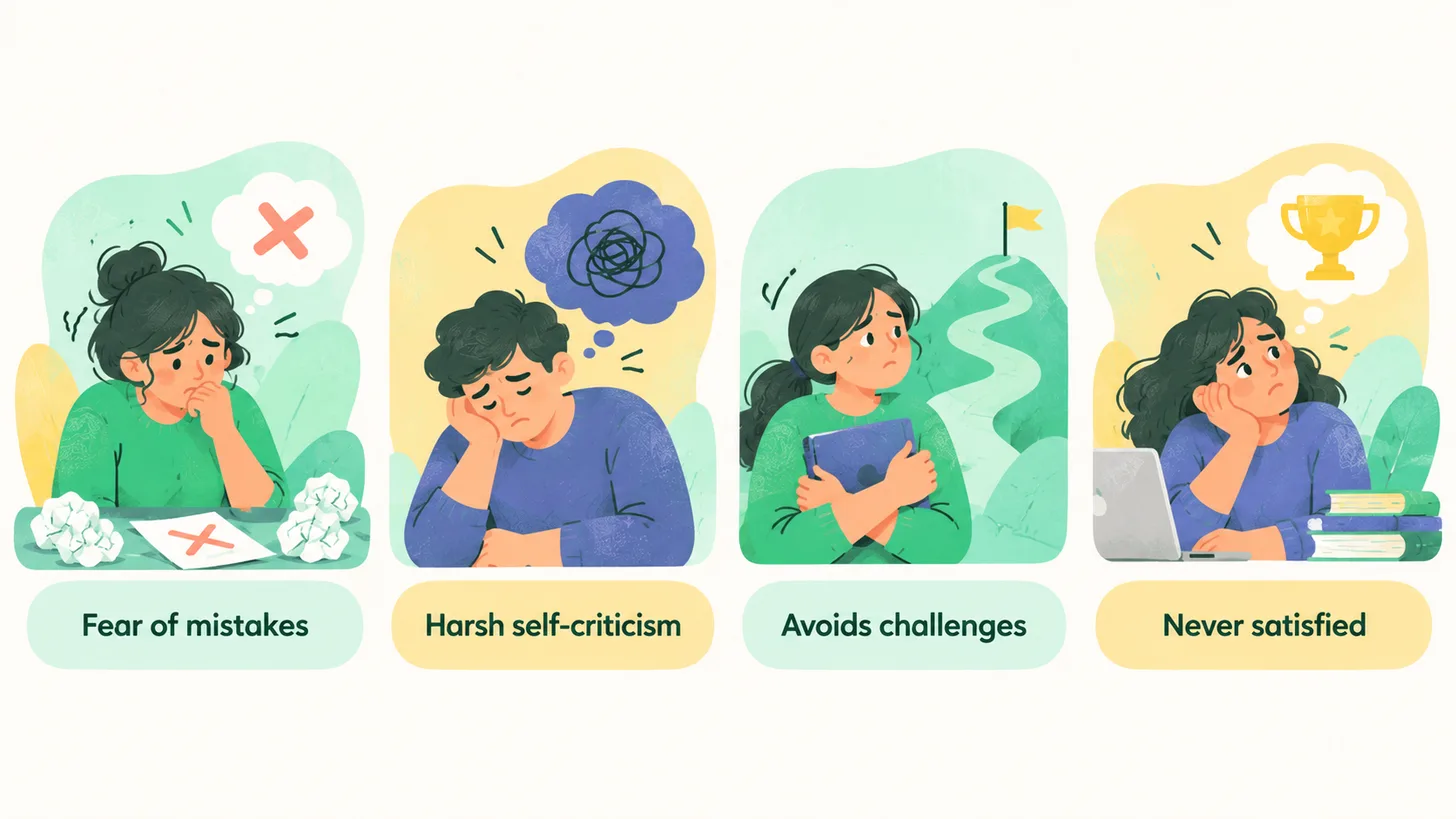
What does the fear of imperfection feel like day to day?
The fear of imperfection often looks like silence. A deck saved in Drafts for three weeks. A message you typed and deleted. A photo you did not post because the light was off. The pain sits in the gap between what is and what should be.
Here are the signs therapists hear often from readers like you.
- You start early, finish late, and still miss deadlines
- One typo in a mail stays in your head till Sunday
- Praise slides off; feedback stays for weeks
- You do not share wins in case the next one is smaller
- You post less than you want, because the inner version is sharper
- You rewrite WhatsApp messages before you send them
In short: the pattern is less about the work and more about what being imperfect would mean about you.
Why do so many Indian readers carry this from school into work?
Most readers I speak to trace this fear back to one line. It is usually some version of “beta, 99.5% kyun nahi?” (why not 99.5%?). Praise was tied to marks early on. The body learned to brace against anything less than top. The pattern then rides into adult life.
Three forces tend to show up together in India.
- The sharma-ji ka beta culture. Comparison is the air, achievement is the ticket.
- Academic ranking as identity. Cut-offs and board scores became personal scores.
- The curated feed. Instagram and LinkedIn add a daily reminder that other people’s lives look edited.
None of this is your fault, and none of it is harmless.
The National Mental Health Survey from NIMHANS (2015 to 2016) found that nearly one in ten adults in India has a current mental health condition (NMHS summary report). Anxiety-related patterns are among the most common. Perfectionism is not an illness, but it sits next door.
In short: this fear is grown, not inherited. The soil was watered long before you noticed.
How is this different from perfectionism, OCD, or fear of failure?
A lot of readers ask whether this is the same as perfectionism, imposter syndrome, or just anxious high standards. The three overlap, but they are not the same thing. The help is a bit different for each. Naming the right one matters more than naming it with a Greek word.
Perfectionism is a trait
- A strong pull toward high standards
- Can be adaptive when stakes are real
- Becomes a problem when self-worth rides on it
Atelophobia leans on the fear side
- Avoidance of anything that might be flawed
- Procrastination from fear, not laziness
- Shame when standards are not met
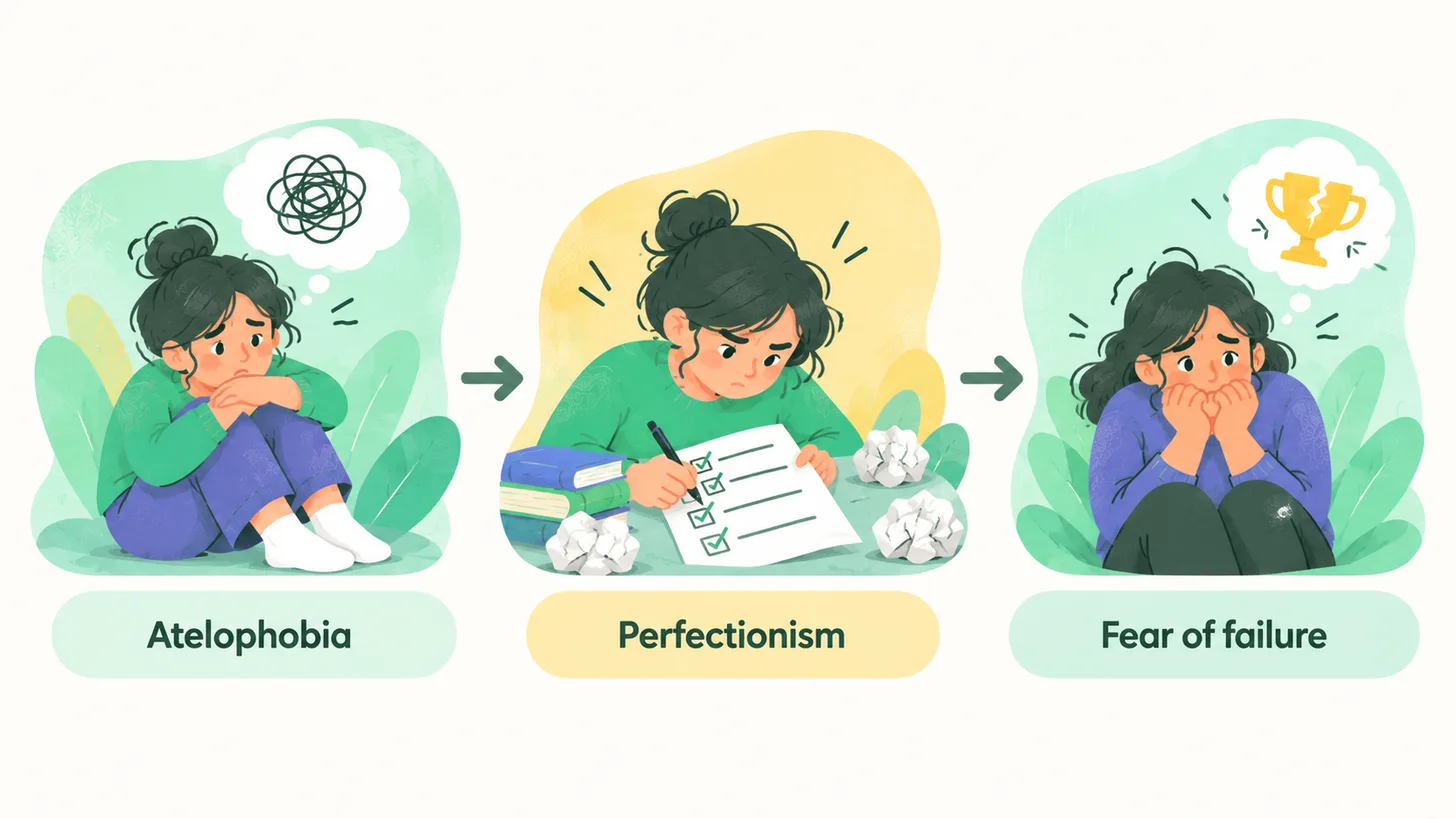
In short: perfectionism is “I want it right.” This fear is “I am afraid of what it means if it is not.”
What helps: therapy and behavioural experiments
The goal here is not sloppy work. It is excellence that does not cost you your peace. A good therapist will not ask you to care less. They will help you separate the standard from the self. That is quiet work, done in small steps.
Here is how care usually looks in India.
- Individual CBT. You map thinking traps with your therapist, and learn to catch a thought before it catches you.
- Behavioural experiments. You share a less-curated post. You send a mail with a typo. You test if the sky falls. It does not.
- Mindfulness and body work. You practise sitting with “good enough” without rushing to fix it.
Behavioural experiments feel strange at first. Most of us have never been given permission to be visibly imperfect. The experiments stay small. One post. One email. One Monday meeting.
A quick reframe can help you spot the thought before it runs. This takes two minutes.
Catch the thought
What thought is weighing on you right now? Write it down just as it sounds in your head.
Name the trap
Does your thought fall into one of these common patterns? Pick any that fit. This part is optional.
Look again
Use these as nudges, not rules. Then write one line back to yourself.
Your reframe
Thoughts are not facts. You just practised stepping back.
This stays on your device. Nothing is saved or sent.
Journaling can help you spot the loop. A therapist can help you break it. The honest answer is that some weeks the experiments work, and some weeks they do not. That is normal, not failure. A reframe will not fix the deep belief in one go. It softens the grip, bit by bit.

In short: this kind of care is not about caring less. It is about caring well.
When should you see a therapist (or a child psychologist)?
Not every perfectionist pattern needs therapy. Some of this is a season you walk through, with sleep, one honest conversation, and a few deliberate experiments. You do not have to be in crisis to see a therapist. It is okay to try the self-help first.
Some signs it may be time to speak to someone:
- The fear is leaking into your sleep, appetite, or relationships
- You cannot finish or submit things that matter to you
- Shame after small mistakes lasts for days
- You cannot celebrate your wins
If the pattern is showing up in your child, speak to a child psychologist, not an adult one.
Signs in a child include hidden homework, torn drafts, and meltdowns after a bad test. Early perfectionism is tender work. The methods are play-based, not adult therapy with smaller words.
For a wider map, our hub piece on phobias and their connection to psychology is a good next read. Online therapy for anxiety is the right first step for most adults.
In short: the help is real, and it starts with naming the problem well.
FAQ
Is atelophobia a real mental health condition?
It is a real feeling, but not a listed diagnosis. You will not find it in the DSM-5 or the ICD-11. Therapists treat it as part of perfectionism and anxiety patterns. The word is useful. The care uses other names.
What is atelophobia meaning in Hindi?
It maps most closely to अपूर्णता का भय (apoornta ka bhay), the fear of being incomplete or lacking. People also describe it as “kuch kam reh jaane ka darr” or “kafi acha na hone ka darr.” The word adhoora often sits in the background.
What causes this fear of imperfection?
There is no single cause. Research links it to conditional praise in childhood, high-pressure academic settings, social comparison, and anxious temperament. In India, exam culture and family expectations are often part of it, though neither is destiny.
Is this the same as OCD?
No. OCD has unwanted intrusive thoughts and rituals a person feels compelled to do. This fear is about avoidance and shame. The two can overlap, which is why a proper assessment matters before you settle on either word.
How is this treated in India?
Therapists use CBT to spot and reframe thinking traps, behavioural experiments to test “good enough” in real life, and mindfulness to sit with discomfort. There is no quick fix, but many people see a shift inside a few months of regular sessions.
Can children have this pattern?
Yes. In India, early signs show up around board exams and entrance tests: hidden drafts, inability to show work, meltdowns after small mistakes. A child psychologist uses play-based, age-appropriate techniques. Adult therapy models are not a good fit.
Can I work on this on my own?
You can start on your own. Journaling, “imperfect” experiments, and daily mindfulness help many readers. If the pattern is leaking into sleep, work, or relationships, a therapist adds a second mind that notices what you do not.




Share your thoughts