
This blog explains the physiology behind it, when it is normal and when it is a signal to pay attention, and the realistic, India-grounded moves that actually help, from Friday afternoon loop-closing to a human Monday morning.
What this blog includes
- What the Sunday scaries actually are, and what they are not
- Why your body braces on a Sunday evening, in plain language
- Normal Sunday dread vs a signal that something’s wrong vs clinical anxiety
- The India picture: 6-day weeks, metro commutes, and joint-family Sundays
- A realistic list of what helps, including a 60-second calming exercise you can try now
- When Sunday evenings have been bad for months and the issue is bigger than Sunday
If you have been dreading Monday from the moment the Sunday sun starts going down, you are not being soft. You are not alone either. Most working people in India feel some version of this.
The question worth asking is whether this Sunday is a passing one or whether every Sunday has started to feel like this. That is the honest question this blog will help you sit with.
GoodLives is India’s most trusted online therapy and counselling platform, trusted by 500K+ people, and we see this exact pattern in intake conversations almost every week.
A quick note before we start. The Sunday scaries are not a formal diagnosis. The patterns below are drawn from how anxiety behaves and from what the WHO calls anticipatory anxiety in its broader anxiety-disorders fact sheet, written in plain language.
If what you are feeling has stopped being a Sunday problem and has become an everyday one, the right next step is a conversation with a therapist, not another article.
What the Sunday scaries actually are
The Sunday scaries are a specific flavour of anticipatory anxiety. Anticipatory anxiety is the body’s stress response firing not for what is happening, but for what you think is about to happen. On a Sunday evening, the thing about to happen is Monday, and the body does not always wait for Monday to react to it.
A LinkedIn News India poll in 2024 found that about 80% of Indian professionals report some form of Sunday anxiety, with the knot starting as early as Sunday afternoon for many. That number is informal, but it matches what therapists see across intake forms week after week.
If you feel this, the issue is not you being unusually fragile. The issue is that the modern Indian work week is designed to make Sundays small.
What the Sunday scaries are not. They are not a sign that you hate your job (sometimes they are, often they are not). They are not a sign that you are weak. And they are not, on their own, a clinical anxiety disorder.
They become one when the pattern spreads to other days, when it does not lift after Monday morning, and when it starts to shape your choices.
In short: the Sunday scaries are your body’s trailer for Monday. It is a real response. It is also, for most people, a response you can change the shape of.
Why your body braces on a Sunday evening
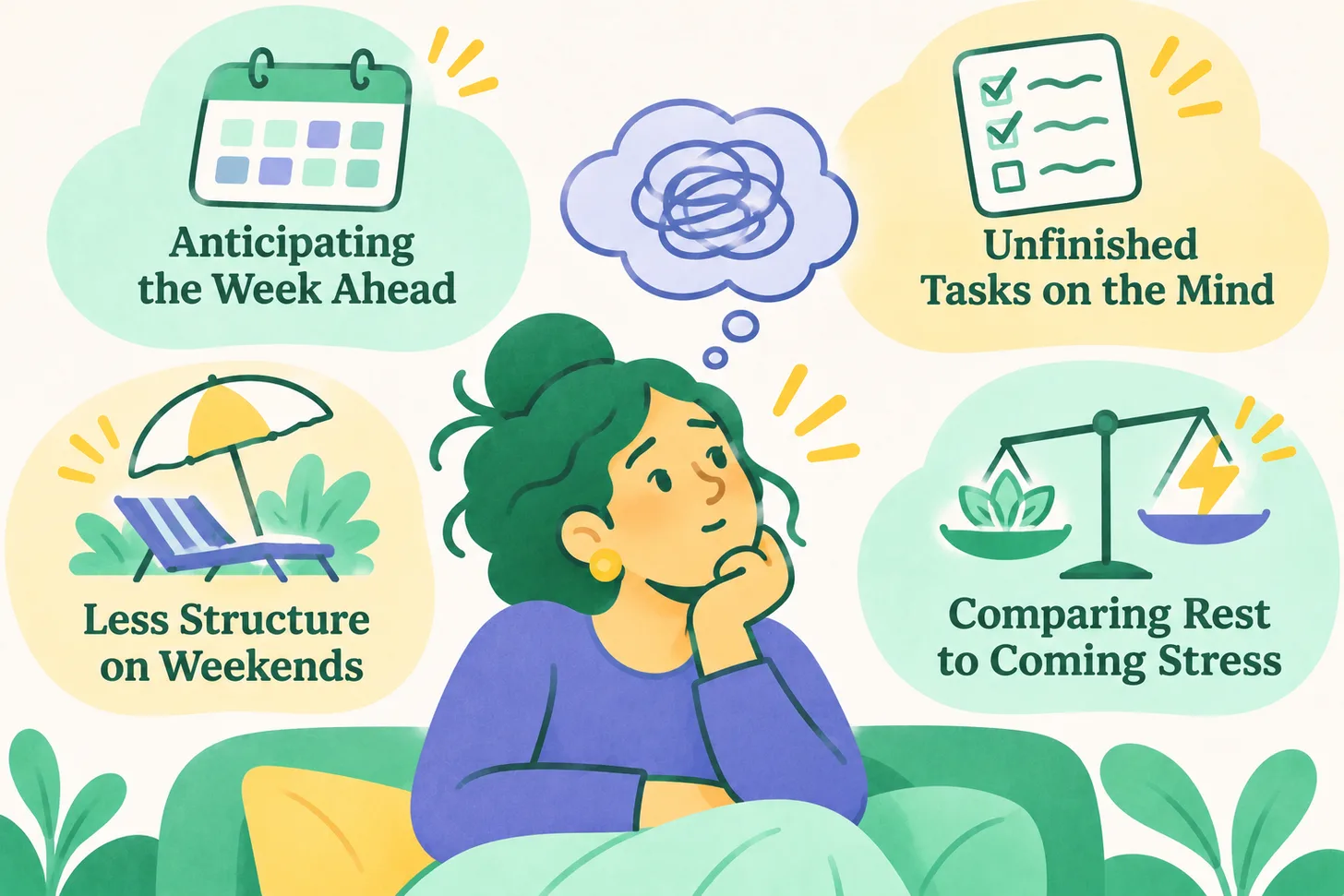
Four things happen on a Sunday evening, often together, that most people never name.
1. The end of agency. For two days, your time has mostly belonged to you. You chose when to eat, when to walk, when to be with people, when to be alone. From Monday morning onwards, your calendar belongs to other people. The nervous system notices this shift the way it notices the sun going down.
2. An anticipatory cortisol spike. Cortisol, the body’s main stress hormone, rises in anticipation of a known demand, not only during one. Even thinking about Monday morning in a quiet way is enough to lift it. If Monday morning has been hard for weeks, the body learns the pattern and brings the spike forward.
3. Rumination on uncompleted tasks. The things you did not finish on Friday do not actually get louder on Sunday. Your defences get thinner. The mail you did not reply to, the deck you half-made, the one honest conversation you kept avoiding, all of it has room to come forward in a way it does not during a busy weekday.
4. Identity mismatch. The person you are at home on a Sunday afternoon, in old clothes, half-watching something, is not the person you are expected to be at 10 am on Monday. For a few hours on Sunday evening, both exist at the same time. That gap can feel physical, in the chest or the stomach, before you have words for it.
Add bad sleep, a bad commute, an unresolved conversation with a manager, or a difficult weekend at home, and the brace is louder. None of this is in your head in the dismissive sense. All of it is in your head in the honest sense, which is that your head and your body are the same system.
Is this normal Sunday dread, a signal, or something clinical
A useful rule of thumb, written down for the first time by many of our therapists in conversations with first-time clients.
Normal. A low hum of “I’d rather it was still Saturday” on Sunday evening. It does not ruin your Sunday. It does not touch your Saturday. By Monday mid-morning, you are mostly in the day. Most working adults experience this across most of their lives.
A signal. The dread has started eating into Saturday. You cannot enjoy Sunday evening even if the day was good. Your sleep on Sunday night is worse than other nights. You have started drinking more on Sunday evenings to take the edge off. You have had at least one small panic surge thinking about Monday. This is not a diagnosis. It is your mind telling you something is building.
Clinical. The Sunday pattern has become an any-day pattern. You dread work most mornings, not just Monday. You have had full panic attacks that are not clearly tied to one event. Sleep is bad four or more nights a week. There are days you cannot make yourself get on the Metro, into the auto, or into the lift at your building. If the thought of Monday is bringing up thoughts of ending your life, that is not Sunday scaries.
The honest line we tell most clients: a Sunday is one data point. A string of six months of Sundays is a trend, and trends deserve help.
The India picture: 6-day weeks, metros, and Sundays that are not off days
Most Sunday scaries writing in English comes from a US or UK work culture. The Indian version has its own weight that is worth naming, because the fixes have to fit the week you actually have.
The 6-day work week. A good share of Indian employers still run a 6-day week, officially or through unofficial Saturday work. If Sunday is the only off day in your week, the drop is sharper. The weekend you are supposed to recover in is a single afternoon that includes groceries, laundry, family calls and some version of rest. The brace on Sunday evening then has very little to push back against.
Metro commutes. For a Mumbai local commuter, a Delhi Metro commuter from the far suburbs, or a Bengaluru professional living an hour from the office, a chunk of Sunday’s dread is honestly about Monday’s commute, not Monday’s work. The commute itself is a sensory event. Your body remembers it. Naming the commute as its own stressor, separate from the work, helps you figure out which part to change.
Joint-family Sundays. Sunday is often a family day. Depending on your family, this can be the thing that rescues the weekend or the thing that uses it up. A Sunday lunch with eight people, a child in your lap, three parallel conversations, and a well-meaning aunt asking about marriage or salary, is a full event, not a rest. If your Sunday ends with you more tired than when it started, your Sunday scaries have less space to resolve.
Hustle-culture language. The “grind never stops” and “Sundays are for planning the week” school of advice can quietly worsen Sunday evenings. If your feed on Sunday night is full of founders talking about their 5 am Monday starts, your body picks that up as pressure. One honest unfollow or a timed social-media break on Sunday evening is a small, real move.
What actually helps on a Sunday evening
Not seven tips. Four moves that work together, picked because therapists see them work with real Indian professionals.
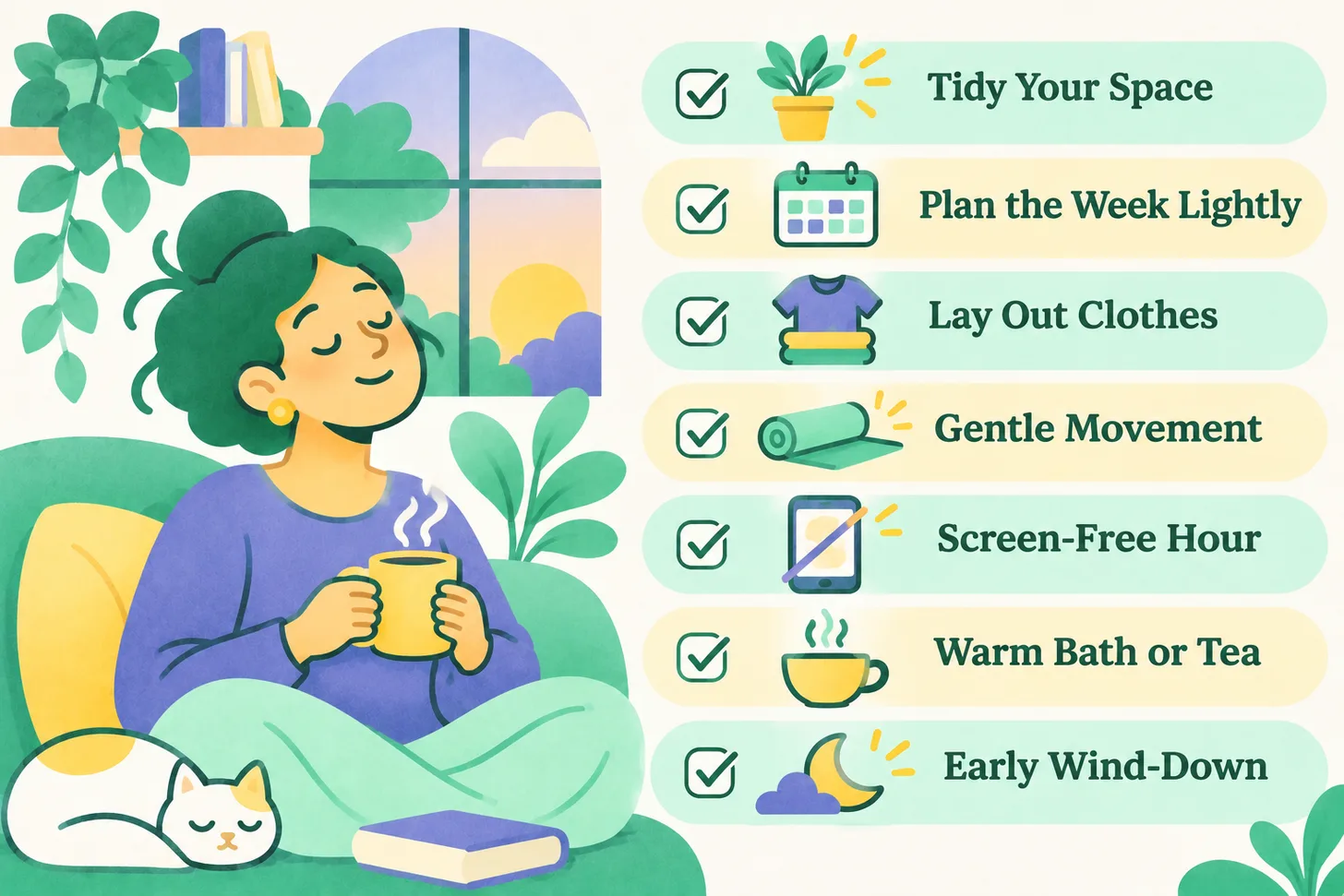
Close your Friday honestly. On Friday afternoon, before you log off, write three lines on paper or in your notes app: the three things you must do first on Monday, one person you need to reply to, and one open loop that will nag you if you leave it. The point is not productivity. The point is that your Sunday-evening brain has nothing new to tell you about Monday. The brain only ruminates about open loops it has not seen clearly.
Pick a physical anchor for Sunday evening. The strongest single move. A 30-minute walk after dinner. Cooking something slow. Listening to one full album, with the phone face down. A movie with the lights off and no second screen. The nervous system settles with a body-first signal, not a mental-first one. Scrolling is not an anchor; it is a dissociation.
Try this one if the knot is loud right now.
A moment to breathe
Follow the circle. Breathe in, hold, breathe out, then hold. Four counts each. Stay as long as you like.
Protect Sunday evening from work. No work email after Friday 7 pm, if your employer allows it. If not, a Sunday-evening hour that is phone-free. Not the whole day; one hour is enough to show the body that there is a line. If your employer actively messages on Sunday evenings and you cannot say no, that is a workload conversation, not a willpower problem.
Make Monday morning human. Set your Monday alarm 20 minutes earlier than you need. Use those 20 minutes for a slow coffee, a short walk, or silence. The first email check should not be in bed. The body learns that Monday starts with something kind, not with a sprint.
If every Sunday has been terrible for six months, the issue is the week, not the Sunday
This is the sentence we end up saying in therapy more often than any other, in some version. If a bad Sunday is a one-off, the fixes above usually settle it. If every Sunday for half a year has been full of dread, the Sunday is not the problem. Your Monday to Friday is.
Three honest questions worth sitting with.
Is it this job, or is it work in general? If the dread is specifically about this manager, this role, this team, this commute, that is a signal about your current job. If the dread would follow you to a different company, that is a signal about work-life balance, pace or your relationship with work itself.
Is it workload or is it meaning? Some Sunday dread is about volume: too much to do, not enough hours. Other Sunday dread is about meaning: enough hours, work that no longer feels like it matters. The fixes are different.
What would have to be true for Sunday evening to feel okay in six months? Writing the answer honestly often tells you what the next real move is, from an honest work-stress conversation to a role change, to therapy, to a job change you have been putting off.
In short: the Sunday scaries are often a messenger. The question is whether you are listening to the message or arguing with the messenger.
When to talk to a therapist
A short list, honestly.
- Sunday dread has started arriving on Saturday or earlier in the week
- You have had at least two panic surges tied to work in the last month
- Your sleep on Sunday night is reliably broken
- You are using alcohol, weed, late-night scrolling, or long gaming hours to blunt Sunday evening
- You have thought about not showing up to work on Monday, more than once
- You are a manager and the Sunday dread has started to shape how you treat your team
- You have taken this burnout self-check or an anxiety self-check and the score was higher than you expected
One or two of these on a hard month is normal human weather. Three or more, carrying across months, is worth a conversation. A therapist does not need you to have a clean story to help; often the first thing good therapy does is give you a cleaner story to work with.
This post is for information only and is not a substitute for professional care.



Share your thoughts