
You do not need to be in a crisis to call.
What this blog includes
- A 10-question anxiety self check adapted from the GAD-7, the screener clinicians use
- A simple 0 to 3 score for each question, and four honest bands at the end
- What to do next for each score, from “keep your habits going” to “see a therapist in two weeks”
- The things anxiety can be confused with (thyroid, OCD, trauma), and why that matters
If you have landed here at 11 pm with a slight tightness in your chest, you are not alone, and nothing is wrong with you for checking. People search for “am I just stressed or is this actual anxiety” every day in India. This page is here to help you decide what to do next, not to label you.
The 10 questions below are adapted from the GAD-7, a short screener published by Spitzer, Kroenke, Williams and Löwe in 2006 in the Archives of Internal Medicine. It is one of the most widely used anxiety screeners in the world and is used in primary care across the US, UK and India.
GoodLives has supported 500K+ people with therapy and workshops. The pattern we see every week is this: people wait months before taking a test like this, convinced their anxiety is “not that bad”. Scoring yourself honestly is the first useful thing you can do tonight.
What an anxiety self check can and cannot tell you
An anxiety self check is a screener. It asks you about common signs of anxiety over the last two weeks and gives you a rough score. If the score is high, it suggests you talk to a professional. That is all it is designed to do.
What it cannot do is diagnose you. A diagnosis in India is made by a clinical psychologist registered with the Rehabilitation Council of India (RCI), or a psychiatrist, after a longer conversation that looks at how long the pattern has been there, where it shows up in your life, and what else might be going on.
Three honest limits of this self check. First, it cannot tell you which kind of anxiety you have. Generalised anxiety, social anxiety, panic disorder, OCD and trauma-rooted anxiety can all raise your score, and they need different kinds of help.
Second, it cannot rule out a medical cause. Thyroid issues, caffeine, some medications and heart conditions can produce symptoms that look like anxiety.
Third, a self-report form cannot see context. The same score means different things on the week of a wedding, the month after a loss, or during a long stretch of workplace burnout.
In short: take this self check for the words it gives you and the direction it points you in, not for the answer it does not have.
The 10-question anxiety self check
Below is a 10-question anxiety self check. It should take about five minutes.
Think about the last two weeks. For each question, pick the option that best describes how often the feeling has shown up. The scoring is 0 to 3: Not at all = 0, Several days = 1, More than half the days = 2, Nearly every day = 3. Add your 10 scores at the end for a total out of 30.
1. Feeling nervous, anxious or on edge. Over the last two weeks, how often have you felt nervous, anxious or on edge, often without a clear reason?
2. Not being able to stop or control worrying. How often have you felt that your worrying has a mind of its own, that you cannot “just stop” even when you try?
3. Worrying too much about different things. How often have you noticed that one worry hands you to the next, from work to family to money to health, through the day?
4. Trouble relaxing. How often has it been hard to actually relax, so that even a Sunday afternoon or a holiday feels tight?
5. Being so restless it is hard to sit still. How often have you felt restless in your body, needing to move, pace, scroll, or get up again?
6. Becoming easily annoyed or irritable. How often have you been quick to snap, flare, or feel pricked by small things that would not usually bother you?
7. Feeling afraid as if something awful might happen. How often have you had a sense of dread, a feeling that something bad is about to happen, even when nothing is actually wrong?
8. Trouble falling or staying asleep because of worry. How often has anxiety or worry kept you up, woken you at 3 am, or left your sleep thin?
9. Avoiding situations or people because of anxiety. How often have you cancelled plans, postponed a call, or taken a longer route to avoid something that makes you anxious?
10. Physical signs of anxiety. How often have you noticed physical signs such as a racing heart, shortness of breath, chest tightness, hand tremors, dry mouth, or an upset stomach?
Add your 10 answers. Your total will be between 0 and 30. Read the band below your score. Each band ends with one honest next step.
What your score means
The four bands below are adapted from the GAD-7 scoring guidance used by Spitzer et al. 2006 and extended to our 10-question version. They are rough guides, not labels.
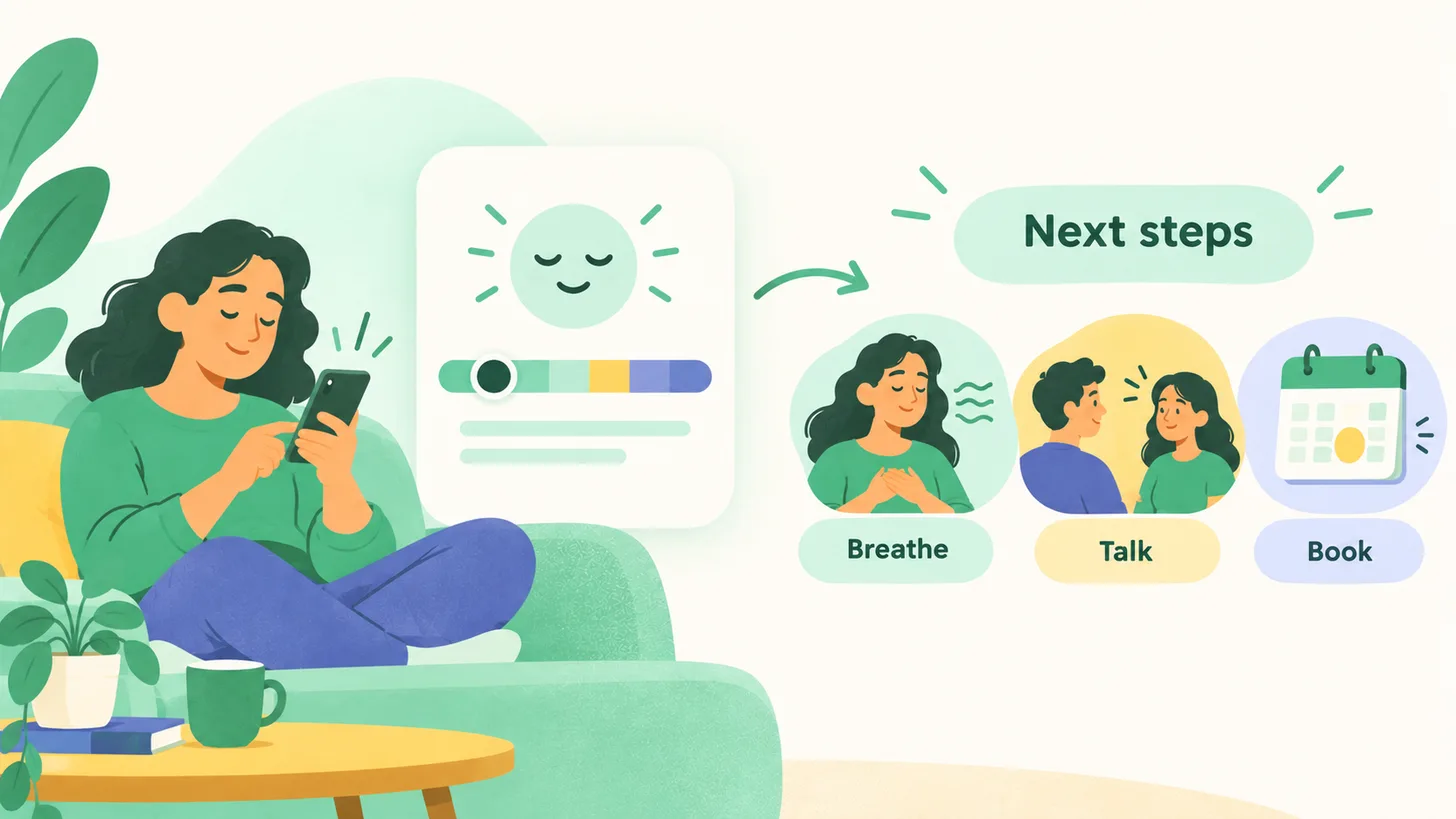
0 to 4: Minimal anxiety. The pattern you described in the last two weeks is not what clinicians call clinical anxiety. Keep the habits that are already helping, usually some mix of sleep, exercise, boundaries at work, and time with people you trust. If something still feels off, read our anxiety guide for a wider map.
5 to 9: Mild anxiety. You have some early signs. For many people this is manageable with self-help: regular sleep, less caffeine, 20 minutes of movement most days, grounding or breathing when the chest tightens, and journaling the worries that keep coming back. If it has been like this for more than a month, consider one session with a therapist to understand what is driving it.
10 to 14: Moderate anxiety. This level of anxiety is interfering with how you live, work and sleep. Self-help alone is often not enough. The honest next step is to book a therapist in the next two weeks. Cognitive behavioural therapy (CBT) is the first-line talk therapy for most anxiety disorders and tends to show results within 8 to 16 sessions. Share this with one trusted person. You do not have to carry it alone.
15 and above: Severe anxiety. This is the band where you need professional help. Please see a therapist and, often, a psychiatrist as well, within two weeks. Medication is sometimes a useful short-term adjunct to therapy, decided together with the psychiatrist.
Any 3 on question 10 with chest pain, breathlessness and faintness in a short burst. That pattern could be a panic attack. Panic attacks peak within 10 minutes and are not dangerous, though they feel terrifying. Our anxiety guide walks through what helps in the moment.
In short: the score is a direction, not an identity. Low means keep going. Mild means watch and support yourself. Moderate means book a therapist. Severe means book both a therapist and a psychiatrist, and tell one person today.
Confusing anxiety with something else
Not everything that feels like anxiety is anxiety. This is the part most self checks skip, and it is the part that matters most. If your score is high, work with a clinician who looks at these before settling on a plan.
Thyroid. An overactive thyroid (hyperthyroidism) can produce a racing heart, trembling hands, trouble sleeping and a feeling of being wired, which look very similar to anxiety. The National Institute of Diabetes and Digestive and Kidney Diseases lists nervousness and irritability among the common symptoms. A simple TSH blood test can rule it out.
OCD and health anxiety. If your worry is sticky and specific, if you check things repeatedly, wash more than feels normal, or run the same scenario on a loop that you cannot push away, obsessive-compulsive disorder (OCD) is worth checking for. OCD is a specific kind of anxiety and the therapy for it, exposure and response prevention (ERP), is different from generic CBT.
Trauma-rooted anxiety. If a specific event, or a long childhood pattern, sits behind the anxiety, trauma-informed therapy (sometimes CBT, sometimes EMDR, sometimes a longer talk therapy) is what actually helps. The feeling can look like anxiety on this screener but the roots are different.
Burnout, not anxiety. Workplace burnout can look like anxiety on the surface, including sleep trouble and irritability. The treatment is different: time off, boundaries, workload change, and sometimes a therapist. Our guide on which doctor to see for anxiety explains who treats what.
Depression with anxious features. Depression and anxiety share about 60% of their signs. If low mood, loss of interest and heavy fatigue are also there, you may be screening high on both. The depression guide covers this overlap in plainer language.
Anxiety, often
- Wires you up, keeps you alert and tight
- Worry about the future dominates
- Physical: racing heart, breath, chest tightness
- Sleep issue: trouble falling asleep
Depression, by contrast
- Flattens you, drains your energy
- Low mood, loss of interest dominate
- Physical: heaviness, slowness, appetite shift
- Sleep issue: waking at 4 am and not going back
In short: a high score on this self check means something is going on. A clinician helps you tell what.
What to do next, based on your score
If this self check gave you a number that fits what you have been feeling, here are three steps in order. You do not have to do all of them this week.
One, talk to a therapist. If your score is 10 or above, a therapist is the right next step. For most anxiety, that is a clinical psychologist or a counselling psychologist trained in CBT. CBT is the therapy with the strongest evidence base for anxiety across the WHO and NICE guidelines. In India, you can see one online for an hour, from your room, in English or Hindi. On GoodLives you can match with a verified psychologist in your language, often within 24 hours.
Two, see a psychiatrist if the anxiety is affecting sleep, work or safety. Psychiatrists are medical doctors who can rule out thyroid or other medical causes and prescribe medication where it is useful. For moderate to severe anxiety, medication plus therapy often works better than either on its own. The decision is yours to make with them.
Three, use self-help as scaffolding, not a replacement. The things that help anxiety on an ordinary week also help on a hard one: regular sleep, 20 minutes of movement, less caffeine after noon, and a daily three-minute breathing practice. Yoga for anxiety is a gentle starting point if the body feels locked. These help, and they do not replace a therapist for a score of 10 or above.
If what you need right now is sleep, a therapy appointment on Friday is not the fastest tool. Not every anxious week needs therapy next month, and not every high score needs medication.
In short: the shortest path from this page to feeling less alone is one 50-minute conversation with a verified psychologist. The rest is scaffolding around that.
FAQ
Is this anxiety self check a GAD-7?
Can an anxiety test online diagnose me?
What is a normal anxiety score?
My score is high but I “function fine” at work. Does that mean I do not need therapy?
Is anxiety treatable in India?
Is this anxiety self check confidential?
How often should I retake this self check?
This post is for information only and is not a substitute for professional care.
Your right to care is protected under the Mental Healthcare Act 2017, which recognises access to free emergency mental-health care at government hospitals.


Share your thoughts