
What this blog includes
- What ADHD in children really is, in plain words
- The three types and how they show up at home and at school
- Why Indian schools and relatives often miss it, and what gets mislabelled instead
- How a careful diagnosis in India actually works, from paediatrician to clinical psychologist
- The small list of things that genuinely help, and the longer list to stop doing
You already know something is off. The teacher has called. The report card does not match the child you see at home. Your daughter stares at the window during homework for an hour, every day.
Your son watches cricket for three hours and cannot copy five lines from the board. You have probably asked your mother, your paediatrician, and a WhatsApp group, and gone to bed less sure than when you started. You might be worried that if you push for an answer, a label will follow your child forever. The honest answer is that a good assessment gives you words, not a sentence.
ADHD in children is not a label for a bad child, and your child is not broken. It is one of the most studied conditions in child mental health. On GoodLives, an online therapy platform trusted by 500K+ people across India and beyond, parents like you meet a verified psychologist every week to make sense of the next step.
This guide is written by one parent to another, in plain words. The aim is not to diagnose your child in a blog post. The aim is to give you the vocabulary, the steps, and the honesty you need before you walk into a clinic.
What is ADHD in children, really?

ADHD, or attention deficit hyperactivity disorder, is a brain-based condition. It makes paying attention, sitting still, and pausing before acting much harder than it is for most children the same age. It is not the result of poor parenting, screen time, or sugar.
A child’s brain is still learning to manage attention and impulse. In ADHD, that learning runs on a slower timeline. Many children grow calmer as teenagers. Some keep features of ADHD into adulthood, in a form grown-ups learn to work with.
You do not need to prove your child has it before you ask for help. If daily life at home or school is a daily fight for both of you, a careful assessment is a fair next step.
In short: ADHD is a specific way a brain develops. It is not a character flaw, and it is not your fault.
The three types, and how each one shows up
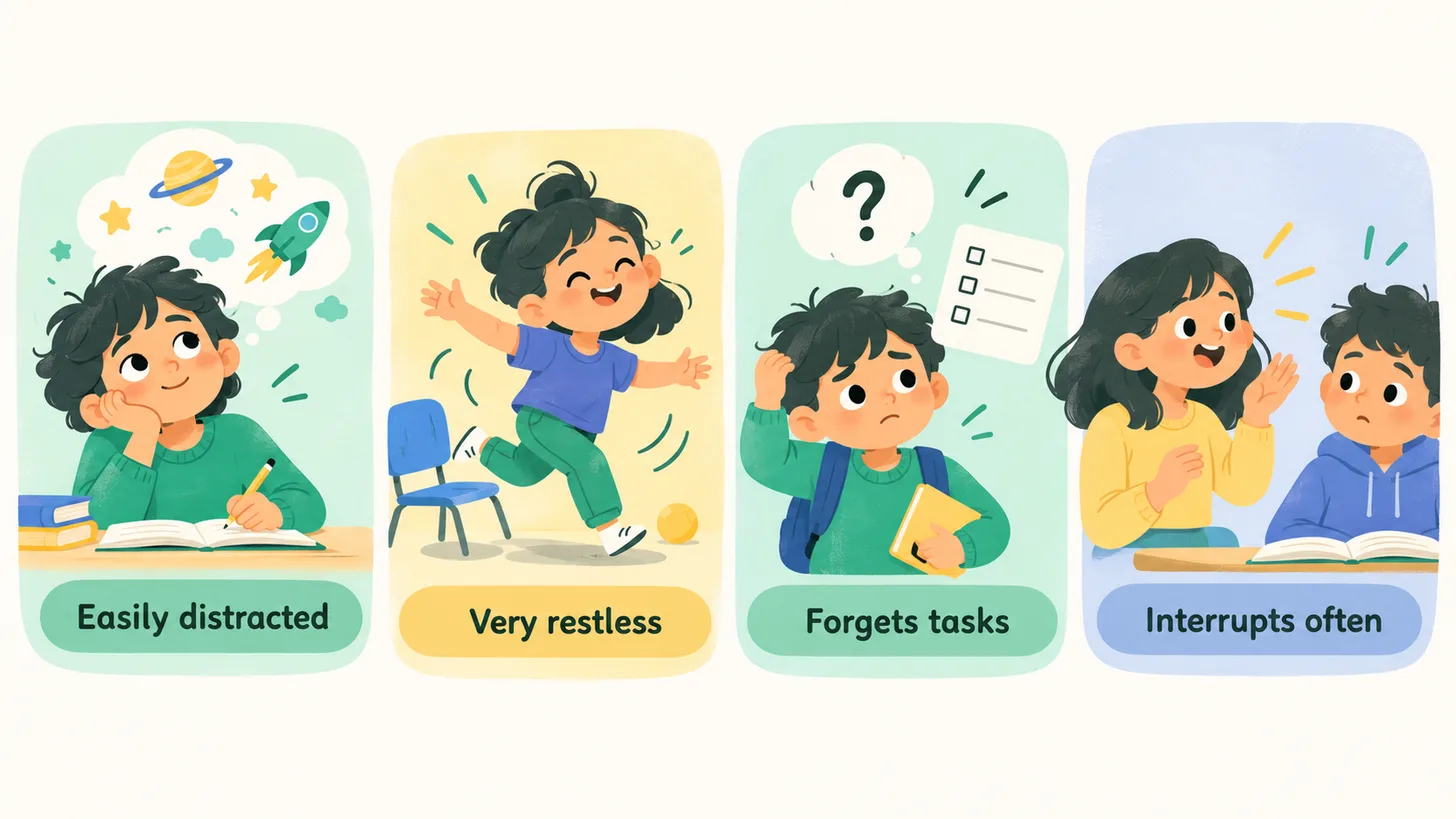
ADHD is one condition with three common shapes. Some children mainly drift and forget. Some mainly run, climb, and interrupt. Many show both patterns. Knowing which shape a child living with ADHD has changes the kind of support you build at home and ask for at school.
Children with the inattentive type often look well-behaved. They sit, but their mind is elsewhere. Homework takes hours. They lose erasers, water bottles, and the thread of what a teacher just said.
Children with the hyperactive-impulsive type are the ones most people picture. They squirm, stand up, blurt out answers, and finish other children’s sentences. They are not rude. Their body is working faster than the rules.
Children with the combined type live in both worlds. Attention wanders, and the body does not sit. This is the most common type overall.
In short: The shape decides what school and home should adjust first. A quiet dreamer needs a different plan than a child who cannot sit.
The DSM-5 checklist clinicians actually use
A careful diagnosis is not a checklist a teacher fills over tea. The DSM-5, the global standard clinicians use, asks for six or more specific symptoms present before the age of twelve, in two or more settings (usually home and school or tuition), for at least six months.
Two settings is the quiet part that matters most. A child who is calm at home but chaotic at school may be bored, anxious, or dealing with a classroom that does not suit them. A child who is attentive in one-to-one tuition but scattered in a crowded class may be overwhelmed, not inattentive.
ADHD shows up in more than one room of life. Clinicians also look at age. These patterns should have started by the time the child was twelve. If attention and restlessness only began at fourteen, after a difficult year at school, the cause is probably different.
In short: One grown-up’s observation is not a diagnosis. Two settings and a trained clinician are.
Why Indian girls get missed, and what “ziddi” is actually telling you
In India, boys who disrupt the class get noticed, often harshly. Girls with the inattentive type get written off as day-dreamers who “need to concentrate harder”. Many girls reach the tenth standard before anyone asks whether there is a real reason. That delay is costly, and it is avoidable.
Indian schools reward quiet compliance. A child who sits and gets through the day is a “good child”, even if her books are blank. Boys who cannot sit get labelled ziddi (stubborn), naughty, or “going astray”. These are feelings a tired family throws around, not diagnoses.
Teachers in classrooms of forty or fifty children do not have time to track one restless child. Relatives offer discipline advice that worked in another generation. By class seven, the story is “he is like that” or “she is just not studious”.
None of this is the child’s fault, and none of it is yours. It is a system that was not designed to spot a quiet daughter who cannot track a worksheet, or a loud son whose brain cannot wait. Our note on exam and academic stress in India is a useful companion read.
In short: If a child is called “lazy”, “spoilt”, or “in her own world” at seven and ten and twelve, the real question is not what else to try at home. It is who to ask for a proper assessment.
What ADHD is often confused with
ADHD rarely travels alone, and it also wears the mask of other conditions that need different help. A careful assessment separates ADHD from anxiety, a specific learning disability, an autism-spectrum condition, a sleep problem, or even a hearing issue the family had not spotted.
Many children with ADHD also have anxiety or a learning disability like dyslexia or dyscalculia. An untreated co-occurring condition can look like ADHD that is not responding to effort.
The Child and Adolescent Psychiatry unit at NIMHANS and similar centres screen for these together, in one visit, so the plan matches what the child actually has.
Sleep is the most under-checked cause of ADHD-like symptoms. A nine-year-old who sleeps six hours a night will not focus on anything by period four. A quick paediatrician check for sleep apnoea, iron, thyroid, and hearing is worth the hour it takes.
If a family is already dealing with daily friction, a short family counselling session can take the edge off while the assessment runs.
In short: Before you commit to any plan, make sure what is in front of you is actually ADHD and not something else wearing its clothes.
How an ADHD assessment actually works in India
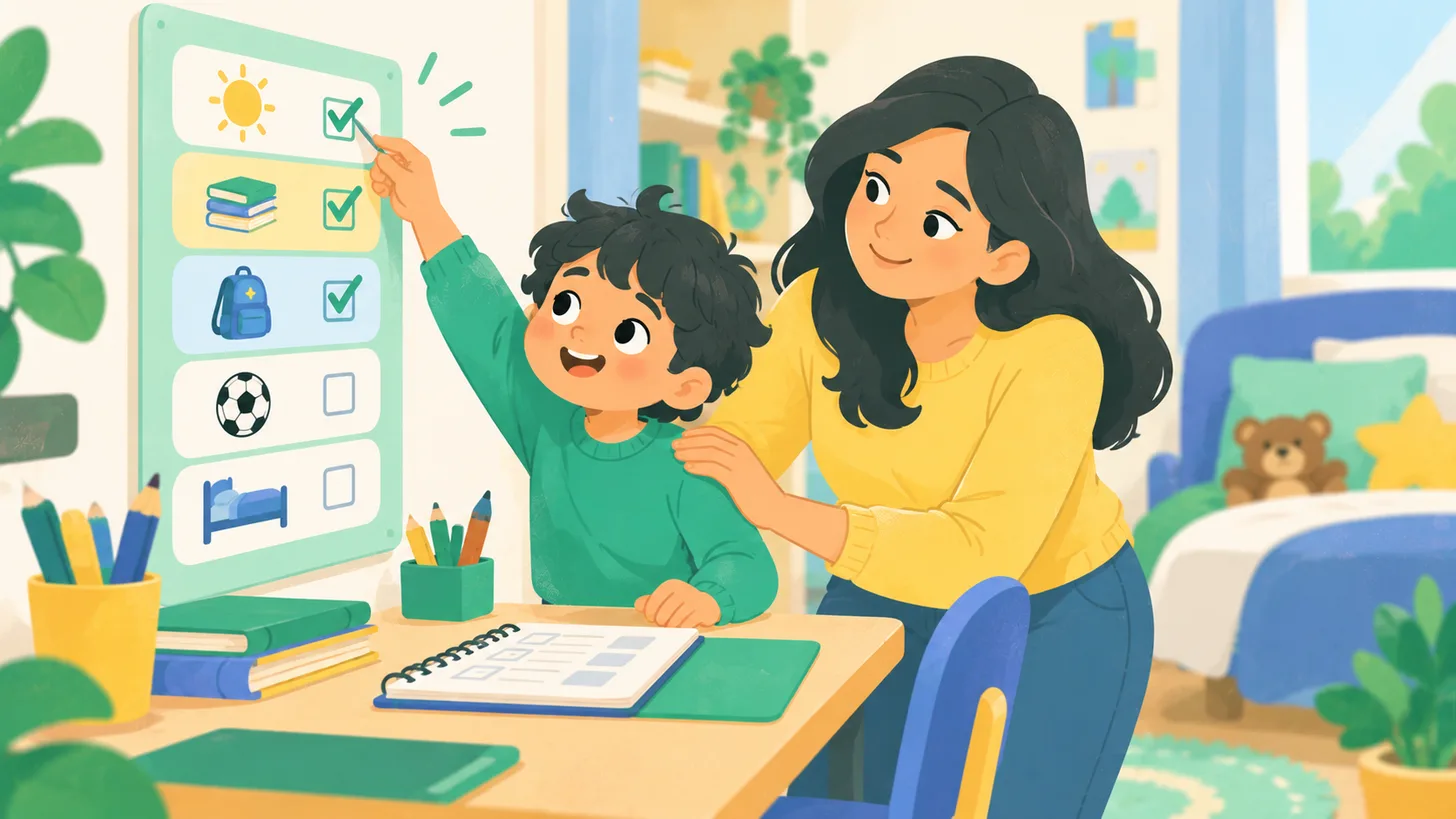
A proper assessment is one conversation, two or three visits, and a few forms. It starts with a paediatrician, moves to an RCI-registered clinical psychologist or a child and adolescent psychiatrist, and ends with a written report you keep. It is not an MRI, and it is not one hour.
The usual path:
- Your paediatrician rules out sleep, hearing, iron, thyroid, and vision issues.
- A clinical psychologist runs a structured interview with you and your child, often across two sittings.
- The clinician gives you and the class teacher a standard rating scale, often the Vanderbilt or the Conners, to fill separately.
- For children where school performance looks very different from ability, an IQ test and academic testing are added.
- The clinician writes a report naming the type, severity, and plan.
Where to go in India:
- NIMHANS, Bengaluru runs a child and adolescent psychiatry clinic. Waiting lists are long; the care is strong.
- AIIMS Delhi and other government AIIMS centres take child psychiatry referrals.
- Larger private hospitals such as Fortis, Apollo, and Max have paediatric mental-health teams in metros.
- Empanelled private clinical psychologists who hold an RCI number are often more accessible than a government queue.
- Online therapy platforms like GoodLives can start you off with a verified clinical psychologist for intake and for parent-side work between appointments.
In short: The report you carry home is the thing that opens up school accommodations, insurance conversations, and the right kind of therapy.
What actually helps, in the order evidence supports
The strongest evidence for younger children sits not in a medicine but in parent training. Older children add behaviour therapy, school accommodations, and for some, carefully prescribed medication. The mix depends on the child’s age, the type, and how big the gap between ability and daily life has become.
For children under seven, the first line of help is almost always a parent training programme taught by a trained therapist. The best studied are Parent-Child Interaction Therapy (PCIT) and the Triple P (Positive Parenting Programme). These are not advice sessions. They are structured weekly programmes, often eight to twelve sessions, where a therapist coaches you through the tiny daily moves that change a child’s behaviour.
For older children, individual behaviour therapy and cognitive behavioural therapy build attention, planning, and impulse control. Play therapy for younger children is another route a clinician may suggest when words alone are not enough.
School-side help matters as much as anything at home. If your child has a recognised neurodevelopmental condition, you can apply for a UDID (Unique Disability ID) card.
That card opens the door to the accommodations the Rights of Persons with Disabilities Act 2016 guarantees: extra time in exams, scribes where needed, lenient marking for spelling, and a sensible seat in class.
Finally, medication. For some older children with moderate to severe ADHD, a paediatric psychiatrist may prescribe a medication from one of two broad classes, stimulants or non-stimulants. This blog does not name specific drugs or doses. That call sits with a paediatric psychiatrist, your paediatrician, and you, in the room, with your child’s full history. If someone online tells you to start, stop, or switch a specific medication, that is the wrong advice from the wrong person.
In short: Younger children, parent training first. Older children, parent work, behaviour therapy, school accommodations, and medication only if a specialist recommends it. Not the other way round.
Things to avoid, and how to be on your child’s side
The hardest part of this diagnosis is that most of what feels natural when you are tired and worried makes ADHD worse. Shaming, hitting, long punishments, and demanding one hundred per cent attention for forty minutes do not teach a child with ADHD anything. They teach them to hide.
Things to stop (even when you have tried everything)
- Shaming the child in front of family or friends
- Hitting, pinching, or slapping as “a lesson”
- Punishment-only approaches with no praise in between
- Comparing with a sibling or cousin who “can sit”
- Demanding one long focused block instead of many short ones
- Removing all breaks and screens as a blanket consequence
Things to try instead
- Short tasks of ten to fifteen minutes with a stretch in between
- One clear instruction at a time, confirmed back to you
- Praise that names the specific thing (“you sat with the book open for twenty minutes, that was hard work”)
- Fixed sleep and meal times every day, with one relaxed day a week
- Movement before homework, not only after
- A quiet corner for homework with no phone in sight, including yours
In short: The children who do best are not the ones with the strictest parents. They are the ones whose parents stop punishing the brain and start working with it.
FAQ
At what age can a child be diagnosed with ADHD in India?
Is ADHD a disability under Indian law?
Will my child grow out of ADHD?
Will cutting sugar or screens make ADHD go away?
My child’s teacher says he is “ziddi”. Should I push for an assessment?
Will medication change my child’s personality?
Is online therapy useful for a child with ADHD?
This post is for information only and is not a substitute for professional care.

Share your thoughts