
A real person will pick up.
What this blog includes
- What a burnout self-check actually is, and what it is not
- The 10-question test across three dimensions
- How to score your answers in under a minute
- What each result band likely means, and what to do about it
- When your score is not the full story (depression, thyroid, long-COVID, sleep apnoea and other look-alikes)
You are not being dramatic. If you are reading this at 11 pm after another week of Sunday dread, you are already paying attention to something real. A burnout self-check will not tell you anything you do not already half know. It will give you a slightly more honest frame to look at it in, in about two minutes.
A quick note before we start. Only a licensed clinician can diagnose anything.
What follows is a self-screener informed by the WHO’s 2019 classification of burnout in ICD-11 and the three-dimension structure of the Maslach Burnout Inventory, in plain language. It is a mirror, not a verdict.
What a burnout self-check actually is, and what it is not
A burnout self-check is a short screener. It asks you to notice how you have been feeling about work over the past few weeks, scored across three dimensions that researchers see together in burnout.
The WHO classifies burnout as an occupational phenomenon, not a medical condition. It names three features: exhaustion, mental distance from work, and reduced professional efficacy. The Maslach Burnout Inventory, first published by Christina Maslach and Susan Jackson in 1981, is the research-grade tool that measures those same three dimensions.
What a screener like this can do, honestly, is three things. It can slow you down for 120 seconds. It can show you which of the three dimensions is loudest. It can nudge you toward a next step that fits what your answers are telling you.
What it cannot do, honestly, is diagnose you. It cannot tell burnout apart from depression, an anxiety disorder, or a physical cause like a thyroid problem or poor sleep. It cannot measure your situation at work, your sleep, or your relationships. One single moment in time, filled in on your phone between meetings, is not the full picture.
In short: this is a reflection tool. Treat the result as a question you can take to a therapist or doctor, not an answer.
Before you start, a note on when this is not the right next step
If right now you are having thoughts of ending your life, if you cannot leave the house because of panic, if you have been dissociating or losing time, or if you cannot do basic self-care, please skip the test and call one of the numbers at the top of this page.
A score tomorrow is a reasonable question. Tonight is a reasonable moment to talk to a person.
The 10-question burnout self-check
Rate each statement on a 0 to 4 scale based on how often it has been true for you over the past four weeks at work.
- 0 Never
- 1 Rarely (a day or two in the month)
- 2 Sometimes (about once a week)
- 3 Often (several days a week)
- 4 Always (nearly every working day)
Write the number next to each question on a piece of paper or a notes app. We will add them up at the end.
Section A: Exhaustion (3 questions)
A1. I wake up already tired, even after what should have been enough sleep. My body feels heavy before the day starts.
A2. By the end of a working day, I have nothing left for the people at home. Even a short conversation feels like too much.
A3. My weekends feel like recovery, not rest. By Sunday evening, the knot in my stomach about Monday is already back.
Section B: Cynicism and detachment (3 questions)
B1. I have become more distant from my work. Projects I used to care about feel like a to-do list I am moving through.
B2. I find myself cynical about my team, my manager or my organisation in a way I did not feel six months ago. Small things set it off.
B3. I feel detached from the point of what I do. The idea that this work matters is harder to hold on to.
Section C: Reduced professional efficacy (4 questions)
C1. I am less confident in my work than I used to be. I second-guess decisions that would have felt normal earlier.
C2. It takes me longer to finish tasks I used to do quickly. Simple things feel sticky.
C3. I have started to feel ineffective at my job, even on days when my output is objectively fine.
C4. I find it harder to concentrate. I reread the same email, forget what I was about to say in a meeting, or lose track of what someone just said.
How to score your answers
Add up all ten numbers. Your total is a single score between 0 and 40.
Then look at each section separately. If one section is noticeably higher than the others (for example, you scored 10 in Section A and 4 each in B and C), that is useful information on its own. Exhaustion-first burnout and cynicism-first burnout can need different first moves.
What your score likely means
Your total falls into one of three bands. The language below is deliberate. The screener is not telling you what you have. It is pointing at what the next kind thing to do might be.
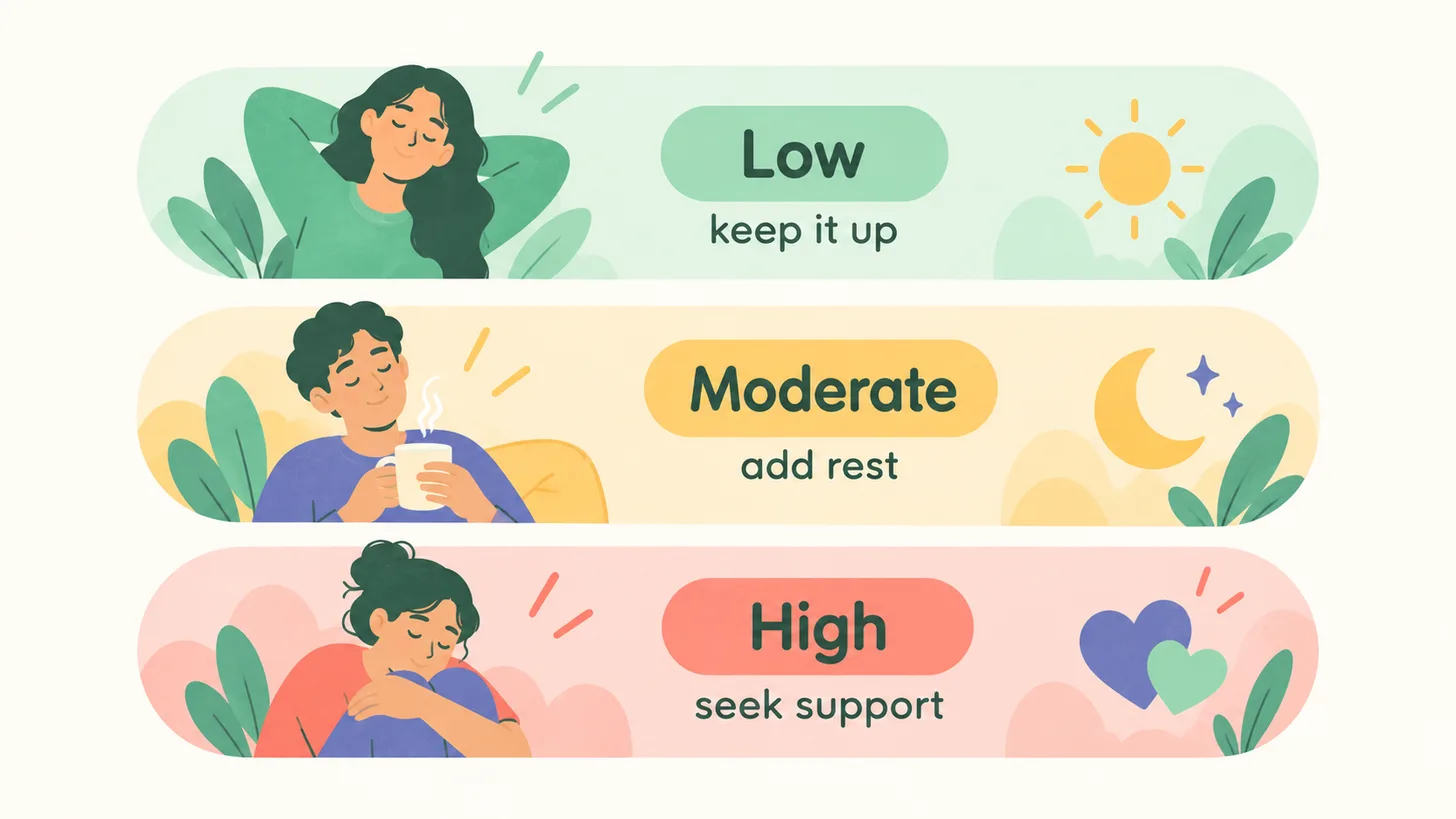
Score 0 to 13: Currently sustainable
Work is work, and you are mostly okay with it. There may be a hard week in there, or one bad project, but your baseline is holding up. The next kind thing is to protect it.
- Keep the boundaries you already have. If your team has an unofficial 8 pm Slack culture, you do not have to join it to prove anything.
- Protect sleep like a meeting. Seven to nine hours, same window most nights.
- Keep one real evening a week that has nothing to do with work. Dinner with friends, a long walk, that class you keep almost signing up for.
Read our full guide on managing work stress and burnout in India for the long-term version of this.
Score 14 to 26: Early signs, worth taking action
You are not imagining it. Some mix of tiredness, cynicism and self-doubt has been louder than usual, and this is the band where small moves made consistently still work. Pick two or three of the following, not all seven, and run them for four weeks.
- A hard stop time, four days out of five. Not a goal; a line.
- One honest conversation with your manager about workload or scope.
- A full phone-free weekend day, once a fortnight.
- Thirty minutes of movement, four days a week. Walking counts.
- A sleep window that starts at the same time every night.
- Food that is not from a delivery app three days a week.
- One session with a therapist to check what is burnout and what is something else.
Online counselling for work stress is one honest way to get an outside view without taking leave.
Score 27 to 40: Signs consistent with burnout
Your answers are consistent with what the WHO describes as burnout. The language matters. You are not broken. You have been running on empty for long enough that your body and mind are showing it. In this band, self-help on its own is usually not enough.
The two kindest things to do in the next two weeks:
- Book a session with a therapist. You do not need a plan going in. A first session is a conversation, not a commitment.
- Have one honest conversation about workload with your manager, HR, or your workplace’s Employee Assistance Programme if one is available. If that feels too much, start with the therapist first.
Match Me with a Therapist → https://app.goodlives.in/signin
In short: a high score is a signal, not a sentence. Burnout responds to the right combination of rest, boundaries, workload change and therapy. People do come back from this.
What this can look like but is not
Burnout shares symptoms with several other things. A score cannot tell these apart, and this is the honest reason the screener ends with a nudge toward a professional rather than a label.
The most common look-alikes:
- Depression. Low energy, loss of interest, trouble concentrating and self-criticism all overlap. The simplest rule of thumb: burnout usually lifts a little on a long holiday, depression often does not. A clinician will ask more careful questions.
- An anxiety disorder. Chronic worry, poor sleep and physical tension can look like burnout exhaustion, especially in cynicism-first scores.
- A thyroid problem. An under-active thyroid (hypothyroidism) can cause the same tired-even-after-sleep pattern as burnout exhaustion.
- Sleep apnoea. If you snore, wake unrefreshed and feel groggy through the morning, this is worth a GP visit regardless of your score.
- Long-COVID. Post-viral fatigue and brain fog from a past COVID infection can mimic exhaustion and reduced efficacy, sometimes months after you felt better.
- Low iron, low vitamin D or low B12. Common in India, often undiagnosed, often the quietest cause of a tired year.
- Chronic fatigue syndrome. Tiredness that does not improve with rest and that gets worse after even light effort is its own diagnosis and needs a doctor.
If your Section A exhaustion score is high and physical symptoms are prominent (poor sleep, dizziness, hair fall, slow digestion, a resting heart rate that feels off), see a GP for a basic blood panel at the same time as you talk to a therapist. A good therapist will ask about this on the first call.
What to do next in India, honestly
Three honest routes, depending on where you are.
If your workplace has an Employee Assistance Programme. Many Indian companies now contract an EAP (Employee Assistance Programme) through a vendor. Sessions are usually free, usually anonymous from your employer’s view, and limited (often three to eight a year). Use them. If you want to go deeper or stay with the same therapist for longer, you can continue privately after that. Private therapy is also useful when you want full control over who sees your records.
If you are paying privately. A verified psychologist on GoodLives, or on any trusted Indian platform, is the common first stop. For the broader map, read our types of stress and work-stress explainer first, then book. The Mental Healthcare Act 2017 and IRDAI’s 2022 circular require insurers to treat mental illness on par with physical illness, so a longer private course may be partly covered by your health insurance; ask your HR or insurer before you start.
If cost is a worry this month. The free government and NGO helplines above are a real option. Many Indians use them as a first conversation before moving to paid therapy.
The one thing we would not recommend: taking the test, scoring high, and then doing nothing for a month because you are too tired to decide. Even one email to an EAP, or one 15-minute call with a helpline, counts as something.
When this is not enough
The screener does not catch everything. If any of these are true for you, please get help today, not after another working week:
- Thoughts of ending your life, or that it would be better if you did not wake up
- Panic that stops you leaving the house, or getting on the lift at the office
- Dissociation, losing time, or feeling unreal for hours
- You cannot do basic self-care like eating, bathing or sleeping even a little
- You are using alcohol or any substance every day to get through
If you are in immediate danger, call 112.
If you have tried one therapist and it did not work, it is reasonable to pause before you try another. A bad fit is a real thing, not a verdict on therapy.
This post is for information only and is not a substitute for professional care.
—



Share your thoughts