
What this blog includes
- A plain definition of narcissistic personality disorder, and when it is not the right word.
- The nine signs a clinician looks for, grouped for a non-clinician.
- Overt and covert narcissism, and why the quiet kind gets missed in Indian families.
- How to cope with a narcissist in two real cases: can leave, cannot leave.
This post is for the person on the other side of the behaviour. Not for the person called a narcissist. You already know how tired you are.
What you feel has a name. Many of us have been there. Only a trained clinician can diagnose NPD. Harm does not need a diagnosis. You can name what you see, protect yourself, and work with a therapist on what the harm did to you.
GoodLives is India’s online therapy platform. Trusted by 500K+ people. 5 Google rating.
What narcissistic personality disorder is, and what it is not
NPD is a long-term pattern. The DSM-5 names it as grandiosity, a need for praise, and a lack of empathy. It sits in Cluster B of the personality disorders. The key word is pervasive. It shows up across years and many bonds.
A narcissistic personality is not NPD. All of us have self-focused days. A clinician names NPD only when the pattern is wide and deep. They name it after weeks with the person.
The Cleveland Clinic says a diagnosis needs five of nine DSM-5-TR criteria.
What is a narcissist is not a yes or no. The narcissist meaning in a dictionary is not clinical. A person can hurt you badly without meeting the bar. A person can meet the bar and still be your parent.
You do not need the label to protect yourself. You have probably been told you are over-reading it. You are not. The harm is the data.
In short: NPD is a long pattern. Only a clinician can name it. Your pain is valid without a label.
Signs a clinician looks for in a long pattern
Clinicians use the DSM-5. Not the internet. The manual lists nine narcissistic personality disorder symptoms. A diagnosis needs five. They must hold over time and across settings. We grouped them in three buckets so you can read without feeling you need to score anyone.
Signs of self-image
- Inflated sense of self, not matched by what they have done.
- Private fantasies of success, power, beauty or ideal love.
- A belief they are special, and should mix only with high-status people.
Signs in how they treat others
- A constant need for praise.
- A sense of entitlement without earning it.
- Using people to meet their own goals.
- Little empathy for how others feel.
Signs in how they respond to criticism
- Frequent envy, or the belief others envy them.
- Arrogance, or sharp anger when they are criticised.
The nine signs above are summarised by the Cleveland Clinic. A 2008 US survey found a lifetime rate of 6.2%. The split was 7.7% in men and 4.8% in women.

Indian data is thinner. A review in the Indian Journal of Psychiatry says India studies have not used standard interviews. They under-count. The honest answer is we do not have a clean Indian number yet.
In short: Five of nine, over time, across settings. Scoring someone from a list is not a diagnosis.
Overt and covert narcissism, and why the quiet kind is often missed
Within NPD, two patterns show up in the research. Neither is a separate name in the DSM-5 or ICD-11. An overt narcissist is the one you spot from across the room. Loud, boastful, clearly entitled when they are not the centre.
A covert narcissist is the one you name only after years. You see it in the tired feeling they leave behind. The covert kind is common in Indian homes and offices that quietly orbit one person.
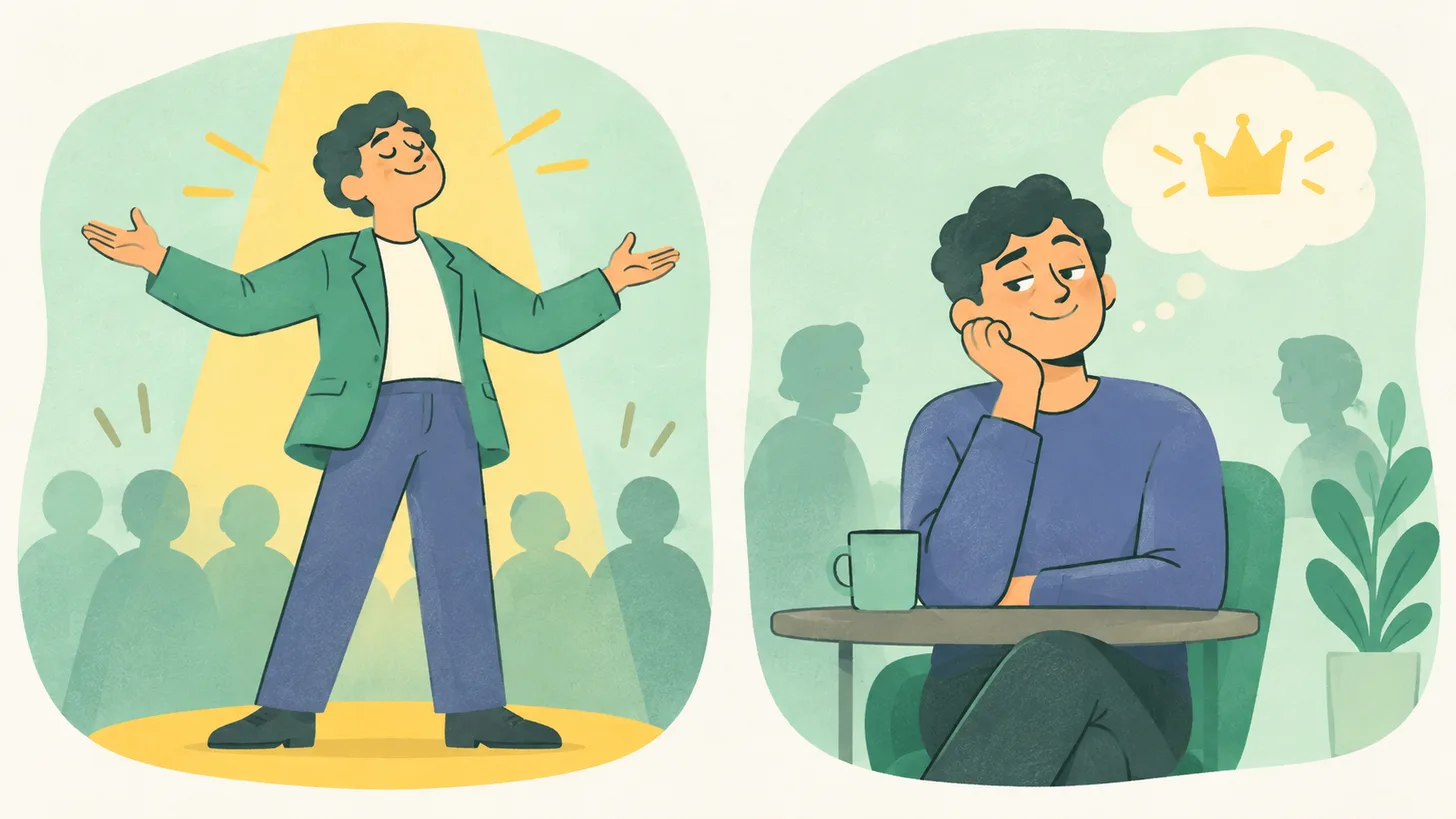
The signs are not loud. They look like love. Self-sacrificing but in charge. Idealised but hard to please. Warm in public. Cold at home. A martyr tone when they are not praised.
Overt narcissist
- Dominates the room, flashy about status.
- Open contempt for anyone beneath them.
- Anger that arrives fast and loud.
Covert narcissist
- Quiet grandiosity, feels misunderstood.
- Guilt-tripping, silent treatment, playing hurt.
- Passive-aggressive sabotage dressed as support.
What narcissistic abuse feels like from the inside
Before any coping move makes sense, name what it feels like. You do not have to prove you are hurt before you are allowed to want it to stop. If any of these land for you, take them seriously, even when nothing out loud was cruel.
- You check your phone before every call, guessing the mood.
- You second-guess your own memory of what was said.
- You apologise before you know what for.
- You feel foggy and small after each contact.
- You defend the person to friends who love you.
- You tell friends only the funny parts.
That last one is the fingerprint of covert narcissism. One incident sounds like nothing. The harm is cumulative.
One thinking trap tends to settle in. The belief that you caused the blow-up. “If I had said it better.” “I made them angry.” That is called self-blame. It is not accurate.
An angry blow-up out of all proportion to what you said is a pattern in the other person. It is not a verdict on you. A quick reframe will not fix them. It will only take the edge off the thought.
Catch the thought
What thought is weighing on you right now? Write it down just as it sounds in your head.
Name the trap
Does your thought fall into one of these common patterns? Pick any that fit. This part is optional.
Look again
Use these as nudges, not rules. Then write one line back to yourself.
Your reframe
Thoughts are not facts. You just practised stepping back.
This stays on your device. Nothing is saved or sent.
A reframe tool helps you spot the self-blame. A therapist helps you see why that first harsh thought was yours to carry.
In short: The feeling is real. Self-blame is a trap, not a verdict. Name it, work with it.
The practical exit plan when you can walk away
If leaving is on the table, do the practical work first and let the feelings come after. Make the exit possible, then feel the grief. These moves come from standard narcissistic-abuse writing. They match what Indian therapists hear in session every week.
Stop explaining. You will not be understood on this. Explaining is their fuel. Say less than feels polite.
Information diet. Share only neutral facts. Your schedule, old friends, your plans. None of it is theirs.
Grey rock method. On contact, be as unresponsive as a grey rock. Short answers. Flat tone. Nothing to pull on. It is boredom as a boundary.
No contact where you can. Block. Mute. Unfollow. The urge to check their last post is the pull back in. Toxic relationship signs often live in those small open doors.
Document. Keep screenshots and dates in a file only you can see. It protects you from gaslighting later.
Tell two people. One friend, one therapist. Isolation is how this works. Being known is how you leave.

You might be worried that leaving will blow up the extended family. That worry is real. It will not blow up as badly as you fear, nor as neatly as you hope. Plan for the middle version.
In short: When leaving is possible, protect your info. Be boring on contact. Tell two people. Feelings get space after safety does.
Coping inside the house if staying is the only option
Many Indian readers cannot walk away. A parent you live with. A mother-in-law at home. A manager you depend on. A spouse where leaving would move the kids’ school. The question shifts. It becomes “how do I live with this and keep the damage small?”.
Set limits that do not need their agreement. You cannot make a narcissistic parent respect a limit. You can make one. Decide what you will not share. Decide which rooms you leave in a fight. Decide which calls you will not take after 10 pm.
See Toxic parents and their impact for the long shape of this.
Protect the children in the room. Break the pattern before it reaches your child. Do not debate the grandparent in front of them. Do give the child the words when you are alone. “That felt unfair, didn’t it?” is a sentence a child remembers.
Keep a parallel life. One friendship. One hobby. One small bank account. One evening a week that is yours. They make the next decision possible.
At work. If the narcissist is your manager, keep a paper trail. Reply over email. “To confirm, you’d like me to do X by Friday?”. The Mental Healthcare Act 2017 names your right to dignity at work.
Here is the honest line. If what you need right now is to leave but you cannot leave this year, therapy will not change the person causing the harm. It can change what the harm is doing to you.
In short: When you cannot go, build limits you enforce alone. Protect the kids. Keep a parallel life.
Does the person with NPD ever change, and what therapy looks like for you
Can a person with NPD change? Rarely, and not on your schedule. The NPD clinical review says there is no standard treatment. Talk therapy is the main way. Many people with NPD never seek help.
That is not hopeless. People with milder patterns, pushed by their own distress, do work in therapy. Some patterns soften over months. But the work has to be theirs.
Narcissistic personality disorder treatments are talk-based, not drug-based. No pill is approved for NPD itself. A doctor may still treat depression or anxiety that comes with it.
For you, the survivor, the work is yours. Recovery therapy usually runs 20 to 30 sessions. It covers naming the pattern, grieving the person you thought they were, and handling the emotional triggers that keep arriving.
GoodLives therapists are RCI-registered psychologists trained in online counselling for trauma. If Hindi or Tamil feels safer, say so at the match step.
In short: The other person rarely changes on your schedule. You can. The first ten sessions are the hardest.
FAQ
What are the signs that someone is narcissistic?
What are the five main habits of a narcissist?
How do you protect yourself from a narcissist?
Is there a narcissistic personality disorder test online that works?
Can narcissistic personality disorder be cured?
Is NPD more common in women or men?
What is the difference between a narcissist and someone with NPD?
This post is for information only and is not a substitute for professional care.




Share your thoughts