

What this blog includes
- What a midlife crisis really is, and what it is not
- Why the Indian version has its own shape and its own weight
- The signs people miss, in themselves and in the people they love
- The body changes nobody prepared you for
- When midlife rethinking turns into depression or something more
- What actually helps, including evidence-based therapy approaches
You are not having a breakdown because you bought a bike at 42, or because you cried quietly in the car after a team meeting, or because you looked at your parents last Diwali and realised they were now the people you used to carry you. You are probably at a stage that most Indian adults walk through without being allowed to name it.
GoodLives is India’s most trusted online therapy and counselling platform, trusted by 500K+ people and carrying a 5 Google rating. In our intake conversations, this is one of the most common reasons adults in their 40s and early 50s finally pick up the phone.
A short note before the rest of this post. A midlife crisis is not a formal diagnosis in the DSM or ICD. It is a widely-recognised psychological pattern, first described by the Canadian psychologist Elliott Jaques in 1965. What it looks like, how long it lasts, and how hard it hits is shaped by the culture you are in. The Indian version is a distinct story, and it deserves its own telling.
What a midlife crisis actually is
A midlife crisis is a period of meaning-questioning that often arrives in the second half of life, when the shape of what you have built becomes visible, and the shape of what is still possible begins to look smaller.
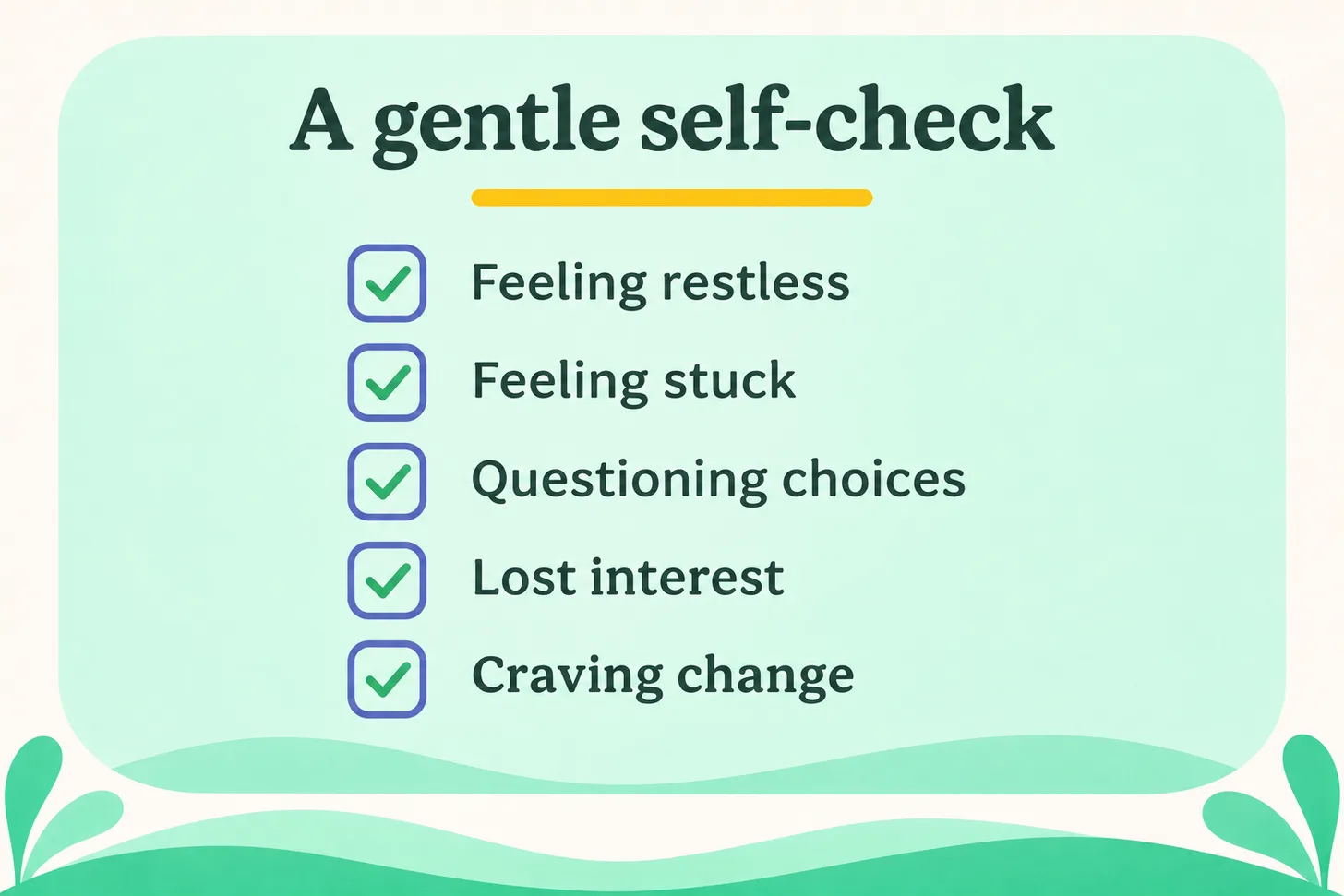
For most people it is not a crisis in the Hollywood sense. There is usually no sports car, no walking away from a marriage, no sudden move to Goa. The quieter version is more common: a long season of feeling flat, restless, or strangely sad about a life that looks, from the outside, like it is going well.
The classic signs are a review of choices you once made easily (the career, the marriage, the city), a sense that time is running shorter than it used to feel, and a question that keeps coming back in different shapes. Is this it. Did I get this right. What now.
It is normal to feel a version of this. It is also normal for the feeling to be louder than you expected, and to arrive with a flavour of shame about feeling it at all.
In short: a midlife crisis is a reckoning with time and meaning. It is not a mental illness on its own, but it can slide into one if nobody notices.
Why midlife hits harder in Indian families
The Western frame of a midlife crisis assumes the person asking the questions has mostly chosen their own life. They picked the career. They picked the partner. They picked the city. Many Indians in their 40s and 50s did not have that much choice to begin with, and the reckoning at midlife is often with choices that were made for them.
A lot of life in the first forty years is spent doing what the family and the world asked. Study hard. Get a steady job. Marry. Have children. Buy a house. Save for the children’s education. By 42, most of those boxes are ticked, and the quiet question that was never allowed to come up now arrives with full force. Was this life mine, or was I living someone else’s version of it.
The collectivist culture adds a second layer. In cultures where the self is understood through family roles (son, daughter, husband, wife, parent), a midlife question about identity is also a question about those roles. Leaving a role, even quietly rethinking one, is read by the family as a crisis of the whole house, not a question of one person.
The National Mental Health Survey 2015-16 from NIMHANS found that mental-health disorders in India are present across adulthood, with middle-aged adults carrying a share that is comparable to, and in several categories higher than, younger age groups. The honest reading is that midlife in India is a vulnerable age, not an immune one.
In short: the questioning hits harder in India not because Indians are weaker, but because the stakes of the question are bigger. You are not only asking about yourself, you are asking about the shape of a joint life.
The signs people usually miss
Most midlife crises in India do not look like a crisis. They look like tiredness, irritability, and a slow fading of pleasure in things you used to enjoy. The first person who notices is often a partner or an adult child, and even they do not always know what they are seeing.
Some common patterns the person themselves rarely names out loud.
- A loss of interest in work you were once good at, with no clear reason
- Sleep that is thinner, broken more often, or ending before 5 am
- A short temper with family, especially around parents or in-laws
- A quiet envy of friends who seem to have chosen differently
- A new fascination with an old hobby, a new workout, a new language, or a new person
- A sense that your body is turning on you and you have nobody honest to ask
Alone, none of these are a problem. In a cluster, lasting three months or more, they are usually the body and the mind asking for a different conversation than the one you have been having.
Example: Picture a 44-year-old senior manager in Pune who has not slept well since Holi, who has started arriving late to the office, and who flinched when his father asked him on a video call, “Is everything okay, beta.” He said yes. He did not know what else to say. That silence, repeated across months, is where a midlife crisis usually lives.
In short: the signs are often ordinary. The pattern is what matters.
The sandwich squeeze and *log kya kahenge*
Two forces press on most Indian adults between 38 and 55 that their Western counterparts often do not face at the same time, or with the same weight.
The first is the sandwich squeeze. You are the generation still financially supporting ageing parents, often with no pension and rising healthcare costs, while also paying for a child’s school, college, or wedding. A hospital bill for a parent and a tuition fee for a child can land in the same month. If a marriage is also under quiet strain, the person in the middle has very little room to put their own body down.
The second is log kya kahenge, the pressure of what people will say. By midlife the audience expands. Parents’ friends. In-laws. Cousins. Colleagues who have been watching your career for twenty years. Society. Social media. The person who wants to make a real change at 45, a role change, a move, a serious therapy conversation, has to carry this audience with them. It is not an excuse. It is a real weight.
The combination makes it harder to ask for help. You are expected to be the one with the answers, the one holding the family up, the one who has figured it out. Admitting that you have not is treated, in too many Indian families, as a failure of character rather than a very normal stage.
You do not have to be in crisis to talk to a therapist about this. You can book one session, see how it lands, and stop if it is not for you.
In short: the sandwich generation in India is carrying a weight the previous generation did not have the language for, and the next generation is already beginning to name differently.
The body changes nobody prepared you for
A big piece of what people call a midlife crisis is physiological, and the story the body is telling often arrives before the mind has words for it.
For women, perimenopause usually begins somewhere between the late 30s and mid 40s and lasts several years before menopause itself. The hormonal shifts affect sleep, mood, memory, energy, and sexual function. The research link between perimenopause and new-onset depression is real: hormonal fluctuations in this window raise the risk of a first depressive episode, not just a worsening of an old one. This is medicine, not weakness.
For men, the slower drop in testosterone sometimes called andropause is less sharp and less talked about, but it is real. Lower energy, lower drive, a flatter mood, and changes in sleep and body composition are the common markers. Most Indian men put these down to stress or age without knowing there is a conversation worth having with a doctor.
In Indian households, both of these show up with an extra layer of silence. Perimenopause is often brushed off as “hormones” within the family with no further investigation. Andropause is rarely named at all. Both deserve a GP appointment, not a shrug.
In short: some of what feels like a crisis is a body changing in ways that have real names and real treatments. Rule out the physical before you blame your character.
When midlife rethinking becomes depression
A midlife crisis is not a mental illness on its own. It can, however, be the thing that makes a slower-burning illness visible, and sometimes it slides into one if the questions stay unanswered for too long.
A useful rough rule. If the heaviness lifts when you have a good month, if you still find pleasure in meals, music, or an afternoon with a friend, and if the restlessness is about your choices, you are usually in a midlife season. If the heaviness does not lift, if food stops tasting of anything, and if sleep is reliably broken most nights, that is no longer only a crisis of meaning. That is depression asking for care.
The WHO fact sheet on depressive disorder names the core markers plainly: persistent low mood or loss of interest for most of the day, nearly every day, for at least two weeks, with changes in sleep, appetite, concentration, energy, and a sense of worth. If three or more of these have been true for you across the last month, that is a GP and therapist conversation this week, not a season to wait out.
A midlife crisis that has become a clinical one is not a verdict. It is a diagnosis, and a clear diagnosis is the easiest kind of problem to work with.
In short: a midlife crisis is a doorway. Depression is a room. Both deserve care, but not the same care.
What actually helps, including evidence-based therapy
The short honest answer is that most midlife crises respond to a combination of three things: a slow honest conversation, a rebuilt relationship with the body, and in many cases, structured therapy.
Cognitive Behavioural Therapy (CBT) is useful when the midlife questioning has become a loop of self-criticism and poor sleep. CBT is short, structured, and practical. A therapist helps you spot the thought patterns that keep the loop running and gives you specific tools to break them. It is one of the most researched approaches for midlife depression and anxiety.
Acceptance and Commitment Therapy (ACT) is often a better fit when the question is not “how do I stop these thoughts” but “how do I live with this question while still moving towards what matters”. ACT helps you sit with discomfort without being ruled by it, and keeps the focus on the values that make a life feel like yours.
Meaning-centred therapy, drawing on the work of Viktor Frankl and more recent clinicians, is specifically built for midlife reckonings. It asks the hard questions directly: what is the point, what did I want, what is still open, and what is a more honest next step. It pairs well with CBT or ACT.
Alongside therapy, four ordinary moves do more than most people expect.
- A GP appointment to rule out thyroid issues, low vitamin D and B12, and hormonal shifts
- Thirty minutes of real physical movement five days a week, outdoors where possible
- One honest conversation with the partner or sibling who has been quietly worried about you
- A reduction in alcohol for one full month, to see what is you and what is the drink
Not every midlife crisis needs therapy. Many of them pass with sleep, a long walk taken alone a few times a week, and a kitchen-table conversation with one honest person in your life. If those three have had a real month of trying and nothing has moved, that is when a therapist earns their place.
In short: there is no single tool for a midlife crisis. There is a stack: your body, your people, a therapist when the questions are bigger than a conversation.
When to talk to a therapist
A short list, honestly.
- The questioning has gone on for more than three months and is affecting sleep or appetite
- You have started to feel that the life you built is not yours, and you cannot tell anyone
- You are the main carer for a parent or a child and you have had no space to put yourself down in months
- Perimenopause or andropause is on the table and you are not sure where mood ends and biology begins
- You have scored higher than you expected on an anxiety self-check or a burnout self-check
- Work has started to feel like a role you are playing, and you are quietly planning an exit without knowing why, which often lives alongside work stress and burnout
- Alcohol or late-night scrolling has become the way you get through most evenings
One or two of these on a hard month is life. Three or more across a season is worth a conversation, not because you are breaking, but because you deserve the kind of clarity that only an honest witness can give you.
A midlife crisis handled honestly often becomes the start of the most settled part of a person’s life. The questions do not go away. The relationship with them changes. Be gentle with yourself tonight. Tomorrow is a longer conversation.


Share your thoughts