

If you have been wondering which doctor to consult for anxiety in India, you are already past the hardest step. Most of us delay this call by months, sometimes years. That feeling of ghabrahat (the restless, chest-tight kind of worry) has a name.
India has three kinds of professionals who treat it. Trusted by 500K+ people on GoodLives, this guide walks you through who does what, whom to consult for anxiety first, and how to tell when both are needed. We cover the right doctor for anxiety and depression at each severity, finding an anxiety specialist, and the costs.
You don’t have to be in crisis to see any of them. A first appointment is not a commitment to anything else. It is okay to go once, see how it feels, and stop.
Which doctor to consult for anxiety or depression in India
Short answer. For mild to moderate anxiety or depression, a psychologist is the right first call. Therapy is the treatment that works best. For severe signs, panic attacks, OCD or PTSD, start with a psychiatrist and add a psychologist for therapy. If this is new and physical, your GP checks for a medical cause first.
Three kinds of professionals work in mental health care in India, and they do different jobs. A psychiatrist is a medical doctor (MBBS + MD in Psychiatry) who can diagnose a disorder and prescribe medicine.
A clinical psychologist or counselling psychologist holds a Master’s or M.Phil in psychology and delivers therapy. A therapist or counsellor is a broader term for someone trained to deliver talk-based support, with varying qualifications.
They often work together. A GP (your family doctor) often comes in before all of them. They check for a thyroid issue, a vitamin B12 or vitamin D deficiency, or a heart rhythm problem that is mimicking anxiety. These are common causes of anxiety-like signs in India. Blood work rules them out quickly.
In short: mild to moderate goes to a psychologist, severe goes to a psychiatrist (usually with a psychologist alongside), and anything that feels new or physical starts with your GP.
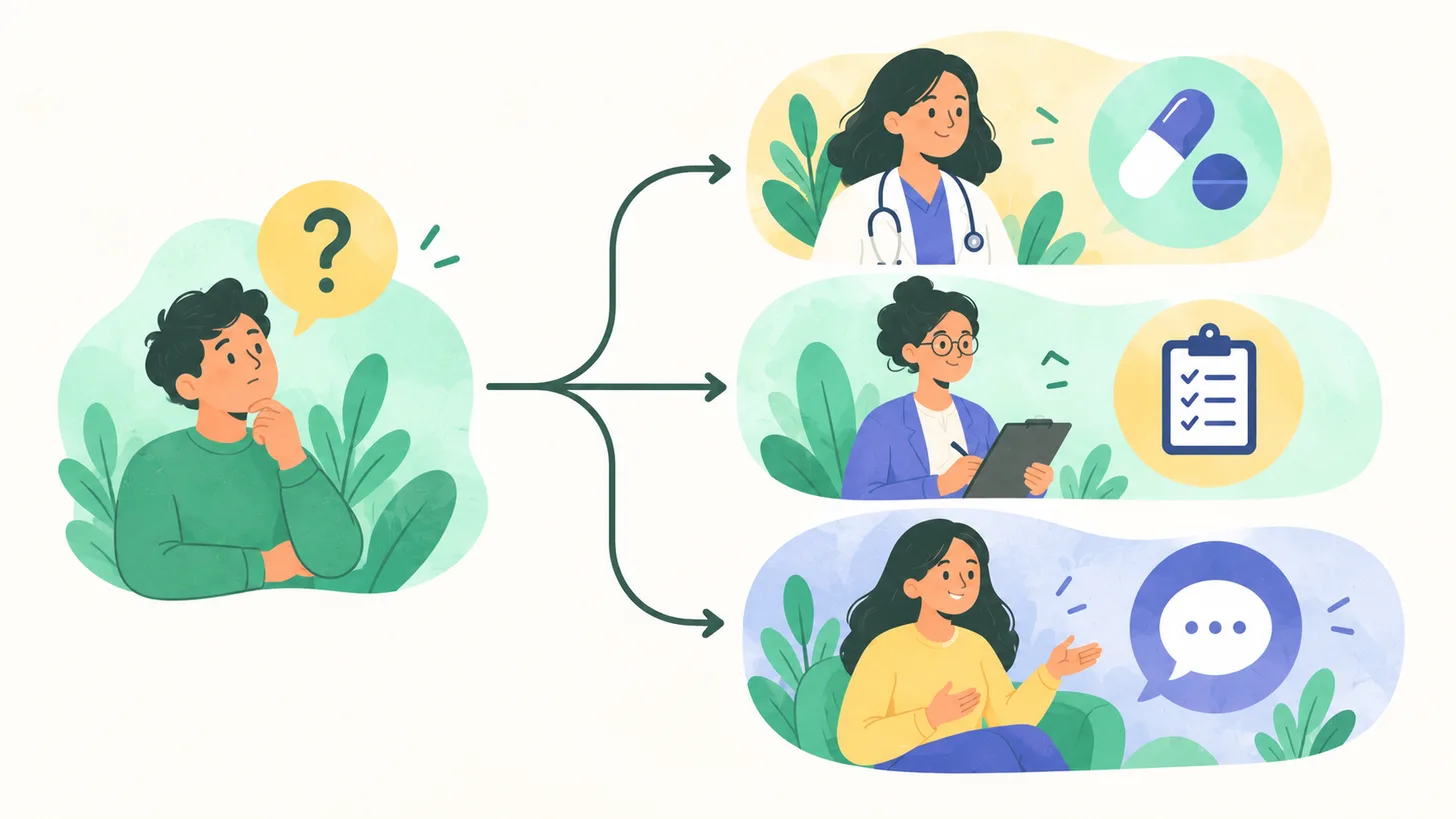
What each professional actually does
Short answer. A psychiatrist diagnoses and prescribes. A psychologist runs therapy sessions. A counsellor or therapist supports you through talk-based work, sometimes without a clinical diagnosis role. In India, their qualifications and registering bodies are different, and that is what tells you who is right for what.
Psychiatrist. An MBBS doctor with an MD or DNB in Psychiatry. Registered with the National Medical Commission (NMC) and the State Medical Council. They diagnose, prescribe medicine, order tests, and admit in rare severe cases. Common classes are SSRIs (antidepressants) and benzodiazepines (anti-anxiety, prescription only).
Clinical psychologist. A two-year M.Phil in Clinical Psychology, done after a Master’s. Registered with the Rehabilitation Council of India (RCI) under the RCI Act. They diagnose using psychological assessments, deliver therapy (CBT, DBT, trauma-informed care, exposure work), but do not prescribe medication.
Counselling psychologist or counsellor. A Master’s in counselling psychology, often RCI-registered as a counsellor. Delivers talk therapy for everyday problems: anxiety, low mood, work stress, relationship issues.
A life coach is not the same thing. For how they compare, read our life coach vs therapist guide.
For a side-by-side look at the three plus a neurologist (who treats brain-nerve conditions, not anxiety), see our psychiatrist vs psychologist vs neurologist comparison.
In short: psychiatrists prescribe, psychologists run therapy, counsellors run shorter talk-based support. Pick by what you need, not by the title.

How to figure out your severity in 5 minutes
Short answer. You do not need a quiz to pick a first step. If you are coping with work and sleep most days but worry too much, that is mild to moderate. If you have stopped sleeping, cannot leave your bed, have panic attacks, or thoughts of harming yourself, that is severe. Severe needs a psychiatrist today, not next week.
Three questions, honestly:
- Can you do your work, eat, and sleep on most days this month? Or has one or more of those stopped?
- Have you had a panic attack, hallucination, or thoughts about ending your life in the last two weeks?
- Did something happen (a loss, a trauma, an accident) that you are not able to put down?
If the first answer is “mostly yes” and the others are no, a psychologist is a good first call. If any of the second question is a yes, see a psychiatrist first. If the third is a yes, a trauma-informed therapist or a psychiatrist (depending on severity) is the right call.
In short: your sleep, work and appetite are the three honest signals. When all three slip, severity is high enough that medication plus therapy is usually the fastest way back.
When your GP is the right first stop
Short answer. If anxiety feels new, started with a physical sign (racing heart, sudden breathlessness, tremor, sudden weight change), or arrived after a change in medicine, see your GP first. In India, anxiety-like signs sometimes come from thyroid issues, low B12, low vitamin D or anaemia. These are easy to miss and easy to treat.
Your GP will usually run a basic blood panel: thyroid (T3, T4, TSH), vitamin B12, vitamin D, haemoglobin, and sometimes an ECG if your heart has been racing. If something shows up, treating it first can resolve a lot of the body’s anxiety response.
If the panel is clean, the GP will refer you to a psychiatrist or a psychologist. In government hospitals, that referral is often needed to get an OPD slot in the psychiatry department.
In short: your GP is the medical rule-out step. One appointment, basic blood work, and either a treated deficiency or a clear referral to the right specialist.
When a psychologist is enough on its own
Short answer. For mild to moderate anxiety, general worry, work stress, or situational low mood, therapy with a psychologist is usually enough. Cognitive behavioural therapy (CBT) is the first-line treatment for anxiety in most guidelines. Most people see change in 8 to 12 sessions.
A psychologist will not prescribe medicine. For many people with anxiety, that is a feature. You talk through what sets off the loop. You work on how you respond. You build a few habits. You don’t always need a pill on top. Not every anxiety needs therapy either. Some of it is a season you walk through with sleep, movement and one honest talk.
For an in-depth look at the credentials, see our page on what a clinical psychologist is and when their training matters most.
In short: if you are coping on most days and the worry is noisy but not stopping your life, start with a psychologist. Therapy without medication is a legitimate full treatment, not a half-measure.
When you need a psychiatrist (and often a psychologist together)
Short answer. See a psychiatrist first when the symptoms are severe: panic attacks several times a week, sleep stopped for days, cannot work, mood changes that swing high then crash, hallucinations, or thoughts of self-harm. Medication can get you to a place where therapy becomes possible, and a psychiatrist for anxiety can prescribe safely.
A psychiatrist’s first visit is usually 45 to 60 minutes. They take a history. They ask about family mental health, physical health and sleep. They may order a few tests. If they prescribe, it is a time-bound plan with a review in 2 to 4 weeks. Medicine is not forever by default.
Many people on medication also see a therapist. Therapy teaches the skills, medication steadies the baseline so you can use the skills. For a longer conversation on this choice, see our page on therapy vs medication.
In short: when the body stops cooperating (sleep, appetite, concentration, safety), a psychiatrist is the right first call. Pair with a psychologist, and the plan works better than either alone.
OCD, panic attacks and PTSD: who do you see first?
Short answer. For OCD, see a psychiatrist for diagnosis plus a therapist trained in Exposure and Response Prevention (ERP). For panic disorder, a psychiatrist settles the attacks while a therapist works on triggers. For PTSD, a trauma-informed therapist (CBT or EMDR) is primary. Add a psychiatrist if sleep or mood needs medicine.
An anxiety attack doctor is not a separate specialty in India. A panic attack is a false alarm the body sends when nothing is actually wrong. It feels like a heart attack because the body does not know the difference.
Treatment combines three parts: understand what is happening, learn to not fight it, and sometimes a short course of medicine to break the cycle.
For OCD specifically, do not accept generic talk therapy as the main plan. ERP is specific. Ask the therapist whether they are trained in it before you book.
In short: these three conditions have specific treatments and specific professionals who deliver them. Ask about the treatment by name (ERP, trauma-focused CBT, EMDR) when you shortlist.
How to check if a professional is really registered in India
Short answer. Psychiatrists are registered with the National Medical Commission (NMC) and their State Medical Council. Clinical and counselling psychologists are registered with the Rehabilitation Council of India (RCI).
Both registers are public. Ask any professional for their registration number and verify it online before your first paid session.
To check a psychiatrist, search the NMC Indian Medical Register or the relevant State Medical Council site by name. The MBBS and MD details should match what they list.
To check a psychologist, visit the Rehabilitation Council of India Central Rehabilitation Register and search by name or CRR number. RCI registration is renewed every five years, so the current year should be active.
If a professional refuses to share their registration number, that is a red flag. Many online directories list unregistered counsellors, and the website looking polished tells you nothing about qualifications.
In short: NMC for psychiatrists, RCI for psychologists. Both searches take two minutes. Do them before you pay for anything beyond a first session.

How much does each type cost in India?
Short answer. In private practice in metro cities today, a counsellor charges roughly ₹800 to ₹1,500 per session, a practising psychologist ₹1,000 to ₹2,500, an M.Phil clinical psychologist ₹1,500 to ₹3,500, and a private psychiatrist ₹1,000 to ₹2,500 per consultation. Smaller cities and government hospitals cost far less or nothing.
A counselling session is usually 50 to 55 minutes. A first psychiatrist appointment runs longer (45 to 60 minutes), follow-ups are shorter (15 to 30 minutes). Medication cost is separate and depends on the prescription class and whether a generic is available.
GoodLives does not publish a single per-session price in blog posts because our therapists span different experience tiers and languages. See our pricing page for the current range.
In short: budget for private care is roughly ₹800 to ₹3,500 per session plus medication if any. Government hospitals and student rates can bring this to near zero, and we cover those next.

Where to go if you cannot afford private care
Short answer. You have options that cost little or nothing. NIMHANS in Bengaluru and the psychiatry OPD at AIIMS Delhi and other AIIMS branches run low-cost or free outpatient services. State and district mental health programmes under the National Mental Health Programme also offer public care. Tele-MANAS at 14416 is free and runs 24/7.
The gap in India is real. The National Mental Health Survey 2015-16, NIMHANS found that India has about 0.75 psychiatrists per 100,000 people, well below the WHO benchmark of three.
That is why queues in government hospitals are long. It is also why going early matters. An OPD slot taken this month beats one you keep delaying.
If you are a student, ask your college counselling centre first. Many universities now have an in-house counsellor at no cost. Some employers have an Employee Assistance Programme (EAP) that gives you a handful of free sessions. Your HR portal is the place to check for names like MindPeers, YourDOST, GoodLives or Amaha.
Readers on r/indiasocial often ask whether an anxiety doctor near me can be free. The honest answer is that a private anxiety specialist usually cannot, but a government hospital psychiatry department can, with patience. Larger cities also have NGO-run clinics where anxiety disorder specialists see patients on a sliding scale.
In short: NIMHANS, AIIMS, district programmes, Tele-MANAS, college counselling, and employer EAPs. Any one of them costs little or nothing, and all are legitimate care.
Can you see them online? And does insurance cover any of it?
Short answer. Yes to both, with caveats. Online psychiatry visits are legal in India under the Telemedicine Practice Guidelines 2020, MoHFW, which let a registered doctor consult over video, audio, or chat.
The Mental Healthcare Act 2017, Section 21(4) says insurers must cover mental illness on the same basis as physical illness. An IRDAI circular in 2022 told every insurer to comply.
In practice, most policies cover inpatient care and some outpatient visits today. Cover for therapy sessions varies by insurer. Ask your insurer in writing whether your plan covers OPD psychiatry and OPD psychology, and what the per-year limit is.
Online therapy and online psychiatrist consultation work well for mild to moderate anxiety and depression. They also help when distance, language, or privacy from family is the barrier.
In-person is better when the case is severe, when a child under 8 is involved, or when a hands-on physical check is needed. Our hub on online therapy in India covers the longer form of this question.
In short: online is legal, insurance for mental illness is a legal right, and real coverage still depends on your policy. Ask your insurer before you commit to a long treatment plan.
[Visual 1 is the Hero image above the H1]
FAQ
How to reduce anxiety?**
Start with sleep, movement, and one professional. Sleep 7 to 8 hours, walk 30 minutes a day, and book one session with a psychologist or your GP. Simple breathing (box breathing, 4 counts in, 4 hold, 4 out, 4 hold) takes the edge off a spike. If anxiety is severe, see a psychiatrist first.
Which doctor is best for anxiety?**
A psychologist for mild to moderate anxiety; a psychiatrist for severe anxiety, panic attacks or OCD. For most people new to this, a clinical or counselling psychologist is enough. If sleep has stopped or panic attacks are frequent, book a psychiatrist and a psychologist together.
What are the 5 warning signs of anxiety?**
The common five: broken sleep; chest tightness or a racing heart; a worry loop you cannot switch off; avoiding places or people; and feeling on edge most of the day. One sign alone is normal. Several together for weeks is worth a talk with a professional.
How to accept anxiety and not fight it?**
Name it, do not argue with it. Anxiety is a false alarm, not a verdict on reality. Try 5-4-3-2-1 grounding, label the thought (“that is my worry voice”), and continue with what you were doing. A therapist can walk you through this.
Can I see a psychiatrist online in India?**
Yes. Under the Telemedicine Practice Guidelines 2020, a registered psychiatrist can consult online over video, audio, or chat. A few restricted medicines cannot be prescribed in the first online visit. Verify the NMC registration first.
Do I need a GP referral to see a psychiatrist in India?**
Private practice, no. Government hospitals, usually yes. Private psychiatrists accept direct bookings. Government OPDs often ask for a referral from the general OPD. If you suspect a medical cause, a GP visit first is still a good idea.
How many sessions will I need?**
For therapy, usually 8 to 12 for mild to moderate anxiety or depression; longer for trauma or OCD. A psychiatrist typically reviews after 2 to 4 weeks and again every month. If a therapist tells you the number is “whatever it takes” without a plan, ask for a review timeline. Clear therapy plans have one.
Ready to talk to someone?
- A 50-minute session with a verified psychologist on GoodLives
- English, Hindi and more Indian languages
- Start when you are ready
Book a Session




Share your thoughts