

What this blog includes
- What venting is, and what it is not
- Six healthy ways to vent out emotions, with when each one fits
- The honest difference between venting and dumping
- Red flags that tell you venting is not enough
Some evenings end with your chest full and your words stuck. The WhatsApp message you did not send, the meeting that went sideways, the sentence your father said at dinner.
That full-chest, heavy-hearted feeling, what in Hindi is sometimes called mann bhari hona (a heart that feels too full), is not weakness. It is pressure asking for a way out. You are not being dramatic. You are being human.
Trusted by 500K+ people, GoodLives has sat with readers at exactly this point. The honest answer is simple: you need healthy ways to vent out, not another listicle of tips you have already tried.
Why does venting out your emotions feel like such a relief?
Your body treats a hard feeling the way it treats a loud alarm. Heart rate rises, muscles tighten, thoughts loop. Venting is any safe way to let the alarm wind down.
The National Institute of Mental Health and Neurosciences notes in its public mental health material that even brief emotional release can reduce stress-related tension. It does not fix the thing that upset you. It gives your nervous system a chance to settle so you can think again.
In short: venting lowers the volume, so the next hour feels easier.
Venting out vs. dumping: the honest difference
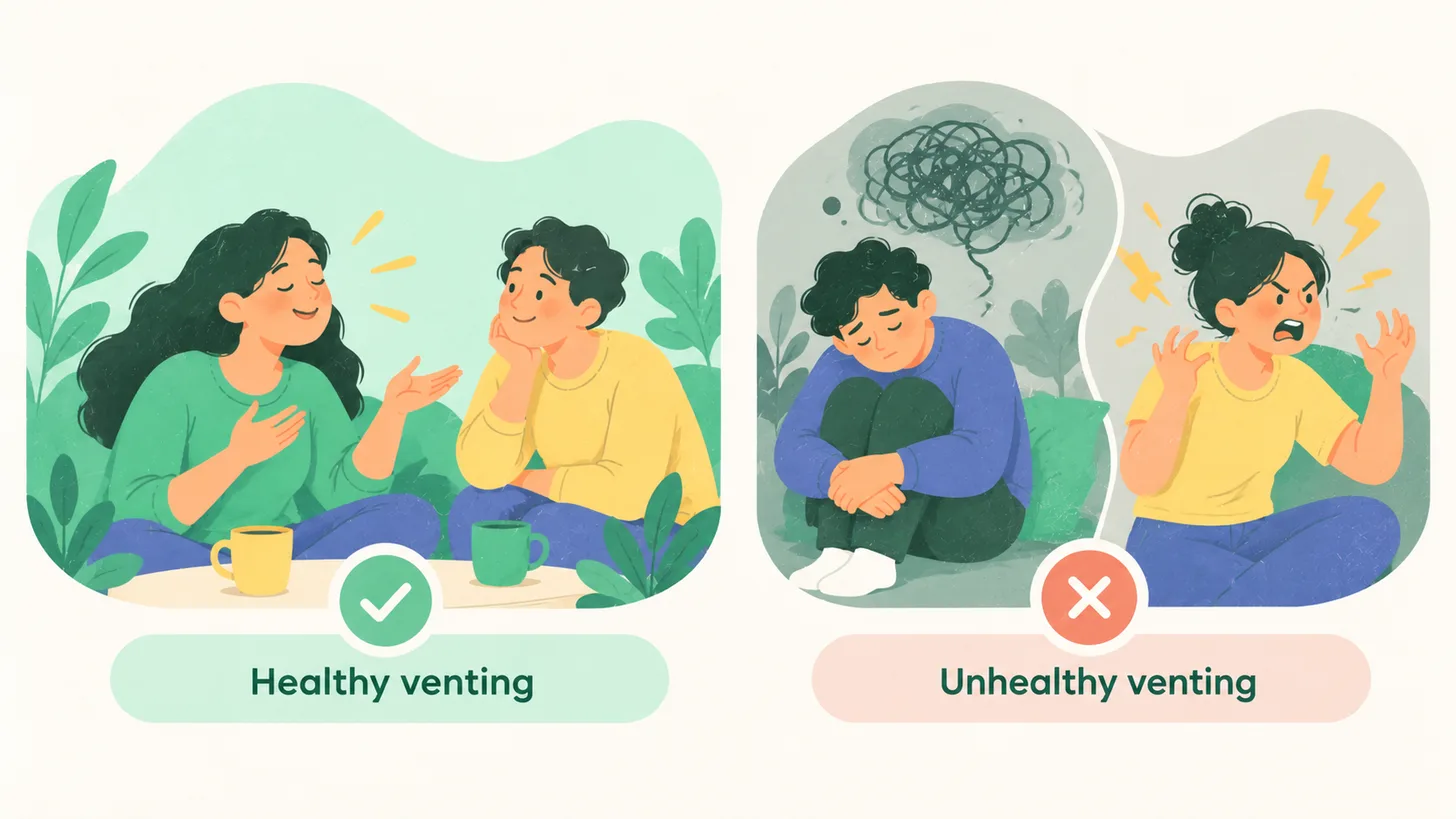
Venting is release that leads somewhere. Dumping is the same story on loop, with no new ground. Most of us have had this phone call with a friend and lost it; one of you felt lighter, one of you felt heavier. The difference is not how much you say. It is whether the saying moves anything.
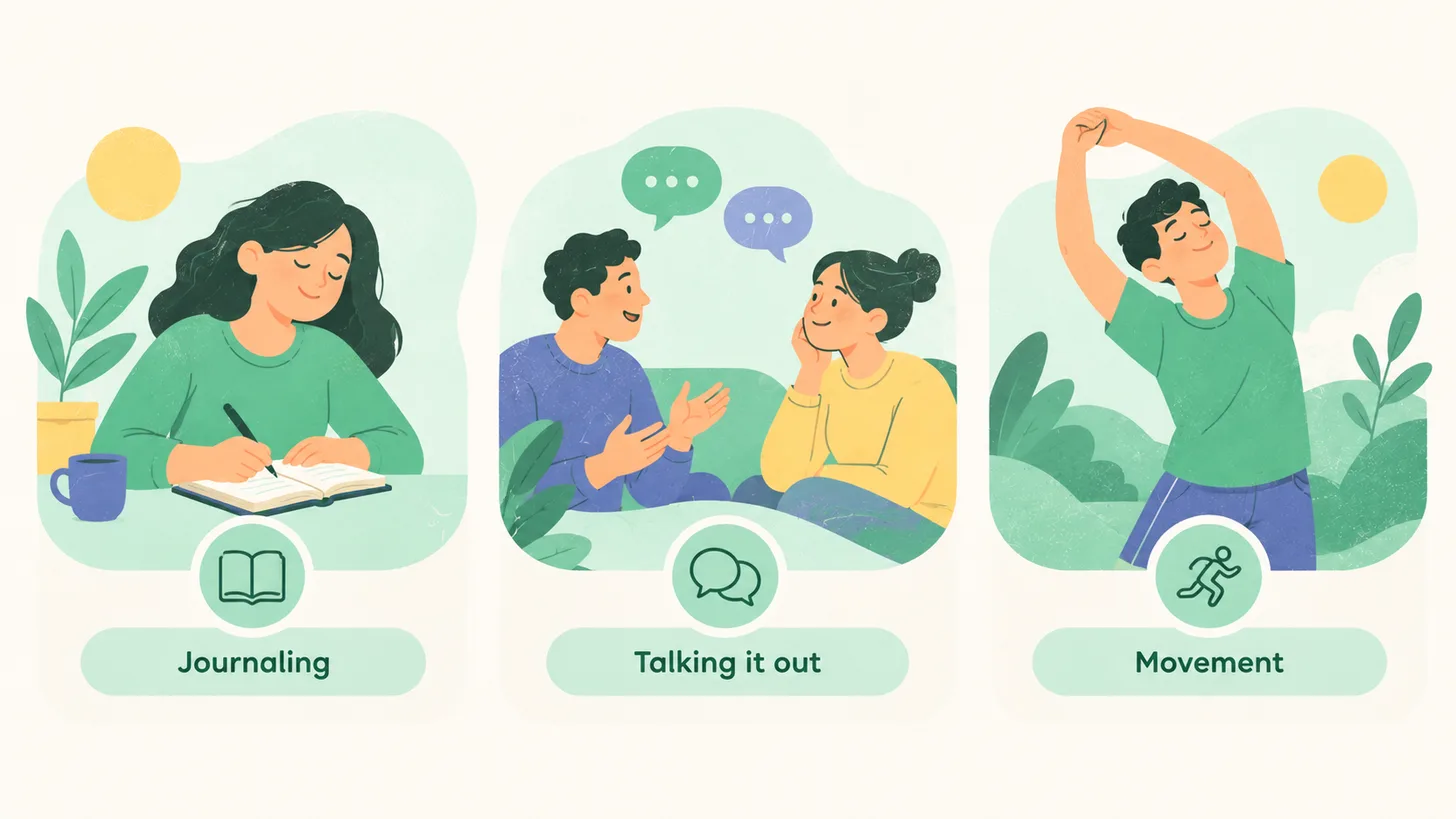
In short: aim for release that leaves space, not a replay that fills it.
Six healthy ways to vent out emotions
Different pressures want different releases. One asks for your pen, one for your legs, one for a friend. The six ways below are supported by decades of research and they all share one trait: they let you feel the feeling without being swallowed by it.

If your chest is tight right now, take one slow minute with this before you read on.
A moment to breathe
Follow the circle. Breathe in, hold, breathe out, then hold. Four counts each. Stay as long as you like.
1. Expressive journaling: 20 minutes, no editing
The simplest and most studied way to vent on paper.
Psychologist James Pennebaker’s work on expressive writing, summarised by the American Psychological Association, suggests that writing honestly about an upsetting experience for 15 to 20 minutes, on three or four days, can improve mood and some markers of physical health in the weeks after.
What to do: open a notebook or your phone’s notes app, set a 20-minute timer, and write what is underneath the feeling. Hindi, English or Hinglish is fine. No editing. No audience. Burn the page after if you want to. Our longer piece on the benefits of journaling covers prompts for different weeks.
When to pause: if writing floods you with trauma memories and you cannot stop, close the notebook and tell a therapist. This method is not for every memory. Expressive arts therapy with a professional is the safer path when a memory keeps you up at night.
2. Talking honestly to a trusted person
Not everyone has one. If you do, pick someone who listens without fixing. Say “I need to vent for ten minutes, no advice” at the start. End with one sentence about what you want to do next, even if that sentence is “nothing tonight”.
They will not try to sell you anything. They will listen.
In short: the goal is to be heard, not to be solved.
3. Movement and sweat
The honest truth is not that exercise is medicine. The honest truth is that moderate movement lowers stress hormones and raises brain-derived neurotrophic factor, which makes the next hour easier.
A brisk 20-minute walk works. A dance to one loud song works. The gym is not required. Our note on the benefits of morning exercise is useful if mornings are your window.
When this way wins: when the feeling is in your chest and your legs, not in your head. Anger, restlessness, that “I need to get out” twitch.
4. Crying honestly (and vocal release)
Research by Dutch psychologist Ad Vingerhoets, published in Frontiers in Psychology, finds that crying can shift mood and bring relief, though not for everyone and not every time. Context matters. Crying alone with a sad song is different from crying in front of someone safe.
In Indian homes, particularly for men, crying is often framed as weakness. It is not. It is the body’s oldest release valve. If sobs will not come, a long, loud sigh or a few shouted words in an empty car do similar work.
5. Creative expression: art, music, dance
You do not have to be good. That is the whole point. The clinical psychologist Cathy Malchiodi’s long body of work on expressive arts therapy suggests that making something, anything, moves emotions that words alone cannot.
Try one of these for 15 minutes: scribble with crayons on scrap paper, hum along to a song in your mother tongue, choreograph a silly dance in your bedroom, cook something that smells of your childhood. Nobody has to see it.
6. Nature and silence
Environmental psychologists Rachel and Stephen Kaplan’s attention restoration theory, developed through decades of research at the University of Michigan, suggests that time in a less demanding natural setting reduces mental fatigue and rumination. Even 20 minutes in a park has an effect.
The honest Indian version: not every metro has safe green space, and not every evening is safe to be out. A quiet balcony at 7 am, a terrace at dusk, a corner of a courtyard, each count. Phone face down. No podcast. Just you, the air, and the sounds of the morning.
In short: the point is less input, not more scenery.
Venting isn’t the goal: what to do after
Here is the honest reframe nobody says out loud. Venting is not the goal. Venting makes space for the goal. The goal is understanding what the feeling is about, spotting the pattern it belongs to, and choosing one small change this week. Journaling helps you spot the loop. A therapist helps you break it.
After a good vent, ask yourself three gentle questions: What was the feeling underneath the feeling? What was it trying to protect? What is one tiny thing I could do differently this week? Our piece on helpful methods to deal with emotional triggers walks through this slowly.
Not every heavy day needs therapy. Some of this is a season you walk through, with sleep and one honest conversation.
When venting isn’t enough: red flags to notice
Venting is a tool for ordinary pressure. If any of the signs below have been true for more than two weeks, the honest next step is a therapist, not a longer walk.
- You cannot stop thinking about ending your life, or hurting yourself
- Panic attacks are happening often enough that you plan around them
- You feel numb, flat, or detached from your own life
- You are drinking, smoking or using something to cope every day
- The same conversation with the same person leaves you worse every time
- Sleep has not been proper for two weeks or more
If you are supporting someone else through this, our note on effective ways to cope with feeling overwhelmed is a gentle place to start.
In short: venting is a release valve, not a treatment plan. When the pressure keeps rising, it is okay to ask for help.
FAQ
What is the healthiest way to vent out emotions?
Is venting the same as oversharing?
Can venting out emotions make you feel worse?
How do I vent when I cannot cry or write?
Is screaming into a pillow actually healthy?
When should venting lead to therapy?
button: Book a Session
This post is for information only and is not a substitute for professional care.


Share your thoughts