
What this blog includes
- The everyday reasons unexplained crying shows up
- When tears quietly point at depression, anxiety, burnout or trauma
- How hormones and the thyroid fit in, from PMDD to perimenopause
- One rare medical cause worth naming
- What helps today, tonight and this week
If you have asked yourself “why am I crying for no reason” this week, read this slowly. You are not being dramatic, and you are not broken. At GoodLives, where we have worked with 500K+ readers, the first thing a therapist usually tells someone in your spot is this: your tears have a reason, even when your mind cannot find it yet.
What does “crying for no reason” actually mean?
When people search “why am I crying for no reason”, they usually mean tears without a trigger they can name, not tears from nothing. Your nervous system has noticed something your conscious mind has not caught up with yet. Older Hindi has a lovely phrase for this feeling, mann bhari hona, the heart grown heavy.
Crying is how the body resets after a feeling builds past what the day can hold. A short cry often leaves you calmer than you started. The honest answer to a 11 pm Google search is usually: there is a reason, your brain just cannot put it into a sentence yet.
In short: Tears without a conscious trigger are a signal, not a glitch.
Everyday reasons the tears show up without warning
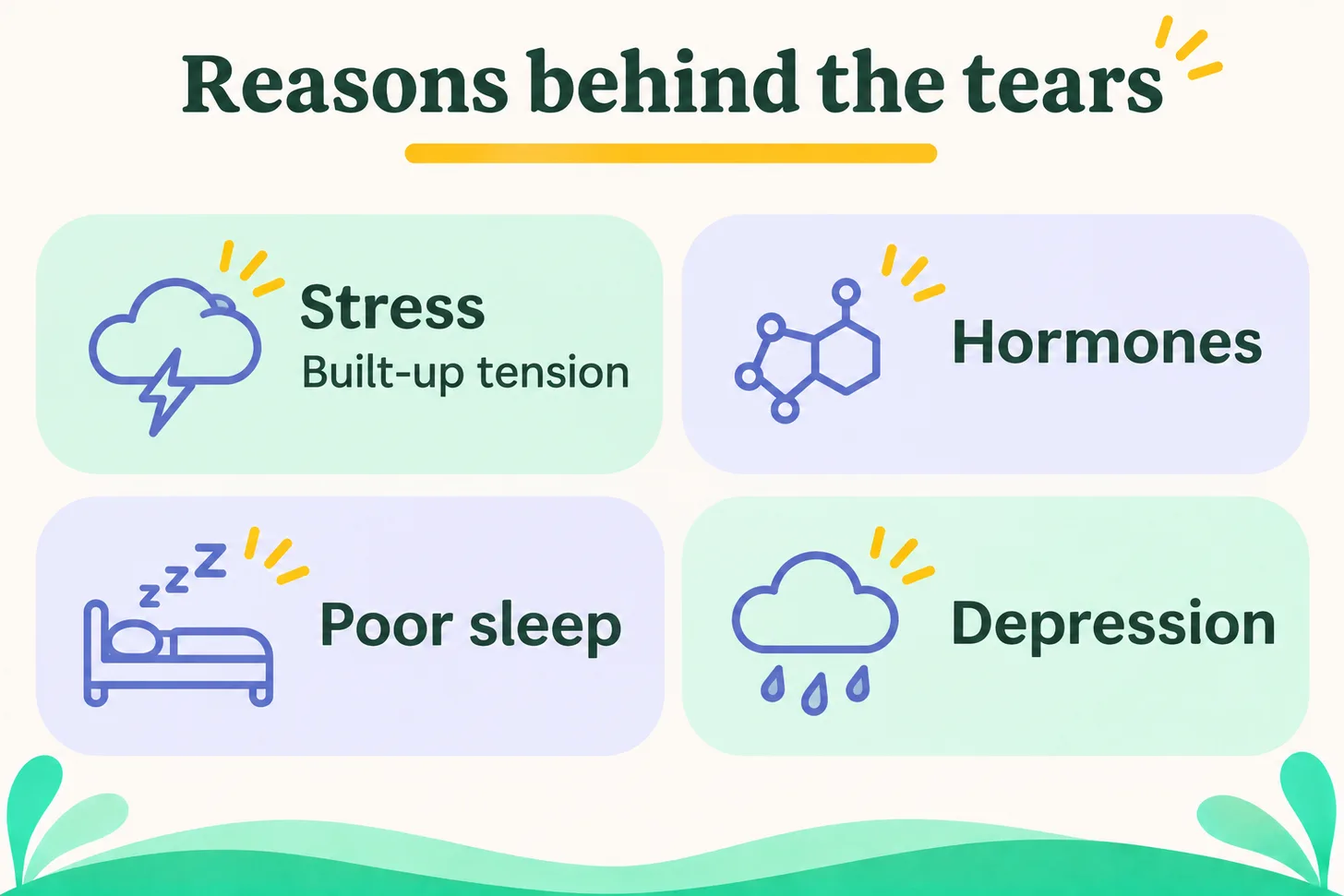
Most of the time, crying for no reason is really crying because four small things stacked. Sleep debt, a hormonal shift, low blood sugar, a tense WhatsApp thread with a parent, a long week at work. Your body added them up before you did and found the number too high.

The four stacking things GoodLives readers mention most:
In short: Unexplained tears are usually a stack, not a surprise.
When the crying is your mind asking for help
If the tears come most days for more than two weeks, or arrive with a flat, heavy feeling, “no reason” stops being accurate. What looks like random crying can be an early sign of depression, anxiety or burnout.
Depression does not always look like sadness. The clinical picture used at NIMHANS describes it as a loss of interest, low mood or tearfulness that lasts most of the day, nearly every day, for at least two weeks.
Anxiety has a softer tell. You hold a mild alarm all day, the tears slip out the moment your body finally sits down, and you call it “being tired”.
Burnout is the one most working Indians miss on themselves. The WHO defines burnout as chronic workplace stress with exhaustion, cynicism and a drop in performance. Tears at your desk on a Tuesday are a common early signal.
Post-traumatic stress, after an event the mind has not fully processed, can also show up as crying triggered by a small sound, a smell or a date on the calendar.
In short: If the crying has stayed longer than a bad week, it may be pointing at something. Pointing is useful information.
Hormones, thyroid and tears: PMDD, perimenopause, hypothyroidism
Hormones write a quiet subtext under a lot of unexplained crying. The three most common ones Indian women read about are PMDD, perimenopause and hypothyroidism. If the tears come on a schedule, or with weight, sleep or temperature changes, this section matters more than most explainers will tell you.
Premenstrual dysphoric disorder (PMDD) is a severe form of PMS. In the week before a period, mood crashes, tears come easily, and the next day you feel like a slightly different person. Tracking two cycles on a period app is often the fastest way to see the pattern.
Perimenopause can start in the late thirties, not only in the fifties, and oestrogen swings in this window can bring on crying spells that feel out of character. Hot flushes and poor sleep usually sit alongside it.
Hypothyroidism is a thyroid condition where the gland slows down. Low mood, tearfulness, cold hands, hair fall and fatigue show up together. A simple TSH blood test from your GP can rule it in or out, and it is more common in Indian women than most of us realise.
If the pattern looks hormonal, the right first door is your GP or a gynaecologist. A therapist works alongside, not instead.
In short: If your tears move with your cycle or your energy, your hormones may be writing the script.
The rare one worth naming: pseudobulbar affect
Pseudobulbar affect is a neurological condition where crying or laughing happens suddenly, often without a matching feeling underneath. It is uncommon, and it is usually linked to a stroke, multiple sclerosis, Parkinson’s or a brain injury. It belongs here because the question leads here, and a short honest answer is kinder than a silence.
If your crying spells are sudden, short, and oddly disconnected from feeling, especially with other neurological changes, this is a conversation for a neurologist. For almost everyone reading this, it is not what is happening. It is here so you can set it down.
In short: Name it, know it is uncommon, and move on.
What helps today, tonight and this week
You have probably tried deep breathing and a walk, and been told to try them again. You do not need a diagnosis to feel slightly better tonight. A few small moves lower the volume so you can think the harder thought tomorrow.
Let the cry finish. If you are already crying, do not stop it. A suppressed cry tends to leave the feeling in the room for longer.
Name what you can. Type one line into your phone: “I am crying, I think it is because of X” or “I do not know why”. Naming lowers the alarm.
Breathe long enough for the body to catch up. Try four-four-four-four: inhale four counts, hold four, exhale four, hold four, for two minutes. Longer exhales calm the nervous system faster than any pep talk.
If you want, take one slow minute with this before you read on.
A moment to breathe
Follow the circle. Breathe in, hold, breathe out, then hold. Four counts each. Stay as long as you like.
Move something gentle. A five-minute walk, or cold water on your wrists, shifts the physiology enough that the next thought lands differently.
Sleep like it is medicine. Aim for seven to eight hours this week with the same wake-up time daily. Two bad nights in a row is one of the most reliable crying triggers your body has.
One honest conversation. Not a performance. One person, one short sentence about what is going on.
Grounding and slow breathing lower your heart rate in two minutes. A therapist helps you see which triggers they work best on, and what to do on days they do not.
In short: Small moves done for one week often tell you more than any Google search.
When it is time to see a therapist or your GP
Not every wave of tears needs a professional. A hard week can look exactly like a hard month, and a good therapist will tell you the difference honestly. But a few signals are worth a conversation with someone qualified, and that conversation often shortens how long this lasts.
The first three belong in a conversation with a therapist. The fourth belongs in a conversation today, with anyone qualified. The fifth belongs with your GP and a referral.
If you have tried online therapy once and the fit was off, that is a real thing and not a verdict on therapy itself. Try once more, with a clear ask of what you want this time. You can start, see how it feels, and stop whenever you need to.
In short: You do not have to earn help by crying longer or louder. If the question has kept you up two nights, that is enough of a reason.
This post is for information only and is not a substitute for professional care.


Share your thoughts