
Helpline, if tonight is heavy If you are thinking about hurting yourself, or life feels like too much right now, please call before you keep reading. You do not need to be in a crisis to call.
What this blog includes
- A 10-question student stress self-check with a 0 to 3 answer scale
- Four honest result bands, including an urgent band for suicidal thoughts
- The other conditions that can look like student stress

If you are reading this at 2 am with a textbook open and a mother’s voice replaying in your head, you are not alone and you are not weak. School and college in India are hard in ways our parents’ generation did not have language for. A test score becomes a referendum on your worth. A classmate’s rank becomes a mirror. A missed call from home becomes a small panic.
What you are feeling has a name, and it is more common than the quietness around it suggests. The National Crime Records Bureau recorded 13,044 student suicides in India in 2022, the highest number ever reported for students in NCRB data. That is a crisis, and the first step out of it is being honest about what you are feeling.
GoodLives has supported 500K+ people with therapy and workshops in India, many of them students, and the pattern we see is this: students do not reach out because they think the stress is normal, or because they do not want to worry their parents. Both are reasons to reach out, not reasons to wait.
What a student stress self-check can and cannot tell you
A student stress self-check is a reflection tool. It takes the research on how stress shows up in young people, including the Perceived Stress Scale (PSS-10) first published by Dr Sheldon Cohen in 1983, and asks the questions in plain language.
If your score lands in the high or urgent band, the test is telling you one honest thing: this is worth a conversation with a counsellor or psychologist. It is not telling you that you have a disorder.
Three reasons the self-check cannot diagnose. First, stress overlaps with depression, anxiety, ADHD, grief and even thyroid issues; only a clinical psychologist can tell them apart.
Second, a diagnosis is made in a 50 to 90-minute conversation, not by a 10-question form on a Thursday night.
Third, stress is a response, not an illness. Chronic stress can lead to a condition, but the stress itself is a signal that something in your life is asking for change or support.
In short: take this test for the clarity it offers, not for the verdict it does not have.
The 10-question student stress self-check
Below are 10 questions. Think about the past month, not your whole life. For each question, pick a number:
- 0 — Not at all
- 1 — Sometimes
- 2 — Often
- 3 — Almost always
Write your answers on a notepad or in your phone. Add them up at the end.
1. Sleep around exams. In the past month, how often has your sleep been shaky in the week before an exam or during an exam stretch — trouble falling asleep, waking at 3 am, or sleeping too much to avoid studying?
2. Not enough for parents. How often has it felt that nothing you do is quite enough for your parents, that one more mark, one more rank, one more thing would finally be enough?
3. Comparing to classmates or siblings. How often do you catch yourself comparing your marks, your attempts, your college, or your pace to a classmate, cousin or sibling, and feeling smaller after?
4. Body symptoms before studying or an exam. How often do you get headaches, stomach aches, loose motions, nausea or chest tightness in the hour before class, a test or a submission?
5. Avoiding tests, assignments or college. How often have you skipped a class, delayed an assignment past the real cost, or avoided opening a test or email because the feeling is too heavy?
6. Panic about the future. How often have you felt a sudden panic that your future is already decided, that one bad semester or one failed attempt means your whole life is over?
7. Crying over marks or feedback. How often have you cried, in private or in public, after seeing a mark, a rank, or a line of feedback from a teacher or parent?
8. Numbness instead of motivation. How often has the response to pressure been shutdown, not fight — a flat quiet, scrolling for hours, not being able to begin?
9. Thoughts of not being here. How often, even for a few seconds, has the thought come up that it would be easier if you were not here, or that your family would be better off without you?
10. Using substances to study or cope. How often, in the past month, have you used alcohol, cannabis, stimulants, or someone else’s prescription (Modafinil, Adderall, Ritalin) to study, calm down, or get through the night?
What your score suggests
Add up your 10 answers. The maximum is 30. Before you read the bands, check question 9. If you answered anything above 0 on question 9, the total score does not apply to you tonight. The right next step is in the urgent band below, regardless of your total.
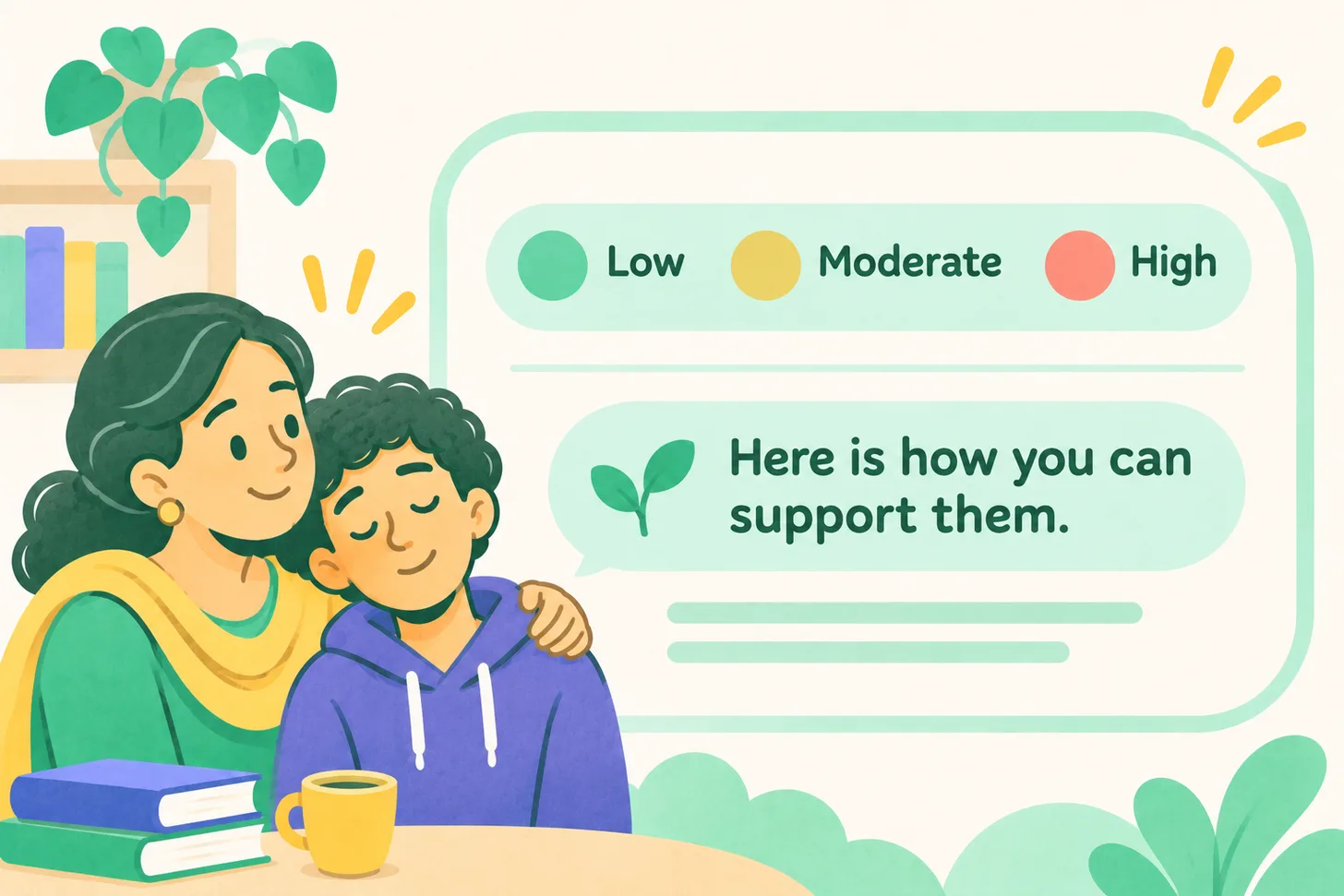
- 0 to 7 — Low stress. The pressure is real, but you are coping. Keep the basics: sleep seven hours, move your body for 20 minutes a day, see a friend who is not studying. If this changes, come back to this test.
- 8 to 15 — Moderate stress. This is a normal response to the volume of what you are carrying, and self-help works at this level. Name the three triggers that are costing you the most, put limits on comparison (social media, group chats), start journaling for 10 minutes a day, and talk to one trusted adult. If your score climbs over the next fortnight, book a session.
- 16 to 23 — High stress. This is more than one person should carry alone. See a school or college counsellor, or a clinical psychologist, within the next two weeks. If a parent or mentor feels safe, tell them one line about what is going on. Taking a short leave from the pressure, where that is possible, is a legitimate option.
- 24 to 30, or any score above 0 on question 9 — Urgent. This is a sign to get help today, not next week.
In short: this check gives you a number and a direction. The actual care happens in a conversation.
The other things that can look like student stress
Student stress is not always only stress. Several conditions overlap with the self-check pattern above, and only a clinician can tell them apart. Knowing the names helps you ask for the right referral.
Depression often sits inside student stress. The low mood, the numbness, the “I do not care any more” after a term of trying — these are not laziness. The World Health Organization lists depression as a leading cause of illness worldwide, treatable with therapy and, in some cases, medication).
Generalised anxiety disorder (GAD) and panic disorder can masquerade as “exam nerves”. If your body is on alert most days, not just before a test, this is worth checking. Our anxiety self-check is a parallel reflection tool for that pattern.
Specific exam phobia, a kind of performance anxiety, is where your mind is clear in the preparation room and blanks the second the paper is in front of you.
ADHD can look like student stress because the inability to start, the time blindness, and the perfectionism create a loop of missed deadlines and panic. If you have been “lazy” since Class 6 despite trying, this is worth a mention to a psychologist.
Thyroid issues, anaemia and undiagnosed sleep apnea are physical causes that look like student stress. A simple blood test and a GP visit are worth doing when the stress is heavy for months.
Grief after a loss, a family financial crisis, or a parental illness can take all the oxygen out of studying. The problem is not your focus; the problem is what is happening at home.
Student stress often looks like
- A build-up around exams and submissions
- Easing when a break arrives
- Clear triggers you can name
- A body response you can trace to a date
By contrast, depression and GAD often look like
- Low or anxious baseline most days
- No real easing even on holidays
- Triggers that are harder to pin down
- Lasting six months or more
In short: stress has a shape with starts and ends. If the heaviness has no edges, it may be more than stress, and the next step is a clinical conversation.
Why Indian students are carrying so much
Student stress in India sits in a specific context, and naming it is part of care, not blame.
Academic pressure in India is high. The Deb, Strodl and Sun study on Indian secondary-school students found that 63.5% of participants reported stress related to academic pressure. That is close to two in three. Research by Bhojak and colleagues in the Indian Journal of Psychiatry describes similar patterns across medical and engineering students.
Coaching ecosystems like Kota, UPSC prep in Delhi, and the private-tutoring culture across metros can turn months into a long test week. The pressure is not just the exam; it is the sunk cost of fees, hostel, and family hope.
Parental pressure is often an amplifier, not the cause. Most parents want the best for you and do not have the vocabulary to say it gently. A conversation with a counsellor can give you words to carry home.
Help-seeking stigma is real for students. “Everyone goes through this” and “do not spoil your rank by thinking about this” are sentences many Indian students have heard. They are wrong. Reaching for help early is the thing that keeps the rank, the health and the person intact.
In short: the context is heavy, and the honest response is support, not solo endurance.
If this self-check reflects your week, here is what to do next
If your score is 8 or above, or any answer on question 9 is above 0, the next step is a conversation. Below are five routes in India, ordered by how fast they can reach you.
Two, speak to your college counsellor. Most Indian institutions now have at least one counsellor on campus, and the service is usually free and confidential. The UGC guidelines on student mental health require institutions to run counselling cells. If your college has one, the first appointment is often a 30-minute conversation; nothing goes on your record.
Three, look at NIMHANS Project YUVA. NIMHANS, India’s premier mental health institute in Bengaluru, runs a student-focused programme called YUVA for young people aged 18 to 25. It offers assessment, counselling and referrals, often at low cost.
Good for a longer, non-emergency conversation when a counsellor at your college is not available.
Five, start therapy on GoodLives. On a GoodLives intake call, ask for a therapist who works with students and understands academic stress. Sessions are online, so you can take them from your room or hostel. See our pricing page for current rates; student support options are listed there.
If what you need tonight is sleep, a therapy intake call on Friday is not the fastest tool. Not every heavy exam week needs long-term therapy; some weeks need a 20-minute phone call and permission to rest.
In short: the shortest path to feeling less stuck is one conversation with someone trained to listen for the specific pattern of student life.
FAQ
How do I know if my stress is serious?
Is this student stress test accurate?
Can academic stress cause depression or anxiety?
What should I say to my parents if I am stressed?
Will seeing a counsellor affect my academic record?
What if I use alcohol or weed to cope with student stress?
Is student burnout the same as stress?
This post is for information only and is not a substitute for professional care.
Your right to care is protected under the Mental Healthcare Act 2017, which recognises access to free emergency mental-health care at government hospitals.


Share your thoughts