
What this blog includes
- Why the “five stages of depression” idea is a myth
- How mild, moderate and severe depression are actually defined
- What subclinical or prodromal signs look like
- The treatment path from first appointment to maintenance
- When to ask for more help, in plain terms
If you have been Googling “stages of depression” at 1 am, trying to work out whether you are in stage 2 of something, you are not alone. The honest answer is simpler and kinder than most search results suggest. There are no five stages. There are severity levels and a care timeline, and telling the two apart lowers a lot of panic.
GoodLives, India’s online therapy and counselling platform, is trusted by 500K+ people and carries a 5 Google rating. What follows is the same clarification we often share with readers who come in confused by the stage models online.

Does depression really move through stages?
Not in the way most articles claim. Depression is not a staircase you climb from denial to acceptance. The World Health Organization and the two main clinical manuals, the DSM-5 (American Psychiatric Association) and the ICD-11 (WHO), describe depression by severity, not by a set of fixed emotional stages.
You will often see pages ranking “the five stages of depression” next to grief. Those pages have blended two different ideas. Grief has the well-known stages from Elisabeth Kübler-Ross’s work with dying patients, later broadened to loss. Depression is a mental health condition, not a response to one event on a timeline.
What clinicians actually track is two things. One, how heavy the symptoms are right now (severity). Two, where you are in the course of care (prodromal, acute, recovery, maintenance). Together these give a far more honest map than any numbered checklist.
In short: depression has severity levels and a treatment course, not fixed emotional stages, and knowing the difference lowers a lot of unhelpful self-judging.
What do the DSM-5 and ICD-11 say about depression severity?
Both manuals grade a depressive episode as mild, moderate, severe without psychotic features, or severe with psychotic features. The grade depends on how many symptoms are present, how badly they interfere with daily life, and whether suicidal thoughts or psychosis are part of the picture.
A depressive episode is defined as low mood or loss of interest, plus other symptoms, most of the day, most days, for at least two weeks. The World Health Organization summary matches this definition.
Severity is not a verdict on your strength. It is a snapshot of the biology and the load you are carrying. Many people move between levels over months, and the grade a clinician writes today is not a permanent label. It is a tool to match care to what you actually need now.
Our full depression guide for India covers the symptoms list in more depth if you want to compare your last two weeks against it.
In short: DSM-5 and ICD-11 rate depression by how many symptoms there are, how disabling they are, and whether suicidal thoughts or psychosis are also present.
What does subclinical or prodromal depression look like?
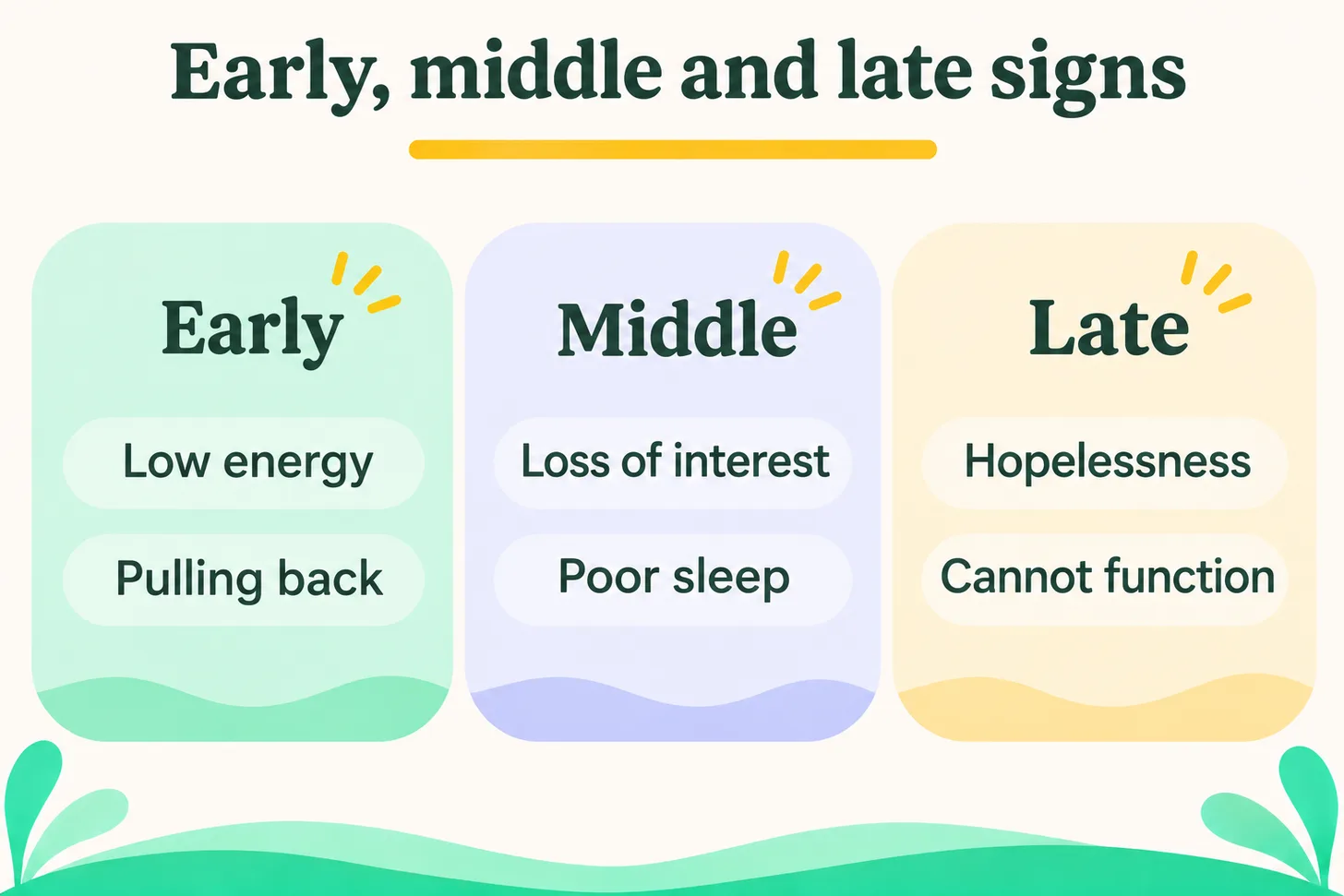
Prodromal is the clinical word for the early phase, before a full episode. Symptoms are there, but they are not yet severe or lasting enough to meet a diagnosis. Weeks of poorer sleep, less interest in food or friends, a low-grade heaviness that keeps leaking into your day, more irritability than usual.
This phase matters for two reasons. People often look back after a bigger episode and realise they had warning signs for weeks or months. And research from NIMHANS and the Indian Journal of Psychiatry suggests that catching depression early reduces how long an episode lasts.
Signs people describe in this phase include:
- Needing more effort for things that used to feel easy
- A slow creeping loss of interest in hobbies, not a crash
- Irritability at home, especially in the evenings
- Early morning waking, even by thirty or forty minutes
- A sense of distance from people you usually enjoy
If this sounds like your last few weeks, it is not proof that a severe depression is coming. It is a reason to speak with a GP or a psychologist before the picture gets heavier. Our depression self-check is a useful first mirror.
In short: prodromal depression is the quiet build-up phase, and catching it early is the biggest single lever for a shorter, lighter episode.
What is mild depression?
Mild depression means you meet the basic criteria for a depressive episode, but you can still do most of what your day asks. Work gets done, often with more effort. Relationships feel strained but intact. Sleep and appetite are off, not collapsed.
Clinicians typically look for five or six symptoms from the DSM-5 list, present most days for at least two weeks, causing distress but not major impairment. Suicidal thinking is usually absent or passive (“I wish I didn’t have to wake up tomorrow”), without a plan or intent.
Mild depression often responds well to psychological treatment alone. Cognitive Behavioural Therapy and Behavioural Activation have the strongest evidence here. According to WHO guidance, medication is not usually first line for mild cases, though your clinician may still offer it if other factors call for it.
If this sounds like your month, the next step is a conversation with a psychologist, not a wait-and-see approach. Mild depression left alone for too long is one of the quietest paths into a heavier one.
In short: mild depression is uncomfortable but functional, and therapy alone, paired with sleep, movement and one honest conversation a week, is often enough.
What is moderate depression?
Moderate depression is the level where life starts to get visibly harder. You might be calling in sick more often, cancelling plans, falling behind at work or college, snapping at people you love. The symptoms are more numerous and heavier, and the interference is clear to you and often to others.
In this zone, combined treatment often outperforms either option alone. That means weekly therapy (CBT, Interpersonal Therapy or similar) alongside a psychiatrist’s review of whether medication from a class like SSRIs or SNRIs could help. Only a psychiatrist can prescribe. GoodLives therapists do not prescribe.
People sometimes ask whether starting medication at this level means they are “worse than they thought”. It does not. It means a clinician has decided the easier route to recovery includes lowering the symptom volume while you do the therapy work.
In short: moderate depression is where function is clearly affected, and adding a psychiatrist’s review to a therapy plan can shorten recovery for many people.
What is severe depression?
Severe depression is medical territory. Most symptoms from the DSM-5 list are present, the interference is major, and there is often active suicidal thinking, inability to eat or sleep for long stretches, and major weight change.
Severe depression comes in two forms. Severe without psychotic features is the above picture. Severe with psychotic features adds hallucinations or delusions, usually matching the low mood. This level needs a psychiatrist urgently, often with same-day care.
The Mental Healthcare Act, 2017 protects your right to urgent treatment at any Indian public hospital, with no referral required and no refusal on the basis of mental illness. Source: Mental Healthcare Act, 2017.
A note we have to say honestly, using safe-messaging language. If someone you love has died by suicide, your grief is real and none of it is your fault. Severe depression is also the level that responds most clearly to active care when it arrives. It is the most treatable level, not the least, once a clinician is leading.
In short: severe depression needs a psychiatrist’s lead and often becomes the most treatable level once active care is in place.
What are the stages of treatment and recovery?
While depression itself does not move through neat emotional stages, the care journey often does. A clinician will usually talk about four phases: acute, continuation, maintenance and relapse prevention.
The acute phase is the first eight to twelve weeks of active treatment, where the goal is to lift the worst of the symptoms. Therapy frequency is usually weekly, and medication, if it has been prescribed, is being adjusted to find a steady dose.
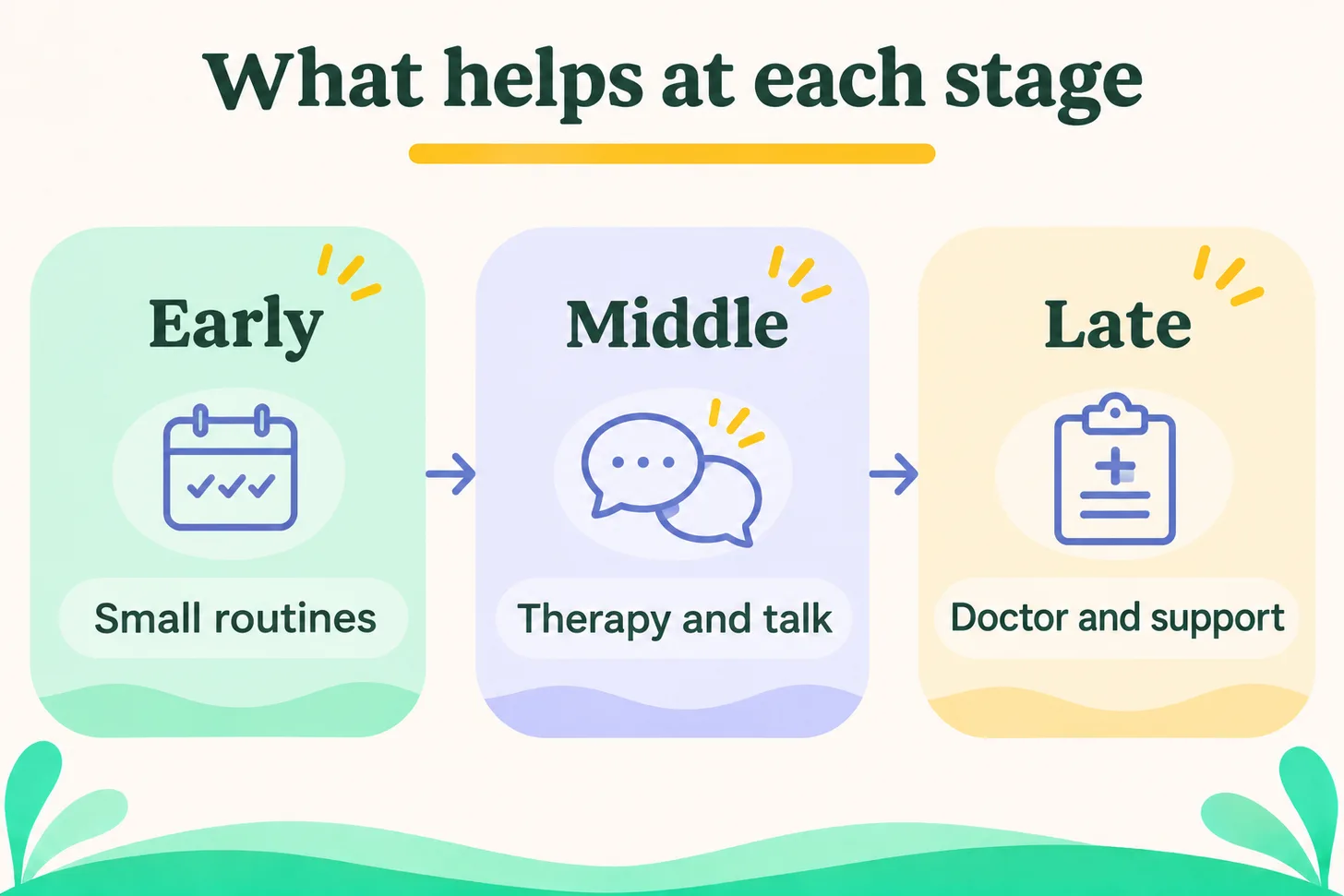
Continuation lasts roughly four to nine months after the symptoms lift, and the goal is to prevent an early relapse. Sessions may space out. Medication, if it is working, is usually continued at the same dose under a psychiatrist’s review, not stopped on your own.
Maintenance applies when you have had two or more episodes. Lighter-touch ongoing care (monthly therapy check-ins, continued medication, planned reviews) keeps the risk of the next episode low. The length depends on your history and your clinician.
Relapse prevention is the long piece. Knowing your early signs, keeping the habits that held you up, and asking for help sooner next time. Many people who have had one episode never have another. Those who do often manage later episodes faster, because the map is familiar.
If you want a fuller walkthrough of the therapy side of this timeline, our guide on online therapy for depression covers formats, cadence and what to expect.
In short: treatment has acute, continuation, maintenance and prevention phases, and the path is longer than people expect, which is also why it holds.
Where does the “five stages of depression” idea come from?
The five-stage framing is borrowed, not clinical. Elisabeth Kübler-Ross described denial, anger, bargaining, depression and acceptance in 1969 as stages that dying patients often moved through. Later work loosely applied the same five words to grief.
Articles online then re-applied those five words to depression as a condition, which is a different thing. There is no textbook, no diagnostic manual and no major meta-analysis that lists five stages of depression. If an article you read ranks them this way, it is confusing a grief model with a mental health condition.
Why this matters. People reading “stages of depression” are often trying to work out how bad their own experience is, or how long it will last. A borrowed stage model gives an answer that feels neat but is not accurate, and it often delays people from asking for actual care.
If you are reading about this because of a loss, our stages of grief guide for India is a kinder starting point than the depression severity map.
In short: the five-stage idea is a grief model, not a depression model, and leaning on it can slow you down from the help that would actually shift the picture.
How can you tell which stage you are in?
The honest answer: a trained clinician is the person who should decide. Self-diagnosis from a blog post, including this one, has a ceiling. What you can do is notice patterns and bring them to the conversation.
Useful questions to sit with before a first appointment:
- How many of the common symptoms have been with me most days for two or more weeks?
- Am I still doing most of what my day asks, or has work or home life changed noticeably?
- Have the signs crept up over months, or dropped on me suddenly?
- Do I have thoughts of harming myself, or thoughts of not being here?
Bringing this short list to a first session saves time. Your psychologist or psychiatrist can then slot your story into a severity level and a care plan, with far more accuracy than any search engine.
In short: the level is the clinician’s call; your job is to notice your own pattern honestly and bring it to someone qualified to read it.
She is not a clinician. The clinical sources in this guide are the World Health Organization, the DSM-5 (American Psychiatric Association), the ICD-11 (WHO), NIMHANS, the Indian Journal of Psychiatry and the Mental Healthcare Act, 2017.
Disclaimer: This post is for information only and is not a substitute for professional care.


Share your thoughts