
What this blog includes
- A plain take on what this test is (and what it isn’t)
- The 9 PHQ-9 questions with a 0 to 3 answer scale
- What each score band suggests, and what to do next
- A short note on question 9 and safety
- Things a screener can miss, and in-India help
You’ve probably had a stretch of weeks where everything felt heavier. Mornings slow. Food either boring or endless. The hobby you loved sitting untouched. You wondered if this is just a bad month, or something with a name.
A depression self check won’t settle that. What it can do is give you a 10-minute reflection you can carry to a therapist or GP. Trusted by 500K+ people with a 5 Google rating, GoodLives talks with first-time readers on this often. You don’t have to be at your worst to make the call.
What is a depression self check, and what is it not?
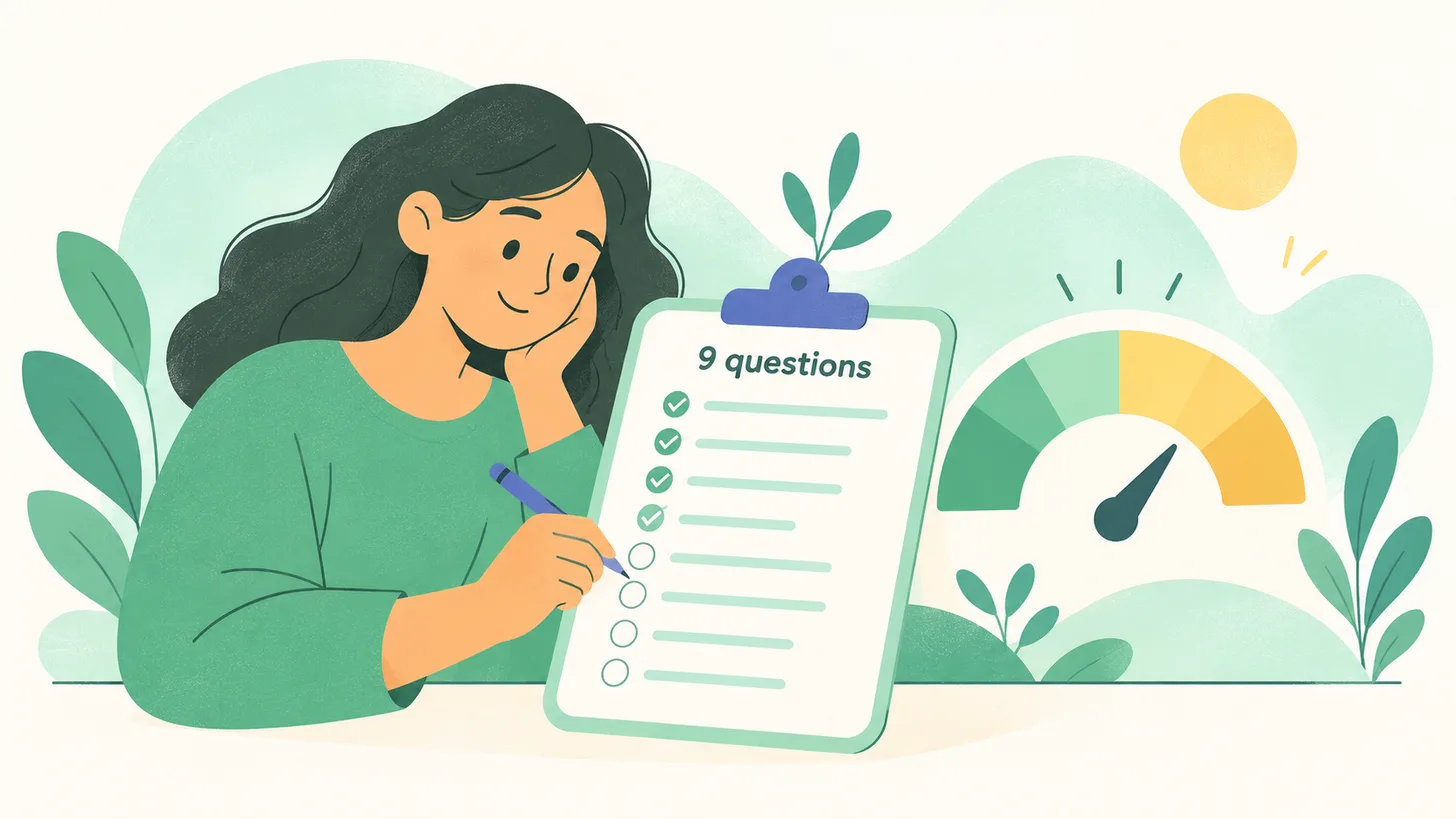
A depression self check is a short set of questions about how you have been feeling, usually over the past two weeks. It reflects a pattern back to you. It does not confirm clinical depression.
The screener used in this blog is the PHQ-9 (Patient Health Questionnaire-9) by Kroenke, Spitzer and Williams, 2001, published in the Journal of General Internal Medicine. It is used in clinics across India and the world. It is quick, it is validated for primary care, and it is one tool among many, not a verdict.
Only an RCI-registered clinical psychologist or a psychiatrist can diagnose depression. They look at your history, your context, your sleep, your family health and your medical reports. A score on this page cannot do that.
In short: a self check is a mirror, not a label.
How does this 9-question depression self check work?
Think back over the past two weeks. For each of the 9 questions, pick one answer:
- 0 = Not at all
- 1 = Several days
- 2 = More than half the days
- 3 = Nearly every day
Jot the numbers down on your phone. Add them at the end.
Over the past two weeks, how often have you been bothered by any of the following?
- Little interest or pleasure in doing things.
- Feeling down, depressed, or hopeless.
- Trouble falling or staying asleep, or sleeping too much.
- Feeling tired or having little energy.
- Poor appetite or overeating.
- Feeling bad about yourself, or that you are a failure, or that you have let yourself or your family down.
- Trouble concentrating on things, such as reading or watching TV.
- Moving or speaking so slowly that other people noticed. Or the opposite, being so fidgety or restless that you move around a lot more than usual.
- Thoughts that you would be better off dead, or of hurting yourself in some way.
Add the nine numbers. Your total will be between 0 and 27.
The score can wait. You matter more than the total.
In short: the test shows a pattern over two weeks, not a one-off bad day.
What does your depression self check score suggest?
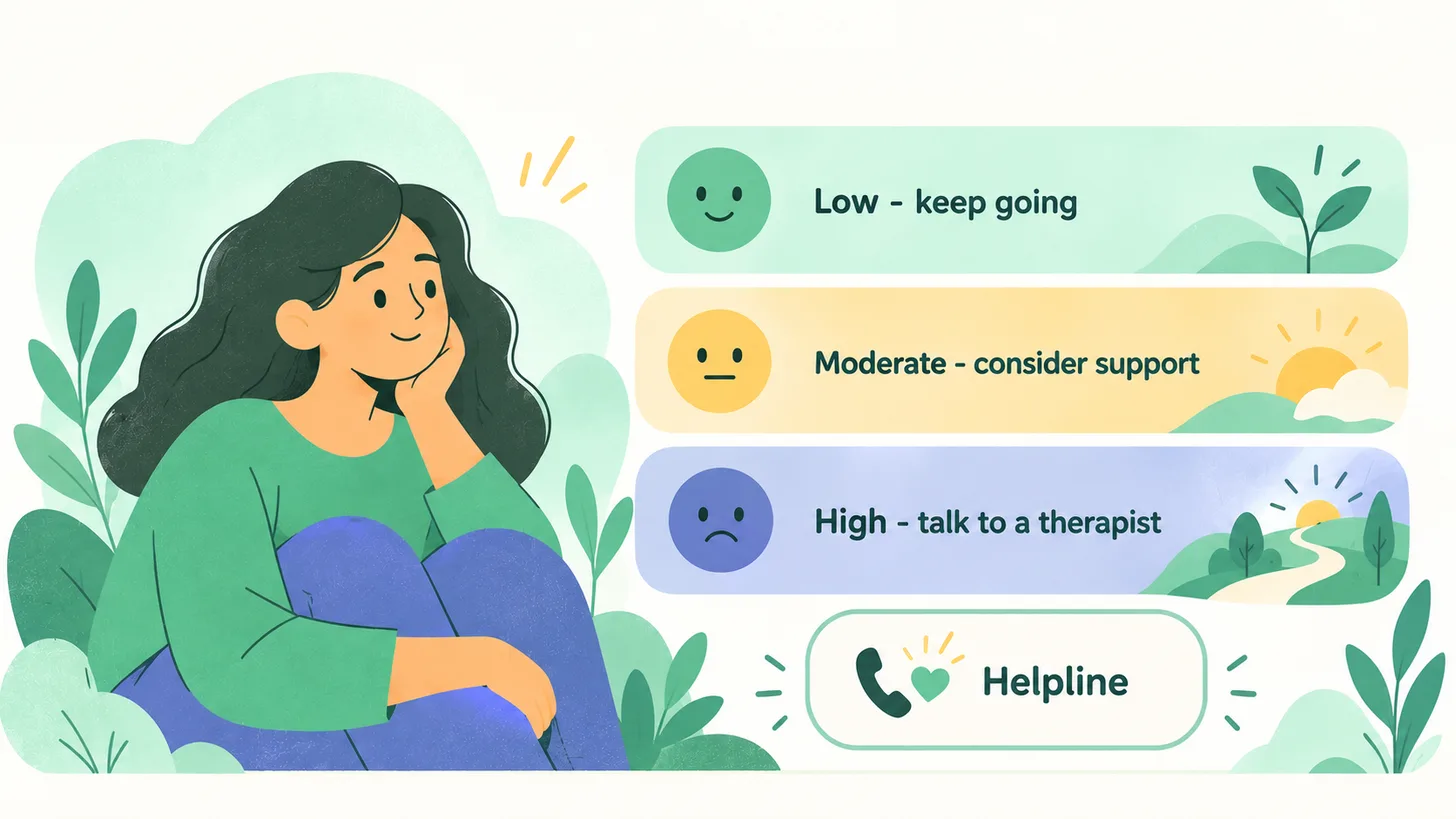
The five bands below come from the standard PHQ-9 interpretation (Kroenke, Spitzer and Williams, 2001). The actions are a plain-English version of what Indian clinicians typically suggest. They are not treatment advice.
0 to 4: Minimal
This range suggests you are probably not in clinical depression right now. A low week is still a low week. Hold your sleep, movement and social contact steady. Watch for a drift upwards over the next two weeks.
5 to 9: Mild
Some of the symptoms are present. Many people in this band feel better in a few weeks with self-help steps: short walks, a sleep window, journalling, a chat with someone you trust. A free workbook or a few therapy sessions can help if it lasts more than a month. Our ways to treat depression guide is a good next read.
10 to 14: Moderate
This band is where most clinicians say the honest next step is a therapist, within two weeks if you can. Cognitive behavioural therapy (CBT) is the first-line talking therapy for moderate depression, per the WHO. You don’t need a worse score to book a session.
15 to 19: Moderately severe
A therapist and a psychiatrist consult are both reasonable here. Combined care, therapy plus medicine, is often the fastest route back to functioning. Not sure who treats what? Our guide on which doctor to consult walks through it.
20 to 27: Severe
Please reach for professional help within days, not weeks. If question 9 is above zero, add a safety plan to that first appointment. A psychiatrist can prescribe where needed; a therapist can walk alongside.
In short: the higher the band, the sooner the honest next step. A score of 10 is already a good reason to talk to someone.
CTA A verified GoodLives psychologist can read the PHQ-9 with you and plan the next step together. No pressure, no long form. button: Match Me with a Therapist Match Me with a Therapist
What a PHQ-9 cannot rule in or out
A screener is a wide net. It will catch some things that look like depression but are not, and miss some things that are. Please read the list below before you worry about a borderline score.
- Grief. A recent loss can push a PHQ-9 score up. Grief is not depression, though the two can overlap. The treatment is different.
- Bipolar depression. A low mood on the PHQ-9 can be the low side of bipolar disorder. Bipolar needs a psychiatrist, not only a therapist. If you have had weeks of racing energy, less sleep with more drive, or risky decisions, read our bipolar self check too.
- Thyroid issues. An under-active thyroid can look exactly like a mild to moderate depression. A simple TSH blood test is worth asking your GP for.
- Low vitamin B12 or vitamin D. Both are common in India and both can flatten mood and energy. A basic blood panel helps rule these in or out.
- Sleep apnea. Loud snoring, daytime sleepiness and a flat mood often travel together. A sleep assessment, not an antidepressant, is the fix.
- Medicines that lower mood. Some blood-pressure tablets, hormonal contraceptives and acne medicines can lower mood as a side effect. Never stop a medicine on your own. Ask the prescribing doctor to review.
- Dysthymia (persistent low mood). If the heaviness has been there for two years or more, lighter than full depression but never really lifting, the name for that is persistent depressive disorder. The PHQ-9 won’t label it. A clinician can.
- Suicide risk. Question 9 is a screen, not a risk assessment. A low total with a positive question 9 still needs a call to a helpline today.
In short: a self check points you towards help. The ruling-in and the ruling-out happen with a professional.
How to get help for depression in India
The National Mental Health Survey (NIMHANS, 2015 to 2016) found that nearly 5 in every 100 Indian adults are living with depression right now. The treatment gap, the share of people who need care and don’t get it, was over 80%. You are not alone, and you are not weak for asking.
Help in India you can call or walk into today:
- Free, 24/7, 20 languages, including Hindi, Tamil, Telugu, Bengali, Marathi, Kannada and more.
- Email counselling also available.
- NIMHANS, AIIMS and state medical-college OPDs · free or low-cost assessment at a government hospital. Ask for the mental-health OPD.
- GoodLives · verified Indian psychologists, Hindi and more Indian languages, flexible plans. See our pricing page.
A free call is a real option, not a lesser one.
Reaching out, in Hindi you may think of this as mann ki baat (speaking from the heart), is strength, not weakness. A culture that dismisses low mood is a culture that is slowly changing. You can be part of that shift by making one call this week.
In short: free, government and paid help all exist in India. Pick the door that fits this week’s budget and energy.
Steady habits while you wait for your first session
A first therapy appointment may be a week or two away. These are not a replacement for care. They are the small anchors most Indian clinicians suggest while you wait.
- Keep a sleep window. Lights out and wake up at roughly the same time, even on weekends.
- Move for 20 minutes a day. A walk around the block counts. Exercise has a real, if modest, effect on mild and moderate depression (WHO).
- Eat on a schedule, even when hungry doesn’t show up. Low mood dulls appetite. A small dal-chawal plate is better than skipping.
- Message one person a day. Not an essay. “Thinking of you” counts.
- Pause the long nights of research. You’ve read enough. One kind step beats three more tabs.
If reading in Hindi feels easier, our depression meaning in Hindi piece may help you share this with family. The bhari mann (heavy heart) that may feel like a wall can soften with the right care.
In short: small routines hold you up while care comes together. See our depression guide for India for the wider picture.
FAQ
How accurate is a PHQ-9 depression self check?
Can this quiz diagnose me with depression?
What score on a depression test means I should see a therapist?
Is a depression test online safe and private?
Does a low depression self check score mean I’m fine?
How often should I retake a depression self check?
What is the difference between a depression test and a diagnosis?
This post is for information only and is not a substitute for professional care.


Share your thoughts