
Mental Health in India

Did you know according to 2015 reports of WHO (World Health Organization), more than 300 million people all around the globe drown in depression?
Yes, you have read it correctly.
According to WHO, mental disorders specifically depression has steeply escalated by 18% from 2005 -2015.
In a developing country like India, mental health is of utmost importance since every nook and cranny of the corporate sectors brews mental trauma.
It is believed that without it, a person can never achieve the ultimate ring of true health (both physically and spiritually).
3 Facts related to Mental Health in India:
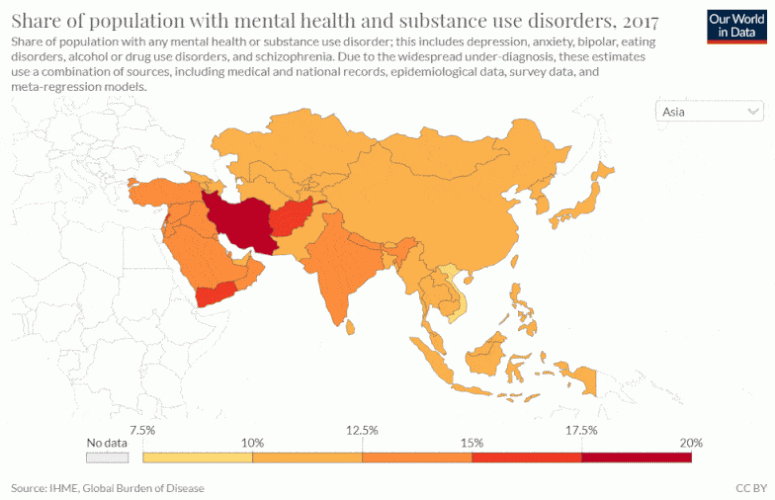
- It is very common. According to WHO reports (1990-2017), approximately one in every seven person in India suffers from mental disorders.
- It is NOT related to social hierarchy or social status.
With proper medication and support from psychiatrists, mental ill-health can be cured but it depends on individual to individual. - According to the World Health Report charted out by WHO in 2001, mental disorders account to 12% of the total global disorders which was estimated to rise to 15% by 2020.
Did you know, meditation have significant effects on curing depression, anxiety, and chronic pain? Check out How to Meditate – Ultimate Guide for Beginners (2020)
9 Certain symptoms of Mental disorder:
-
- Restlessness
- Claustrophobia
- Sweating
- Appetite loss
- Nervousness
- Increased mood swings
- Sudden breakdowns
- Social exclusion
- Confused in managing one’s anxieties and problems
Status of Mental Health in India (4Facts):
- In India, mainly individuals ranging between 15-29 years are mostly affected by the icy touch of depression and mental health
- According to the 2015-2016 reports of National Institute of Mental Health and Neurosciences (NIMHANS), 1.3 billion of India’s population suffer from the latent problems of mental health
- All the more, the stigma related to mental health in Indian culture has further escalated the suicidal tendencies of the victims. According to WHO’s Global Burden of Diseases Study (2015) on an average, 2.2 lakh people die in a year due to suicides owing to their built-up mental ill-health
- National mental health survey of India (2015-2016) further highlights that nearly 150 million Indians need mental health care services but less than 30 million are seeking care
Did you know, you can tackle depression in certain ways? Find out here: 7 Ways to fight depression.
2 Ways to create awareness about Mental Health:
India still being a conservative country with a major section of the population deprived of proper education to date stigmatizes mental health; calling out names like lunatic, light-headed, and so on.
-
- Firstly, the concept of the stigma attached to mental illness in India can be reduced or eradicated via proper awareness programs and by proper advertising the key importance of mental health
- Secondly, the students from a very young age should be taught about its nuances and related importance and usefulness
3 Government schemes to spread mental health awareness
- Swach Mansikta Abhiyan to implement various sessions of conversation between the victims and the psychiatrists
- National Mental Health Programme (NMHP) launched by the Government of India in 1982 aims at introducing ‘life skills training and counseling’ in the various institutions mainly educational and dense workplaces. This program also incorporates means to prevent suicides and tries to reach out to the suicidal victims through structured levels of services via National, District (District Mental Health Programme;DMHP), and Rural authorities
- Accredited Social Health Activist (ASHA) was launched by National Rural Health Mission to provide mental health counselling to women and children
It is high time, people are made to understand the plethora of advantages of maintaining a healthy peace of mind through school curriculums and awareness programs introduced by the Government.
At the very initial stages of awareness programs, light-hearted conversations can help the people who are struggling to open up more candidly with the rest of the crowd likewise in non-governmental interaction sessions of crowd-sourcing or human libraries.
At this juncture, more awareness needs to be circulated than health literacy. All sorts of the stigma attached to the concept of mental health in India should be eradicated by outlining the various causes of mental disorders and their respective recovery procedures.
Conslusion:
Conclusively, with the dawn of the tech-savvy world, sectors can also come forward to fight against mental illness through new scientific technologies and carry the torch of awareness even to the rural pockets of India.
Hopefully, with the various government and non-government programs amalgamated with the education of the masses, the day is not far when people will cast away the taboo of mental health and will embrace its importance with open arms.



Share your thoughts