
What this blog includes
- What mental exhaustion is, and what it is not
- How it is different from burnout, depression, chronic fatigue syndrome and apathy
- The signs most people miss
- The real causes, including the ones a self-help article will not mention
- The Indian version: metros, caregiving and the rest-is-lazy script
- What actually helps, including the seven types of rest
- When to rule out a medical cause first
- When to see a therapist, and who to see
If you have been telling yourself you are “just tired” for three months, you are probably not just tired. The brain fog, the Sunday dread, the way a simple email now takes 40 minutes, the holiday that did not feel like a holiday. There is a word for this, and it is older than our group chats about burnout. Mental exhaustion is a signal, not a weakness. It is also, honestly, treatable.
A quick note before we start. This is a reader guide, not a diagnosis. If anything you read here lines up too neatly, please take it to a doctor or a therapist. In Indian English we would say, mann bhari hona (heavy-hearted) is worth paying attention to, not pushing through.
What mental exhaustion actually is
Mental exhaustion is the state your mind reaches when the demand on it has been higher than its recovery for too long. The usual tools stop working. The brain’s attention systems, the parts of you that filter noise, hold a thought, and make small decisions, run down the way a muscle does. The repair side has not kept up with the use side.
It can show up as mental fatigue (the cognitive side), emotional thinness (the feelings side) and a physical heaviness you cannot explain. Most people have all three at once by the time they Google the phrase.
A short working definition for this guide: mental exhaustion is a sustained state of cognitive, emotional and often physical depletion from prolonged mental effort or emotional load, where ordinary rest no longer restores you.
The word “sustained” is doing a lot of work in that sentence. A hard week is not mental exhaustion. A hard eight months, with no change in the input and no real recovery in the output, usually is.
In short: mental exhaustion is a capacity problem, not a mood problem. The point is not to feel better in a day. The point is to notice what is pulling the capacity down and change it.
Mental exhaustion vs the other words that look like it
The reason this gets confusing is that four or five different states share symptoms and need different responses. Mixing them up is how people spend months doing the wrong thing. Here is the honest map.
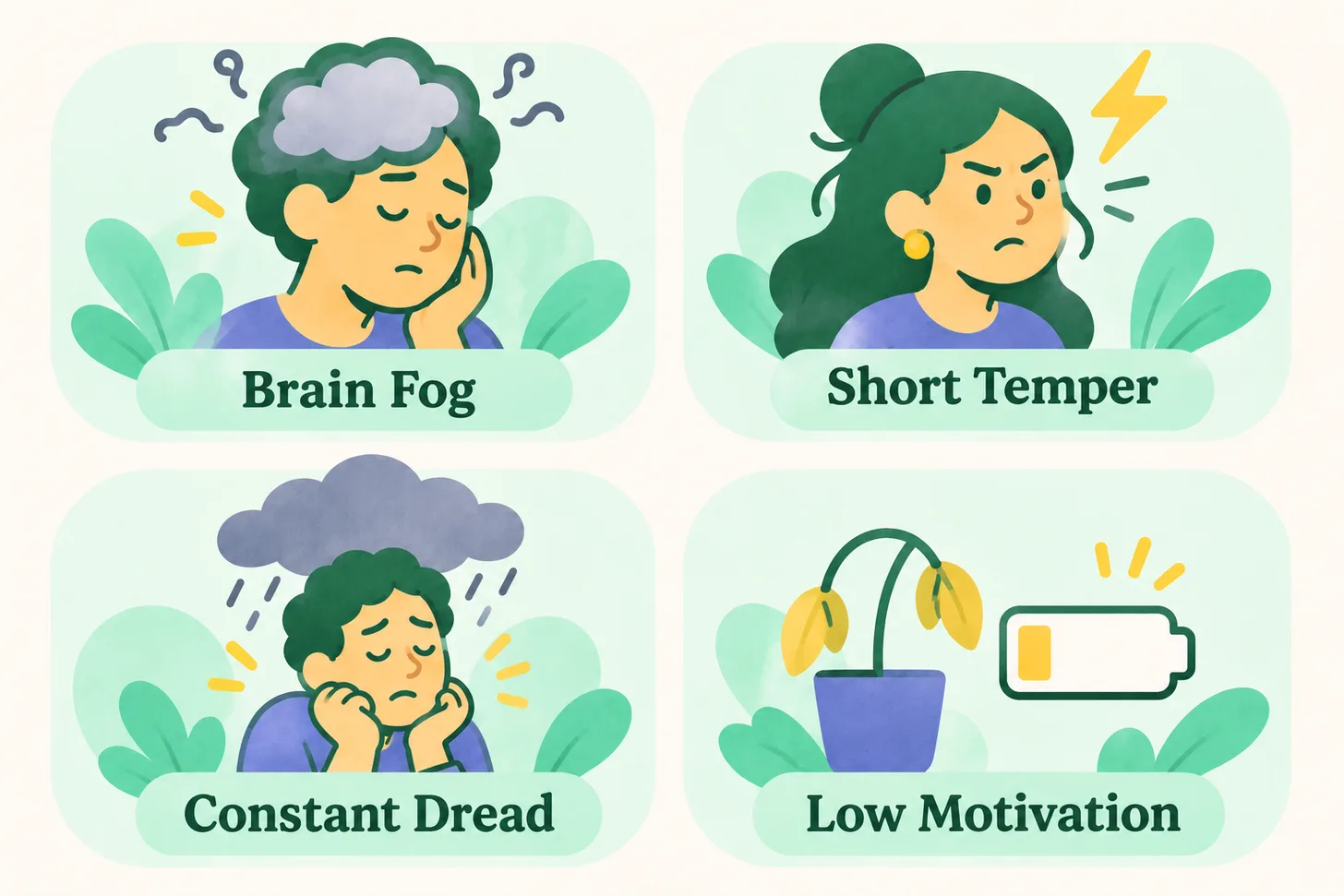
Mental exhaustion vs physical tiredness. Physical tiredness lifts with a long sleep, a nap, a weekend. Mental exhaustion does not. You can sleep nine hours and still wake up with a flat battery, because the drain was never only physical.
Mental exhaustion vs burnout. Burnout, as the WHO defines it in ICD-11, is specifically occupational: exhaustion plus mental distance from work plus a drop in professional efficacy. Mental exhaustion is broader. It can come from caregiving, grief, chronic illness in the family, parenting young children, information overload, or the slow weight of a difficult relationship. All burnout involves mental exhaustion. Not all mental exhaustion is burnout. Our burnout self-check is the two-minute version if the work angle fits you.
Mental exhaustion vs depression. Clinical depression, in the WHO’s ICD-11, is marked by three things. A low mood that stays. A loss of interest or pleasure (anhedonia). And a thinking pattern that turns against the self: hopelessness, guilt, self-criticism. Mental exhaustion is depletion without that spiral. You can still enjoy things when you have the capacity for them. The problem is that the capacity is low. Mental exhaustion can tip into depression if it goes untreated for long enough. That is one honest reason to not wait.
Mental exhaustion vs chronic fatigue syndrome (ME/CFS). Chronic fatigue syndrome, or ME/CFS, is a diagnosed medical illness. Its signature is post-exertional malaise: a hard crash in symptoms 12 to 48 hours after even mild effort. Mental exhaustion is a state. ME/CFS is a disease. If a short walk or a work call puts you in bed for the next two days, please see a doctor.
Mental exhaustion vs apathy. Apathy is a flat absence of motivation. Exhaustion is an absence of capacity. The feeling under exhaustion is often, “I want to, I just cannot.” The feeling under apathy is, “I do not want to, and I do not know why.” They look similar from the outside and need different first moves.
Read our explainer on apathy if that one feels closer to your own experience.
In short: the state you are in decides the first step. Mental exhaustion needs restoration. Burnout needs workload change. Depression needs a clinical conversation. ME/CFS needs a doctor. Apathy needs a therapist to look under it. Getting the label roughly right saves you months.
The signs of mental exhaustion that most people miss
The loud signs are easy to name: you are tired all the time, you cannot concentrate, you snap at people. The quieter signs are the ones that tell you how long this has been going on.
Cognitive signs
- Brain fog that does not lift after coffee or sleep
- Decision fatigue: picking lunch feels harder than it should
- Trouble holding a thought long enough to finish a sentence or email
- Memory lapses, especially word recall and appointments
- Rereading the same WhatsApp message three times
Emotional signs
- Thin-skinnedness: small things set off big feelings
- Irritability, especially with the people you live with
- Loss of interest in things that normally refuel you
- A sense of flatness, not sadness exactly, just less colour
- Resentment that arrives faster than empathy
Behavioural signs
- Procrastinating things you used to breeze through, not because you do not care but because starting feels enormous
- Doomscrolling that feels like rest but is not
- Cancelling plans you were looking forward to
- Opening tabs and forgetting why
Physical signs
- Sleep that does not restore you, even when you get the hours in
- Headaches, muscle tension, a jaw that is clenched before 10 am
- Gut symptoms: appetite changes, nausea, loose stools, acidity
- Falling sick more often, longer recoveries
- A feeling of weight behind the eyes
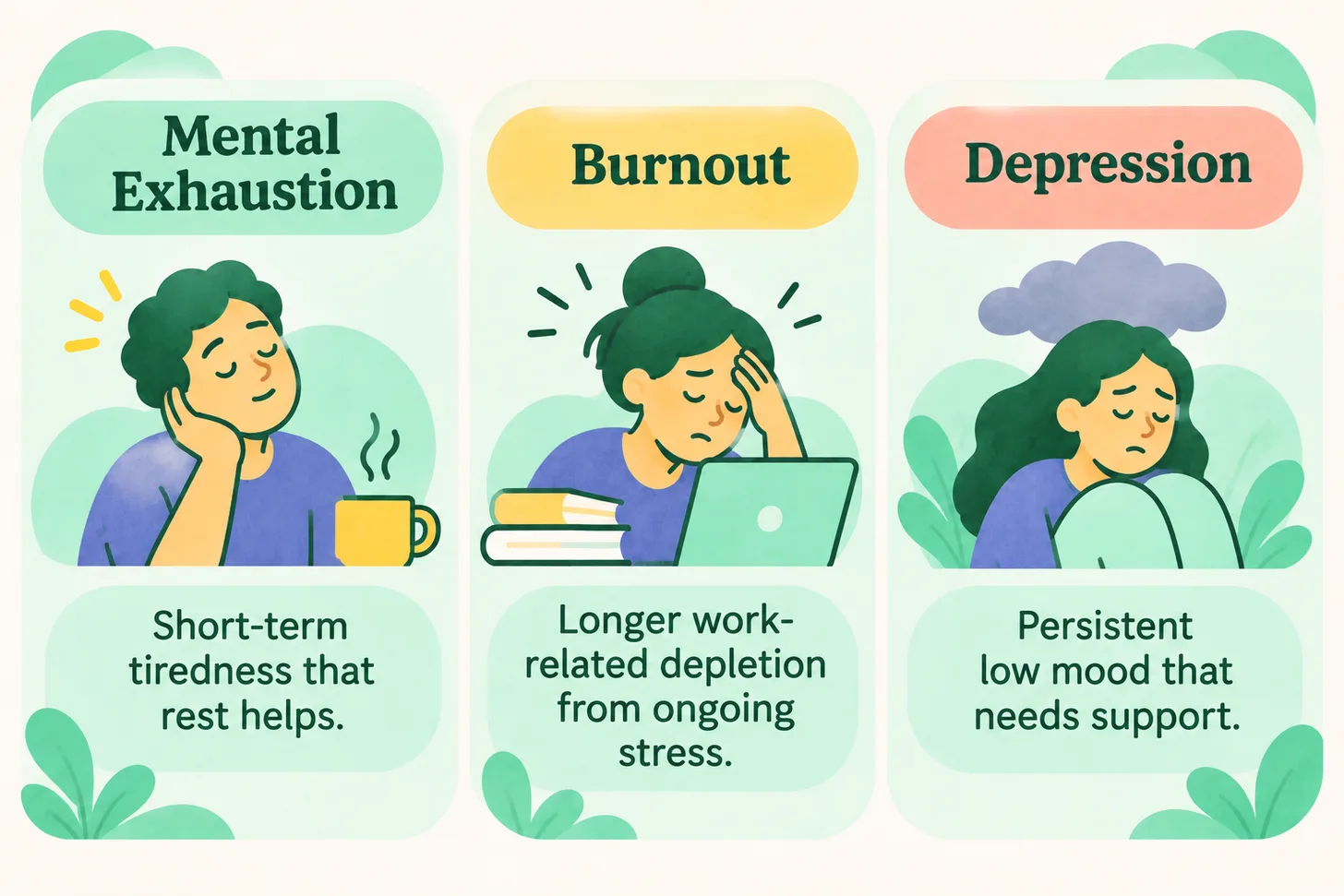
The specific tell: “I need a holiday, but a holiday does not help.” When five days away does not touch the state, the drain is deeper than scheduling. That is the sentence to take to a therapist or a doctor.
In short: mental exhaustion is a system state, not a symptom. If you can tick three signs from the cognitive list and three from the physical list, you are not being dramatic.
Why you are mentally exhausted (the honest list of causes)
Most posts about this stop at “stress”. That is true, and it is not useful. Here is a more honest list.
Chronic stress. Work pressure, caregiving load, grief, financial strain, a long-running relationship conflict, a court case, a chronic illness in the family. The nervous system does not care which of these is yours. It is reading sustained demand.
Emotional labour. Jobs where the work is holding other people’s feelings. Teaching, nursing, HR, counselling, hospitality, retail, delivery, call-centre work. Parenting young children. Being the person in the family who manages everyone else’s moods. Emotional labour is real work, even when it is unpaid, and it drains the same accounts that paid work drains.
Information overload. The news, social media, group chats, work notifications. The modern average Indian professional’s phone sends roughly 60 to 90 interruptions a day. Each one costs attention. Attention is the capacity that mental exhaustion depletes.
Sleep debt. Not one bad night. The slow kind, built from a year of 11.30 pm bedtimes and 6.30 am alarms. The US National Sleep Foundation recommends 7 to 9 hours a night for adults. Most people reading this are getting six.
Unresolved trauma. A nervous system that has not come down from an earlier threat stays on. People with childhood trauma, intimate-partner violence, a serious accident, or long exposure to high-stakes work (healthcare, journalism, aid work) often read as “stressed” when the system is actually stuck.
Medical causes. Thyroid problems, low B12, low vitamin D, iron deficiency, anaemia, perimenopause, poorly managed diabetes, sleep apnoea, long-COVID, and some autoimmune conditions can all show up as mental exhaustion. A GP visit before a therapist visit is often the right order.
ADHD executive-function depletion. For adults with ADHD, the daily cost of masking, task-switching and holding focus is higher than average. The exhaustion is real, and the strategy is different. A clinical psychologist familiar with adult ADHD is the person to see.
In short: mental exhaustion usually has more than one cause. Treating only one of them is why self-help loops.
The Indian version of mental exhaustion
The international literature on mental fatigue is written mostly from western work-and-family patterns. Our version has a few extra layers.
The metro commute plus 10 to 12 hour work day. When your office is in Gurgaon, your home is in Noida and your meetings start at 9.30 am, your working day is already 13 hours before anyone has asked anything of you. The decision tax of planning that commute runs even when you are not commuting.
The caregiving load. In many Indian households, caregiving for ageing parents, young children, or a sibling’s family lands on one person. Usually the daughter-in-law, the eldest daughter, or the woman who said yes once. This is emotional labour at a scale a weekend will not undo.
The “rest is lazy” script. For a generation of Indians raised on padhai, naukri, shaadi (study, job, marriage) as the only acceptable rhythm, resting without a reason feels like a moral failing. The guilt itself drains more capacity than the rest would restore. The cultural rewrite is slow, and it is happening, but if you grew up with it, it is probably still in your head.
Service and gig work. For the delivery, retail, cab-driving and domestic-work workforce, the day is both emotionally and physically demanding, often with no break room and no sick leave. Mental exhaustion in this group is less likely to get named and more likely to be treated as laziness, including by the person feeling it.
Joint-family dynamics. The hidden mental tax of being “on” at home, in a space where everyone has opinions on your choices, is one of the most under-researched drivers of mental fatigue in India.
In short: your mental exhaustion is not just about your work. The context you are living inside is also an input.
What actually helps (and the honest limits of rest)
Here is where most articles say “try meditation and a bubble bath”. That is not nothing, but it is not enough for a real state of mental exhaustion. A more useful frame comes from physician Dr Saundra Dalton-Smith, who names seven types of rest in her book Sacred Rest. The point is simple. Sleeping more does not help if the kind of rest you are missing is a different kind.
The seven types of rest, in plain language
- Physical rest. Both passive (sleep, naps) and active (gentle stretching, yoga, a walk). What most people think of as rest.
- Mental rest. Deliberate quiet from thinking: a notes app for the running list in your head, five minutes of staring out a window with no phone, a boring task done slowly.
- Emotional rest. Space where you do not have to manage anyone else’s feelings. The friend you can sit with in silence. Not having to perform wellness.
- Social rest. Time away from demanding relationships, and time with low-demand ones. Both matter.
- Sensory rest. Dim lights, no screens, no notifications, quieter sound. For urban Indian life, this is often the one that is most missing.
- Creative rest. Being around beauty you did not have to make. A long walk somewhere green. A museum. Watching a good film without second-screening.
- Spiritual rest. A sense of belonging to something larger than your to-do list. Religion for some. Service, nature, art, or a meditation practice for others.
If you only ever rest the physical kind, you will stay tired. That is the point.
A pared-down recovery plan
- Reduce decision load. Pre-plan clothes, meals, workouts. Remove options. Every decision you do not have to make tomorrow is capacity you keep.
- Set a boundary around digital inputs. Turn off notifications you did not consent to. One deliberate scroll window instead of 30 ambient ones. One phone-free hour before sleep. Our short guide to mental peace has more honest, non-gimmicky small moves.
- Micro-recovery during the day. Five minutes between meetings with no screen. A short walk after lunch. The pause is not a luxury.
- Sunlight and nature. Fifteen to 20 minutes outside, ideally in the morning. The research on morning light and sleep is strong and inexpensive to apply.
- Movement, counterintuitively. Moderate exercise reduces mental fatigue in most studies, even when you feel too tired to move. Walking counts. Twenty minutes four days a week beats one gym burst a fortnight. Our guide on exercise and mental health breaks down the honest minimums.
- Low-demand social contact. Phone a friend who does not need you to perform. See one person who makes you feel more yourself after.
- Protect sleep. Same window, most nights, 7 to 9 hours, phone out of the bedroom. Treat it like a meeting.
- Address medical causes. Ask your GP for a basic panel: TSH, B12, vitamin D, iron and ferritin, HbA1c. If you snore and wake unrefreshed, ask about sleep apnoea.
- Therapy for the pattern. When the state has lasted more than six weeks, when the usual tools are not touching it, or when you keep ending up here, a clinical psychologist can help you look at what is driving the overload.
One minute to down-regulate, right now
If reading this list has made your chest tight, try one minute of slow breathing before you go on. It will not fix anything on its own. It will give your nervous system a signal that this moment is safe.
A moment to breathe
Follow the circle. Breathe in, hold, breathe out, then hold. Four counts each. Stay as long as you like.
In short: rest is not one thing. If the kind of rest you are getting is not the kind of rest you need, the state will not shift.
When to rule out a medical cause first
A rule that saves people months: if a thyroid problem, iron deficiency, B12 deficiency, poor sleep (including sleep apnoea), perimenopause, or long-COVID could be contributing, see a GP before you see a therapist. You can still do both, in parallel. The order matters only in that an untreated medical cause will keep tanking the therapy work.
The basic ask when you book: a general check-up with a blood panel that includes thyroid (TSH), B12, vitamin D, iron and ferritin, and HbA1c. If sleep is bad, ask about a sleep study. If you are over 40 and female, ask about perimenopause. If you had COVID and have not felt right since, say so.
A good doctor will not dismiss mental exhaustion as “stress”. A great doctor will treat the body and send you to a therapist for the pattern. Both matter.
In short: your body is part of your mind. Ruling out the common medical causes is not a detour from the work. It is part of the work.
When to see a therapist, and who to see
Three signs it is time:
- The state has lasted longer than six weeks and is not responding to sleep, boundaries and the usual tools.
- It is impairing your function at work, in relationships, or at home.
- You are having thoughts of giving up, going flat, or ending things.
Who to see, honestly:
- GP first for the medical rule-out.
- Clinical psychologist for the pattern work. What is pulling the capacity down. Which parts of your life need a change. Which coping habits have outlived their use.
- Psychiatrist if there is a strong overlap with clinical depression or anxiety, or if sleep has not responded to anything.
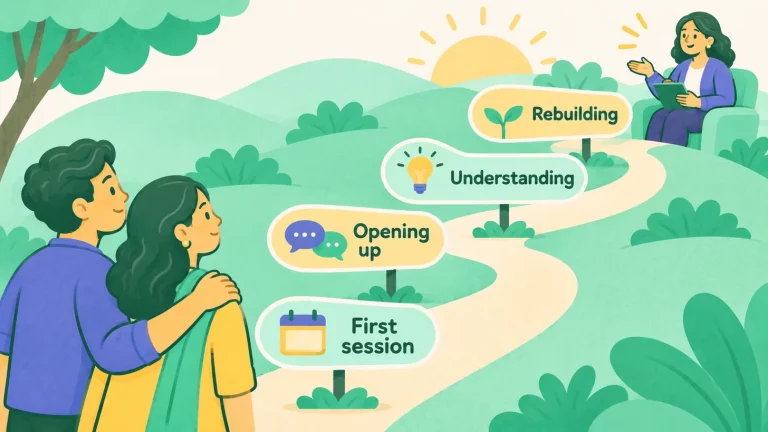
- A good therapy journey often moves between these three people over three to six months. That is normal.
This post is for information only and is not a substitute for professional care. If you are in distress, please speak with a qualified doctor or therapist.



Share your thoughts