
What this blog includes
- A plain take on what BPD is and what the label gets wrong
- The nine clinical signs of BPD, in Monday-morning language
- A 10-question self-check with four score bands
- The therapies that actually work for BPD, and India’s honest availability
- When to see an RCI-registered clinical psychologist, and what to ask them

If you have been reading about BPD late at night, you are not alone. People often arrive at this page after a fight that got bigger than the moment, or after someone said a word that stuck. Perhaps a partner, a parent or a well-meaning Instagram reel used the word “borderline” and it has not let you sleep.
What you are feeling has a name, and plenty of people have been here before you. A BPD self-check is not a verdict. It is a way to put words on a pattern. GoodLives has supported 500K+ people with therapy and workshops in India, and the one thing we see every week is this: people are more afraid of the label than of the condition itself. BPD is treatable, and recovery is real.
What BPD actually is, in plain language
Borderline personality disorder is a condition of emotional sensitivity. The nervous system of a person with BPD reacts faster, climbs higher and takes longer to come back down than most. The term “borderline” is a historical hangover from the 1930s, when clinicians thought the pattern sat on the border of two older diagnoses. The name has aged badly. The condition it describes is real.
Marsha Linehan, the psychologist who built the therapy that works best for BPD, calls it a “biosocial” condition. In her model, a person is born with a temperament that feels emotion more intensely. If that temperament grows up in an environment that teaches them their feelings are too much, too loud or wrong, the two combine into the adult pattern we call BPD. See Linehan’s foundational paper on the biosocial theory.
That is why BPD is not a character flaw. It is a sensitivity-regulation condition. People with BPD are not bad. Their internal weather is louder.
In short: BPD is a real, treatable condition of emotional sensitivity, not a label that describes a person’s worth.
The nine clinical signs of BPD
Clinicians diagnose BPD using the DSM-5-TR, the manual the American Psychiatric Association keeps for mental-health diagnoses. The DSM-5-TR lists nine signs for BPD; a clinician looks for five of nine, present since early adulthood, across more than one part of life.
The nine signs read dry on paper. Here is what each one looks like in a real Indian week.
1. Frantic efforts to avoid being left. When someone important seems distant, you feel like they may vanish for good. You text fourteen times before they reply once. You start a fight so you can end things first. Later, these moments feel out of character.
2. Relationships that swing. In close relationships, your feelings swing between “this person is everything” and “this person does not care about me at all,” sometimes in the same week. The swing is called idealisation and devaluation in textbooks.
3. Identity that will not hold still. You feel unsure of who you are. Your values, your interests, even your career plans shift depending on who you are around. One month you want to quit for an art degree. The next month you cannot remember why.
4. Impulsivity in two or more risky areas. Clinicians look at spending, sex, substance use, binge eating or reckless driving. For BPD, impulsivity is often about turning down the volume of feelings. A shopping cart filled at 1 am. A tenth drink. A ride on an unfamiliar bike.
5. Self-harm or suicidal thoughts, recurrent. When the emotional pain spikes, the mind reaches for a way to stop it. Cutting, burning, overdose fantasies, or talking about ending it. This is the sign that most needs honest help today.
6. Mood that shifts in hours. Not days or weeks. From okay to deeply low or sharply angry in response to something small. By the end of the evening you are flat again.
7. Chronic emptiness. A quiet khaalipan that sits in the background even when things look fine on paper. It is not sadness. It is a flat quiet that reads as nothing when someone asks how you are.
8. Anger bigger than the moment. The anger can be loud, or it can be a cold three-day silence. Either way, it is hard to put down after the thing is over.
9. Dissociation or paranoia under heavy stress. You feel outside your own body during a hard call. You briefly believe people you trust are lying. The feeling passes when the stress drops.
Five of these nine, present for weeks and months, across more than one setting, is the clinical bar. A single bad fortnight is not BPD.
In short: these nine signs are not weaknesses. They are patterns clinicians are trained to recognise and work with.
The 10-question BPD self-check
Below is a 10-question BPD self-check. It covers the nine clinical signs, with impulsivity split into two questions because it so often shows up in two forms. Read each question twice. The second read is the honest one.
Answer Yes only if the pattern has been there for weeks or months, in more than one part of your life, not just one hard fortnight.
1. Fear of being left. When someone important seems distant, do you panic that they will leave you for good, and act in ways that later feel out of character?
2. Relationships that swing. Do your closest relationships swing between “this person is everything” and “this person does not care about me at all,” sometimes in the same week?
3. Unsure who you are. Do you often feel unsure of your values, your interests or what you actually want from life, and does it shift depending on who you are around?
4. Impulsive to soothe. When you are upset, do you turn to unplanned spending, binge eating, substances or sex to feel better, and later wish you had not?
5. Impulsive to escape. Have you done risky things on impulse, such as fast driving, unsafe sex or sudden big decisions, that calmer-you would not have done?
6. Thoughts of ending the pain. When the pain gets very intense, do thoughts of hurting yourself or ending the feeling come up?
7. Moods that shift in hours. Do your moods swing sharply within a few hours, from okay to deeply low, angry or anxious, in response to something small?
8. Empty inside. Do you often feel empty, a quiet khaalipan that is there even when things look fine on paper?
9. Anger bigger than the moment. Do you have anger that feels bigger than the moment, loud or cold, and hard to put down after?
10. Disconnected under stress. Under heavy stress, do you feel outside your body, or very suspicious of people you usually trust?
What your score suggests
- 0 to 2 Yes. The pattern you describe is not the one BPD describes. If something still feels off, our anxiety self-check or depression self-check may fit better.
- 3 to 4 Yes. Some signs are present. A conversation with a clinical psychologist is a good next step. It may be BPD traits, trauma, mood issues or a mix.
- 5 to 7 Yes. Strong signs. The clinical bar for BPD is five of nine; the signs you have ticked are worth a proper assessment with an RCI-registered clinical psychologist.
- 8 or 9 Yes. The pattern is highly suggestive. Please book an assessment with a clinical psychologist with BPD experience, soon.
- Any Yes to question 6. Please talk to someone today. The helpline block is at the top of this blog and again at the end. You do not need to be in a full crisis to call.
In short: this check gives you the vocabulary. The verdict belongs to a trained clinician who can sit with you for an hour and ask the follow-up questions a form cannot.
What this self-check cannot tell you
A screener is a mirror, not a diagnosis. Four honest limits sit around any BPD self-check.
One, overlap. BPD overlaps with complex PTSD (cPTSD), bipolar II, ADHD-related emotion dysregulation, and depression. A clinical psychologist tells them apart by taking a full history, which a form cannot do. Our bipolar self-check is a useful companion if the mood shifts in your pattern feel longer than hours.
Two, trauma context. A great deal of what the BPD label describes maps to complex developmental trauma, as Bessel van der Kolk and others have shown. Many clinicians prefer to work with the trauma underneath the pattern rather than the label on top.
Three, pervasiveness. The DSM-5-TR bar is “pervasive pattern since early adulthood”. A hard three months after a breakup, with similar feelings, is not BPD. Clinicians look for a pattern that has run for years, in more than one setting.
Four, the label is contested. The ICD-11, the WHO’s newer manual, has moved away from fixed personality disorder categories to a dimensional model of personality difficulty. The condition is real; the exact label is debated.
In short: take the score for the words it gives you, not for the answer it does not have.
CTA Not sure where to start? A GoodLives clinical psychologist can sit with the pattern this self-check reflected back, in English, Hindi and more Indian languages. No pressure, no long form. button: Match Me with a Therapist Match Me with a Therapist
The therapies that work for BPD
Four therapies have the strongest evidence for BPD. All four are structured and specific. A general counsellor without this training is not the right first fit.
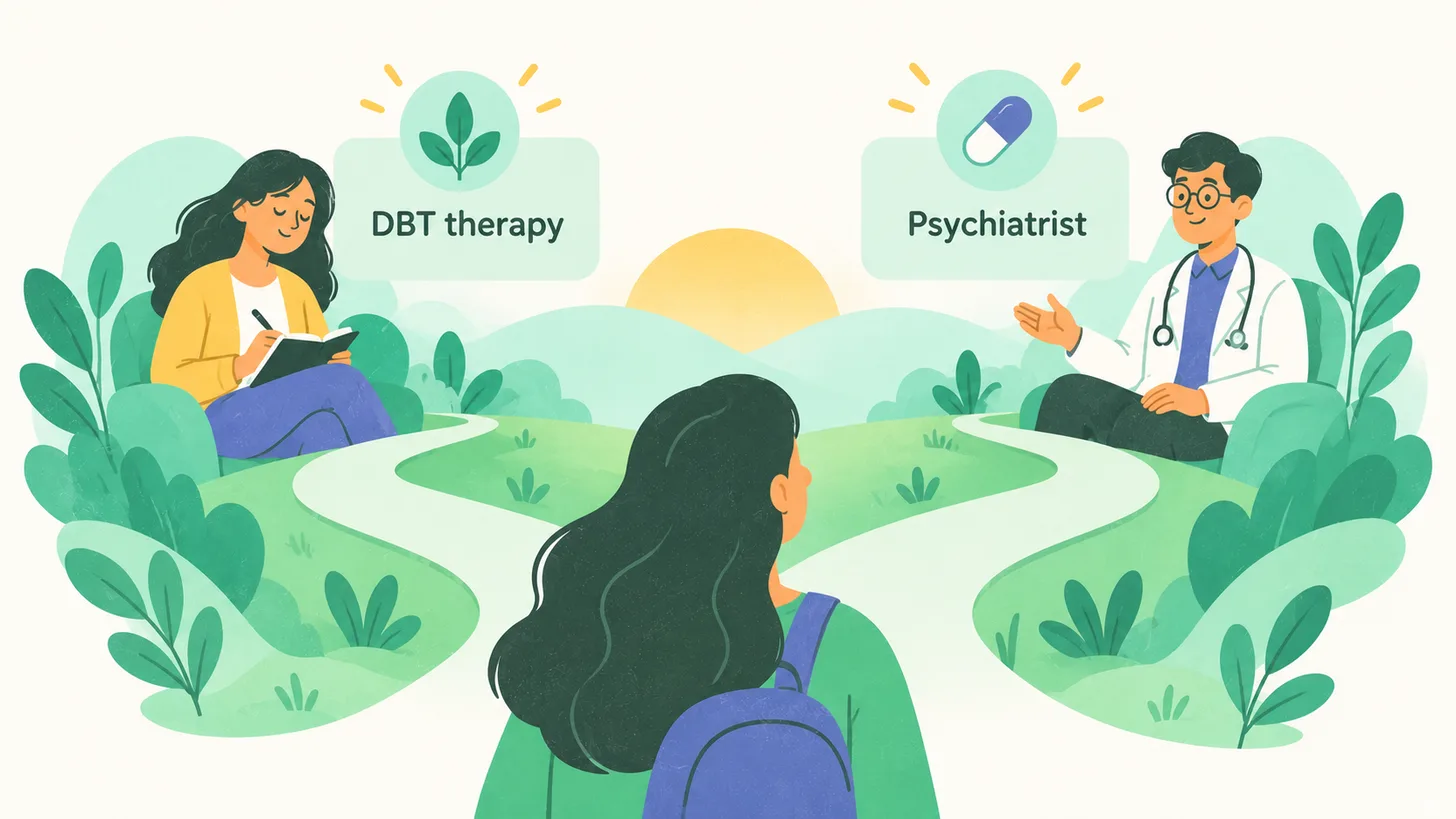
Dialectical Behaviour Therapy (DBT). DBT is the gold standard. Marsha Linehan built DBT specifically for BPD in the 1990s. A full DBT programme runs for a year and combines weekly individual therapy with a weekly skills group across four modules: mindfulness, distress tolerance, emotion regulation and interpersonal effectiveness. Read our DBT therapy guide for how it works in India.
Mentalisation-Based Therapy (MBT). MBT was developed by Anthony Bateman and Peter Fonagy. It helps a person hold on to the sense that other people have minds of their own, which is the sense BPD often loses under stress. Strong trial evidence for BPD.
Schema Therapy. Jeffrey Young’s model treats long-standing patterns laid down in childhood. For BPD it works with four core modes: the vulnerable child, the angry child, the detached protector and the punitive parent. Good evidence; often used when CBT alone has not worked.
Transference-Focused Psychotherapy (TFP). Otto Kernberg’s TFP uses the relationship with the therapist itself as the material of therapy. It is intensive and runs for one to three years. Strong evidence base in Europe and the US.
What is not first-line for BPD is pure CBT without emotion regulation training, or pure psychoanalysis without structure. Medication is not first-line for BPD itself, but a psychiatrist may add an SSRI or mood stabiliser for a comorbid depression, anxiety or sleep problem. Specific medicine names are a chat for you and your doctor.
In short: DBT, MBT, Schema Therapy and TFP are the four therapies with the strongest BPD evidence. All four need a therapist with specific training, not a general counsellor.
DBT and specialist BPD care in India, honestly
A full one-year DBT programme is rare in India. Here is what is actually available.
NIMHANS, Bengaluru, runs a DBT service as part of its psychotherapy outpatient. See the NIMHANS website for current clinics; waiting times can be long.
Private DBT teams exist in Bengaluru, Mumbai and Delhi. Cadabam’s in Bengaluru runs programmes that include DBT skills work. A small handful of private clinical psychologists in each metro offer DBT-adherent individual work.
DBT-informed therapy is more widely available online, including on GoodLives. “DBT-informed” means a therapist who has done training in DBT skills and uses them in sessions, without the full weekly group. It is a weaker version of the real thing, but it is often what is available right now.
Schema Therapy and MBT practitioners are a smaller group still. Ask the therapist about their specific training programme, not just the acronym on their LinkedIn.
The honest line: if you can commit to a full DBT programme at NIMHANS or a specialist team, that is the strongest option. If a programme is not accessible this month, a DBT-informed clinical psychologist on GoodLives or elsewhere is a reasonable start while you look.
In short: full DBT in India is scarce; DBT-informed therapy is more available, and both are better than waiting.
What recovery actually looks like
Long-term studies tell a hopeful story. In the McLean Study of Adult Development, a 10-year follow-up found that 85% of people with BPD no longer met the diagnostic criteria after a decade, with most reporting significant improvement in two to three years of good therapy. Recovery is slow, and it is real.
Recovery with BPD does not mean the sensitivity vanishes. It means the sensitivity stops running the show. People with BPD lead full lives, hold careers, parent well, and keep long friendships. The nervous system does not change its wiring. The person learns the skills to meet it.
A gentle note on language. The word “manipulative” gets attached to people with BPD and it is unfair. Reaching hard for connection when you are frightened of being left is not manipulation. It is a nervous system doing what it learned to do. The right therapy teaches gentler ways to ask.
If reading in Hindi feels easier for someone in your family, our depression meaning in Hindi piece may help start a family conversation. Family often lacks a framework for BPD; some psychoeducation at home goes a long way.
In short: BPD is one of the most treatable conditions in mental health. Most people with BPD who stay in good therapy no longer meet the diagnostic criteria after a few years.
FAQ
What are the 9 signs of BPD?
How do I check if I have BPD at home?
Is BPD curable?
Is BPD the same as bipolar disorder?
Are people with BPD manipulative?
What therapy is best for BPD in India?
Does BPD need medication?
This post is for information only and is not a substitute for professional care.
Your right to care is protected under the Mental Healthcare Act 2017, which recognises access to free emergency mental-health care at government hospitals.


Share your thoughts