
What this blog includes
- The plain asexual meaning, from AVEN, and the spectrum underneath it
- The split attraction model: sexual, romantic, sensual and aesthetic
- Why asexuality is not celibacy, a low libido, or a disorder
- Honest myths, the ones you have probably heard twice this year
- What it is like to be asexual in India, from family pressure to the law
- How to find an affirming therapist, and the kind to avoid
You are somewhere between a Reddit thread and a close friend’s doubt right now. You have read a few definitions, looked up the ace flag, and still cannot say whether the word fits. Maybe family has started asking about marriage. Maybe a partner asked a question you did not know how to answer.
The word you keep landing on is asexual. Asexual meaning, in the plainest words, is this: you feel little or no sexual attraction to other people, and that is a steady part of who you are. Not a diagnosis. Not a reaction. Not a phase.
At GoodLives, we work with LGBTQIA+-affirming therapists across India (trusted by 500K+ people), so this guide carries the care a first session does.
What does asexual actually mean?
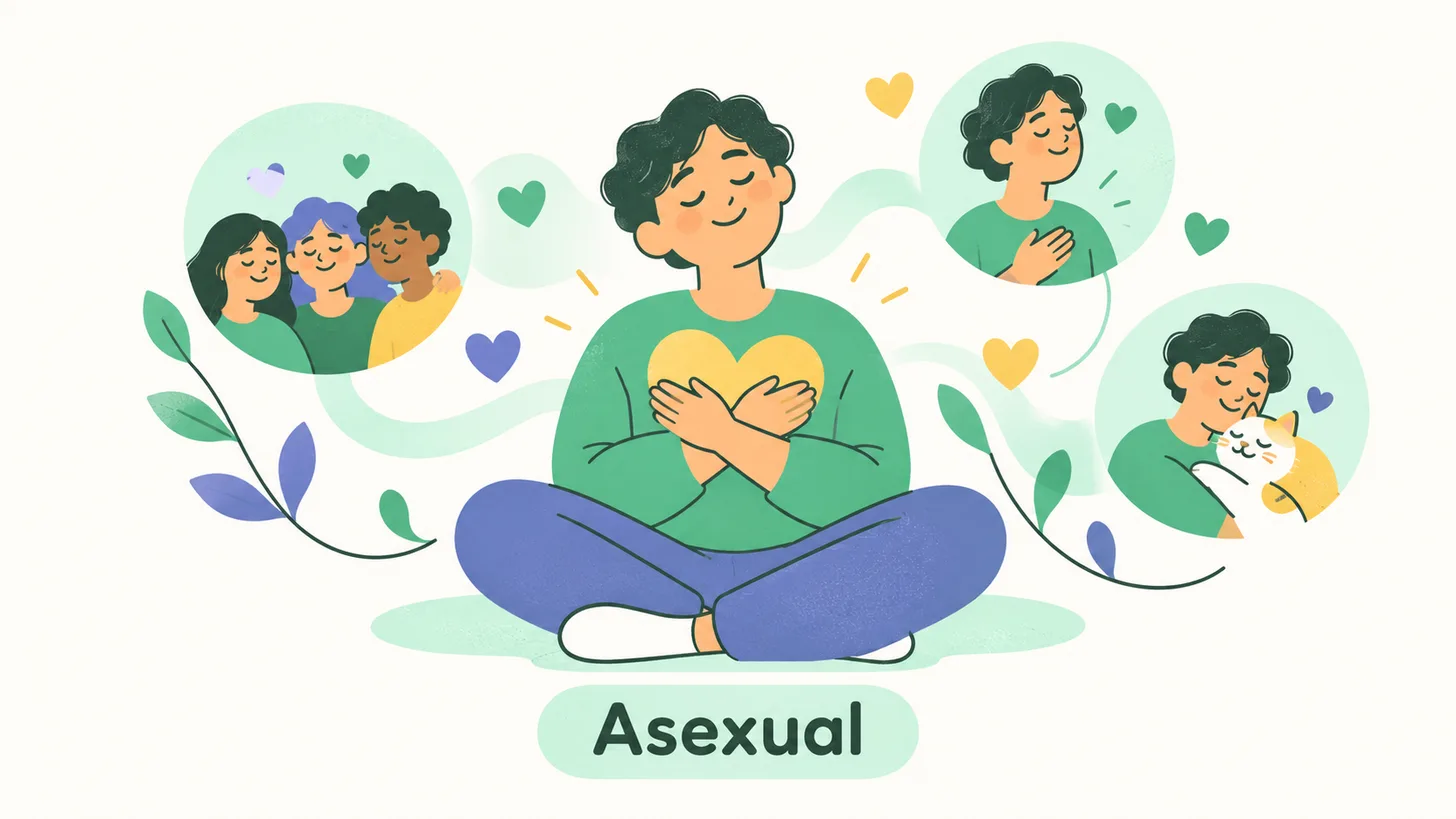
Asexual means feeling little or no sexual attraction to anyone, consistently. The Asexual Visibility and Education Network (AVEN) has used that working definition since 2001. It is a sexual orientation, like being gay or straight, and the people who use the word sit across a spectrum.
Shorthand: ace. Allosexual is the word for everyone else: people who do experience sexual attraction. Our psychology terms hub covers neighbours of this one, from aromantic to demisexual.
In short: Asexual is a sexual orientation, not a lack of one. Ace is the short form. Allosexual names everyone else.
The asexual spectrum: ace, grey-ace, demisexual, aromantic
The asexual spectrum is a range, not a single door. At one end, asexual people feel little or no sexual attraction. In the middle, grey-asexual (grey-ace) people feel it rarely, only in specific contexts, or in a way they cannot quite place. Demisexual people feel it only after a strong emotional bond. Aromantic is a separate axis.
Grey-ace (graysexual) names the honest in-between. Some grey-ace people feel sexual attraction once in a few years. Some feel it only in specific settings. The grey is not indecision; it is the shape of their experience.
Demisexual means attraction shows up only after a real emotional bond. A demisexual person is not asexual, and not allosexual either. The order is different: closeness first, attraction later, sometimes.
Aromantic is a different question. It names a person who feels little or no romantic attraction. You can be asexual and romantic, aromantic and allosexual, both, or neither. The two sit on different axes.
In short: Asexual, grey-ace, demisexual and aromantic are related, not the same. The spectrum holds all four.
The split attraction model: four kinds of pull
The split attraction model breaks “attraction” into four kinds. They often travel together. Sometimes they do not. Naming them helps many ace and aro people say what they actually feel, instead of forcing one word to carry everything.
- Sexual attraction: wanting sex with someone specific.
- Romantic attraction: wanting a romantic relationship with someone specific.
- Sensual attraction: wanting physical closeness, not necessarily sex.
- Aesthetic attraction: finding someone compelling to look at, with no sexual pull.
For allosexual people, these four often arrive together and rarely get named. A heteroromantic asexual woman may want a male partner, long conversations, a shared life, and not want sex. That sentence makes sense once the four kinds have four names.
In short: Attraction is not one feeling. Four plain names make space for the shape yours actually takes.
Asexuality is not celibacy, a low libido, or a sexual disorder
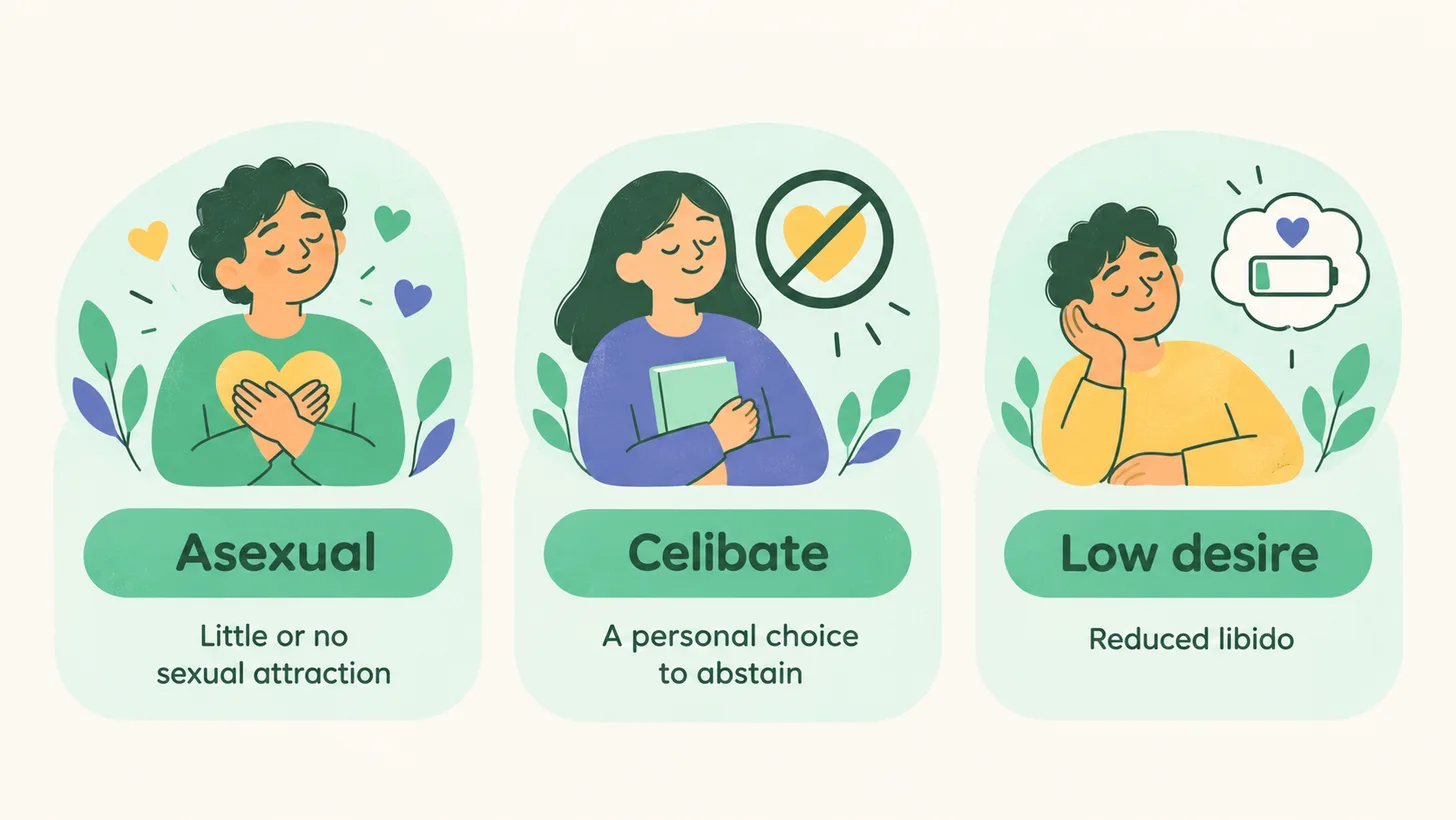
Asexuality gets confused with three other things. Celibacy. A low or changing libido. And the clinical condition the DSM-5 calls Female Sexual Interest/Arousal Disorder, or Male Hypoactive Sexual Desire Disorder. All three are different, and the difference matters.
Celibacy is a choice to abstain from sex, often for faith, focus, or a season of life. Asexuality is an orientation, which is not a choice. An asexual person who never wanted sex is not being celibate; the word does not fit.
Low libido is a state, not a steady trait. It can rise and fall with sleep, stress, a thyroid issue, a new medication, a difficult relationship, or grief. Asexuality does not come and go with the week.
HSDD and its newer DSM-5 names describe distress around a loss of sexual desire, usually in a person who used to feel it. Here is the line most readers miss.
The DSM-5-TR, the manual the American Psychiatric Association uses, explicitly says these diagnoses should not be given to a person who self-identifies as asexual. An orientation is not a disorder. If a therapist tells you otherwise, they are reading the manual wrong.
In short: Celibacy is a choice. Low libido is a state. The DSM-5 explicitly excludes asexual people from the sexual-desire disorders. Different words, different things.
Myths about asexuality (and the honest answers)
A few myths about asexuality travel further than the definition does. If you have heard one of these from a friend, a parent, or a WhatsApp forward, you are in good company.
- “You just haven’t met the right person.” The same sentence has been said to every sexual minority for a hundred years. Orientation is not a vacancy waiting for the right candidate.
- “Something must have happened.” Many ace people have histories that include trauma. Many do not. Assuming a cause flattens both groups.
- “You are a late bloomer.” Some name the word at 15, some at 40. Naming late does not mean the orientation showed up late.
- “Asexual people cannot have relationships.” Many are in happy long-term partnerships. Communication, not drive, carries a relationship.
- “Isn’t it the same as being celibate?” No. Celibacy is a choice. Asexuality is the orientation underneath a different question.
In short: Most myths treat asexuality as a problem waiting for a cause. The honest answer is that it is a shape, not a gap.
What it is like to be asexual in India
Being asexual in India sits inside a country where marriage is read as the goal of adulthood. The word for orientation rarely leaves English. The Supreme Court only decriminalised consensual same-sex intimacy in 2018. The pressure is specific.
The most common sentence an ace Indian hears is some version of “ye phase hai” (this is a phase). The second is about shaadi ki umar, the age everyone expects you to marry. Both arrive early, often by the first long family dinner after your mid-twenties.
In Navtej Singh Johar v. Union of India (2018), a five-judge Supreme Court bench read down Section 377. The judgment recognised sexual orientation as part of the right to dignity and privacy.
Asexual people are not a separate legal category under Indian law yet. But the dignity reasoning covers you.
Coming out to family in India usually has no script. You are explaining a word they have not met, in a language that is not fully theirs. You do not owe a full lecture to anyone who did not ask you for one.
For partners, our guide to marriage counselling online in India sits next to this one.
In short: You don’t have to come out to anyone to know what is true for you. In India, the dignity is yours by law; the timeline is yours by right.
How to find an LGBTQIA+-affirming therapist (and what to avoid)
An affirming therapist works with your identity, not against it. They use the word “asexual” plainly. They do not try to find a cause for the orientation itself. If a therapist offers to help you “feel attraction again”, they are not practising affirmingly.
Here is the clinical line in India: conversion therapy is prohibited. The National Medical Commission’s 2022 ethics regulations, issued after a 2021 Madras High Court direction, classify conversion therapy as professional misconduct.
A doctor or psychologist who tries to change your orientation is in breach of their own code.
Good signs when you call a therapist for a 15-minute intake:
- They use the word “asexual” comfortably and do not ask when you will “really know”.
- They ask what you want help with, not what caused the orientation.
- They answer “yes, I have worked with ace clients” without a long pause.
- They are clear they do not do conversion therapy, if you ask.
Therapy is not what will tell you whether you are asexual. Only you can decide the word that fits. An affirming therapist can help with the fallout: family pressure, a partner’s questions, the loneliness of being read wrong. The label is yours to try on and set down.
In short: An affirming therapist works with the person in front of them. The ones to avoid frame your orientation as the problem.
FAQ
What is asexual in simple terms?
Is asexuality a disorder?
Can asexual people fall in love or be in relationships?
What is the difference between asexual and celibate?
What does demisexual mean, and how is it different from asexual?
Is asexuality legal and recognised in India?
How do I find an LGBTQIA+-affirming therapist in India?
This post is for information only and is not a substitute for professional care.


Share your thoughts