
What this blog includes
- The 100-millisecond rule and the “thin slices” research
- Why the halo effect and primacy make first reads stick
- Where first impressions help, and where they lie
- Which mental-health states the first read gets wrong
- The India layer: arranged-marriage, caste, English accent, class
- How to make a better first impression, honestly
- How to read other people’s first impressions better
- When first-impression worry becomes a therapy question
You walk into a room. Someone glances at you. You feel them decide something before you have said a word. Maybe you have been the one glancing. Maybe you have replayed a job interview at 2 am. Or a biodata meeting. Or a first day at a new office. You wonder what they thought of you in those first seconds.

That half-formed worry is tracking something real. First impressions psychology has been studied for a hundred years. The findings are both strange and hard to sit with. Humans do size each other up in less than a second. Those snap reads help with some things. They lie badly on others. The honest line is this. Trust first reads for safety. Question them for closeness.
What the psychology of first impressions actually shows
The classic headline comes from Princeton. In a 2006 study, Alexander Todorov and Janine Willis showed {rel=”nofollow”} something strange. People form judgments about a stranger in about 100 milliseconds of seeing their face. They rate how warm, how smart, how safe, how likely to lead. More time to look did not change the judgments much. It only made people more sure of them.
A hundred milliseconds is a tenth of a second. That is faster than you can finish the word “hello” in your head.
The second big finding is older and still startling. In 1992 and 1993, Nalini Ambady and Robert Rosenthal ran “thin slices” studies {rel=”nofollow”}. They showed strangers 30-second silent clips of university teachers. The strangers rated how good each teacher seemed. Those ratings matched the end-of-semester scores. From students who had sat with the same teacher for months.
Thirty seconds. No sound. And a close read of a whole semester.
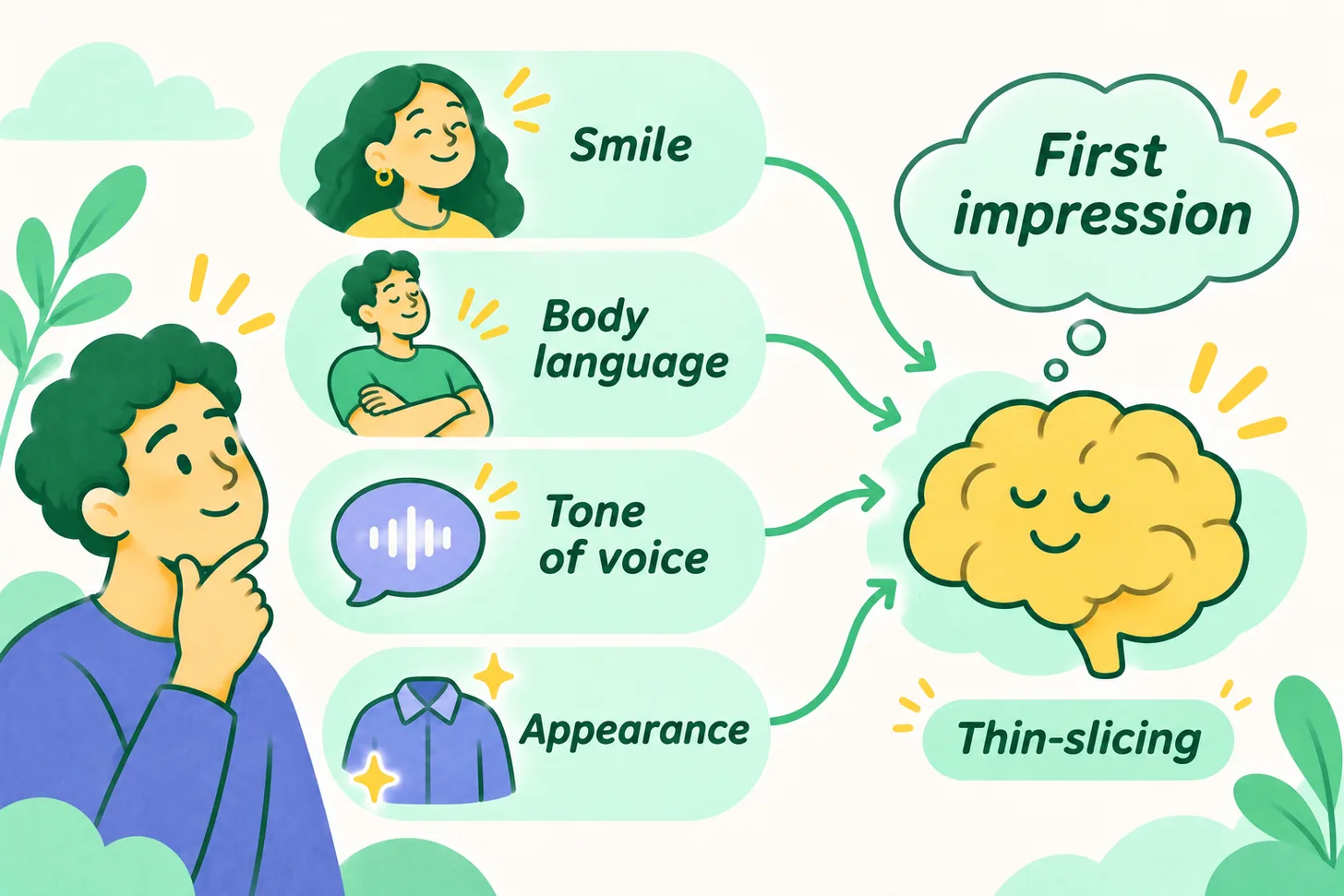
Put together, the research says this. Your brain is running a fast read of other people. It uses their face. Their posture. Their walk. Their voice. The read is not reasoning. It is pattern work, built up over the kind of social sorting humans have always needed.
In short: first impressions are not a weakness or a cliche. They are the brain doing one of its oldest jobs. In a tenth of a second. Before thought catches up.
Why first impressions stick so hard
If first reads were just a first guess that updated calmly, we would be fine. The trouble is, they bias all that comes after.
The clearest version of this is the primacy effect. In 1946, Solomon Asch gave people a list of traits {rel=”nofollow”} about a person. He asked for their overall take. The order of the list mattered a lot. “Smart, hard-working, bold, picky, stubborn, envious” felt warmer than the same list in reverse. Later research has shown this effect is softer than Asch first claimed. But the direction holds. What you learn first weighs more.
Then there is the halo effect. It was named by Edward Thorndike in 1920. Judge someone as warm, and warmth leaks into every other read. They seem smarter. More honest. More attractive. The “horns effect” is the mirror. One cold read dims every other quality. Interviewers rate the same CV in different ways based on the first ninety seconds.
The third piece is confirmation bias. Once your first read is set, your brain quietly collects what fits it. It discounts what does not. You remember the two awkward things the person said. You forget the four warm ones.
In short: first impressions stick for three reasons. What came first weighs more. One trait leaks into the rest. Your mind defends its own first read. It is not that you are judgmental. It is how the whole system is built.
Where first impressions genuinely help
The research is not all cautionary. For some tasks, your snap read is doing useful work.
Safety. Danger reads have to be fast. The brain’s amygdala can flag an unsafe face or a tense body before thought arrives. On a dark road at night, this system is a feature, not a bug.
Social reads. Taking in a room, a mood, a tone in the first few seconds lets you behave without a long briefing. Humans who could do this quickly stayed safer.
Mating signals. Early work by David Buss and others suggests the first physical read is one layer of fit. Not the only one. Not the right one for a long bond. But a layer.
Memory. What you take in first about a person gets the strongest hold in memory. Years later, you can still recall the first thing someone said to you.
In short: your first-impression system is not a flaw. For safety, speed and quick social reads, it is one of the sharpest tools you have.
Where first impressions quietly lie
The same system that keeps you safe can also do real harm. These are the places the research says our snap reads let us down most.
- Introverts get read as cold. A quiet person in the first 30 seconds often reads as less warm, less sharp, less likeable. Depth and listening do not show up in a thin slice.
- Trauma survivors get read as hostile. A person with a trauma history may look guarded, slow to smile, slow to meet your eye. The thin slice reads “unfriendly”. The real story is a nervous system staying safe.
- Depression gets read as laziness. The low energy, flat tone and slow speech of a down day often get read, cruelly, as “doesn’t care”.
- Anxiety gets read as coldness. Someone whose social anxiety is firing may skip eye contact, say little and leave the room first. Others often read it as “doesn’t like me”.
- Autism and ADHD get read as rude. Different eye contact norms, direct speech, flat tone, interrupting. All of it can look like bad manners in a 30-second slice.
- Marginalised groups face stereotype-driven reads. Race, caste, gender, body size and class shape the first read, usually against the person being read. The brain mistakes “familiar” for “trustworthy”.
- Dating-app profiles are curated first impressions. The photo, the bio and the prompts are picked to work. The gap between the thin slice and the real person is often the whole story of the first three dates.
A 2010 study by Nicholas Rule and Nalini Ambady {rel=”nofollow”} showed something sharper. Strangers could guess some personal traits above chance from just a photo. The finding is real. The honest read is not “see, first reads are right”. It is “see, our brains are quietly running a stereotype engine”. The harm lands on the person being read. Not the one doing the reading.
In short: first impressions can be trusted for safety and surface signals. They cannot be trusted for warmth, worth or who someone really is. Many of the people they get most wrong are the ones already carrying the heaviest social load.
The India layer first-impressions research rarely names
Most of the first-impressions research was done in American and European labs. The pattern is the same across cultures. The content of the thin slice is not.
Three Indian layers show up again and again.
The arranged-marriage meeting. A biodata. A photograph. A 15 to 30 minute first meeting. For many families, that still carries the weight of a lifetime choice. The research on 100 ms reads and thin slices has an uncomfortable thing to say here. You are not really meeting a person. You are meeting a thin slice, through the family’s thin slice, in a setting that keeps the real person small. People marrying this way are not naive about it. They are usually hoping the slow-build second meeting gets a chance.
Caste, class and English fluency. In most urban Indian first impressions, four things get read fast. The name. The English accent. The brand of the shoes. The shade of the skin. These are stereotype-driven halos. They favour the already-privileged. They quietly rule out people whose warmth and depth never got a chance to show. Honest talk about hiring, dating and in-law meetings in India starts here.
In-law first impressions. The first meeting with a partner’s family carries a weight the Western studies miss. The halo effect and primacy effect get a cultural boost. A daughter-in-law or son-in-law can carry the thin slice of “that first lunch” for a decade.
A fourth, quieter layer. Workplace first impressions in India often over-weight English fluency and a certain “polish” that comes with elite schooling. The person who prepared harder but speaks Hindi-first can lose the first round. Every round. Before anyone has heard what they think.
In short: growing up in India adds its own layers. The halo effect here runs on caste. On class. On language. On family name. The research done abroad rarely names any of them.
“They already judged me”: a reframe
Before we go into how to make and read first impressions better, this is worth a slow minute. Most people who worry a lot about first impressions carry a quiet, aching belief: “they already judged me, and I cannot change it.”
Catch the thought
What thought is weighing on you right now? Write it down just as it sounds in your head.
Name the trap
Does your thought fall into one of these common patterns? Pick any that fit. This part is optional.
Look again
Use these as nudges, not rules. Then write one line back to yourself.
Your reframe
Thoughts are not facts. You just practised stepping back.
This stays on your device. Nothing is saved or sent.
The research would soften that line. Yes, people formed a snap read. No, it is not forever. First reads get edited every time a new one lands on top. The first one weighs more. It does not weigh everything. The second, third and fourth reads do their quiet work. Especially when you keep showing up.
In short: the first impression they formed is a sketch, not a photograph. You get many chances to add to it. Your job is not to control it. Your job is to keep showing up as yourself.
How to make a better first impression, honestly
Not the Dale Carnegie list. The honest, research-backed version.
- Effort of grooming beats expense of grooming. Clean, fitting clothes, groomed hair and cared-for shoes read as competence and respect for the setting. The brand does not.
- An honest smile beats a polished one. Smile when you mean it. Research on genuine smiles (with the eyes crinkling) shows strangers can tell the difference, even if they cannot name it.
- Match the local greeting. Firm handshake where it fits. Namaste where it fits. Confident, not performed.
- Listen for the first two minutes. Research on likeability keeps finding the same thing. People who ask one real question in the first minute read as warmer than people who talk about themselves.
- Say the person’s name back once. It helps you remember them. It signals attention to them.
- Open body language. Shoulders back, hands visible, feet grounded. Not a power pose. Just not hidden.
- Prepare one or two interesting things to share. A line about a book, a show, something you noticed on the way. Specific beats generic every time.
- Honest beats performed. You cannot keep up a performance across the second and third meeting anyway. Start with the real you, warmly dressed up.
A quiet note. If social anxiety makes this list feel impossible, that is not a motivation problem. Working with your anxiety, not against it, is the move. Our post on social anxiety walks through the honest version of that work.
In short: better first impressions come from effort, warmth and listening. Not from performing a confidence you do not have.
How to read other people’s first impressions more accurately
The other half of this, often skipped, is how you read strangers.
- Give people a second chance by default. The thin slice is often wrong for anxious, introverted, trauma-affected or neurodivergent people. A warm second meeting undoes a lot of a cold first one.
- Notice what primed you. Were you tired, hungry, running late, stressed? Your read of the person you met in that state is partly a read of you.
- Separate “I don’t know this person” from “I don’t like this person”. Unfamiliar often gets stored as “not warm”. Hold the drawer open a little longer.
- Ask one real question before you decide. Research on reducing stereotype-driven judgments keeps finding the same thing. Specific, personal information disrupts the halo. “Where did you grow up?” lands differently than “what do you do?”
- Many short interactions beat one long first interaction. Three fifteen-minute chats across a month tell you more than one ninety-minute meeting.
- Context matters more than you think. The same person is a different thin slice when stressed, tired, excited or at home. See them in two settings before you decide.
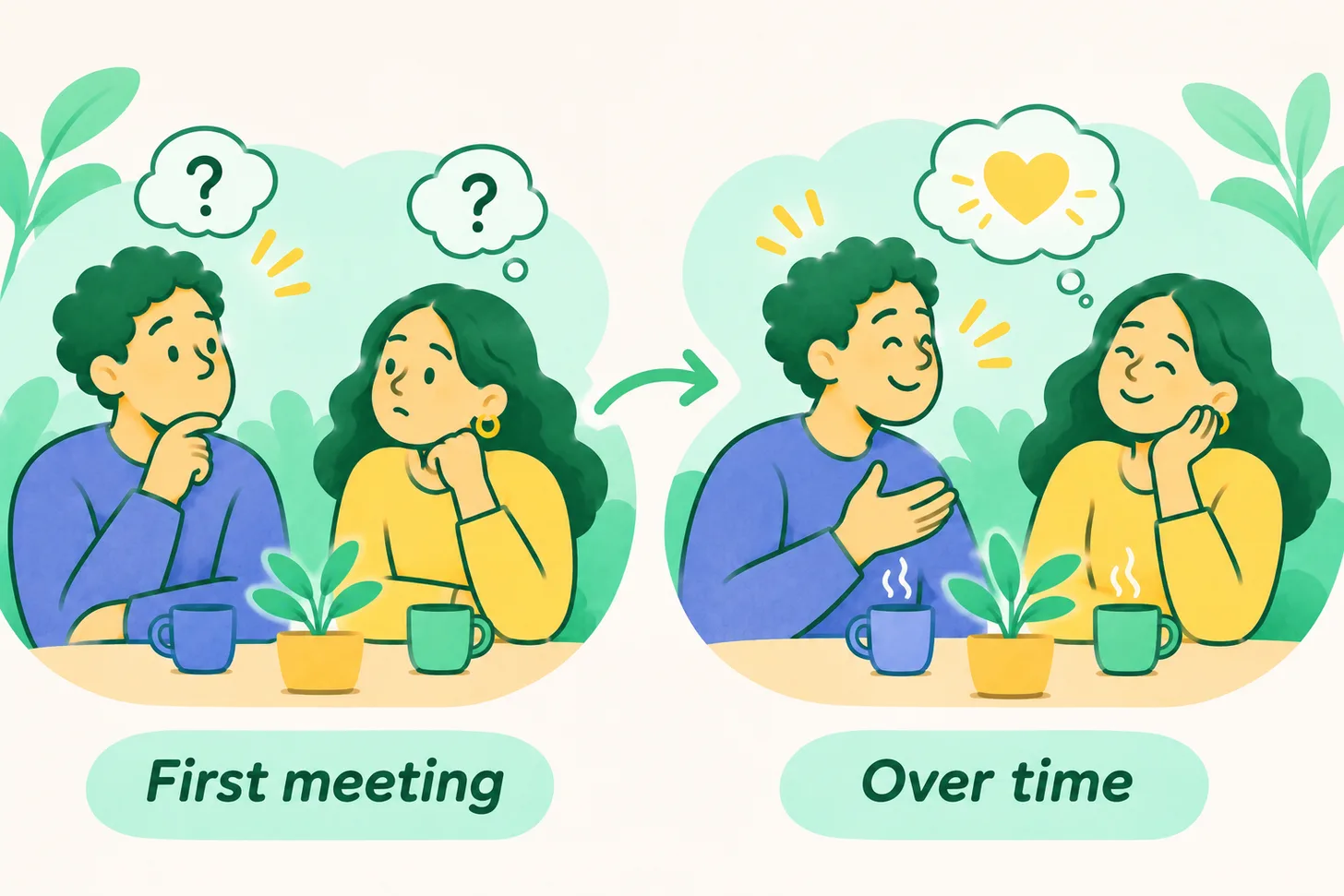
In short: reading first impressions well is less about getting better at the snap read. It is more about leaving room for the second one.
When first-impression anxiety is something a therapist can help with
Worrying about first impressions is normal. For some people, it becomes a daily low-level dread. That is worth looking at.
Signs it has crossed a threshold:
- You dread new meetings for days before they happen
- You replay first meetings for weeks, picking at every tiny moment
- You avoid networking, dating, work events, parties and new friendships
- You feel physically sick (racing heart, nausea, sweating) before a first meeting
- You hear your mother’s voice, or a classroom bully, in every stranger’s first glance
- You read every neutral first chat as rejection
The patterns underneath this are usually one of three.
Social anxiety disorder. A real, treatable fear of being judged. Clinicians often name it when it has lasted six months or more and started making real life smaller.
Rejection sensitive dysphoria. A sharp, physical response to any sign of being rejected or picked at. It often shows up alongside ADHD or trauma.
Trauma showing up in new relationships. For people whose first bonds were unsafe, every new face is a possible repeat. The nervous system reads a stranger’s thin slice as if an old scene is about to happen again. Our post on attachment issues walks through this pattern. People with trust issues often spot this one.
Therapy for first-impression anxiety often blends four tools. CBT for the thinking patterns. Gentle exposure for the avoiding. Self-compassion work for the inner critic. And sometimes trauma-focused work where the roots go deep.
Honest timeline. Most people see real change over three to six months of weekly sessions. Six weeks is a start, not a verdict.
In short: if first-impression worry is running your social life, it is a pattern therapy knows how to work with. You do not have to white-knuckle this one.
Disclaimer This article is for general information and is not a substitute for professional medical advice, diagnosis or treatment. If you need support, please speak with a qualified mental-health professional.


Share your thoughts