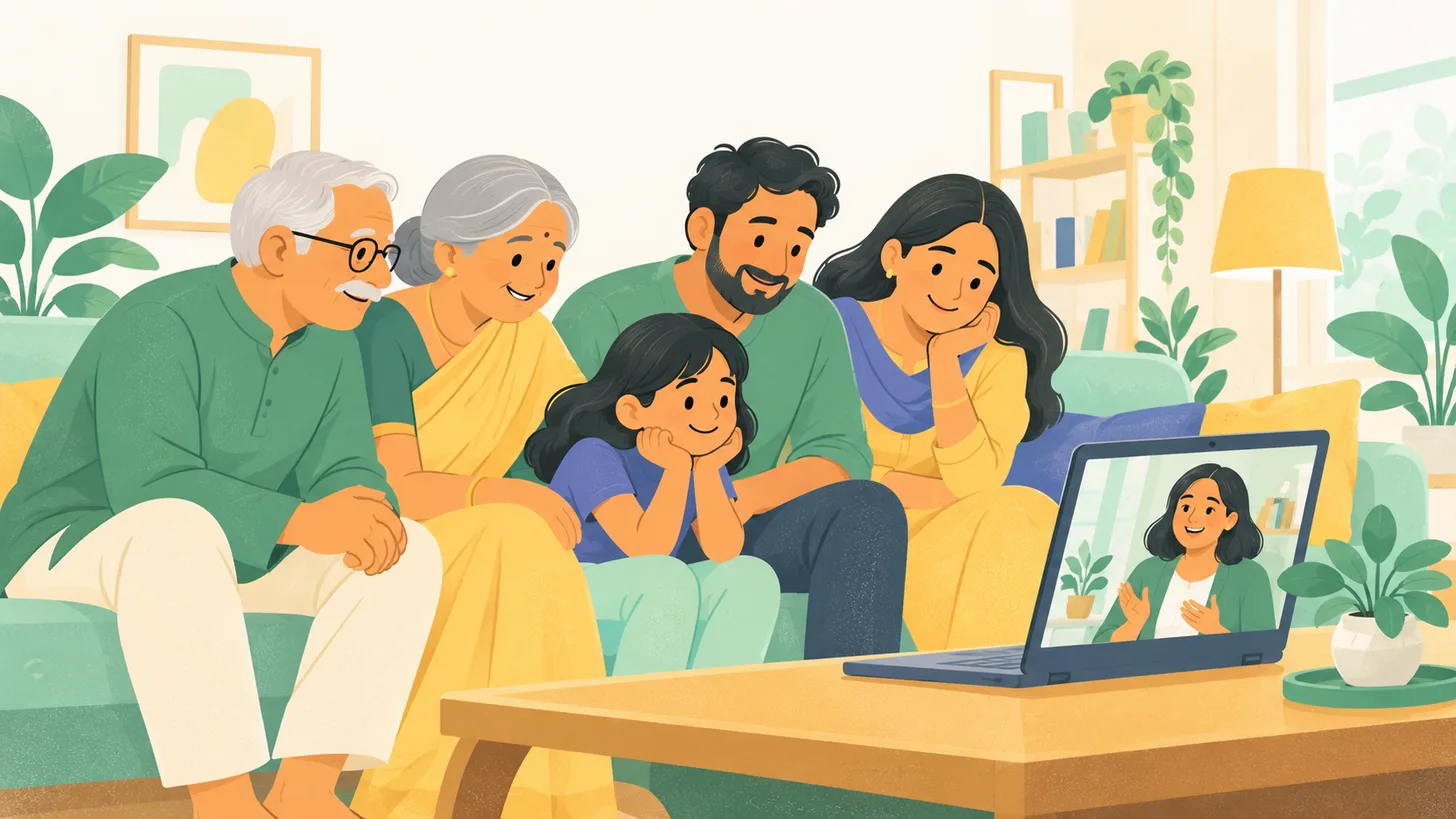

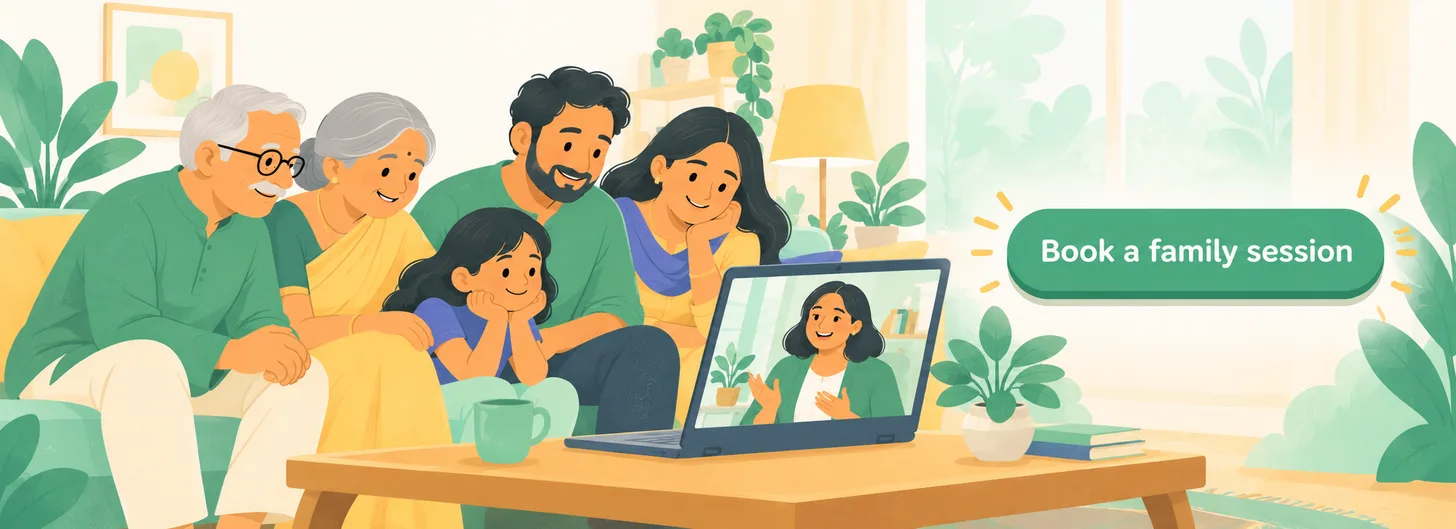
Most of us have had the same argument three times this year, with the same person. A family counsellor does not take sides. She holds the room, slows the pace, and helps each person say the one sentence that keeps getting swallowed. Online therapy makes this possible even when parents live in Jaipur, a sibling is in Bangalore, and the daughter-in-law is in Pune. [Visual 1: multi-generational Indian family in an online session]
What family counselling is, and when it actually helps
Family counselling is talking therapy where two or more members of a family meet a trained counsellor together. It is sometimes called family therapy, or in older textbooks family and marital counseling. The counsellor will not fix the family on her own. She helps the family hear itself.
A family counsellor (or family counselor, both spellings mean the same person) works with the shape of your home, not against it. In Indian homes, that shape is often a joint family. A son and his parents. A daughter-in-law and her mother-in-law. A sibling pair that stopped speaking after one got married. A couple with a teenager who will not eat at the table.
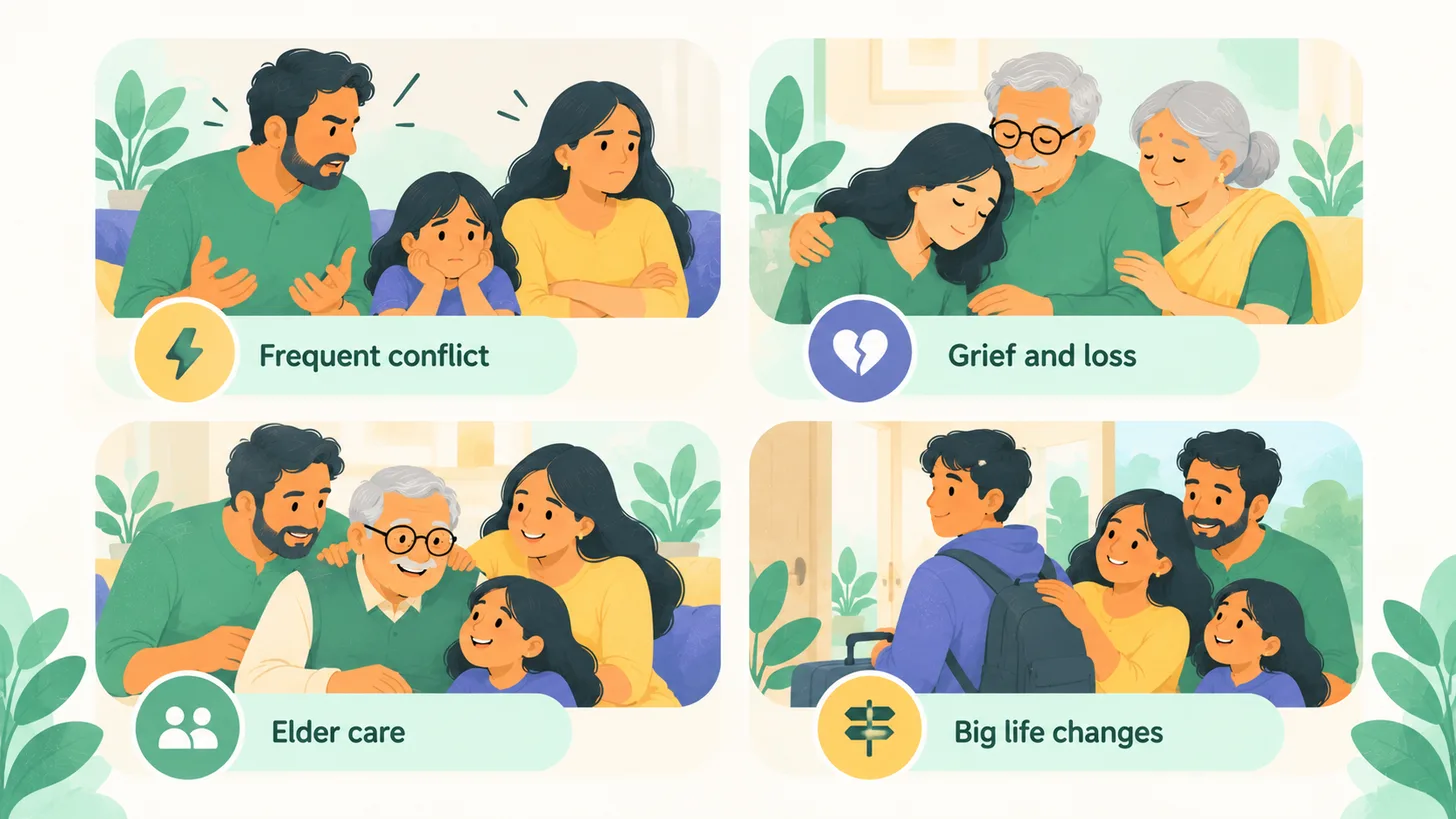
Family counselling helps in situations like these:
- Open conflict that keeps looping, with the same fight every month
- A child or teenager showing distress at school, at home, or in sleep
- Grief inside a family, when each person is handling it in a different way
- An adult sibling’s divorce, engagement, breakup, or move abroad
- Caring for an ageing parent when the plan keeps changing
- Communication gone silent, where messages are passed through a third person
- Addiction or illness in one member that shifts how the others cope
Family counsellors use different methods: systemic, structural, strategic, and narrative work are the common ones in India. Each has its own way of helping a family see itself. You do not need to know these names before you book. The counsellor explains her method on the first call.
In short: Family counselling works on the home, not on one person inside it. If the pattern keeps returning, a counsellor in the room can slow it down enough for a new one to form.
Who joins the session, and across how many homes?
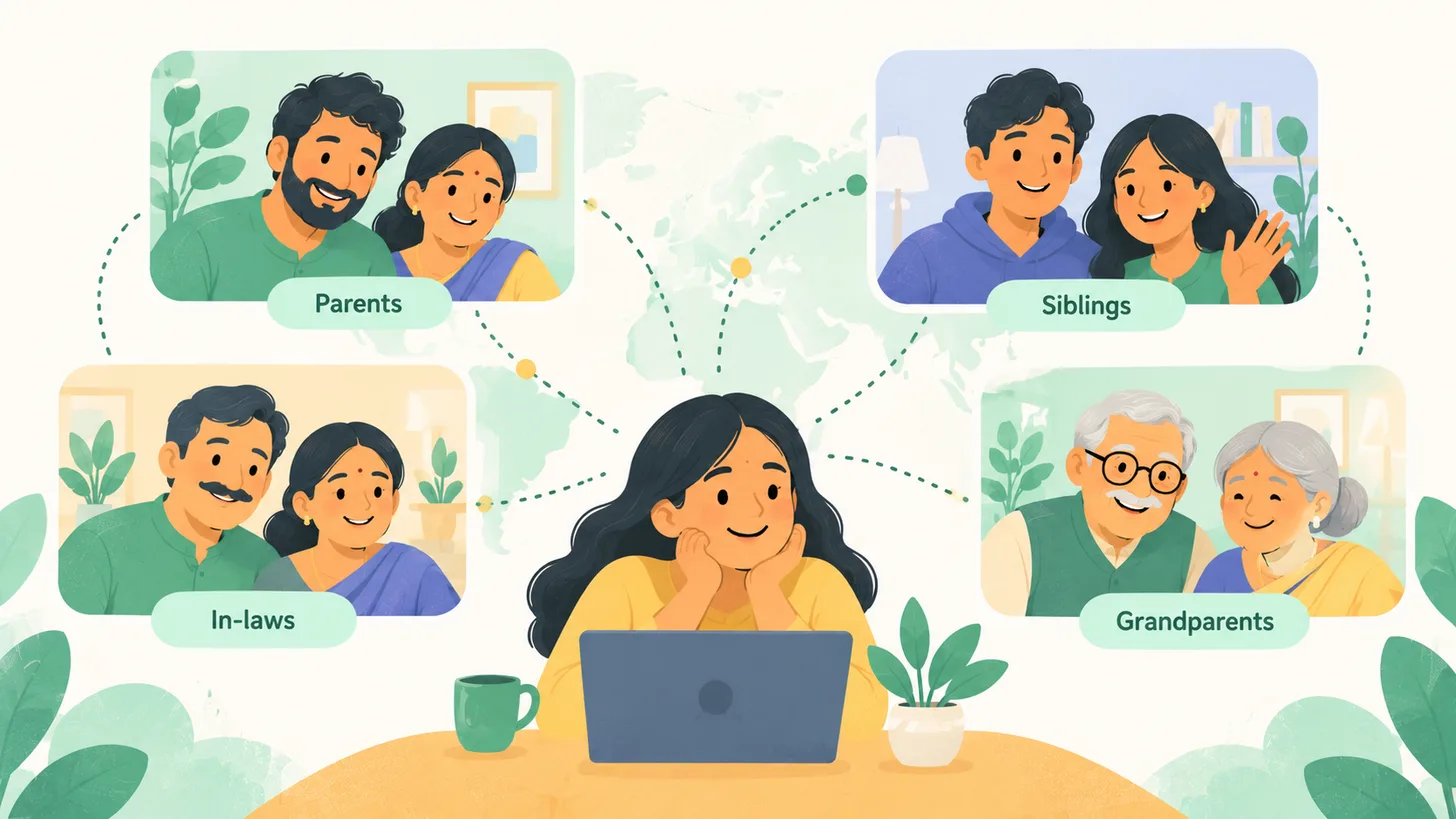
The honest answer: as many as the problem needs, as few as the family can agree on. One parent and one adult child. Two siblings. A couple with their teenager. A joint family of six across three cities. A daughter-in-law who starts alone, with her husband joining from session three.
When individual therapy fits
When family counselling fits
In short: Family counselling is flexible. Start with the people most ready to talk. Add others when the room can hold them.
When family counselling is not the right first step
Family counselling is a shared room. It only works when the room is safe. If someone in your family is being hurt right now, the first step is safety, not therapy. If what you need right now is for one person at home to not be hurt tonight, call a helpline first.
A family counsellor cannot keep a shouting match safe over Zoom. She cannot stop a hand being raised. She cannot keep what one member says in session hidden from another at home. If any of the lines below describe your family tonight, do the safety step first.
If any of these are live right now, individual therapy plus safety planning is the correct first step. Family work can follow once each person is safer. Our page on toxic parents and their impact on mental health covers patterns that often need individual therapy first.
In short: A room full of family members only helps when the room is safe. If it is not, the first call is a helpline, not a counsellor.
Inside an online family therapy session
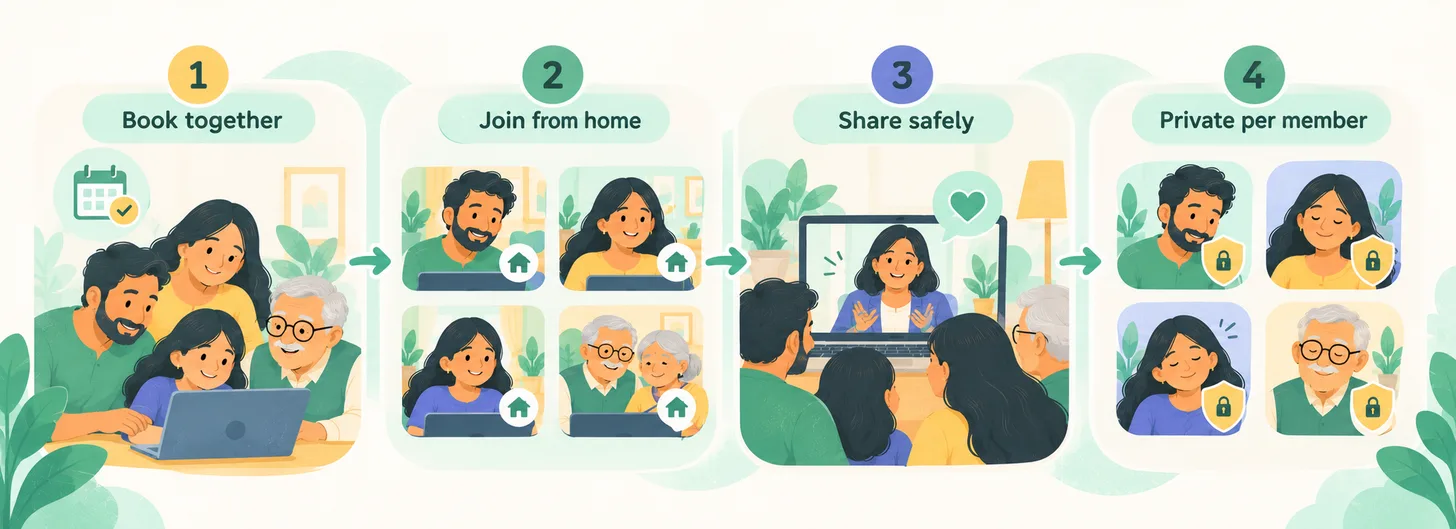
An online family counselling session is a 50-minute video call where each member joins from wherever they are: a mother in Jaipur, a son in Bangalore, his sister in Pune. The counsellor opens the room, invites each person to share one line, and then slows the pace enough for a real conversation to begin.
Before the first session, everyone signs a short consent form online. It takes two minutes. It covers what will be discussed, how notes are kept, and what stays between whom. For minors, a parent or guardian signs for them.
Privacy inside a family session is a careful thing. Your counsellor explains at the start what she will keep and what she will not. In most cases, a no secrets rule applies.
If one member shares something in a one-on-one check-in that affects the family’s safety, the counsellor will encourage that member to say it in the shared session, with her support. She will not share it on her own.
If a conversation at home has been looping, your body is probably bracing before you log in. One slow minute helps you listen instead of defend.
A moment to breathe
Follow the circle. Breathe in, hold, breathe out, then hold. Four counts each. Stay as long as you like.
A typical session runs through four moves. A check-in, where each person says one line. A focus, where the room agrees on what to work on today. A slow unpacking, where the counsellor asks each person what the pattern looks like from their seat. A close, with one small shift to practise before next week.
Sessions are usually weekly for the first four to six weeks, then fortnightly, then as needed. Some weeks it works and the room shifts; some weeks it does not, and the counsellor still holds the pace. That is normal, not failure. [Visual 4: how an online family session works and privacy per member]
If you have been searching for family counselling near you, family counsellor near me, or a family counselling centre nearby, nationwide online therapy answers most of what a local centre does. The one difference: you cannot sit in the same waiting room. For families already spread across cities, that is a strength, not a loss.
In short: An online session is a 50-minute video call, with written consent and a clear privacy rule, where everyone is heard once before anyone is heard twice.
How much does family counselling cost in India today?
Family counselling in India is priced by the counsellor’s training and experience, not by how many people are in the room. A supervised early-career counsellor and an M.Phil Clinical Psychologist both run 50-minute sessions. The second has four to six more years of clinical training, and that shows up in the fee.
| Experience tier | INR range per session | Session length | Best for |
|---|---|---|---|
| Supervised Novice (counsellor-in-training, supervised) | ₹300 to ₹700 | 50 minutes | Early-stage, low-complexity family conflict |
| Counsellor (M.A. Counselling Psychology) | ₹800 to ₹1,500 | 50 minutes | Everyday family conflict, communication, grief support |
| Practicing Psychologist (M.A. + 2 to 5 years’ experience) | ₹1,500 to ₹2,500 | 50 minutes | Mid-complexity family work, joint family dynamics, caregiver stress |
| M.Phil Clinical Psychologist (RCI-registered) | ₹2,500 to ₹4,000 | 50 minutes | Complex cases involving one member’s diagnosis, trauma, or child mental-health work |
| GoodLives | See our pricing page | 50 minutes | Matched by language, concern, and tier |
We verified these ranges from public pricing pages across six Indian online therapy platforms on October 23, 2026. Prices change; this is the honest band today.
Your health insurance may cover part of this. Under Section 21(4) of the Mental Healthcare Act 2017, every insurer in India must provide medical cover for mental illness on the same basis as for physical illness. Policies vary on what they cover for talk therapy; call your insurer by name. The regulator is IRDAI.
In short: Family counselling costs about ₹300 to ₹4,000 per 50-minute session in India today. Insurance may cover part of it.
Red flags when picking a family counsellor
Choosing the right person for your family matters more than choosing the cheapest option on a list. A good counsellor shows her training, names her method, and refers out when another therapist would help you more. The five lines below are signals a counsellor may not be the right fit.
A good counsellor is honest when she is not the right fit. If she thinks a psychiatrist should see one family member first, she will say so. If a specialist in child therapy would help your eight-year-old more than she can, she will refer. That honesty is itself a credential.
In short: A trustworthy counsellor shows her training, names her method, and refers out when another therapist would help you more.
7 questions for a 15-minute intake call
Most Indian online therapy platforms offer a free 15-minute call before you book. Use it. Fifteen minutes with the right questions tell you more about a counsellor than her bio ever will, and more than her profile reviews. The seven below are a starting kit for a family topic.
In short: Fifteen minutes with the right questions tells you more than fifteen reviews.
How to raise this at home with parents and in-laws
The hardest part of family counselling, for many Indian families, is not the sessions. It is the conversation before the sessions. Telling your mother you have booked a counsellor. Telling your husband you want his sister to join. Telling your in-laws something has to change.
That heavy-hearted feeling, chinta (worry that sits in the chest), is the one most readers describe before they book. You are not being dramatic. You are being honest about where things are.
You do not have to call it therapy if that word is loaded at home. “A family consultation”, “a counsellor to help us talk”, or “someone who works with families” are all honest and lower the first hurdle. The person who booked does not have to lead the first session. The counsellor does.
You might be worried your mother will refuse to come. Many do, the first time. Go yourself for a session or two with the counsellor’s help. Then bring the invitation back with a specific question.
Not “will you come to therapy”, but “will you come for one call to talk about Dad’s medicines”. A small ask is easier to say yes to.
Our page on communication barriers in relationships covers the first-conversation move. If the family you are trying to reach includes a dynamic that keeps shutting conversation down, start with yourself and come back to the family room when you are steadier.
In short: You do not have to call it therapy. A small, specific ask lowers the first hurdle.
FAQ
What is a family counsellor, and what do they actually do?
A family counsellor is a trained psychologist, usually with an M.A. or M.Phil, who runs sessions with two or more family members together. She slows the pace, names patterns the family may not see from inside, and helps each member say the one thing that keeps getting swallowed.
How much does family counselling cost in India?
Family counselling in India in 2026 ranges from about ₹300 for a supervised counsellor-in-training to about ₹4,000 for an M.Phil Clinical Psychologist, per 50-minute session. Most families book in the ₹800 to ₹2,500 band. GoodLives’s own fees are on our pricing page.
Can we start family counselling with just one person?
Yes. Many families do. One member starts, the counsellor helps her prepare, and the others join from session three or four. It is also common for a family to come for two or three sessions, then step back into individual work. The format is not fixed.
Will what I say be shared with other family members?
Not without your knowledge. Your counsellor explains the privacy rule at the start. In most cases, a no secrets rule applies: if something you share one-on-one affects the family’s safety, she will encourage you to say it in a shared session, with her support. She will not share it on her own.
Can children and teenagers join family counselling in India?
Yes, with a parent’s or guardian’s written consent. Teenagers often join from the start. Children under 13 are usually met one-on-one in play-based work, with the parents brought in separately. A good family counsellor adapts the room, the length, and the language to the child’s age.
How is family counselling different from couples therapy or marriage counselling?
Couples therapy is for two partners, usually romantic. Marriage counselling sits inside couples work, often around staying together, separating, or pre-marital readiness. A marriage and family therapist is trained in both. See couples therapy online in India and marriage counselling online in India.
Does GoodLives offer family counselling in Hindi and other Indian languages?
Yes. We match you with a counsellor who speaks the language your family is most comfortable in. For a joint family where members prefer different languages, the counsellor will decide with you how to run the room. Share preferences on the intake call.



Share your thoughts