
If you have Googled anxiety twice tonight, this page is for you. GoodLives is India’s online therapy and counselling platform, trusted by 500K+ people. The goal is not to label you. It is to help you decide what to do next. We cover anxiety disorder symptoms, the main types, treatment options, and the honest signs that it is time to call someone.
What does anxiety actually feel like?
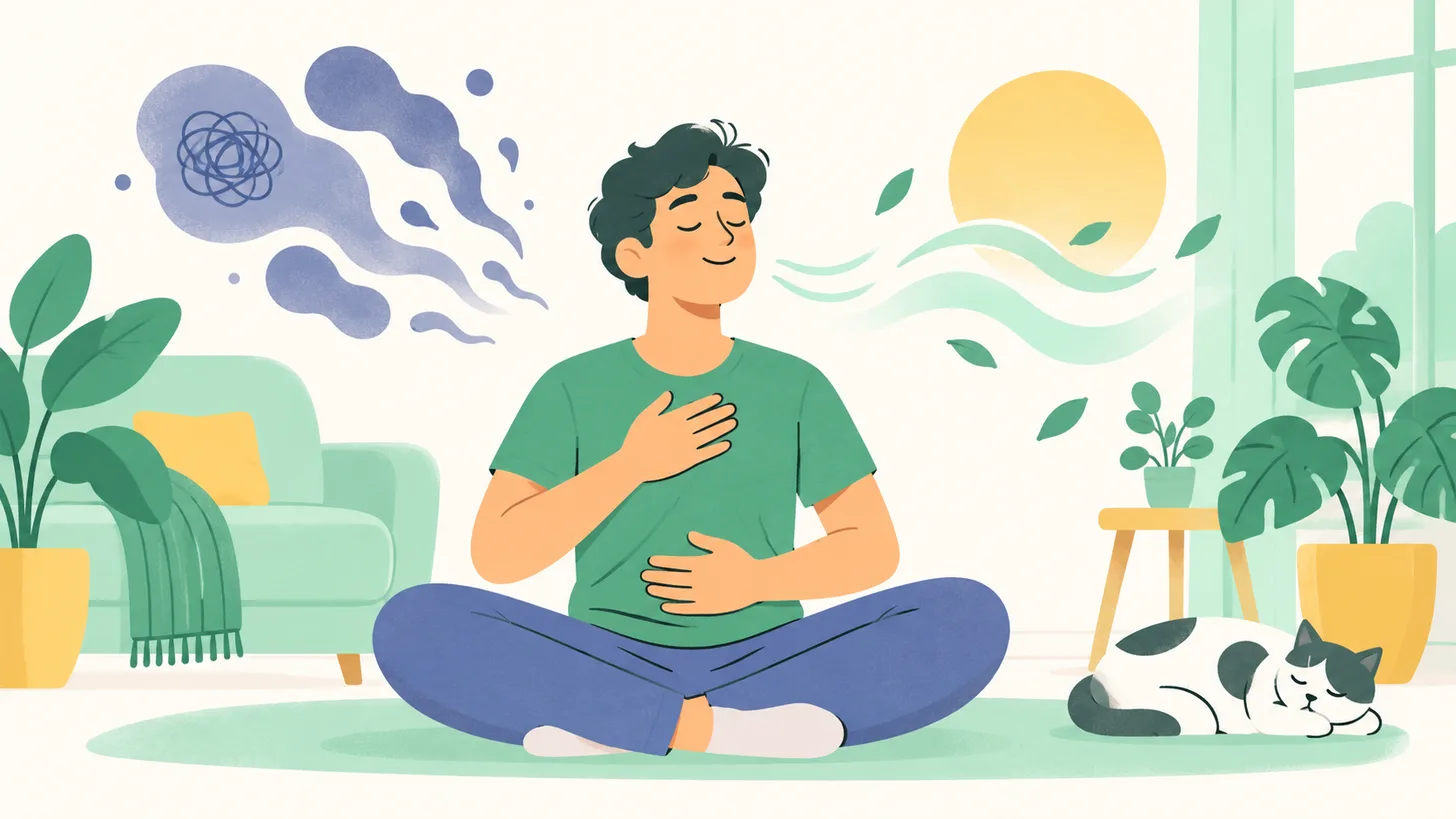
Anxiety is the tight-chest, racing-mind signal your body sends when it thinks something is wrong, even when nothing is. For most of us, it comes and goes with a work deadline. For some, it stays and starts to run the day. That second shape is what we call an anxiety disorder.
The word “anxiety” is both the everyday feeling and the diagnosis. The feeling is useful. It makes you check the stove once.
The diagnosis is what we talk about when the feeling arrives too often, lasts too long, or sits in your body on a quiet Sunday.
Many of us carry anxiety for months before asking for help, because we are told we are overthinking or should just relax. Neither is the answer. What you are feeling has a name, and plenty of us have been there.
In short: anxiety is a normal signal that can turn into a condition when it stays switched on.
How anxiety shows up in your body and mind
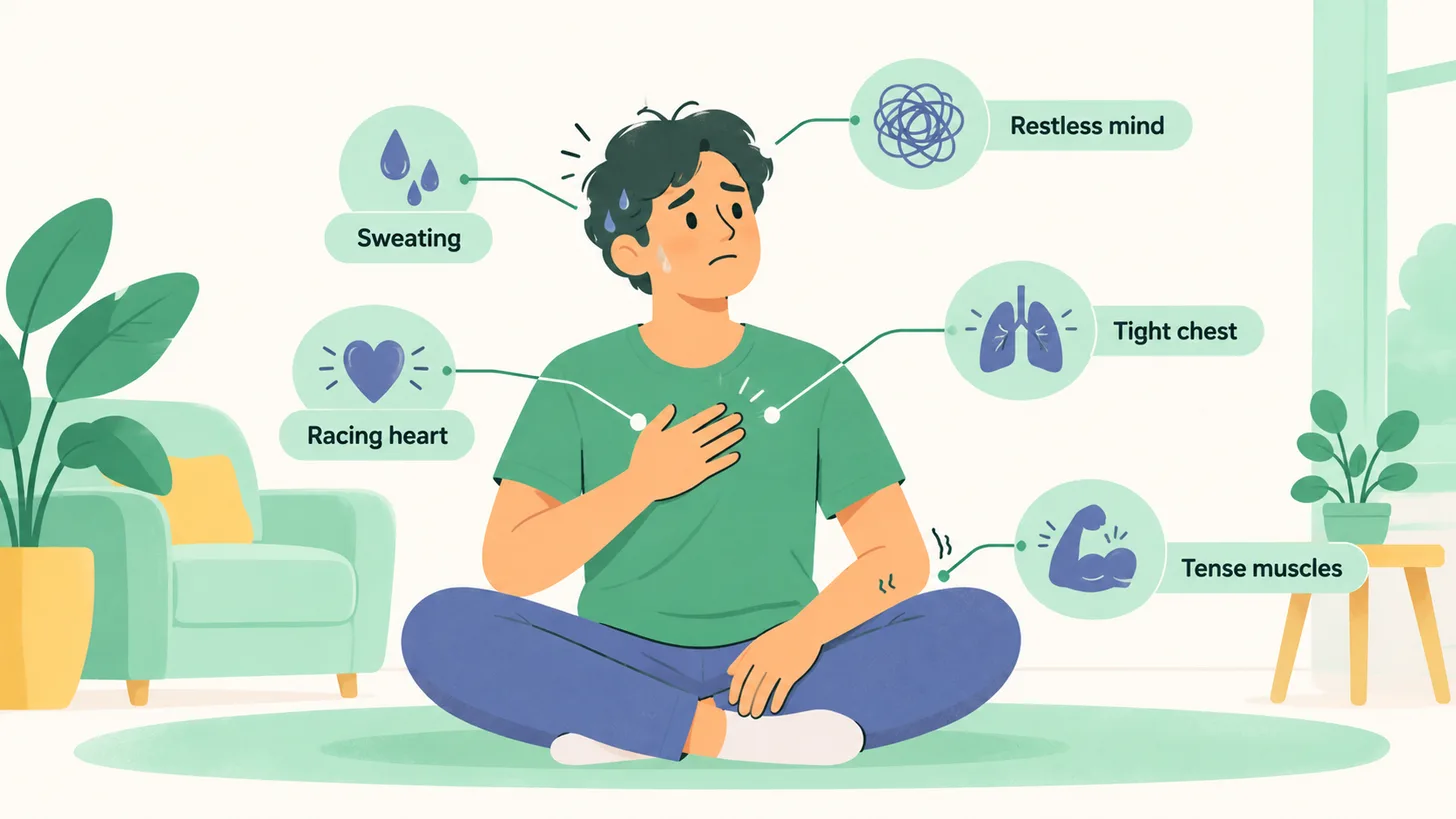
Anxiety is not only in your head. It is in your breath, your stomach, your shoulders, your sleep. People often arrive at a first therapy session saying their body is unwell, not their mind. Both can be true. Below are the signs we hear most often from readers.
In the body:
- A tight chest, racing heart, or feeling you cannot take a full breath.
- Headaches, often a dull pressure around the forehead or neck.
- Stomach knots, nausea, or going to the bathroom more often.
- Sweating, shaking hands, or feeling cold and clammy.
- Trouble sleeping, waking at 3 am with your mind already running.
An anxiety headache is not a separate illness. It is a tension headache built from clenched jaws, shallow breathing, and tight shoulders. If you treat the anxiety, the headache usually eases with it.
In the mind:
- A loop you cannot switch off, often about one topic.
- Worst-case thoughts that feel real even when you know they are not.
- Trouble focusing at work or in a conversation.
- A low-grade dread that sits under the day.
- Snapping at the people closest to you, then feeling guilty.
If three or more of these have been true most days for two weeks, it is worth talking to a professional.
The World Health Organisation says about 4 in 100 people live with an anxiety disorder each year (WHO, 2023). In India, the National Mental Health Survey put the lifetime share at 3.5% (NIMHANS, 2016).
In short: anxiety shows up as body signs first for many people. Noticing the physical pattern is often the first honest step.
The main types of anxiety disorders, in plain words
Clinicians group anxiety disorders by shape, not by severity. Any of them can be mild or heavy. The shape matters. What works for a phobia is not what works for daily worry. Here are the main types, one line each.
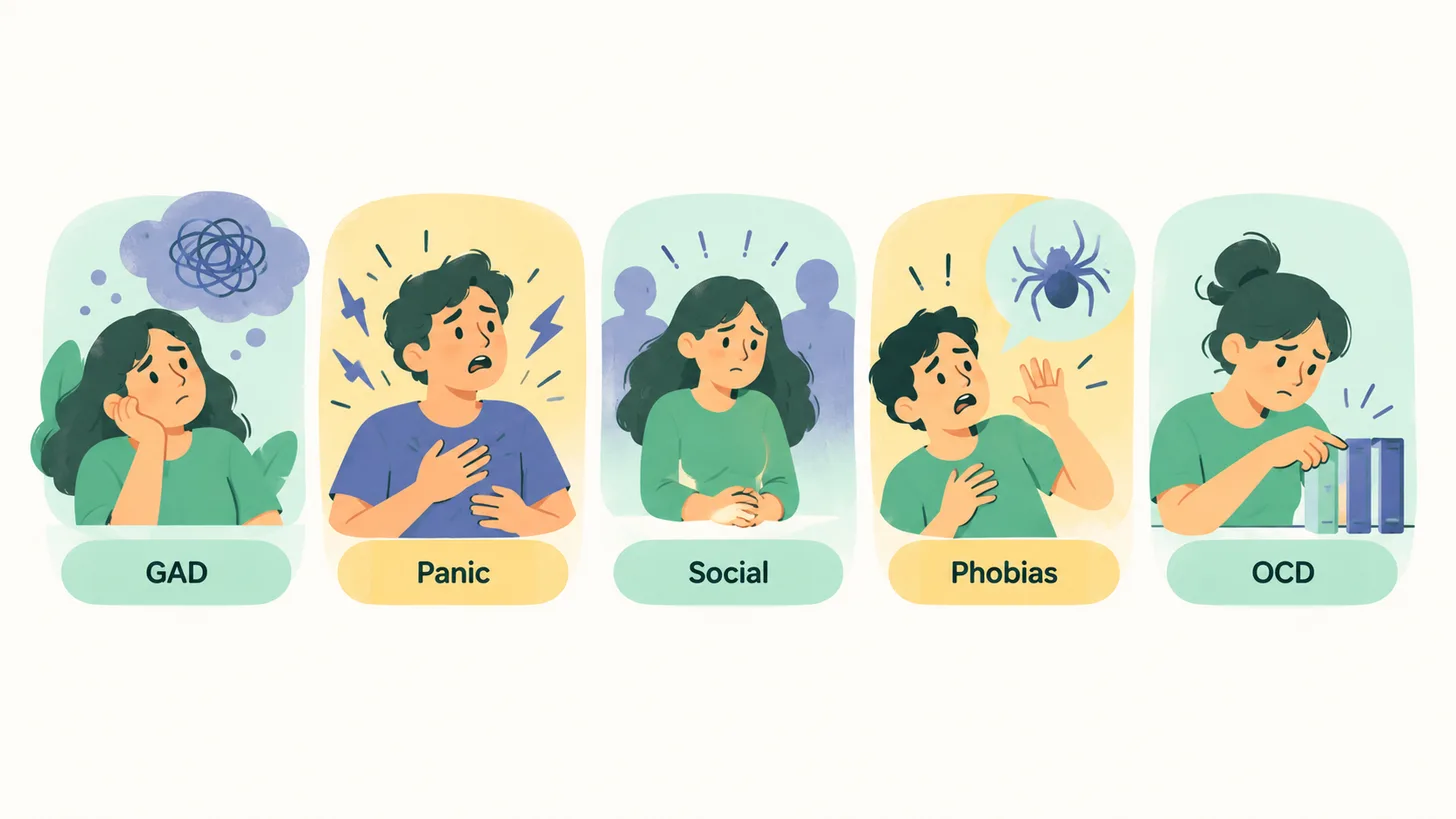
- Generalised anxiety disorder (GAD): worry across many things, most days, for six months or more. The worry jumps and rarely lands.
- Panic disorder: sudden surges of fear that peak in minutes, with a racing heart and the sense of losing control. We call these panic attacks.
- Social anxiety: fear of being judged in everyday situations, from phone calls to parties. We cover it in a separate guide on social anxiety.
- Specific phobias: intense fear of one thing, like heights, injections or lifts. The fear is out of proportion to the risk.
- Agoraphobia: fear of places where escape feels hard. Often linked to panic.
- Separation anxiety: heavy worry about being apart from people you love. Common in children, present in some adults too.
Two more sit next to this family. Obsessive-compulsive disorder (OCD) is now its own category. The worry mechanism is similar. Post-traumatic stress disorder now sits under trauma, not anxiety. Many people with trauma also live with anxious thoughts.
In short: the shape of your anxiety decides the first treatment to try. A short chat with a therapist can usually tell you which bucket you are in.
Why your body reacts first: fight-or-flight explained
Anxiety starts in a part of your brain called the amygdala. It runs a very old alarm. When it reads something as a threat, it tells your body to fight or run. Your heart beats faster. Breathing speeds up. In a real emergency, this saves lives.
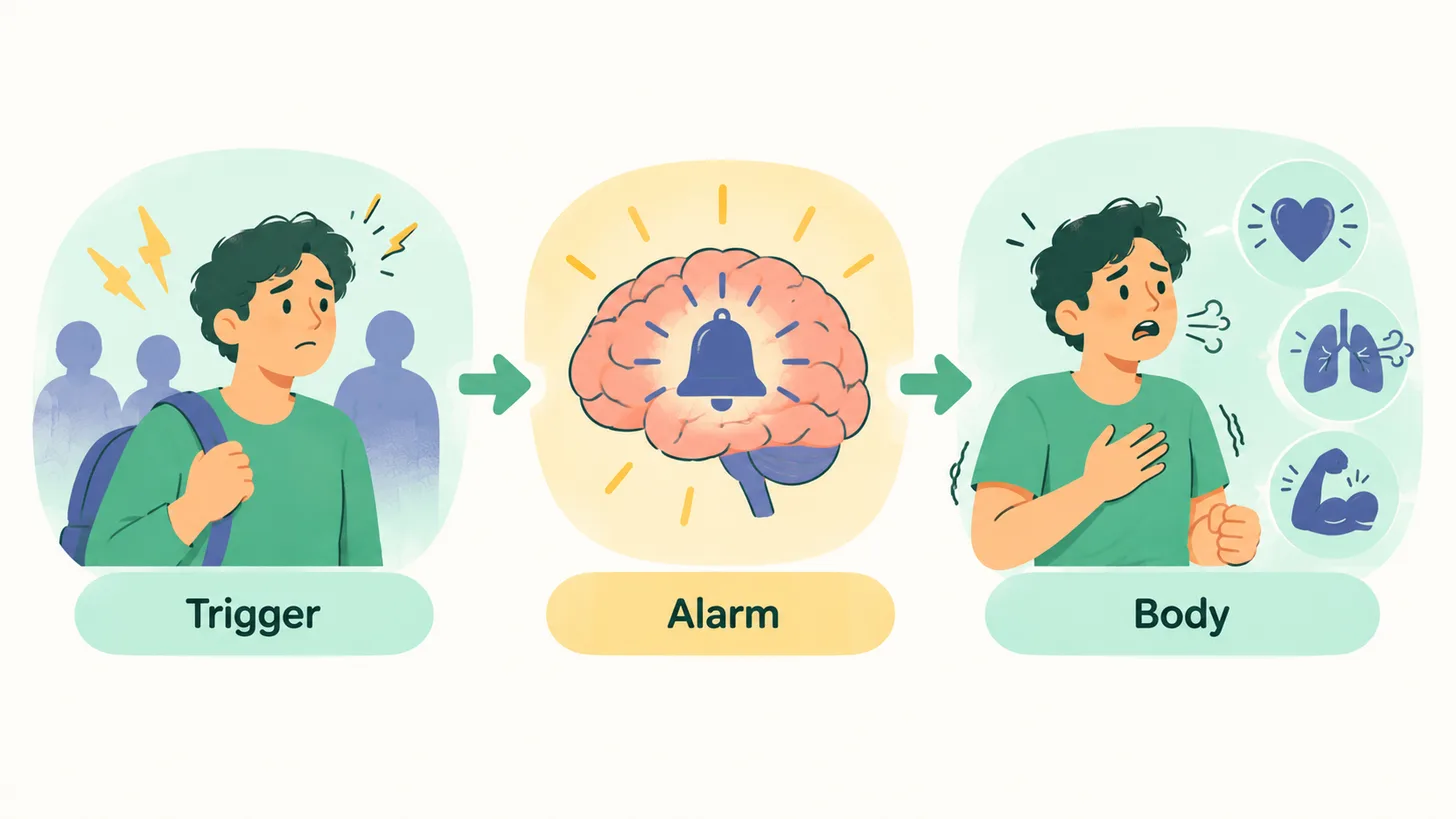
The problem is that the amygdala cannot tell a real threat from a thought about one. A rude message from a boss. A WhatsApp from a parent. A long silence from a partner. Any of these can trip the same alarm. Your body prepares to fight a tiger that is not there.
Three forces usually combine to tip a person from normal anxiety into an anxiety disorder:
- Biology: family history matters. Some of us have more reactive nervous systems.
- Life events: a job loss, a loss in the family, a childhood with little safety, a long illness.
- The current week: poor sleep, high caffeine, no movement, no one to talk to.
Any one of these is usually manageable. Two or three together, over months, is where many people quietly cross the line.
In short: anxiety is not weakness. It is an old alarm, triggered too often, by a life your body has not yet learned to feel safe in.
Is “anxiety neurosis” the same thing?
Anxiety neurosis is an older name clinicians used until the 1980s. It mostly described what we now call generalised anxiety disorder. If a parent or older doctor uses the term, they are usually pointing at the same long-running worry pattern. The anxiety neurosis definition of that era was broad.
In Hindi, that feeling is often called ghabrahat, a restless, chest-tight kind of worry that families recognise even without an English word for it. The search phrase anxiety neurosis meaning in hindi usually maps here. The current name does not change what the person feels or what helps. Our longer explainer is in the anxiety neurosis guide.
In short: if an older doctor says anxiety neurosis, they usually mean GAD. The treatment is the same.
Can anxiety actually get better?
Anxiety becomes a mental health condition when it is heavy enough and long enough to affect how you live. That is the honest line between a hard week and a diagnosis. The diagnosis is not a verdict. It is a label that lets a therapist choose the right tools.
People ask us some version of this often: is anxiety curable, can it be sorted for life, can I ever be free of it? The honest answer has three parts.
- A full “cure” is the wrong frame for most of us. Anxiety is not like a bacterial infection you clear in a week. It is more like asthma. You can get it down to a quiet background and keep it there.
- Treatment works for most people who stay with it. The American Psychiatric Association says most people with anxiety disorders see real improvement with therapy, medication or both (APA, 2024).
- Promises of a two-week fix are a red flag. If a website or ad guarantees to solve anxiety in two weeks, close the tab. Mental health does not work on that timeline.
So, is generalised anxiety disorder solvable in the strict sense? Mostly, no. Can it be managed to the point you live a full life, work, sleep and travel? Yes, often. That is what honest clinicians mean when they say anxiety is treatable.
In short: we do not promise fixes. We promise that most people who get real help get real relief.
What helps right now when anxiety is loud
When your chest is tight and your head is racing, long-term therapy is not the right tool for the next ten minutes. You need something your body can respond to in the room you are in. Breathing and grounding are the two most reliable options. Both give your nervous system something slow and real.
If you want, take one slow minute with this before you read on.
A moment to breathe
Follow the circle. Breathe in, hold, breathe out, then hold. Four counts each. Stay as long as you like.
The box above walks you through four-count box breathing: in for four, hold for four, out for four, hold for four. The slow exhale tells your nervous system the emergency is over. Three or four rounds usually settle a racing heart.
The second tool is the 5-4-3-2-1 grounding exercise. Name five things you see, four you touch, three you hear, two you smell, one you taste. It pulls your attention out of your head and into the room. Our longer walk-through is in the grounding technique guide.
These are tools, not treatments. They will not fix the thing that made you anxious. They help you ride out the next ten minutes so you can decide the next step from a calmer place.
In short: when the alarm is loud, slow your breath and name your senses. Save the harder work for a time when your body is listening.
High functioning anxiety: when it looks fine outside
High functioning anxiety is not a formal diagnosis. It is a shorthand many Indian professionals know well. On the outside, the person is doing well. Inside, the engine is running hot. The work is driven by fear of failing. The friendliness is driven by fear of being disliked. Rest feels unsafe.
People with this pattern often reach a therapist later, because nothing in their life looks broken. But the body knows. Sleep is light. The jaw is tight at night. The chest holds a dread that only quiets when a new task shows up.
If you recognise yourself here and your work is going well, that is not a reason to wait. The honest reframe is that you have been paying a tax to stay functional. A therapist can help you lower the tax without lowering the output.
In short: functioning is not the same as being well. If life is working and you are not sleeping, that is a signal, not a success.
Anxiety treatment: therapy, self-help and when psychiatry helps
Anxiety treatment in India sits across three layers. Most people need some mix of two. The three layers are self-help, therapy, and medical support from a psychiatrist. The right mix depends on how heavy the anxiety is, how long it has lasted, and what else is going on in your life.
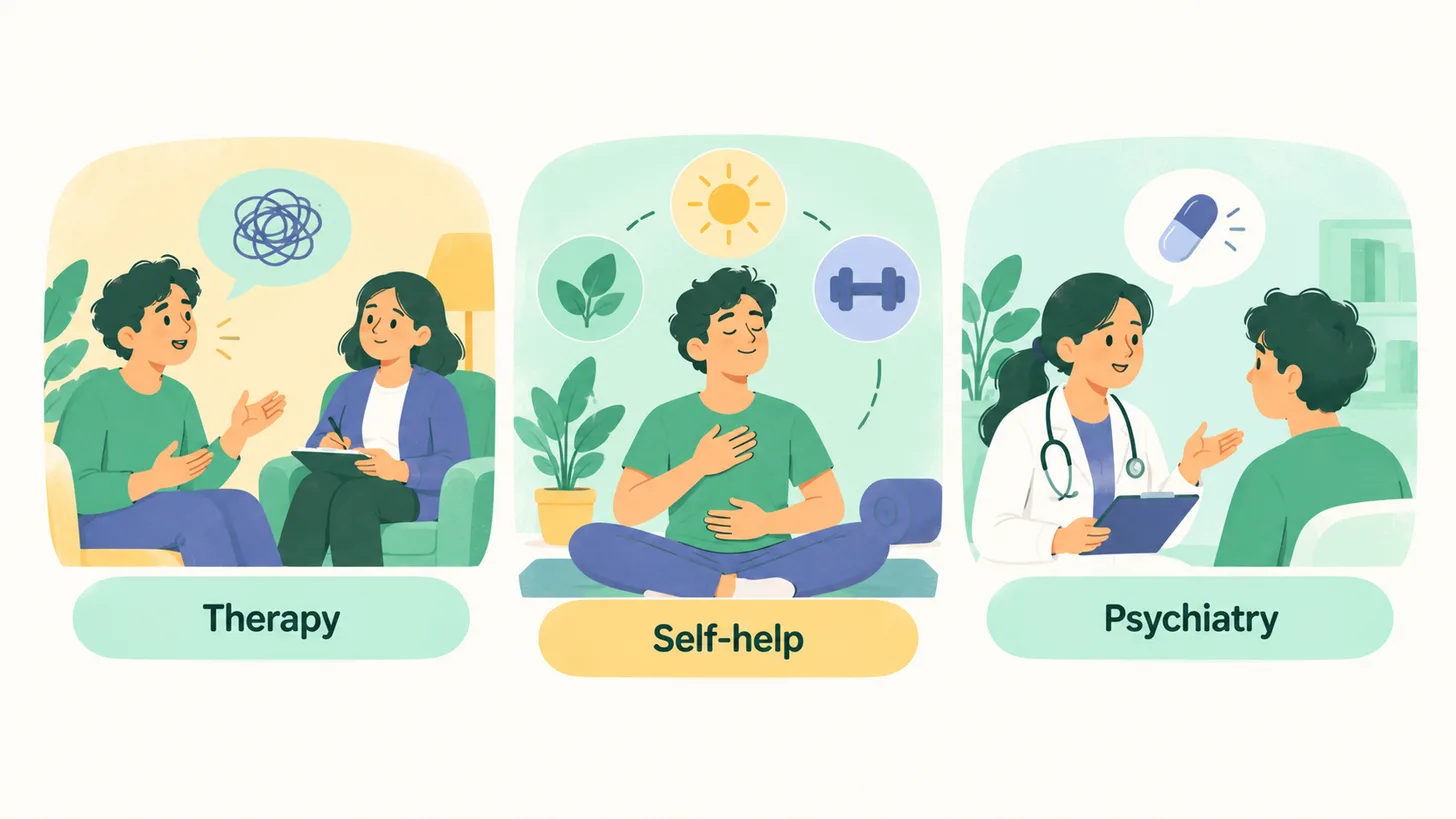
Self-help. Daily movement, caffeine within reason, enough sleep, time off your phone, one honest conversation a week. For mild and new anxiety, this can be enough. For heavier cases, it still helps.
Therapy. The most researched talk therapy for anxiety is cognitive behavioural therapy (CBT). CBT is a short, structured therapy that helps you spot anxious thoughts and reframe them. For many people, 8 to 20 sessions make a real difference. A therapist may also use acceptance and commitment therapy, exposure therapy for phobias, or trauma-informed therapy. If old thought loops are part of the picture, our guide on negative thoughts walks through the CBT steps.
Psychiatric support. A psychiatrist is a medical doctor who can prescribe medication. For heavier anxiety, a short course of medication can lower the baseline so therapy can take hold. This matters most when sleep is broken or you cannot work. We do not name specific medications in a blog. That is a conversation for you and your doctor.
Breathwork lowers your heart rate in two minutes. Therapy lowers your baseline over three months. One is a tool for the next ten minutes. The other is a change you build with a trained person who sees what you are carrying.
The Mental Healthcare Act 2017 gives every Indian the right to access mental health care (India Code). It also protects your privacy. You do not need your family’s permission to book a session as an adult.
In short: most people with an anxiety disorder get better with the right talk therapy and a few habit changes. Medication is a tool, not a failure, when it is needed.
Panic attack: what it feels like and what helps
A panic attack is a sudden surge of fear and body alarm. The heart races. Breathing feels blocked. The hands shake. Some people feel tingling in their fingers or a sense of watching themselves from outside their body. The whole thing usually peaks in about ten minutes.
The signs people describe most often are:
- A hammering heart or chest pain that mimics a heart attack.
- Shortness of breath, or feeling you cannot breathe deeply enough.
- Shaking, sweating, or feeling cold.
- A fear of losing control, dying, or going mad.
- Dizziness, blurred vision, or a sense the room is far away.
What helps is counter-intuitive. The body is in a false alarm, so the goal is not to escape it. It is to slow it down. Sit if you can. Lengthen the exhale (count four in, six out). Name five things you can see. Remind yourself the feeling will pass, because attacks always do.
If this is your first one, see a doctor to rule out a heart problem. That peace of mind is worth the visit. Our longer walk-through is in the panic attack guide if attacks have been happening more than once.
In short: a panic attack feels dangerous and is not. The body will land again. A therapist can help you make the next one shorter.
When to get help, and the signs that mean now
Not every anxious week needs therapy. Some of this is a season you walk through with sleep, a plan and one honest conversation. The question is where the line sits. Below is the honest version we would give a friend.
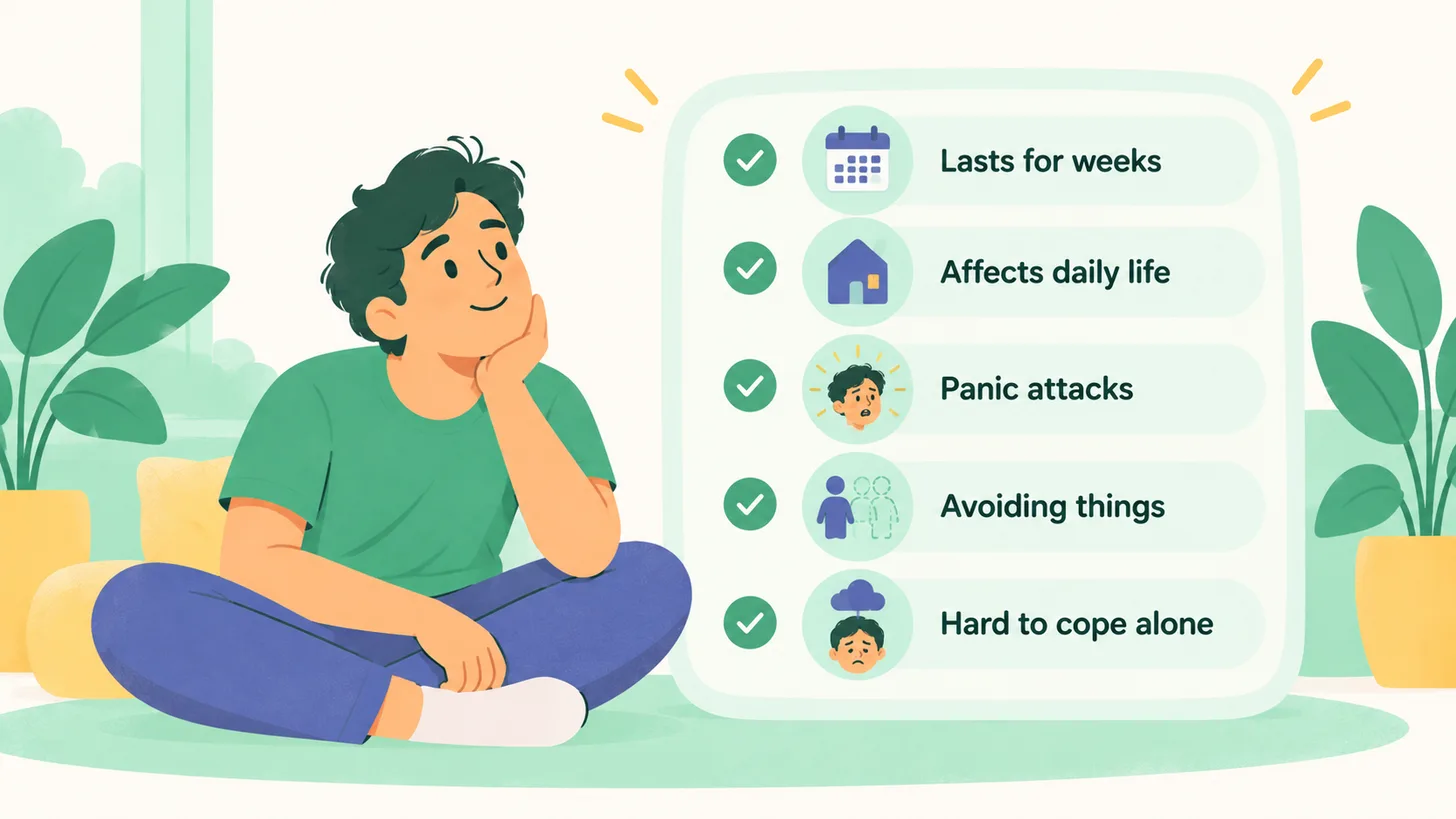
Book a therapy session when any of these is true:
- Anxiety has been loud most days for two weeks or more.
- You are missing work, college or family time because of it.
- You are using alcohol, cannabis, or sleep medication to switch it off.
- You have had two or more panic attacks in a month.
- You have thoughts of ending your life, or of hurting yourself.
- A trusted person has said something is going on, and you know they are right.
If the last two are true, please call a helpline first. Tele-MANAS (14416) is free, 24/7, and run by the Government of India. The call is confidential and will not reach your family unless you want it to. You might be worried that if you call, your family will somehow find out. They will not.
Call a helpline today if the feeling is loud now. Call if you are not sure you are safe. Call if you cannot sleep for a third night, or if you need to hear a kind voice before Monday.
If what you need tonight is to sleep tonight, a therapy session on Friday is not the fastest tool. Call Tele-MANAS and go to bed. Therapy is for next week, and next week is close.
In short: the honest line is time and function. Two weeks of most days, or anything affecting work, sleep or safety, is a reason to talk to someone this week.
How to raise anxiety with your family at home
This is often the hardest part. Many Indian families still hear “I am seeing a therapist” as “I am unwell” or “I am weak.” The two lines that help most are not clinical. They are specific. “I have been sleeping badly” lands with a parent in a way “I have a disorder” does not.
A few things to keep in mind:
- You do not need permission as an adult to see a therapist in India.
- You can see a therapist without telling your family at all, in English or Hindi, from your room.
- If you do want to tell them, pick a quiet evening and a parent who tends to listen. Start with the body signs, not the diagnosis.
- A line that often works: “This is not about anyone in the family. I just want to talk to someone trained to help with this.”.
If a parent gets scared, that is love showing up in a hard shape. Give them a week. Share one plain article (this one works). Some weeks it works, some weeks it does not. Many families come around once they see a person getting better.
In short: families worry because they care. Lead with sleep, body signs and the fact that this is common. Save the big words for later.
FAQ
What are 5 symptoms of anxiety disorder?
Common signs are a tight chest or racing heart, trouble sleeping, a worry loop you cannot switch off, and avoiding places that used to be fine. Headaches or stomach trouble doctors cannot explain are also common. If three of these have been true most days for two weeks, it is worth talking to a therapist.
Is anxiety a mental disease?
It is a mental health condition, not a disease like flu. An anxiety disorder is a pattern your nervous system has learned, and it responds to therapy and, when needed, medication. Most people with the right support see meaningful improvement, often within three to six months of starting.
What are the signs of a panic attack?
The common signs are a hammering heart, shortness of breath, shaking, sweating, dizziness, and a fear of losing control. It usually peaks in about ten minutes. If this is your first one, see a doctor to rule out other causes. Attacks pass, and a therapist can help lower how often they happen.
Is there a cure for anxiety?
Not a one-time fix, but strong treatment. Most people who complete a course of therapy, often CBT, see anxiety drop to a quiet level and stay there with light upkeep. For heavier cases, medication from a psychiatrist can help the therapy take hold. Honest clinicians say “manageable and treatable”, not “solved”.
What is the difference between anxiety and an anxiety disorder?
Anxiety is the feeling. An anxiety disorder is the pattern. Everyone feels anxious before a job interview; that is useful. A disorder is when the feeling arrives too often, lasts too long, or affects how you sleep, work and relate to people. The clinical cutoff is two weeks of most-days symptoms.
Can anxiety cause headaches and stomach problems?
Yes. Anxiety raises muscle tension, which creates tension-type headaches around the forehead and neck. It also slows digestion, which can cause nausea, stomach knots, or going to the bathroom more often. These usually ease when the anxiety is treated. See a doctor if the physical symptoms are heavy.
Do I need medication for anxiety?
Often, no. Mild to moderate anxiety usually responds to therapy and better sleep. For heavier anxiety that is stopping you from working, a psychiatrist may suggest medication for a few months. The goal is to lower the baseline enough for therapy to work. Medication is a tool. It is not failure, and not for life.


Share your thoughts