
What this blog includes
- The plain English grief meaning, and how it differs from mourning and bereavement
- Hindi vocabulary for grief, with a gloss anyone can read
- The five stages of grief, and why they are rarely a straight line
- Indian cultural practices around loss, and the silences inside them
- When grief needs a professional, and where to get help in India
Grief is love with nowhere to go. If someone you cared about is no longer here, your mind and body will do strange things for a while. The chest tightness in a cab you have taken a hundred times. A song that lands differently today. The grief meaning most of us carry is “a terrible sadness after someone dies”. That is true. It is also not the whole picture. Trusted by 500K+ people, GoodLives has sat with readers through this kind of week before. You are not being dramatic.

Grief meaning: what grief really is
The clearest grief meaning is this: grief is the natural response of your mind, body and relationships to a loss that matters. It is not a disorder. It is not weakness. It is what love looks like when the person, pet or future it belonged to is gone.
Three words often get used together, and they are not the same thing.
Grieving meaning in Hindi: शोक का अर्थ, in plain English
The grieving meaning in Hindi is simple, and the words carry more than their translations. Shok (deep sorrow after a loss, held with respect) is the most formal word. Dukh is the everyday sadness that colours a bad week. Each word points at a different corner of the same feeling.
शोक का अर्थ, in one line: a quiet, serious sorrow after a loss, held with care. You might hear “unke parivar mein shok hai” at a neighbour’s house when someone has died. The word asks you to lower your voice and bring food, not advice.
When you Google grieving meaning in Hindi, you tend to see the Devanagari word शोक and a two line definition. Both are correct. The longer version is that grief in India is often shared out loud, in rituals, in gatherings, in food, in the way the house changes for 13 days.
The quiet comes later, after everyone has left.
Many of us have grown up hearing kind advice about not taking a loss too much to heart. The advice is well meant. It is also not the whole truth. You can hold a cup of chai with one hand and keep a loss in the other hand, and both are allowed.
In short: Grief in India is often loud at the start and quiet later. Both parts need care.
The five stages of grief, and why they are rarely a straight line
The five stages of grief, as most people have heard them, come from the psychiatrist Elisabeth Kubler-Ross. She wrote about them in 1969, after sitting with people who were themselves dying. The names are useful. They are not a schedule.

Here is the honest version.
Denial is the first “this cannot be real”. You open WhatsApp to text them. You still set two cups. Anger is the question “why”. Why them, why now, why me. Sometimes it lands on the person who died, on God, on the hospital, or on yourself. Bargaining is the mind’s “what if”. What if we had seen the doctor sooner. What if I had called. What if I had been there. Depression here is not the same thing as clinical depression. It is the heavy, hollowed-out sadness that comes once the first shock passes. It is loud quietness. Acceptance does not mean you are okay with the loss. It means you have made room for it, in a life that keeps going.
Here is the part the original list did not say loudly enough. These stages are not a staircase. Many people loop through them in a day. Some never feel anger. Some sit in bargaining for months. Some skip “depression” and move to a slow acceptance.
A review in Mortality (Stroebe and colleagues, 2017) found the five stage model is poorly supported by research. The grief scientists who built on Kubler-Ross’s work moved to a different idea.
That newer idea is called the dual process model. You do not pass through grief. You move between two things. Some days are “loss focused”, when you cry, remember, miss. Other days are “restoration focused”, when you cook, work, laugh, make a plan. Both are grief. Switching between them is not avoidance.
The third modern idea is called continuing bonds. The old advice was to “let go”. The new, kinder research says most people never fully let go, and do not need to. You keep the person with you, in the dal you cook, in the inside jokes you still think. That is love continuing.
In short: The five stages are a map, not a timetable. You can skip one, loop, or hold a bond with the person for life. All of that is grief working.
What grief feels like in your body, your mind, your days
Grief does not stay in your heart. It spreads. You might feel empty inside one morning, then burst into tears making tea the next. Your chest feels bruised. Sleep splits into two short halves. You read the same email three times and still cannot say what it means.
Below is a plain list of what grief often does. Not everyone gets all of these, and the mix changes week to week.
- Chest tightness, a lump in the throat, sudden tears
- Trouble sleeping, or sleeping too much
- Loss of appetite, or eating for comfort
- Trouble concentrating, forgetfulness, missed appointments
- Waves of guilt about things you did or did not say
- Pulling away from friends and family, or clinging harder
- A quiet relief, especially after a long illness, which can feel confusing
The waves are the part most people are not warned about. You can be fine for days, and then a smell or a song or a bus route hits you. Suddenly you are back in the first week. If you have ever asked yourself why am I crying for no reason, a loss two months ago may still be the answer. The body keeps time differently from the calendar.
If you want, take one slow minute with this before you read on. It will not fix the loss. It will help you ride out the next ten minutes.
A moment to breathe
Follow the circle. Breathe in, hold, breathe out, then hold. Four counts each. Stay as long as you like.
In short: Grief shows up in your body, your mind and your days. The waves are normal, and they do not mean you are getting worse.
Grief in Indian families: rituals, expectations and the silences in between
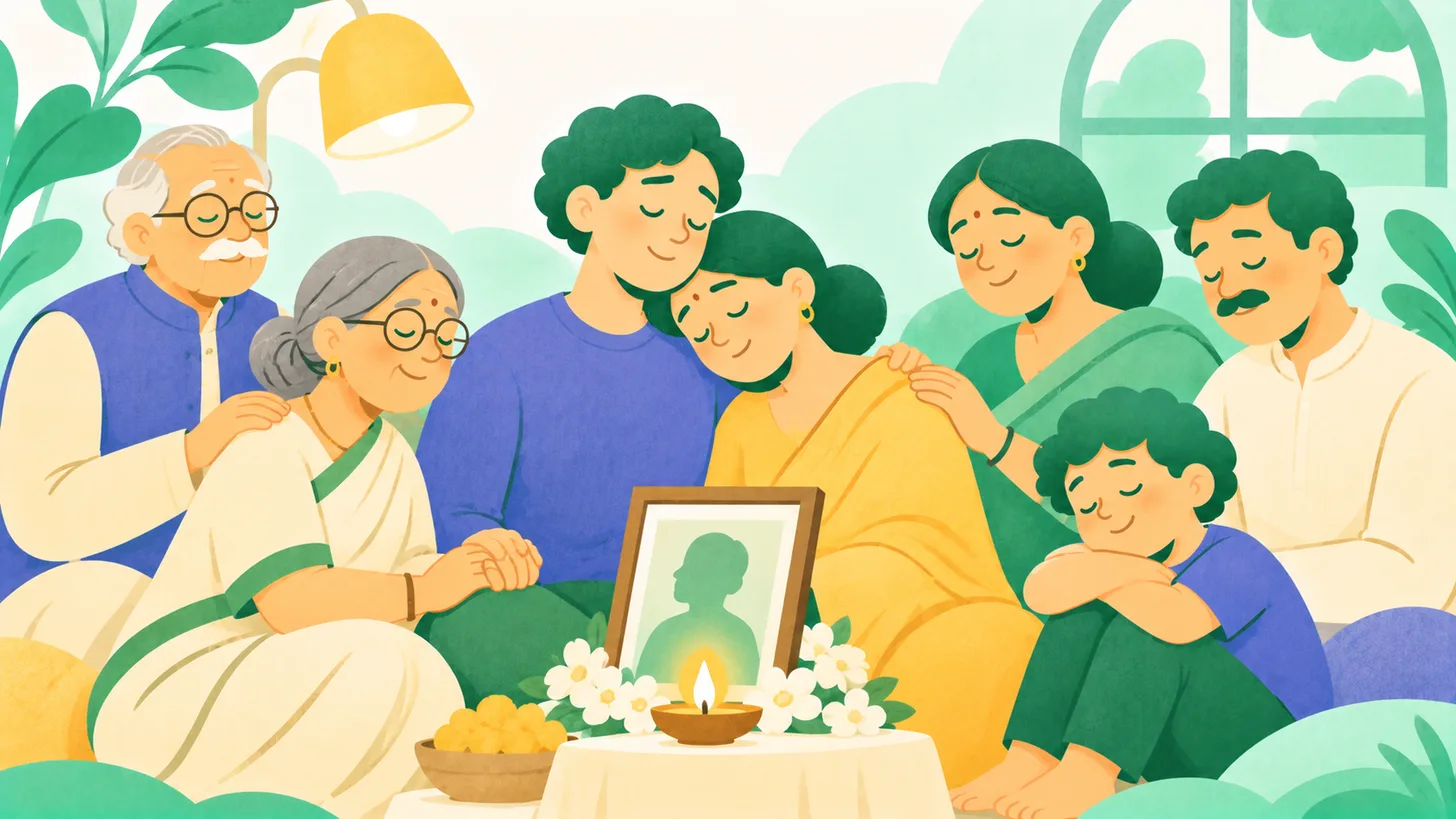
Grief in India is rarely a private project. The 13 day period after a death, the antim sanskar (last rites), the shraddh rituals, the terahvin on the thirteenth day. Christian families hold a novena. Sikh families gather for antim ardas. Each tradition does something similar. It says, we are here with you.
These rituals are a gift. They give the body something to do, feed the family, mark time. A 2019 review in the Indian Journal of Psychiatry suggested cultural mourning practices can help people feel supported, as long as the person grieving is not forced into them.
The hard part comes after.
Day fourteen, when everyone has gone back to their lives, and your life has a hole in it. The relative who said “be strong for the family” meant well. The office that gave three days of bereavement leave meant to be kind. The friend who stopped texting after two weeks is not cruel. They just do not know what to say.
The silences in an Indian grief tend to be about three things.
- The things you could not say to the person who died
- The money or property questions no one wants to raise
- The feeling of a parent still telling you to be fine quickly
If your community grieves out loud, honour that. If your community expects you to be fine by Diwali, you do not have to be. Some weeks you will show up for the rituals and feel comforted. Some weeks you will skip them and feel more honest. Both are okay. A loss belongs to the person who lost someone, first.
In short: Indian rituals do beautiful work in the first weeks. The family then has to figure out the quieter months on its own. You get to choose how much of your grief is shared.
When grief needs more help: prolonged grief disorder and warning signs
Most grief is painful, and it is not an illness. It changes shape slowly, over months and years. For some people, grief becomes a longer, heavier condition that researchers now call prolonged grief disorder, or PGD. Only a trained professional can tell if you cross the clinical threshold.
The American Psychiatric Association added prolonged grief disorder to the DSM-5-TR in March 2022. The World Health Organisation added it to the ICD-11 in 2019. In plain words, PGD is grief that stays very intense for more than a year after the loss (six months in children), with a daily longing and real trouble getting through the day. About one in ten adults who lose someone close develop PGD, the APA states.
You might be worried that what you are feeling is “too much”, or lasting “too long”. The honest answer is that only a qualified professional can tell you if you cross the clinical threshold. These are the signs a therapist or psychiatrist would want to know about.
If any of those are true for you, talking to someone trained helps. Grief and depression can look alike from the outside. A good first session is often a careful conversation about which one you are in, or whether you are in both.
The short version of grief vs depression is that grief tends to come in waves and still allows moments of connection. Depression is a steadier flattening of mood and interest.
A note on grief after a death by suicide. This loss is especially hard. The guilt arrives in a way that most other grief does not, and so do the questions. You do not have to carry this alone.
The Mental Healthcare Act 2017, in Section 18, gives every person in India the right to access mental healthcare without discrimination, including grief and bereavement care. That is a law, not a favour.

In short: Most grief does not need a diagnosis. Some grief does, and that is not a verdict on you. If the loss is not softening after about a year, a conversation with a professional is a kind thing to give yourself.
How to cope with grief after a loss: 7 small steps that help
Not every grief needs therapy. Some grief needs time, people, rituals, sleep, and one honest cup of chai at a time. The seven steps below are the ones that come up most often in bereavement research and in Indian clinical practice. Pick two. Try them this week. Leave the rest for later.
- Name what you lost, specifically. “I lost my mother” is true. “I lost the person who called me every Sunday” is more useful. Writing down the particular things you miss helps your mind sort grief from guilt from fear.
- Keep basic routines, even badly. Eat something at the usual times. Sleep in the usual bed. Shower, even if you cry in the shower. The scaffolding of a day holds you up when nothing else can.
- Let waves come, do not fight them. The feeling will rise, peak and ease, usually in less than 20 minutes. Set it a timer in your head. You can keep breathing while it passes.
- Build one small daily ritual. A photo on the dashboard. A diya at 7 pm. One line in a notebook. The ritual does not solve the loss. It gives you a place to put it.
- Say the person’s name out loud. Many families stop, out of care. The silence often hurts more than the mention. “I was thinking about Papa today” is a gift to everyone who misses him.
- Move your body for 10 minutes a day. A walk around the block counts. Movement helps the body process what the mind cannot say yet.
- Talk to one safe human a week. A sibling, a friend, a cousin, a therapist. The talking does not have to be deep. It has to be regular.
If you cannot do any of these this week, it is okay. The 5 minute version is: drink water, step outside once, text one person. That counts. Grief has a way of making a normal day feel like a marathon. On those days, the win is finishing the day.
Journaling and gentle body based practices like yoga and pranayama can also help as adjuncts, when they are not framed as replacements for care. Specific ways to treat depression overlap with coping with grief when the two sit together, which they often do.
Online therapy in India is one way to speak to someone trained in grief work from home. A therapist cannot bring the person back. A therapist can help you build a life that still has love in it. That is a different, slower kind of fixing.
In short: Small, repeated acts beat one grand gesture. Routines, body movement, one named ritual and one weekly conversation are the backbone of coping.



Share your thoughts