
Safety first If you are facing physical, sexual or emotional violence at home, or if either of you is thinking about ending your life, please reach for help now. Divorce decisions can wait a day. Safety cannot.
What this blog includes
- How often divorce actually happens in India, and what is changing
- The main legal grounds for divorce in India across religions
- The real reasons marriages end, named honestly
- When divorce is the mature choice, and when therapy is worth trying first
- The legal process, costs and timelines in plain language
- Where to find support in India, legal and emotional
If you are reading this at 2 am, you are not the first. Most people in India search for the reasons for divorce in India after months of carrying something they could not name out loud. A fight that keeps looping. An in-law comment that will not leave your head. A silence at dinner that feels louder than any argument.
Divorce in India is still rare. Fewer than 2 in 100 marriages legally end, according to UN data cited by the BBC. But the numbers in metros are climbing, and the shame is slowly lifting. This piece is not a push toward divorce. It is also not a push to stay. It is an honest look at why marriages end here, what the law says, and what a good next step might be for you.
GoodLives is India’s online therapy and counselling platform. We work with couples and with individuals thinking about their marriage.
How common is divorce in India in 2026?
India has one of the lowest divorce rates in the world. Across the country, roughly 1 to 2% of marriages legally end, as per widely cited UN estimates. Metros tell a different story. Family courts in Mumbai, Bengaluru and Delhi have reported sharp year-on-year rises in filings over the past decade.
Three things are shifting at once. More women are financially independent. Younger couples are less willing to stay in a marriage that is quietly hurting them. And the law, after the Supreme Court’s 2023 ruling, now allows the six-month cooling-off period for mutual-consent divorces to be waived in some cases.
Divorce is still not a casual choice in India. For most couples who file, it is the last stop after years of trying.
In short: divorce in India is rising in metros, but it is still an exception, and it is still a hard decision.
Legal grounds for divorce in India
Indian law does not have one divorce code. Each personal law covers its own community. Below is the plain version of the main ones.
Hindu Marriage Act, 1955 (Section 13). Applies to Hindus, Buddhists, Jains and Sikhs. Fault grounds include adultery, cruelty, desertion for two or more years, conversion to another religion, mental disorder, communicable disease, renunciation of the world, and presumption of death. Section 13B also allows mutual-consent divorce when both agree.
Special Marriage Act, 1954. Covers civil, interfaith and intercaste marriages. The grounds are similar to the Hindu Marriage Act.
Dissolution of Muslim Marriages Act, 1939. Lets a Muslim woman seek divorce on grounds like husband’s cruelty, failure to maintain her, imprisonment of seven years or more, impotence, and desertion of four years. A Muslim man may use talaq; a woman may use khula or talaq-e-tafweez.
Indian Divorce Act, 1869. Governs divorce for Christians. Grounds include adultery, cruelty, desertion for two years and conversion.
Parsi Marriage and Divorce Act, 1936. The grounds include adultery, cruelty, desertion, bigamy and grievous hurt.
Protection of Women from Domestic Violence Act, 2005 (PWDVA). This is not a divorce law. It is a civil law that lets a woman stay safe, keep her home, and get a protection order while deciding what to do next. Many women use it alongside a divorce filing.
Mutual-consent divorce under Section 13B of the Hindu Marriage Act is often the shortest route. The usual timeline is six to twelve months. Contested divorces run three to seven years.
In short: the ground that fits your case depends on your personal law, and most couples who file go the mutual-consent route when they can.
The real reasons marriages end in India
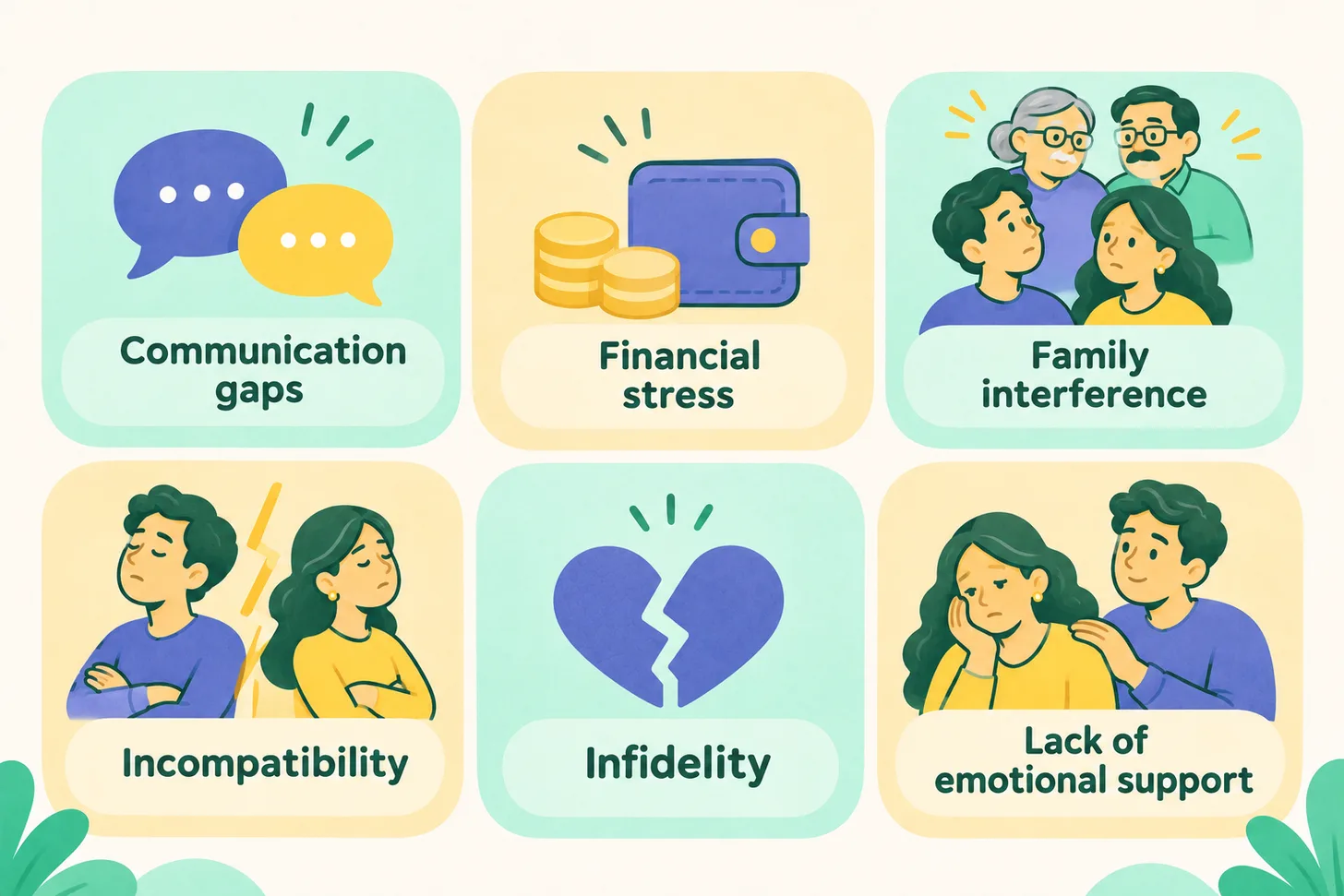
Court papers list legal grounds. Real couples sit with something softer and more honest. Below are the reasons we see most often as therapists, grouped the way they actually feel.
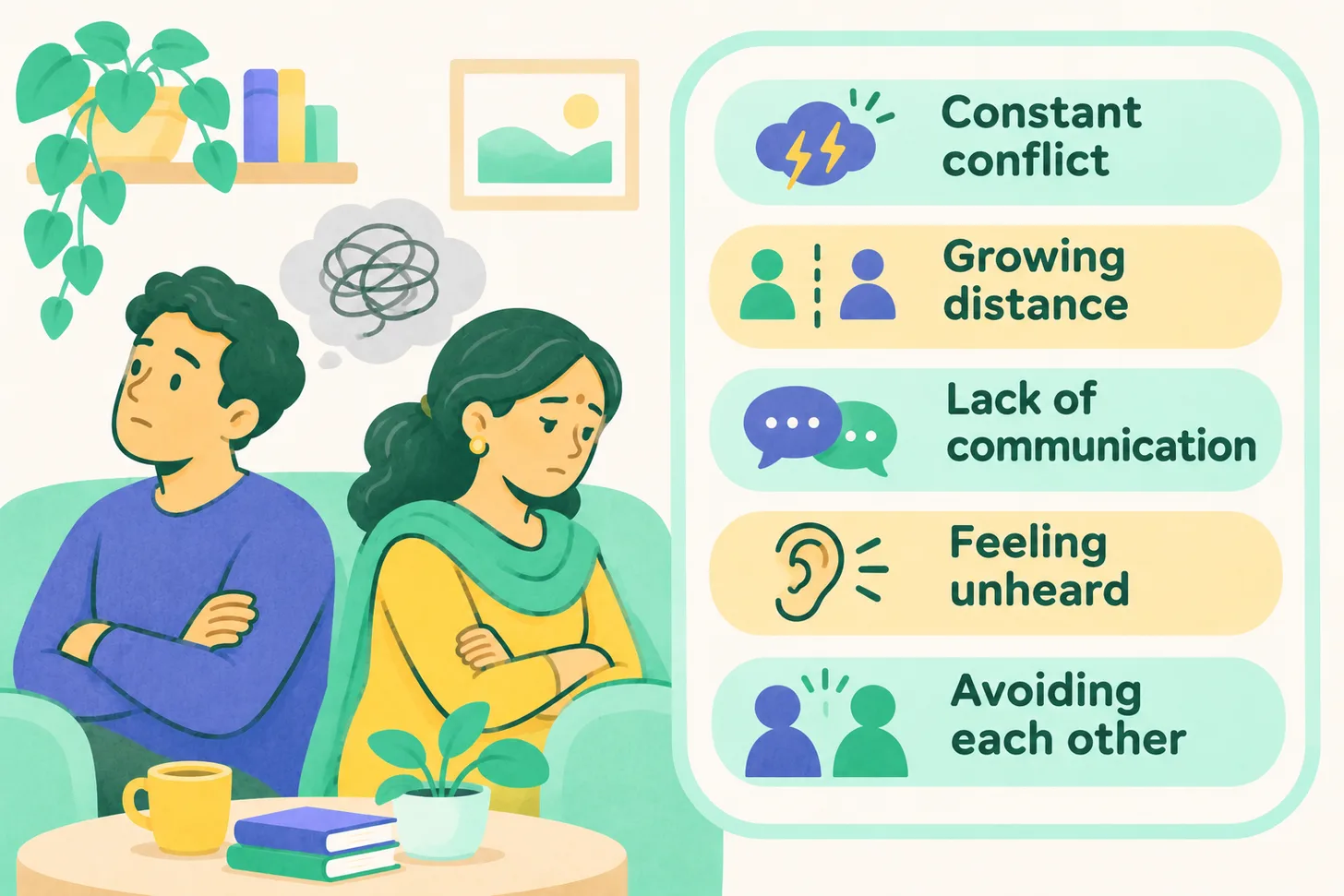
1. Emotional neglect and loss of intimacy. The most quoted reason by Indian couples. The marriage did not blow up. It thinned out. Over years, you stopped turning toward each other. Sex, long talk, a hand on a shoulder, all slowly gone.
2. Infidelity. Physical or emotional affairs. In India, emotional affairs over long WhatsApp threads are now almost as common as physical ones. Trust can be rebuilt after an affair, but only when both partners want to try.
3. Domestic violence. Physical, sexual, emotional, financial, verbal. Any form. Violence is both a ground for divorce and a crime. The PWDVA 2005 and Section 498A of the Indian Penal Code cover cruelty by a husband or his family.
4. In-law conflict and joint-family dynamics. The Indian-specific layer most global therapy books miss. A marriage in India often includes four parents, their siblings, and a hundred quiet expectations. Many good marriages buckle here.
5. Dowry harassment. Still real in 2026. The practice is banned under the Dowry Prohibition Act, 1961, and harassment is prosecuted under 498A. If dowry is being demanded or you are being punished for a shortfall, that is a crime and a ground for divorce.
6. Financial conflict. Hidden debt. Business failure. One partner controlling the money. A spending mismatch. Over time, money fights often sit on top of a trust or respect issue that was never named.
7. Untreated mental illness or addiction. Depression that will not be seen by a doctor. Bipolar episodes without treatment. Alcohol or drug use that takes over family life. The partner who stays alone cannot do therapy for two. Learn how to spot the signs of depression.
8. Child-rearing differences. How much freedom. Which school. How strict. These disagreements age badly when they are never resolved out loud.
9. Interfaith and intercaste pressure. Family refusal. Religious conversion demands. In-laws who never fully accept the marriage. For many Indian couples, the honeymoon ends at the first festival nobody can agree how to celebrate.
10. Career-trajectory mismatch. Transfers, foreign postings, a startup year. Many Indian marriages fail quietly because one career asks the other to shrink.
11. Growing apart. Long marriages, often fifteen years or more. You married young. You both changed. The shared life no longer fits either of you. Nobody did anything wrong.
12. Infertility pressure. The medical journey is one thing. The silence after it, with in-laws asking every family dinner, is another. Blame often lands on one partner.
13. LGBTQIA+ coming out. Still rare in India, but real. A partner coming out of a straight marriage, often years after the wedding, is a divorce reason the family courts now see.
14. Substance abuse. Alcohol dependence, drug use, prescription-pill misuse. When one partner refuses help, the other partner’s work has an end.
15. Second-marriage conflicts. Step-parenting, blended-family money, children from a previous marriage. These marriages often buckle under logistics nobody mapped out before.
In short: most Indian divorces are not caused by one event; they are the end of several unaddressed patterns.
The Indian layer: stigma, generation and class
Divorce in India does not sit outside the family. It sits inside it. Many of us know this feeling well, even if we have never named it. The weight is uneven, and it is honest to say so.
Generation. Parents who married in the 70s and 80s often grew up on the idea that marriage ends only in death. For them, the word divorce carries a disgrace yours may not. The talk at home will often start here.
Class and city. In an urban upper-middle-class flat, divorce is awkward but survivable. In a smaller town or a traditional joint-family setup, divorce can mean a woman loses access to housing, income and extended family. The practical fallout is not the same.
Community. Some communities, including many South Indian and North-Eastern groups, are more open about divorce than others. The reaction of your relatives is not a measure of your decision. It is a measure of what they have been given to work with.
Women and work. The old economic trap is loosening. More women now earn enough to leave. More men do too, since many wait for a spouse’s permission to leave a marriage they no longer want. Economic independence is quietly reshaping Indian divorce.
The “stay for the children” line. Children do not benefit from a hostile home. They do not benefit from a violent home. Co-parenting after divorce, done well, is better than a daily cold war with the lights on.
In short: the pressure to stay is social and economic, not moral, and it falls hardest where women and class meet.
When divorce is self-care, and when couples therapy is still worth trying
Not every marriage can be saved. Not every marriage should be ended. The honest line between the two is thinner than you think.
What the Indian divorce process actually looks like
The law is not kind to anyone in a hurry, and family courts are slow. A rough map helps.
Mutual-consent divorce. Both of you file a joint petition. The court sends you to counselling. There is usually a six-month cooling-off period, which the Supreme Court can now waive under its powers in Shilpa Sailesh v. Varun Sreenivasan, 2023. Second motion follows. Decree issued. Usual timeline: six to twelve months.
Contested divorce. One partner files; the other opposes. Evidence, witnesses, cross-examination. Timelines run three to seven years, sometimes longer. Appeals can extend further.
Maintenance and alimony. Under Section 125 of the CrPC and Sections 24 and 25 of the Hindu Marriage Act, a spouse unable to maintain themselves can seek maintenance from the other. The amount is not fixed in law; it is set by the court based on income, lifestyle and need.
Child custody. Courts in India use the “welfare of the child” principle. Mothers often get custody of young children. Fathers often get visitation. Shared custody is slowly becoming more common in urban family courts.
Streedhan. A woman’s streedhan (jewellery, gifts, money received from either family) legally belongs to her. It is not part of the matrimonial settlement.
In short: a mutual-consent divorce in India is roughly a year’s work; a contested one is often several years.
How to have the family talk
The family is often the hardest room, not the courtroom. Many Indian couples delay a decision for a year because they cannot picture the Sunday lunch where it is told.
Tell your parents before the extended family. You are not asking for permission. You are telling them, and asking for their support.
Lead with your reasons, not theirs. “We have tried, and we cannot build a life together” is harder for a parent to argue with than a list of complaints.
Expect the first conversation to go badly. Parents often need weeks to catch up. The second conversation usually goes better.
Loop in a sibling or cousin you trust. A quiet ally in the family helps.
Protect children from blame. If you have kids, both of you keep the other parent as a good parent in front of them, even when it is hard.
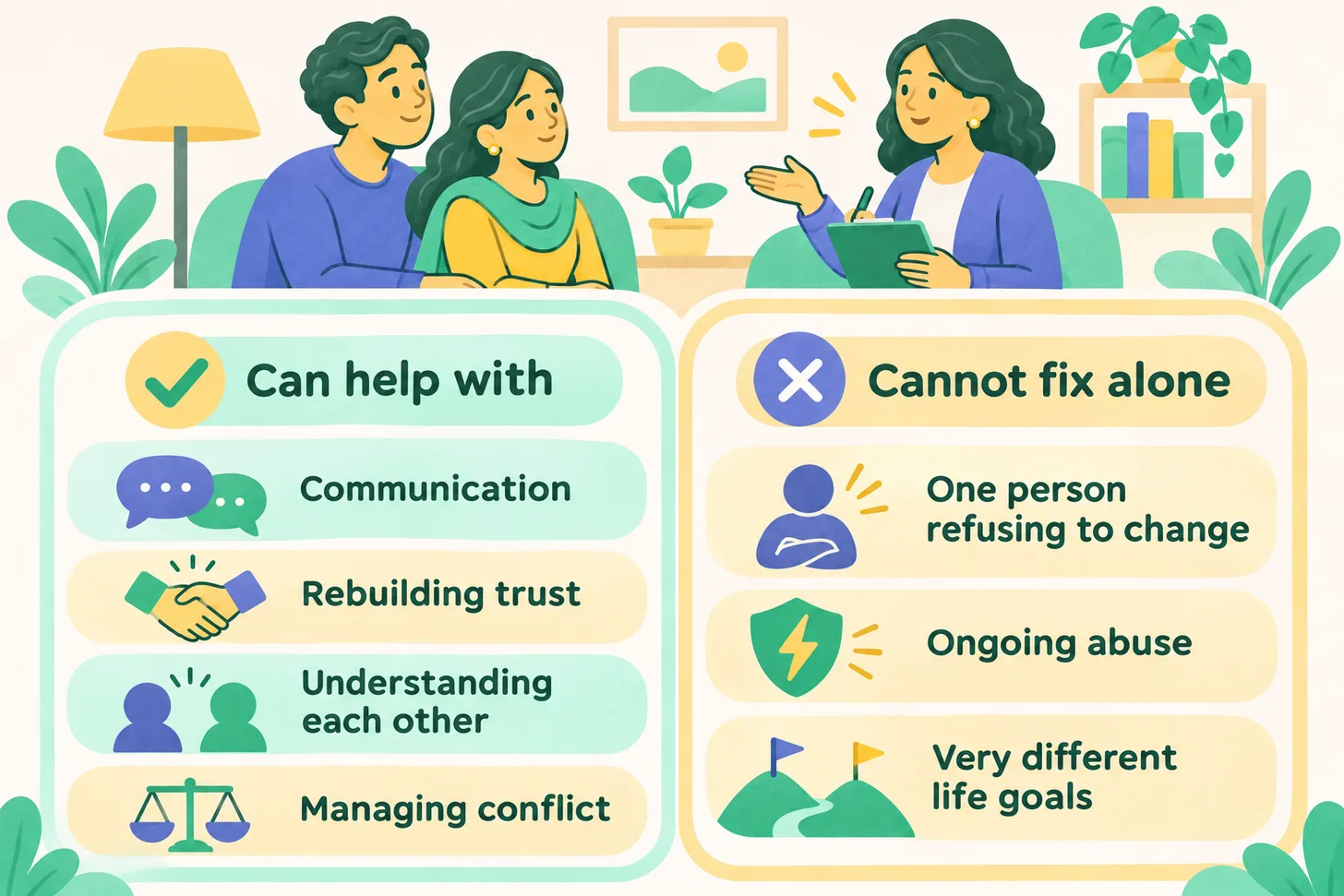
Many Indians find a therapist helpful just for the family talks, even without the marriage work.
In short: the family will catch up slower than you want and faster than you fear.
Where to get real support in India
You do not have to figure this out alone. There is real help in India, and most of it is free or affordable.
For safety and immediate help
For legal help
- Majlis Legal Centre (Mumbai) — legal and social support for women facing violence
- Lawyers Collective — pro bono legal advice in some states
- Family Courts and mediation centres — every district has one; mediation is often free
For emotional support
- Online therapy on GoodLives — verified psychologists, in your language, from home
- Local therapy — see our guide on how to find a therapist near you
- Support groups — some NGOs run peer groups for separated and divorced individuals
For LGBTQIA+ readers
- Humsafar Trust (Mumbai), Sahodari Foundation (Chennai), SAATHII, Nazariya (Delhi) run community support
In short: in India in 2026, there is more help than most people are told; use it.
FAQ
What are the main reasons for divorce in India?
What is the fastest ground for divorce in India?
Can a woman file for divorce in India?
Is cheating a legal ground for divorce in India?
How long does a contested divorce take in India?
Does a wife always get alimony in India?
Should we try couples therapy before divorce?
Will divorce hurt my children?
This post is for information only and is not a substitute for professional care.


Share your thoughts