
What this blog includes
- The plain people pleaser meaning, without judgement
- Eight signs you may already recognise in yourself
- Why we people-please, from fawn to Indian family roots
- Four ways to stop, with scripts you can use
If you say yes before thinking, and spend the ride home replaying what you should have said, you are not weak. You are a people pleaser. The pattern was often protective in the home you grew up in.
Trusted by 500K+ people, GoodLives writes for the reader who already Googled this twice tonight. The honest answer is this. We will not add a tenth tip. We will name what is happening, and what quietly helps.
What does people pleaser actually mean?
A people pleaser puts other people’s comfort above their own, often by reflex. The cost is sleep, time, money or self-respect. The people pleaser meaning is not “someone who is kind”. Kindness has a choice. People-pleasing is a reflex, said before the brain catches up. You have probably noticed it in yourself, mid-sentence.
The clearest tell is the gap between the sentence and the body. The mouth says “no worries, I’ll do it”. The shoulders rise. The jaw sets. The evening fills with a low hum of resentment nobody else can see.
Generosity leaves you feeling warmer. People-pleasing leaves you smaller. If you say yes and feel a quick, cold drop in your chest, that drop is useful.
In short: A people pleaser is someone who agrees before they have asked themselves what they want.
Which signs you may recognise in yourself
Most people pleasers do not need a quiz. You already know. The signs below are the ones readers describe most often. Two or three fitting is enough to take the pattern seriously, and to start treating yourself more gently about it.
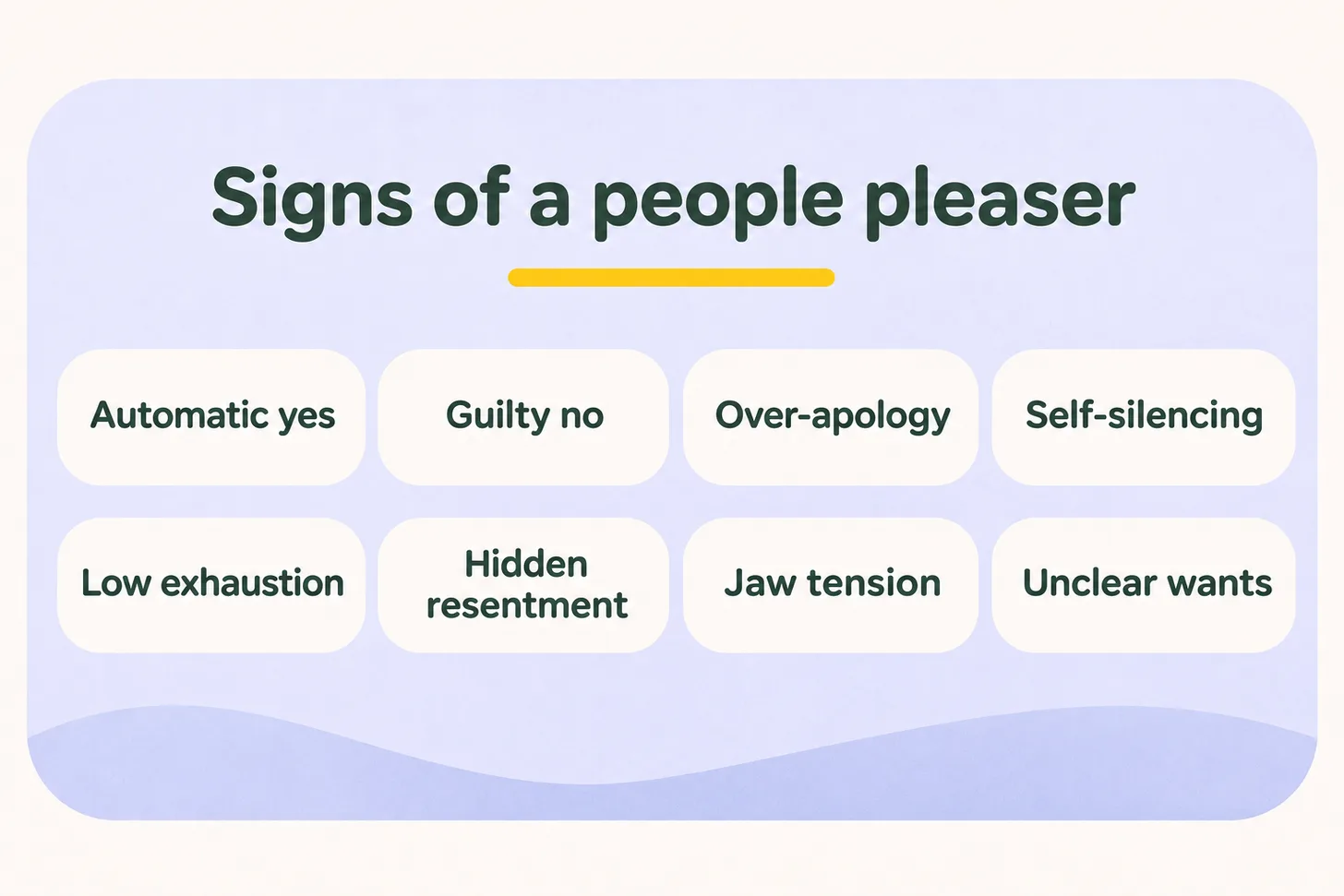
- The automatic yes. You answer before the request has finished.
- Guilt when you say no. A clean no feels like you hurt someone.
- Over-apologising. You open messages with “sorry to bother”.
- Self-silencing. You soften your real opinion, then vent in the group chat.
- Exhaustion with no clear source. You slept, you ate, yet you are tired.
- Resentment at 1 am for the no you did not say.
- Jaw and shoulder tension. The body carries words the mouth did not say.
- No clear sense of what you want for the weekend or your career.
Some of this looks like being a good team player. You can be a team player and still know what you want. If this maps onto a relationship at home, our piece on recognising a toxic relationship is a kinder next read.
In short: The signs cluster around three things. An automatic yes. A guilty no. A body tired of carrying both.
Why do we people-please? The gentle roots
People-pleasing is not a weakness. It is a learned pattern, often protective in your early environment. Many people pleasers grew up in homes where saying no cost something, warmth, approval, or peace at the dinner table. The brain learned early that smoothing other people was the fastest way to be okay.
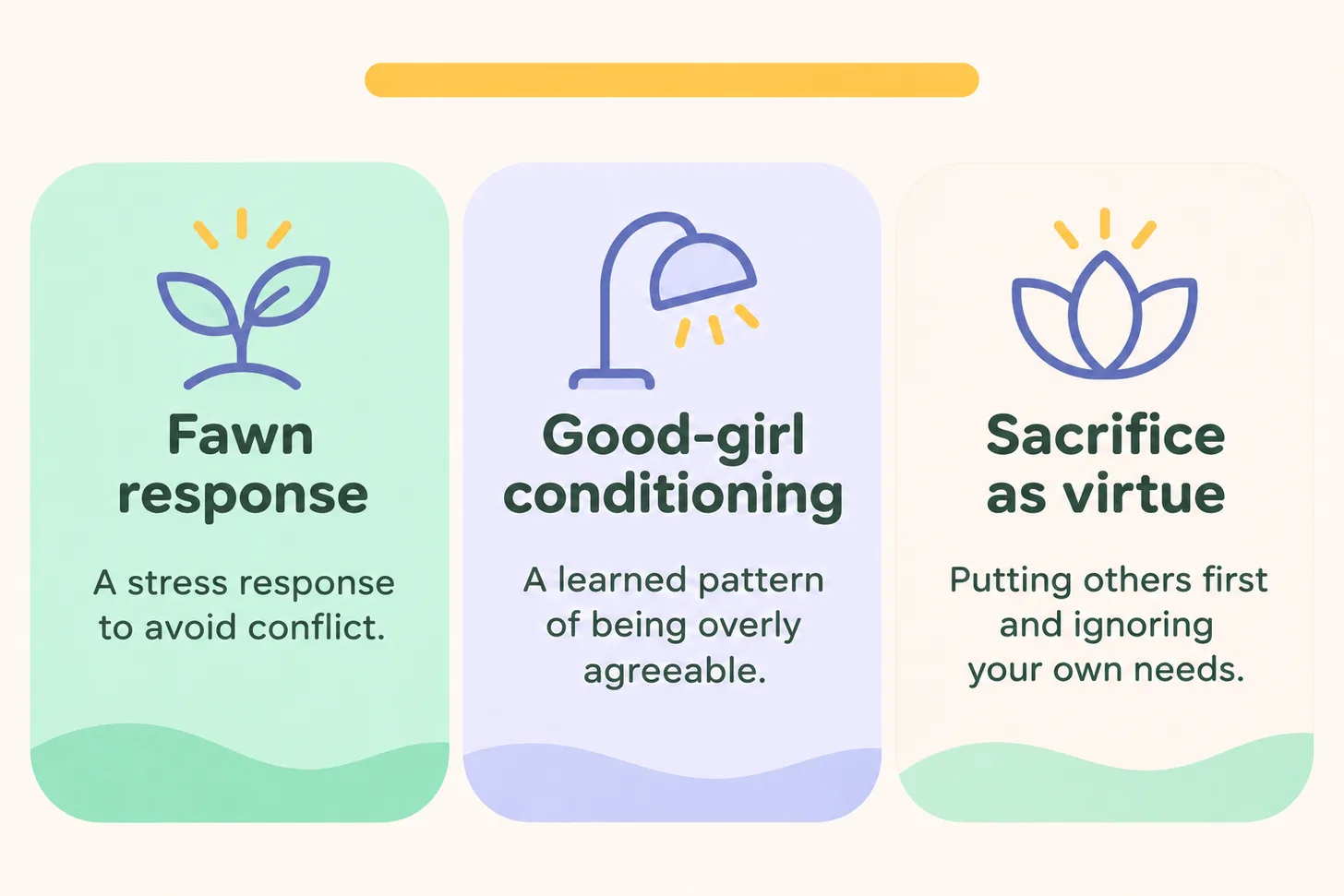
The therapist Pete Walker named this response fawn, alongside fight, flight and freeze, in his writing on the 4Fs of complex trauma. Fawn is not weakness. It is a nervous system picking the only strategy that worked for a long time. The work is to update the strategy, not shame it.
In India, the pattern has a specific texture. The good girl praised for being helpful. The eldest daughter handed the caretaker role at ten. The only son carrying the family’s hopes. Caste, class and gender quietly decide who shrinks. Religion can turn sacrifice into virtue.
The reflexive yes in Hindi has its own word, haan ji (a quick, polite yes). If that word sits in your mouth when the answer is no, you are not alone. The piece on toxic parents and mental health sits with that history gently.
In short: People-pleasing was often the thing that kept you safe at seven. It does not have to be the thing that keeps you tired at twenty-seven.
4 ways to stop people-pleasing, without guilt
Stopping does not mean saying no to everything. It means putting a small, quiet gap between the request and the answer. Pick one step for this week, not all four. You might be worried that saying no will push people away. That fear is usually bigger than what actually happens.
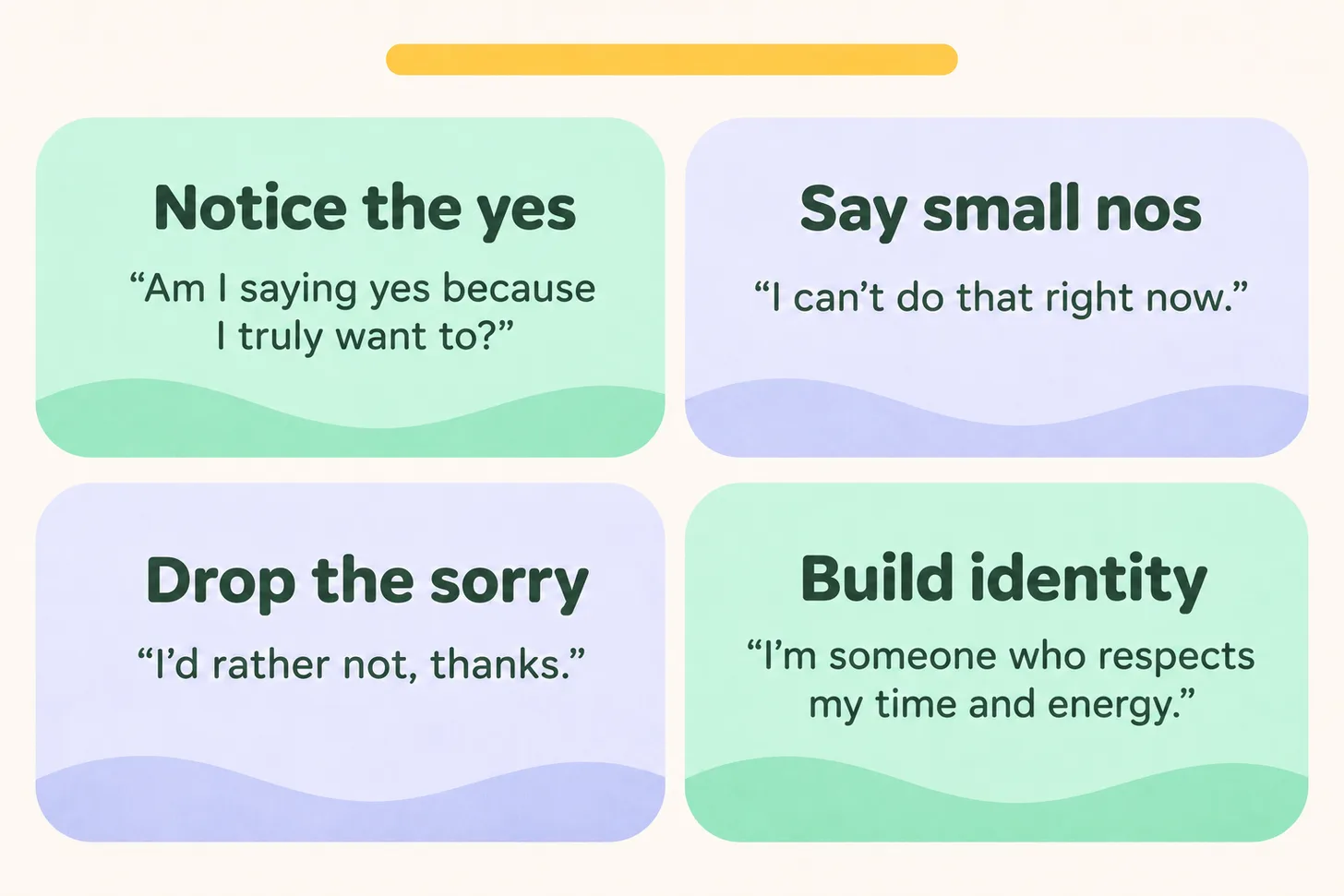
1. Notice the automatic yes
For one week, every time you say yes, pause for two seconds and ask, “Did I want to say that?” You do not have to change the answer. You only have to notice. Most people are surprised by how often the yes is already on the tongue before the request is fully heard.
2. Say no to small things first
Do not start with your mother-in-law. Start with the delivery person asking for a tip, the colleague wanting a last-minute favour, the WhatsApp forward. A clean no like “I cannot this week, thank you for asking” is a muscle. It grows with small reps.
The thought behind the automatic yes often sounds like: “If I say no, they will stop liking me.” That thought is worth questioning. Try the exercise below.
Catch the thought
What thought is weighing on you right now? Write it down just as it sounds in your head.
Name the trap
Does your thought fall into one of these common patterns? Pick any that fit. This part is optional.
Look again
Use these as nudges, not rules. Then write one line back to yourself.
Your reframe
Thoughts are not facts. You just practised stepping back.
This stays on your device. Nothing is saved or sent.
3. Replace the apology with directness
People pleasers hide behind the word “sorry”. The swap is to replace an apology with a plain sentence.
People-pleasing at work, which looks different
People-pleasing at work wears a different costume. It is the person who takes on the project nobody else wants, stays back on Friday, and says yes to every “quick call” that is never quick. The quarter ends in burnout. The promotion goes to someone louder.
Offices often reward helpfulness without naming it. The reliable yes becomes the person you give more to, not the person you promote. This builds the kind of exhaustion a weekend does not touch.
The small shift that helps: make your yeses visible, and your limits ordinary. Keep a weekly tracker of what you took on. In your next one-on-one, say: “Here is my plate this quarter, which of these should I drop?” You are not being difficult. You are being a professional with a workload.
In short: People-pleasing at work looks like being helpful. It costs you the thing being helpful was supposed to buy.
When self-help is not enough, how therapy helps
Reading an article will not fix twenty years of fawning. Watching your automatic yes for a week will show you the pattern. Noticing it is a start. Changing it is a different piece of work, and it is often slower and quieter than self-help listicles make it sound.
For most people pleasers, a short course of talk therapy, often 12 to 20 sessions, is a reasonable band. Many therapists use CBT. CBT is a short, structured therapy that teaches you to spot and rework the thoughts behind a behaviour. It can help catch the automatic yes before it leaves your mouth.
Others use a trauma-informed approach to sit gently with the childhood roots. Both are honest work. Both are confidential; the Mental Healthcare Act 2017 protects that right.
Not every yes needs therapy. Sometimes the generous answer is just a kind one. If what you need right now is a weekend of sleep and a Sunday walk, book that first.
If your home or workplace punishes a no, therapy will not change the environment. It will help you build the plan for it. You can start, see how a few sessions feel, and stop if it is not the fit. A first session is not a commitment.
If you have never spoken to a therapist before, our read on what online counselling involves covers the practical bits.
In short: The reading names the pattern. Therapy helps you rebuild the muscle under it.
FAQ
What is a people-pleaser personality?
Is being a people pleaser a red flag?
What is the root cause of people pleasing?
Is people-pleasing a trauma response?
How do I stop people pleasing without hurting anyone?
Why do I feel guilty when I say no?
Can therapy really change this?
This post is for information only and is not a substitute for professional care. If you are struggling, please speak to a qualified mental health professional.




Share your thoughts