
What this blog includes
- Why saying no feels so hard, honestly
- The real cost of over-committing
- Two therapist-tested frameworks, DEAR MAN and NVC
- 8 polite no scripts you can copy today
- Saying no in Indian families, joint events and the office
- When saying no is not safe, and when therapy helps

If you have ever said yes and then stared at the ceiling at 1 am wondering how to get out of it, you are not weak or selfish. You are a person whose nervous system learned, early, that smoothing other people was the fastest way to be okay.
Trusted by 500K+ people, GoodLives writes for the reader who has already Googled this twice tonight. The honest answer is this. A polite no is a learnable sentence. It will feel awkward for a few weeks. Then it starts to feel like oxygen.
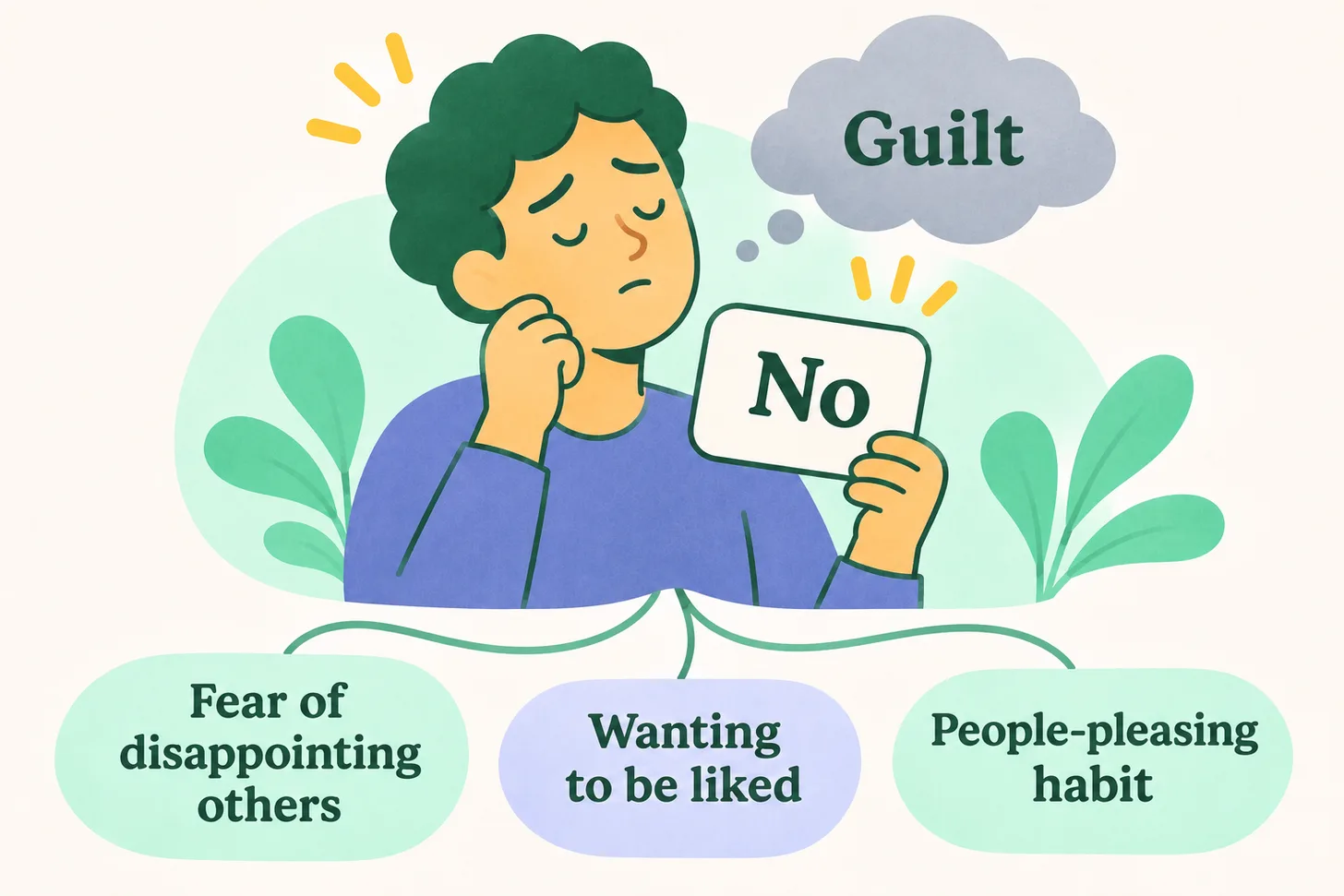
Why is saying no so hard?
Humans are wired for tribe. For most of our history, being pushed out of the group meant real danger. Your brain still runs that software. A no can register in the body as a small threat, even when the stakes are a plus-one invite you did not want.
On top of the wiring sits conditioning. In many Indian homes the good girl was the quiet girl, the good son was the one who did not complain. Hierarchy mattered. Log kya kahenge (what will people say) was a sentence you heard before you could spell it.
Add a metro job where the fear of being seen as difficult feels like a career risk, and the yes becomes automatic.
You have probably noticed the gap already. The mouth says “sure, no problem”. The chest tightens. The evening fills with resentment nobody else can see.
In short: Saying no is hard because your body thinks belonging is at stake. Usually it is not.
What over-committing actually costs you
A yes is cheap in the moment. It gets expensive by Thursday.
- Resentment. The person who did not want to come to dinner starts hating the host, and then themselves for the hating.
- Burnout. The quiet accumulation of yeses leaves you tired in a way sleep does not touch.
- Lost self-respect. Each unspoken no chips at the sense that you have a self at all.
- Erosion of trust. People stop knowing what you really think, because you never tell them.
- Half-presence. You are at the thing you did not want to be at, so you are not fully at any of it.
A clean no protects the yeses you actually mean. If this pattern feels bigger than one awkward conversation, our piece on the signs of a people pleaser sits next to this one well.
In short: Over-committing does not make you generous. It makes you tired, resentful, and absent from your own life.
Rude no, honest no, resentful yes: the three options
Most people think the choice is between being rude and being nice. There is a third option, which is where the work happens.
In short: The honest no is kinder than the resentful yes. The person on the other side gets a real answer they can plan around.
Two frameworks therapists actually use
Before the scripts, two frameworks worth knowing. You will spot them inside most of the lines below.
DEAR MAN (from Dialectical Behaviour Therapy)
Dr Marsha Linehan built DEAR MAN as part of DBT, a therapy originally designed to help people hold difficult conversations without losing themselves. The letters are a checklist for the sentence, not a script.
- Describe the situation in plain words.
- Express how it affects you.
- Assert what you need or do not want.
- Reinforce by naming what the other person gets from your honest answer.
- Mindful: stay on the point if they change the subject.
- Appear confident: calm voice, slower than usual.
- Negotiate when a middle path exists.
In practice: “You asked me to lead the Diwali party planning again this year (describe). I love the party, but last year I ran on three hours of sleep for a week (express). I cannot lead it this year (assert). If I help you pick the caterer, I will enjoy showing up as a guest (reinforce + negotiate).”
Non-Violent Communication (NVC)
Dr Marshall Rosenberg’s NVC is softer, built around four moves: observe, feel, need, request. It is especially useful inside family and romantic relationships, where the goal is to stay close and still be honest.
In practice: “When I come home from work and we go straight into guests the same evening (observe), I feel wiped out (feel). I need thirty quiet minutes before I can be present (need). Can we plan guests after 8 pm on weekdays (request)?”
In short: DEAR MAN keeps the sentence structured. NVC keeps the sentence kind. Pick whichever one your brain can hold under pressure.
The polite no formula
Most of the scripts in the next section follow a quiet pattern.
Appreciation → Reality → (Alternative, if there is one) → Firmness.
- Appreciation: honour the person who asked.
- Reality: a short, true reason without over-explaining.
- Alternative: offer one, only if you mean it. “Can we revisit this next month?”
- Firmness: do not undo your own no in the next sentence.
Short, warm, clear. If the person pushes back, repeat your sentence once more. You do not owe a longer explanation. The urge to over-explain is the resentful yes trying to sneak back in.
In short: A polite no has four small parts. Most of your awkward yeses skipped the last two.
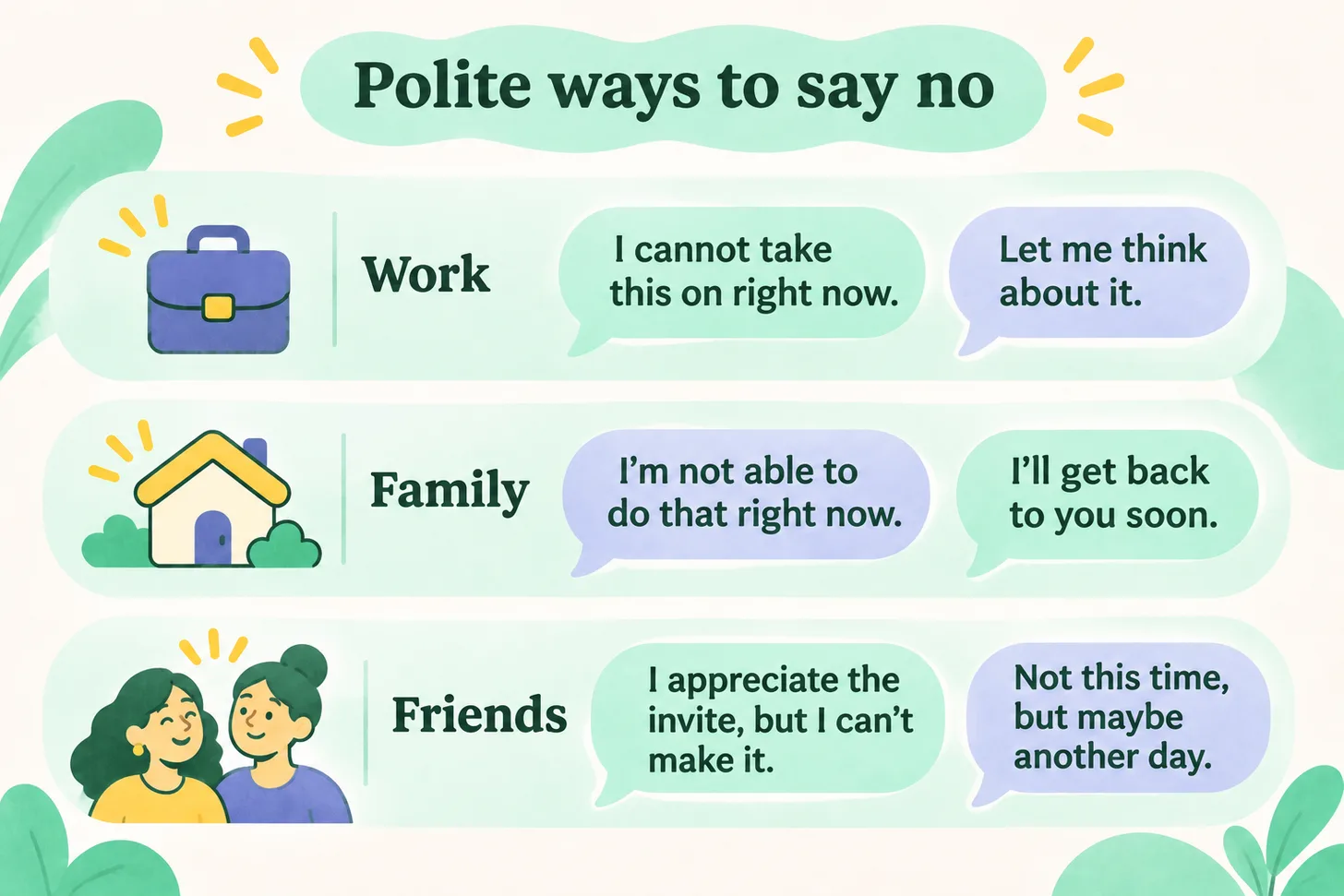
8 polite no scripts you can borrow today
Copy any of these as they are. Change one word to make it sound like you.
- At work, honest and short. “Thank you for thinking of me. I cannot take this on right now. I would rather do a smaller job well than overcommit.”
- To a wedding or event invite. “I really appreciate the invite. I am going to sit this one out, but I hope it is a lovely evening.”
- To a vague request. “That is a kind offer. I am not in a place to say yes to anything new this month.”
- When you might say yes later. “I would love to, but my plate is full. Can we revisit this in January?” Only if you mean the January part.
- To a close family member. “I value our relationship, which is why I need to be honest. I cannot do this one. Can we plan something else next weekend?”
- When the relationship can take it short. “Not this time, thank you.” The shortest honest no in the book.
- When details are not owed. “I have a prior commitment that evening.” Full stop. No elaboration.
- Work-formal, with a priority frame. “That does not fit my priorities for this quarter. If something shifts, I will come back to you.”
A note on reasons. You do not owe a long one. The longer the explanation, the more hooks you give the other person to argue with. “I am not able to this time” is a complete sentence.
In short: A polite no is appreciation, a short true reason, and no apology spiral. Shorter is kinder.
Saying no in Indian families, without war
The scripts above work. Family is where they get hardest. Hierarchy, love and old guilt sit at the same dining table.
To parents and in-laws
Elders in Indian families often experience a no as rejection, not information. The trick is to honour the relationship out loud while holding the limit.
Try: “Mummy, I know you want me to come home every weekend. I love you, and I cannot do every weekend right now. Can we plan one weekend a month that we both protect?”
Say the loving part first. Say the no in the middle. Offer the specific alternative at the end. Expect a sigh. A sigh is not a disaster.
At joint-family events
Weddings, functions, overnight stays at a relative’s house. The pressure is social, not personal.
Try: “We will come for the mehendi and the sangeet. We will miss the reception, we have an early morning on Monday. We are so happy for them.” Short, warm, decided. Do not negotiate with the aunt who tries to extend.
To extended-family money or favour requests
The cousin who needs a loan. The uncle who wants you to put in a word at your office. The relative asking you to host their son for a month.
Try: “I thought about this carefully. I am not able to help with this one. I hope you find a good way through.” Do not add a maybe. The maybe is the resentful yes putting on a jacket.
At work in Indian offices
The dynamic is different. Hierarchy still matters, and the fear of being seen as not a team player is real.
Try, with your manager: “I want to do this well. Looking at my current list, if I take this on, something else slips. Which of these would you like me to deprioritise?” This is not a no. It is a visible-plate conversation that turns one person’s workload into a shared decision.
In short: In Indian families, lead with love. At work, lead with the plate. The sentence after the first comma is where your no actually sits.
When the sentence feels true but the voice says you are selfish
Here is the paragraph after the polite no, which most listicles skip. You will often get the sentence right and then spend the next three hours convinced you are a bad person. That voice is old, and it is loud. It is also wrong.
The honest work is to notice the thought, name it, and swap it for one that is kinder and still true.
If you want, try one minute with this before you read on.
Catch the thought
What thought is weighing on you right now? Write it down just as it sounds in your head.
Name the trap
Does your thought fall into one of these common patterns? Pick any that fit. This part is optional.
Look again
Use these as nudges, not rules. Then write one line back to yourself.
Your reframe
Thoughts are not facts. You just practised stepping back.
This stays on your device. Nothing is saved or sent.
In short: A polite no said with love is not selfish. The voice that calls it selfish is older than you.
When saying no is not safe
Some readers are not in a position to say a clean no yet. If a parent has threatened to cut you off, if a partner has a history of punishing a boundary, if a boss has made clear your job is at risk, a direct no can carry real cost.
In those homes and workplaces, the honest answer is this. A no is still your right. The timing of the no is a safety question. Sometimes the quieter options are correct for now: delaying, going vague, logging the incidents, planning the exit before announcing it.
In short: Saying no is a right. Saying no in the next five minutes is a question of safety, not courage.
When over-giving is a pattern, not a one-off
If you read this blog and recognised yourself across every section, the pattern may be deeper than a social skill.
Dr Pete Walker named the fawn response alongside fight, flight and freeze, in his writing on complex trauma. For some people, the automatic yes is a nervous system that learned very early that smoothing others was the only safe move.
For others, it is codependency, a word used in therapy for a learned pattern of taking responsibility for other people’s feelings at the cost of your own.
Neither is a weakness. Both respond well to therapy. CBT (a short, structured therapy that teaches you to spot and rework the thoughts behind a behaviour) helps you catch the automatic yes. Trauma-informed work helps the body feel less unsafe about the no.
Our piece on why you feel guilty saying no and the one on recognising emotional manipulation sit next to this honestly, if the no is being punished at home.
In short: If no feels dangerous almost always, that is worth taking seriously. Therapy helps.
When self-help is enough, and when a therapist helps
Reading an article will not undo twenty years of yes. The scripts will carry you through the next three invitations. Beyond that, if the yes is tied to childhood roots or an ongoing hard relationship, a short course of therapy is a kinder next step than another listicle.
For most readers, 12 to 20 sessions of CBT or trauma-informed work is a reasonable band. Both are confidential. The Mental Healthcare Act 2017 protects that right.
Not every polite no needs therapy. If what you need this week is to send three honest WhatsApps and sleep two early nights, do that first. If you have tried the scripts for a month and still cannot get the sentence out, a therapist can sit with the reason underneath.
Saying no, in the end, is a love language. To yourself, obviously. And often, more quietly, to the other person, because a clear no is kinder than a yes you will resent.
FAQ
How do I say no politely without feeling guilty?
What is the most polite way to say no at work?
How do I say no to parents without disrespecting them?
Is saying no selfish?
What if the person keeps pushing after I say no?
How do I say no to a wedding or family function?
Can therapy help if I cannot say no?
—



Share your thoughts