
Quick summary
Couples therapy is not two people being told who is right. It is two partners sitting with a trained psychologist who helps them see the loop they are stuck in, hear what each person is really asking for, and learn new ways to turn toward each other. Most couples do 12 to 20 sessions. The first one is for history and goals. The middle ones get heavier before they get lighter. The later ones build upkeep skills. In India (as of November 2026), one session costs INR 2,000 to 5,000. It can save a bond. It can also help two people part with less damage. Both are honest outcomes.
What this blog includes
- What actually happens in the first session
- The arc across 12 to 20 sessions, session by session
- The main evidence-based approaches (Gottman, EFT, Imago, Discernment)
- What the therapist is doing (and what they are not)
- What makes couples therapy work, and what does not
- When couples therapy is not safe or not appropriate
- Costs, formats and how to find a good couples therapist in India
- A soft widget for the moments between sessions
- FAQ
Before we start: who this is for
If you are reading this at 1 am because the last fight did not end, and you are wondering if a stranger can really help you two, this is for you. You are not failing. Most couples wait about six years after things start to feel off before they reach out, per the Gottman Institute’s research summary. Reading this is already the first step.
What is couples therapy, really?
Couples therapy is a steady, planned talk between two partners and a trained psychologist. The therapist is not on anyone’s side. They are on the side of the bond itself, as a third thing in the room. They are also on the side of each partner’s safety and growth. That is the whole frame.
It is not two people fighting in front of a referee who scores points. It is not one partner’s own therapy with the other quietly watching. And it is not a quick repair shop.
In short: couples therapy is a space where the pattern becomes visible, so two people can decide what to do with it.
What happens in the first session?
The first session is a joint one, 50 to 90 minutes long. The therapist is doing three quiet things at once.
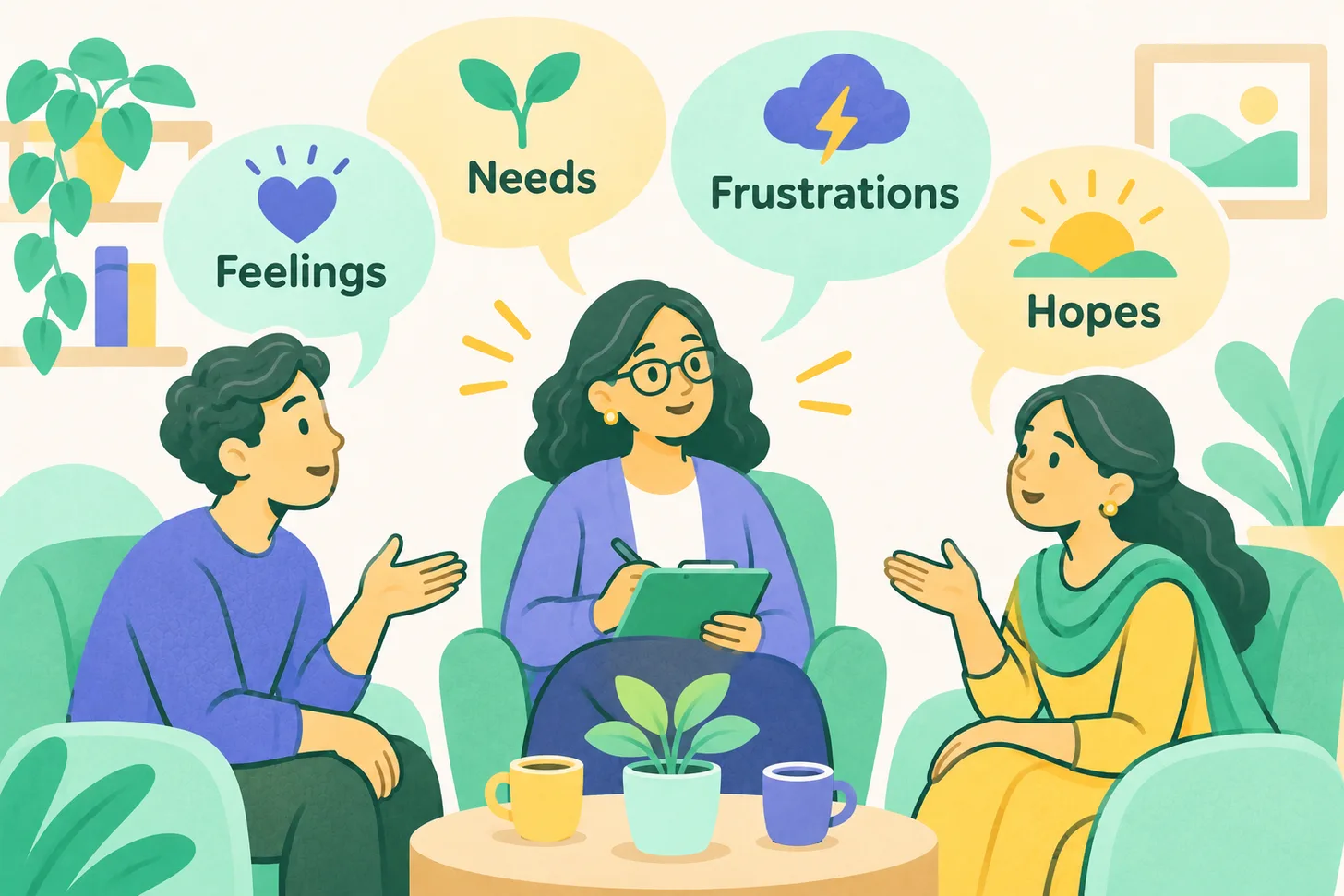
First, they gather history. How you two met. When things felt good. When they stopped feeling good. The big ruptures. The small daily frictions. Who did what, when.
Second, they listen for each person’s view of the same event. Partner A says the fight on Diwali was about the in-laws. Partner B says it was about feeling unseen for weeks. Both are true. The therapist tracks that both can be true.
Third, they set goals and limits. What do you each want from therapy? What does success look like? They also lay out a privacy pact, and what happens if secrets come up. Every therapist does this a bit differently; a good one tells you upfront.
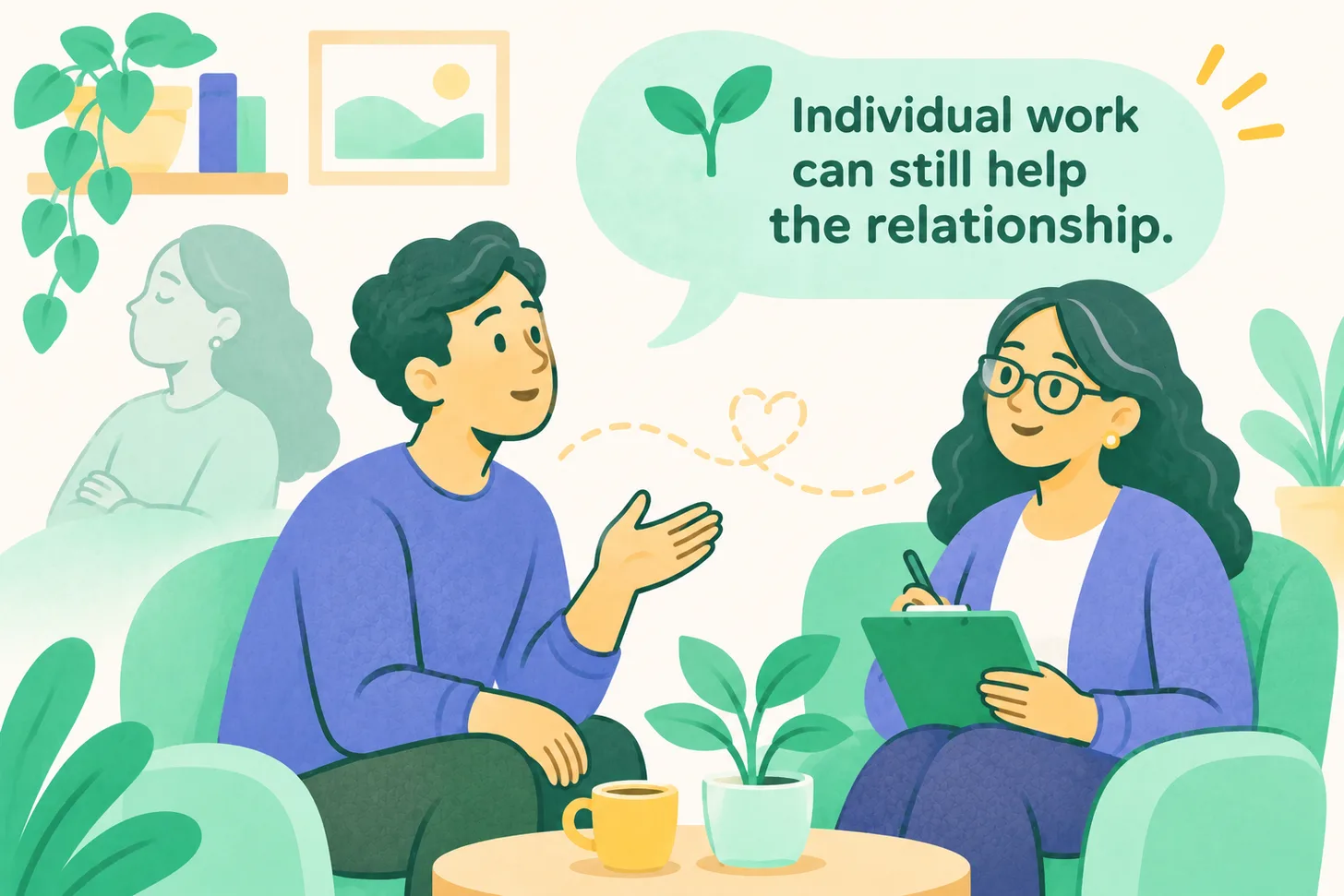
Some therapists, in Gottman Method, work this way: one joint session, then one solo session with each partner, then back to joint. The solo sessions let the therapist hear what each person may not say in front of the other. If your therapist does this, it is standard, not a red flag.
In short: the first session is slower than you expect, and heavier than you expect. That is normal.
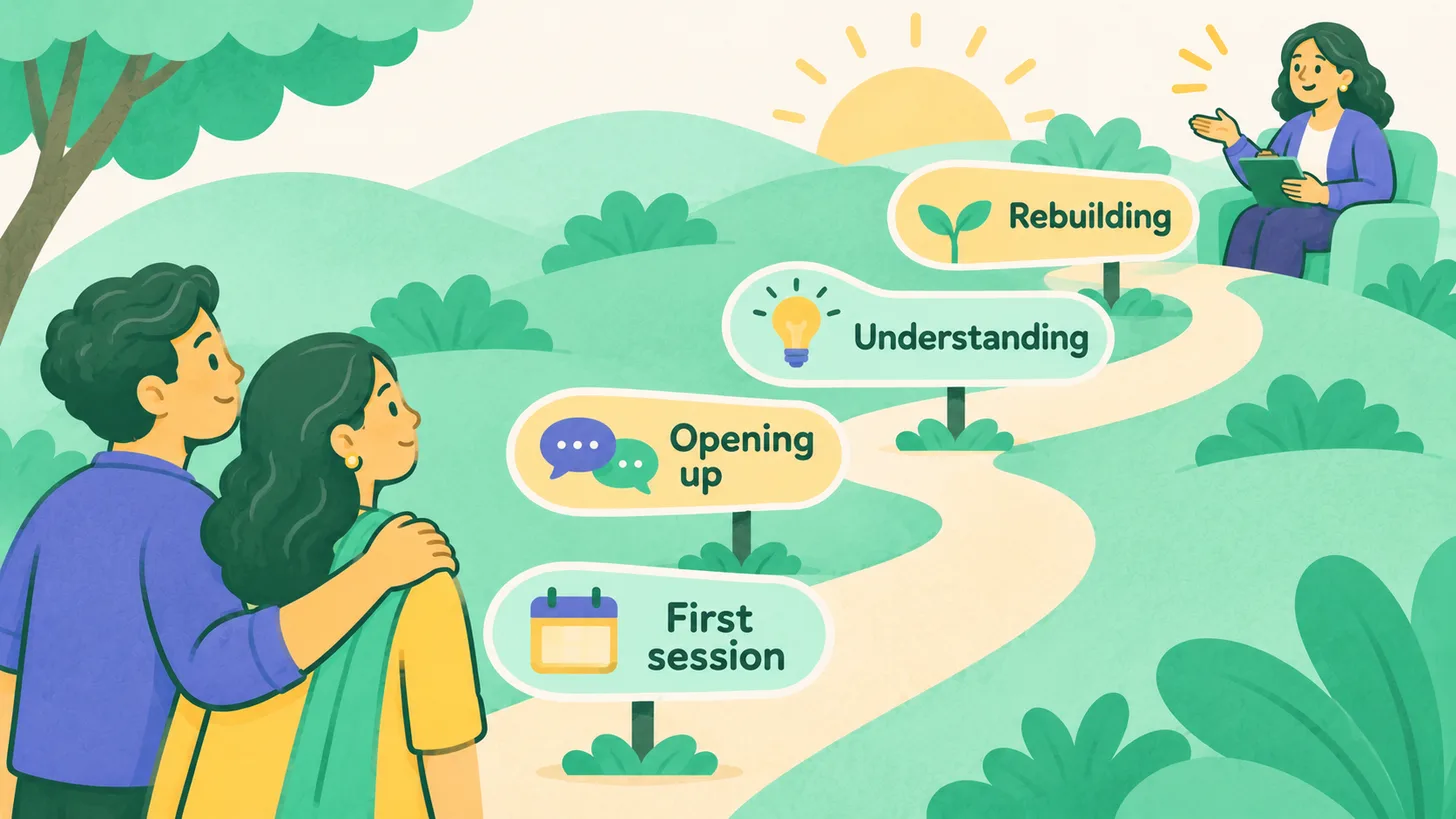
The arc of couples therapy: session by session
Most couples do 12 to 20 sessions. More for affair recovery, long trauma histories, or deeply entrenched patterns. Here is roughly how it moves.
Sessions 1 to 4: getting the full picture
The first four sessions are mostly a map-building phase. The therapist is drawing a map of your bond, your family histories, and the specific loops you two run (the chase-and-withdraw loop, the blame-and-defend loop, the shut-down loop).
This part can feel heavy. You will likely talk about things you have put off for years. Many couples feel worse before they feel better. That is not therapy going wrong. That is old pain coming up in a safe room.
Sessions 5 to 15: the real work
This is where change happens. The therapist starts teaching clear skills: how to repair after a fight, how to listen without planning your defence, how to steady your own body when your partner’s tone sets you off. You will also work on the issues on your list, which tend to fall into a few buckets:
- How you two talk, cut in, or shut down
- Intimacy (both emotional and physical)
- Money, parenting, in-laws (the Indian family triangle shows up a lot here)
- Trust breaks, affairs, or lies
You will likely have between-session work. Not homework in a school sense. Small tests. Try asking this one question before you react. Notice what happens in your body in the first 90 seconds of a fight. Report back next week.
Sessions 16 and after: making it stick
If things have shifted, the later sessions help you keep the shift. The therapist helps you build a plan: weekly check-ins, early warning signs, what to do when the old loop tries to come back. Some couples spread these last sessions out (every two weeks, then once a month) to practise on their own.
In short: 12 to 20 sessions is the usual arc, with a heavy middle, a working middle, and a lighter end. Expecting a straight line is where most couples get discouraged.
The main evidence-based approaches
A good couples therapist is trained in a specific method, not just “general counselling”. These are the four you are most likely to encounter in India.
Gottman Method
Built by Drs John and Julie Gottman over 40 years of watching couples in a “love lab”. The core idea is a model called the Sound Relationship House, which the therapist helps you build floor by floor: friendship, shared meaning, and how you handle fights. Gottman’s research also named the Four Horsemen of a breakdown: criticism, contempt, defence, and shut-down. If your therapist talks about these, this is where it comes from.
Emotionally Focused Therapy (EFT)
Built by Dr Sue Johnson. EFT is based on bonding: it treats most couple fights as a bid for closeness, where one partner is reaching for the other but in a way the other can only hear as attack. The therapist helps re-shape how you two reach for each other. Research by the International Centre for Excellence in EFT shows about 70 to 75% of couples recover and 90% improve in trials.
Imago Relationship Therapy
Built by Dr Harville Hendrix. Imago uses a tight talk form (mirror, validate, empathise) to slow talks down so each partner really hears the other. It is useful for couples who talk over each other, or who come from very different family worlds.
Discernment Counselling
Built by Dr Bill Doherty. This one is different: a short, 1 to 5 session format for couples where one partner is leaning out and the other is leaning in. It is not about saving or ending. It helps both partners decide, with clear eyes, whether to go into couples therapy, stay as is, or part. If one of you has already quietly made up your mind, this is often more honest than regular couples therapy.
In short: ask any couples therapist in India which approach they are trained in. “I use a mix” is okay if they can name the specific trainings. “I just use whatever works” is a flag.
What the therapist is actually doing
A good couples therapist is doing many jobs at once, and almost none of them is “settling the argument”.
- A neutral. Not a judge. Not a referee. Not telling you who is wrong.
- A pattern mirror. Showing you two the loop you cannot see from inside it.
- A skills teacher. Teaching repair moves, slow-downs, and soft start-ups.
- A holder. Holding the big feeling that would spill into your kitchen at midnight.
- Sometimes a solo voice for one of you. If one partner is being hurt, the therapist’s first job becomes safety, not couple’s work.
If a therapist takes sides, keeps naming winners, or tells you what the “right” answer to your fight is, that is not couples therapy. That is a bad fit.
What couples therapy is NOT
Clearing this up early saves a lot of hurt later.
- It is not a promise the bond will last. The therapist’s job is honest work, not a set outcome.
- It is not one partner’s therapy with the other listening. If only one of you talks and the therapist focuses only on them, that is solo therapy in a couples room.
- It is not a 50-minute venting space. You can bring the ugly stuff, but a good therapist will cut in and point back to the pattern.
- It is not a quick fix. Three sessions almost never undo a decade of hurt.
- It is not about who started it. What matters most is what you two do next, together.
What makes couples therapy actually work
Research is clear on this. The couples who benefit most share a few things.
- Both partners show up for real. One partner dragged in rarely works. If one of you is being asked to come without really wanting to, name that in session one. Consider discernment counselling first.
- Honesty, even the hard kind. This includes affairs, money, substance use, old anger, the thing you have never said aloud. Therapy without this is theatre.
- Doing the between-session work. The real repair happens between Tuesday and the next Tuesday, not in the room.
- Being open to seeing your own part. This is the hardest one. If both of you can only point at the other, change is slow.
- Therapist fit. If after three or four sessions neither of you feels heard, switch therapists. Fit is clinical, not personal.
What does not work
Being honest about this matters too.
- Coming in to prove you are the “better” partner.
- Quietly staying for one set verdict (that you are right, or that they will leave).
- Hoping the therapist will tell your partner to change.
- Refusing to do any between-session work.
- Switching therapists every two sessions until you find one who agrees with you.
A hard truth: couples therapy can save bonds. It can also help two people part well, with less damage, when staying hurts more than parting. A good therapist does not push either way. They help you both see clearly.
Between sessions: a 2-minute reset
When a talk is heating up and both of you can feel the usual loop starting, pausing to breathe before you say the next line changes what the next line is. Try this together, phone down, 2 minutes.
[gl-breathe]
Both of you doing it at the same time matters more than doing it perfectly.
When couples therapy is not safe or not appropriate
Some situations need a different kind of help first.
- Active abuse in the partnership. Physical violence or heavy control is not a couples-therapy issue. It is a safety issue. The partner being hurt needs their own support first. Couples work can actually raise the risk in these cases. If this is your situation, please read our guide on recognising emotional abuse first.
- One partner has already decided to leave. Discernment counselling, not couples therapy.
- Active, untreated addiction. The addiction usually needs its own care first. Couples work can start alongside once the person is in treatment.
- Severe, untreated mental illness in one partner. Acute psychosis, uncontrolled bipolar, a severe depressive phase where one partner cannot engage. Solo care first.
A good couples therapist screens for these in session one. If yours does not, it is okay to bring it up.
What couples therapy costs in India (November 2026)
Online couples therapy in India usually runs INR 2,000 to 5,000 per session as of November 2026, checked across platforms like GoodLives, Amaha, YourDOST and Rocket Health. In-person at a private clinic can run higher, often INR 3,500 to 7,000. Session length is 50 to 90 minutes. Some therapists charge the same no matter the length. Some charge per block.
A few notes for Indian couples:
- Online works. NIMHANS tele-mental-health research and other studies show online couples therapy gives much the same results as in-person for most issues.
- Insurance may cover part of the cost. The IRDAI rule on mental health parity says mental-health care must be covered like any other illness. But couples therapy depends on your insurer. Call and ask.
- Many couples do sessions from two cities on video (one partner travelling, bi-city marriages). Normal.
See our pricing page for the current GoodLives rate.
How to find a good couples therapist in India
A short checklist.
- Credentials. RCI-registered psychologist (that is the Rehabilitation Council of India, the base credential for a psychologist here). Ask for the registration number if it is not shown.
- Couples training. Ask: Gottman Level 1, 2 or 3? EFT externship? Imago Therapist certification? A general counsellor without couples training is a weak fit for serious relationship work.
- Fit for both of you. The therapist should feel fair, not partial, within the first three sessions. If one of you feels ganged up on, say so. If it does not shift, switch.
- Format. Online or in-person, both work. Pick what you can both commit to weekly.
- The quiet test. After the first session, do you both feel the therapist saw something about your loop that you two could not say yourselves? If yes, go on. If no, give it two more. If still no, change.


Share your thoughts