
What this blog includes
- What expressive arts therapy is, and how it differs from an art class
- Who it fits, who it does not, and what the research honestly says
- How a session runs, and the forms a therapist may bring in
- Fees in India in 2026, and how to find a trained practitioner
You searched for expressive arts therapy because something inside you is louder than the words you have for it. Maybe grief that will not sit still. Maybe a memory your body remembers before your mind does. Maybe a creative part of you that got quiet somewhere between class 10 and your first job.
You don’t have to be an artist for this to be for you. In expressive arts therapy, the point is not the painting. The point is what happens between you and the material while a trained therapist stays with you. If words have been doing a lot of heavy lifting on their own, there is another way in.
What is expressive arts therapy, really?
Expressive arts therapy is the deliberate use of more than one art form, inside a therapeutic relationship, by a trained therapist. Visual art, music, movement, drama, creative writing and play are the main ones. The core premise is simple and old: the creative process is itself healing, not only the finished piece.
This is sometimes called the intermodal approach, a word used by Paolo Knill at the European Graduate School and carried forward by the International Expressive Arts Therapy Association. Intermodal means the therapist moves with you from one art form to another as the moment calls for it. You might start with clay, land in a sound, and leave with a line of writing.
Three names recur in the field. Natalie Rogers built person-centred expressive arts on her father Carl Rogers’s work. Shaun McNiff, in Art Heals, argues that making art is itself a form of knowing. Cathy Malchiodi writes on expressive arts and trauma. Their frameworks sit under most Indian practitioners’ training.
In short: it is therapy with more than words, by a trained therapist, grounded in the idea that making is part of the medicine.
How is this different from an art class, or doing art for fun?
Doing art for fun is wonderful. It is not therapy. Three things change inside a session.
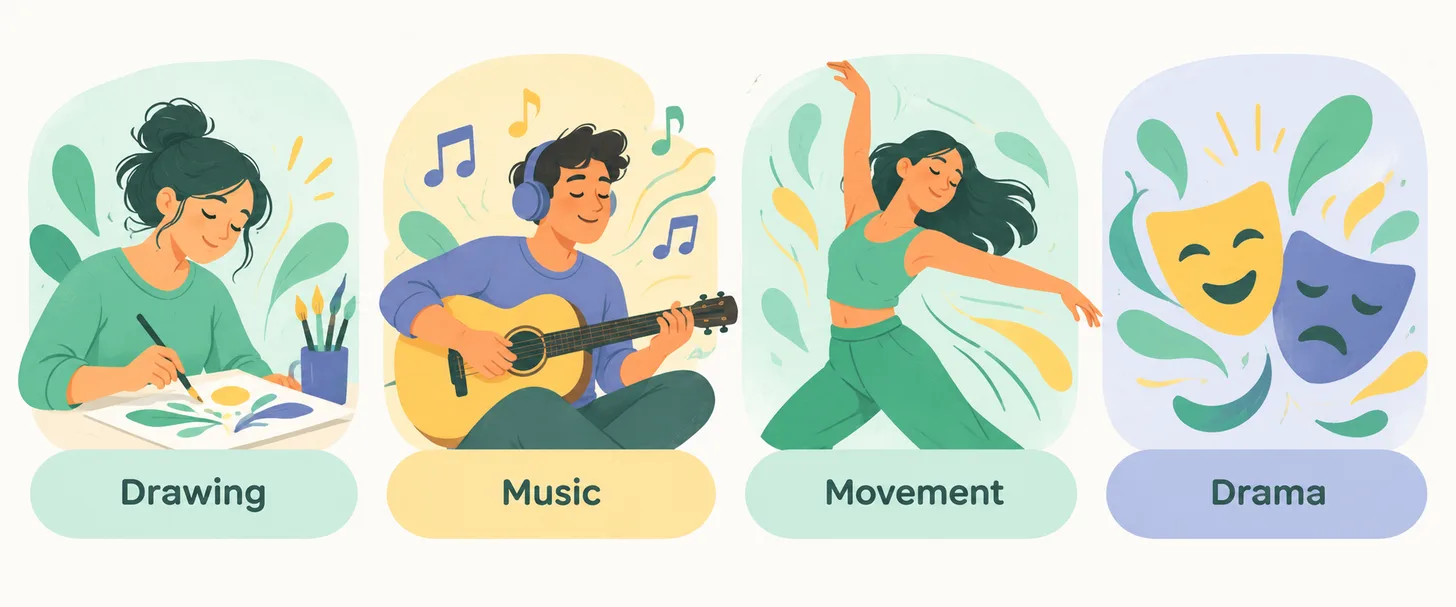
- A therapeutic relationship. A trained therapist is in the room with you, holding what comes up. The art is a doorway, not the destination.
- Witness-first, not interpretation-first. A good expressive arts therapist does not tell you what your drawing “means”. They stay with the image, invite you to stay with it, and let the meaning land in you.
- The invitation, not the task. You are not graded. You are not making it pretty. You are letting the material (clay, paint, sound, body, voice) hold what words cannot carry yet.
If a session ever starts to feel like an art class, say so. A trained therapist will slow down and come back to you, not the piece.
In short: the art class is about the art. Expressive arts therapy is about you, with the art as the way in.
Who does this therapy fit well?
Honestly, it fits some readers very well and others less. The honest-fit list:
- People who find talk-only therapy constraining. You know what you feel but can’t name it, or the words feel too small.
- Children and teens. Play and image are their first language.
- Trauma survivors with body-held memory. The kind that shows up as a tight chest or a held breath long before a sentence can find it. A short grounding technique can also help in the moment, between sessions.
- Grief, chronic illness and big life transitions. When your life changes shape, the shape of your expression often needs to change with it.
- Creatives who have gone quiet. You used to draw, sing or write, and slowly stopped, and feel the loss.
In short: if your inner world is bigger than your vocabulary, this therapy is built to meet you there.
Who does it not fit on its own?
A fair guide names its limits. Expressive arts therapy, on its own, is usually not the right first door for:
- Severe untreated psychosis. Stabilisation with a psychiatrist comes first. Expressive work can come in later, in a team plan.
- People for whom art-making is itself a trigger. A strict art teacher, a shaming parent, a classroom panic can make picking up a brush its own problem. A thoughtful therapist will go slow or choose another door.
- Readers who want a short, structured, homework-heavy plan. CBT is often a better fit; see our types of therapy guide for a wider map.
In short: expressive arts therapy is powerful, not universal. A good therapist will say so.
What does the research actually say?
Honestly, this is a smaller evidence base than CBT, and growing. Three threads matter.

James Pennebaker’s expressive writing paradigm, from the University of Texas at Austin, is the most studied piece. Short bouts of writing about an emotional event, over a few days, are linked to small but real shifts in mood and some physical symptoms.
Cathy Malchiodi’s work on Trauma and Expressive Arts Therapy draws together findings on arts-based methods for post-traumatic stress. The idea, in plain words: trauma stored outside language often needs a non-verbal way out.
Arts-in-therapy reviews, including ones from SAMHSA and the American Art Therapy Association, generally find that expressive arts methods are a reasonable adjunct, and for some groups, a reasonable primary approach. “Not a cure” is a line the honest literature holds.
In short: real research, smaller than CBT’s base, strong enough to take seriously.
If you want a slow, written taste of the Pennebaker idea at home, our prompts on healing through journaling are a soft start.
Even on hard days, a few small things hold up.
Let's find three. It takes about a minute, and it never leaves your device.
Three good things
Take them one at a time. Small really counts here. If a prompt doesn't fit, swap it for another.
Your good list for today
Noticing good things doesn't cancel the hard parts. It just gives them some company.
Come back tomorrow and add three more.
This stays on your device. Nothing is saved or sent.
Match Me with a Therapist
If you are not sure whether expressive arts therapy is right for you, tell us one thing you want help with. We will suggest two therapists in your language, free. No pressure. > button: Match Me with a Therapist
How does a session actually run?
Sessions vary, but most share a shape.
- Check-in. A few minutes of talking, so the therapist knows what you bring today.
- An invitation. The therapist offers a prompt, a material or a movement. You can accept it, change it, or ask for a different one.
- The making. You draw, write, play music, move, sculpt, or role-play. The therapist is present and quiet.
- Staying with it. You and the therapist look at, listen to or move with what you made, without rushing to analyse it.
- Closing. A short landing, and often a simple way to carry what came up into the week.
A session is usually 50 to 60 minutes, in person or online. Online works for most people. For movement and some trauma work, in person helps.
In short: a slow, witnessed hour where what you make is treated as news from a part of you that does not always get the mic.
The art forms a trained therapist may use
A good expressive arts therapist moves between forms, not stuck in one.
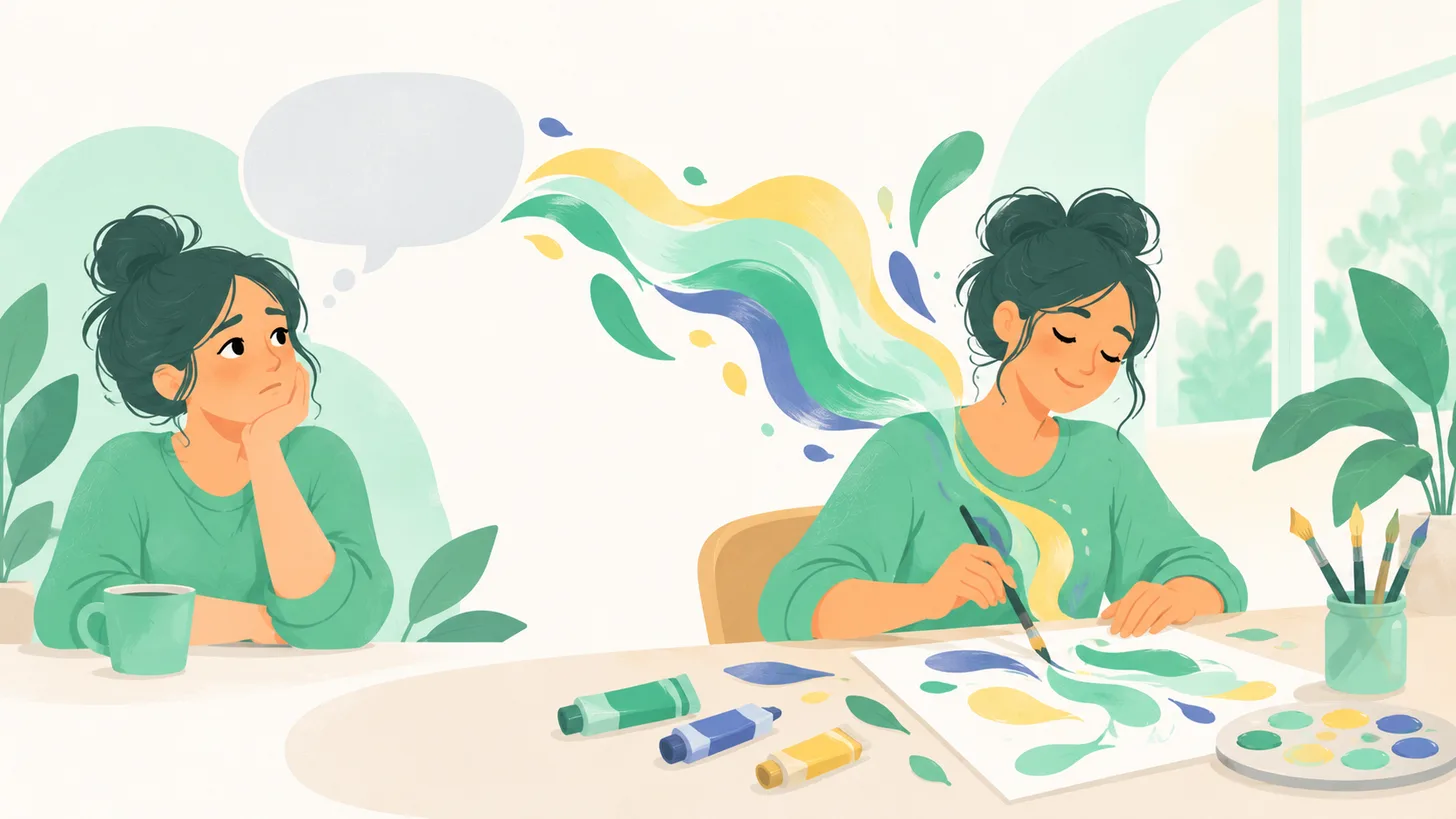
- Visual art. Drawing, painting, collage, clay. Often the first door, because it feels low-stakes.
- Music therapy. Listening, playing, voicework. Useful for anxiety, grief and non-verbal states.
- Drama therapy. Role play, chair work, playback. Strong for stuck patterns in relationships.
- Dance movement therapy. The body as first language. Fits body-held trauma and dissociation.
- Writing and poetry. Free writing, structured prompts, letters to parts of yourself.
- Play therapy. The language of children; a trained play therapist is a separate specialism.
If a therapist offers “art therapy” and only draws, that is one modality. Expressive arts therapy, done well, is intermodal.
In short: more than one art form, picked for the moment, by a therapist trained to use them in therapy.
How much does it cost in India?
Honest fees as of October 2026, from Indian practitioner websites and listings.
- One-to-one session: INR 1,800 to 4,500. Senior therapists in metros sit at the upper end; junior associates and online-only practices sit lower.
- Group formats (studio or workshop): INR 500 to 1,500 per session. Common in Chennai, Bengaluru and Mumbai.
- Short programmes of 6 to 12 sessions are often sold as a package at a small discount.
Expressive arts therapy is usually not covered by Indian health insurance today. The Mental Healthcare Act 2017 is slowly shifting some policies. Ask your insurer in writing before you book, and keep the reply.
If cost is a concern, group formats and student-clinic sessions at university training programmes in Chennai and Bengaluru are the common lower-cost routes. A moderated space between sessions, like our Support Circle community, can also carry some of the weight.
In short: more than a workshop, less than a hospital. Group formats are the kinder entry.
Where do I find a trained expressive arts therapist in India?
The practice is growing in Chennai, Bengaluru, Mumbai, Delhi, Pune and Hyderabad, with a wider pool online. Credentials to look for:
- Clinical psychologists registered with the Rehabilitation Council of India (RCI), who have added expressive arts training. RCI is the main Indian regulatory frame today.
- Expressive arts therapists who trained abroad, often at the European Graduate School or at MA programmes in the UK or Europe. India has no RCI-recognised expressive arts credential yet.
- Indian programmes. The MA in Expressive Arts Therapy at St. Xavier’s University, Mumbai, and training routes through WCCLF, Bengaluru, are two visible pathways in 2026.
Red flags: anyone advertising “art therapy” with no clinical training; a practitioner who promises cures or a fixed number of sessions on the sales page; a therapist who cannot tell you why a given art form fits your issue.
In short: check the credential and the training route, and trust a practitioner who speaks plainly about both.
When to add it, and when to replace talk therapy
A rough map you can trust.
- Add it alongside talk therapy when words feel too small, or when you want a slower, non-verbal way into grief, trauma or a creative block.
- Replace talk therapy with it rarely. Usually only when talk therapy has been actively uncomfortable, when the client is a young child, or when a body-held issue has not shifted with talk alone.
- Choose a specialist when the issue is body-held trauma, long-standing dissociation or complex grief. The specialised training matters.
- Stay with a general therapist comfortable with creative methods when the issue is everyday distress and you simply want more than words.
In short: add it when words hit their limit; replace it only when a trained therapist agrees.
This post is for information only and is not a substitute for professional care.


Share your thoughts