
What this blog includes
- What abandonment issues really are, in plain English.
- Where the fear of abandonment comes from in childhood and after.
- The adult signs that look like clinginess, coldness, or self-sabotage.
- How this links to BPD traits without being a diagnosis.
- What therapy for this pattern looks like, and an honest timeline.
Have you ever started a fight you did not want, just so you could be the one to leave first? That reflex has a name. Abandonment issues are a learned pattern where closeness and loss feel like the same thing.
You are not weak. You learned this somewhere. Many of us did, quietly, in homes that looked fine from outside. GoodLives, trusted by 500K+ people, works with Indian adults on exactly this kind of early-life pattern.
The map goes back to the work of John Bowlby and Mary Ainsworth. The American Psychological Association still calls attachment theory the clearest frame we have for why adult love can feel like a cliff edge.
What are abandonment issues, really?
Abandonment issues are a persistent fear of being left, built early and set off in adult closeness. The nervous system, once trained to expect a caregiver to vanish, reads a late text or a quiet partner as the same old threat. The fear is not irrational. It is out of date.
They are not a diagnosis you will find in the ICD-11 or the DSM-5. Your psychologist will not stamp a label on your file.
The closest clinical frame is anxious-preoccupied attachment, or in some cases disorganised (fearful-avoidant) attachment. Both come up in posts about attachment issues and the four styles.
In Hindi the fear often sounds like chhod ke chale jaana (to leave someone behind). The phrase names something English misses. Not just leaving. The decision to leave, taken by someone you needed.
In short: this is a pattern, not a personality. Your younger self built it to stay safe. It is still running in a life that no longer needs it to.

Where does the fear of abandonment come from?
The usual answer is “childhood trauma”, which is both true and too big. The useful version is more specific. Abandonment fear forms in the small, repeating moments when comfort did not arrive, or arrived unpredictably. Not a single event, in most cases. A pattern.
Four early experiences show up often in the research and in therapy rooms in India.
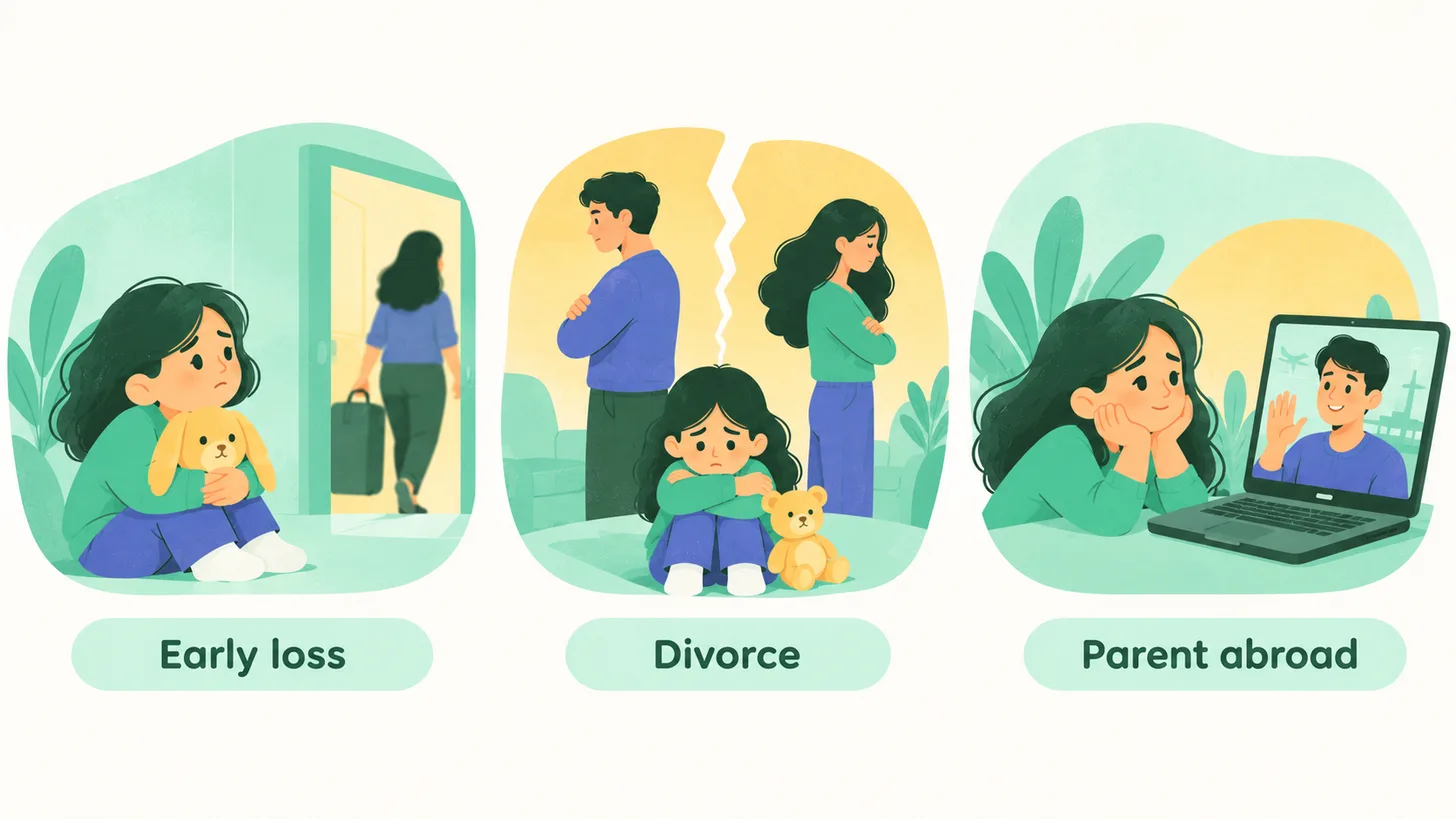
- Early loss or long separation. A parent who died young. A mother who went abroad for work when you were five. A father posted in a different city for most of your school years.
- Emotional neglect in a loving home. Parents who paid school fees and fed you well but were not reachable for feelings. Many Indian millennials grew up here.
- Parentification. You became the small adult. You looked after a younger sibling, or a sad parent, or a household during a long illness. Your own distress had nowhere to go.
- A sudden rupture. Parents who divorced without a conversation. A caregiver who disappeared after a fight. A boarding school start at age six.
Later life can add to the pattern. A controlling first relationship. A partner who ghosted after two years. A friend group that quietly dropped you after college. These do not plant the seed. They water it.
In short: this fear is built from unpredictability, not from unlove. The adults you grew up with may have loved you very much, and still left your body on alert.
What does this look like in adults?
This fear rarely announces itself. It shows up as ordinary relationship behaviour that feels, from the inside, like proof you are right to worry. The common signs sit in three clusters. Clinging. Shutting down. Sabotaging.
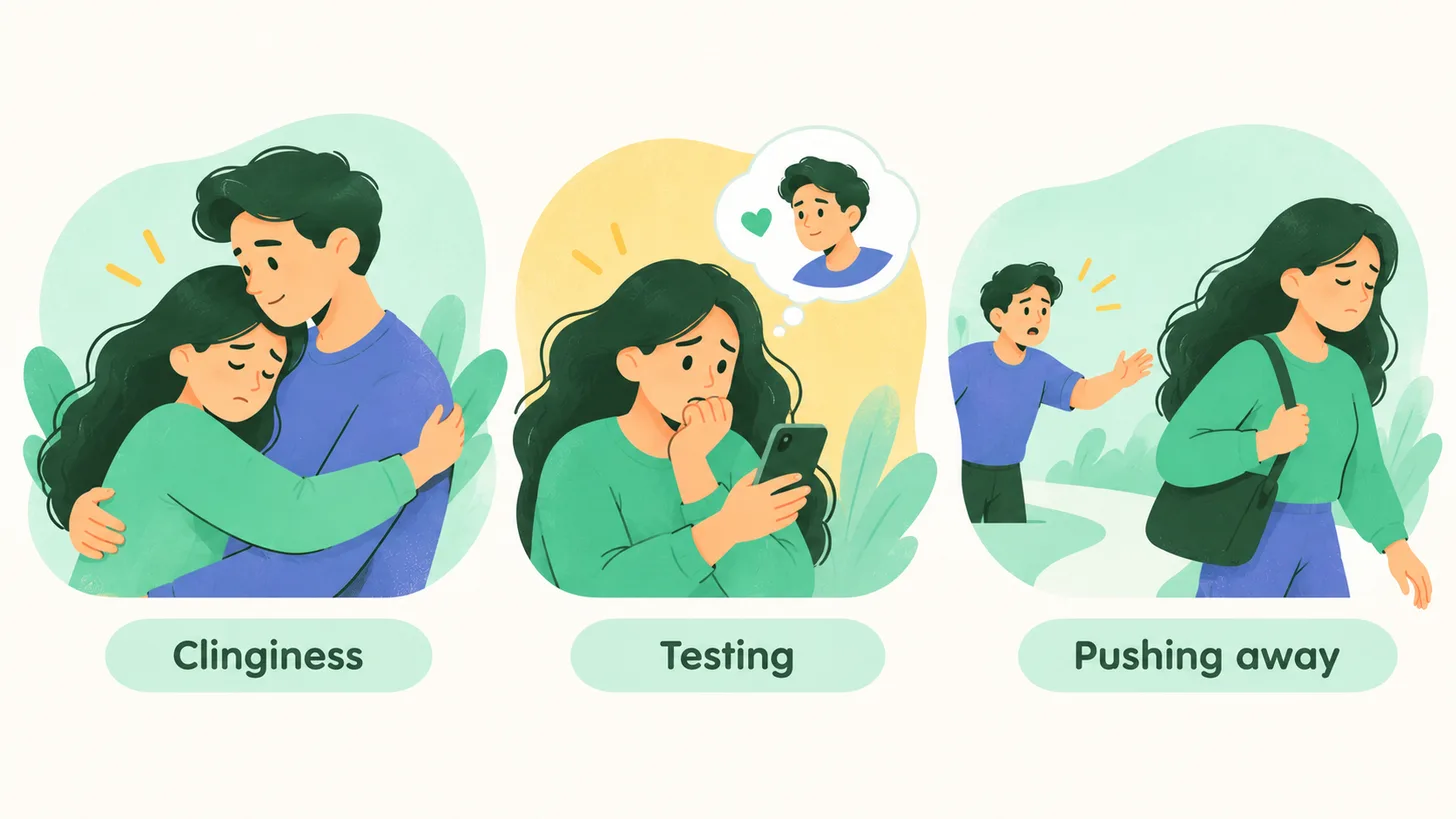
The clinging cluster looks like reading tone, checking last-seen, asking “are we okay?” one more time. A pre-emptive apology lives here too. You say sorry before anything has happened, so no one has a reason to leave. You know it is a lot. You cannot quite stop.
The shutting-down cluster is the opposite shape of the same fear. You go cool. You stop replying. You pick an argument before a holiday. You tell yourself you were never that interested. The private version is grief you will not let anyone see.
The sabotaging cluster is the hardest to spot. You leave first, so you cannot be left. You pick partners who are a little unavailable. You confess a bad opinion on the third date to see if they bolt. You feel strangely calm when they do.
In short: the signs are not weakness. They are a nervous system trying to control an ending it believes is coming.
Is this the same as BPD?
Not quite, and also not nothing. Intense fear of abandonment is one of the nine traits used clinically to assess Borderline Personality Disorder (BPD), and it appears in the ICD-11 description.
But having the fear does not mean you have BPD. Most people with abandonment issues do not meet full criteria. Diagnosis and care in India are governed by the Mental Healthcare Act 2017.
BPD is a pattern of several things together, over time: intense relationships, an unstable sense of self, sharp mood shifts, sometimes self-harm, sometimes rage. Only a trained psychologist or psychiatrist can assess for it. A reel or a quiz cannot.
If a few lines in the “what it looks like” section hit hard, that is information, not a diagnosis. A proper assessment is worth it. You will either get clarity or rule something out. Both are useful.
In short: abandonment fear is one thread. BPD is a whole fabric. Only a clinician can tell you which one, and even that takes more than one session.
How does joint-family life shape this fear?
The Indian joint family adds a specific texture. More adults can mean more chances for a steady one. It can also mean more chances for a quiet one. Children in large households often learn early that no single adult is theirs alone.
Three patterns come up in Indian therapy rooms. Parental migration for work is the first: a father on a ship, a mother on an onsite project in another city. Video calls do not substitute for a parent at the dinner table at age seven.
Boarding school from a young age is the second. Even loving parents send children away. Some children adjust. Others carry a quiet belief that family left them, and come back warm on the outside, watchful underneath.
Rotating caregivers is the third. Aunts, grandmothers, and neighbours all step in. Some children get a secure base this way. Others get a steady message: nobody will be there consistently, so you had better not need too much.
In short: the Indian family shape can be a safety net or a maze. For many of us, it was both.
If a thought like “they will leave me if they really see me” keeps looping, take two minutes with this before you read on. It will not fix the fear, but it will loosen its grip.
Catch the thought
What thought is weighing on you right now? Write it down just as it sounds in your head.
Name the trap
Does your thought fall into one of these common patterns? Pick any that fit. This part is optional.
Look again
Use these as nudges, not rules. Then write one line back to yourself.
Your reframe
Thoughts are not facts. You just practised stepping back.
This stays on your device. Nothing is saved or sent.
Can this fear actually be healed?
Yes, in the sense that matters. The fear can soften. The reflex can slow. You will still feel the old pull in some moments. You will have more choices in most. Researchers call this earned secure attachment: people who did not start secure and got there anyway.
The honest part is that it takes time. Earned security is built in real relationships, with a therapist and, when it is safe, with a partner, friend, or sibling. By staying when you want to run. By asking for what you need instead of testing to see if the other person will guess. By being believed, slowly, over months.
You might be worried that you are too old for this, or that the pattern is too set. You are not. Research on adult attachment (Indian Journal of Psychiatry) suggests patterns shift across the lifespan, especially with sustained care.
In short: this is not a condition you treat and close. It is a pattern you come to know so well that you can finally choose something new.
What kind of therapy helps with abandonment issues?
Therapy for this works because the pattern was built in a relationship. It is unlearned in one. Your therapist’s job is to be a steady, kind, boring-in-the-best-way presence. Your body practises new data: “someone stayed when I was difficult, and nothing bad happened.”
Four approaches come up most often with Indian clients.
- Attachment-based therapy. Direct work on the pattern itself, with the therapeutic bond as the practice ground.
- Emotionally Focused Therapy (EFT). Developed by Dr. Sue Johnson. Especially useful for couples caught in the anxious-avoidant pull.
- Schema Therapy. Looks at the old survival rules (“if I am not perfect, they will leave”) and helps you update them.
- DBT (Dialectical Behaviour Therapy) skills. Not the full programme for everyone, but DBT’s distress-tolerance and interpersonal-effectiveness modules help when the fear peaks.
Most Indian counsellors blend these with CBT and some body-based or somatic work, because the fear lives in the body, not only the head.
An honest timeline. Most people notice real movement in 20 to 40 sessions, spread over six to twelve months. Six sessions will tell you if you have found the right therapist, not whether the pattern has shifted. A first session is a conversation, not a commitment.
If therapy is not possible this season, three small things help. Journal the moment the fear spikes, including the trigger and the body sensation. Read Sue Johnson’s Hold Me Tight. Tell one trusted person what the pattern is called, so you have a shared word for it. These are a bridge, not a replacement.
Not every abandonment fear needs therapy to shift. Some of it is a season you walk through with sleep, one honest conversation, and time. The therapist is for when the pattern is older than the relationship it is showing up in.
In short: the work is slow, relational, and real. Twenty to forty sessions with the right person is the usual shape of change.
FAQ
What does it mean to have abandonment issues?
What is the root cause of abandonment issues?
Are abandonment issues a sign of BPD?
Can abandonment issues be fixed without therapy?
Is clinginess always abandonment issues?
How long does therapy for abandonment issues take?
Can abandonment issues ever come back?
This post is for information only and is not a substitute for professional care.


Share your thoughts