
What this blog includes
- Why exam stress hits Indian students so hard
- Study-phase tools (spaced repetition, active recall, Pomodoro, sleep, movement)
- Night-before and morning-of routines
- A one-minute reset if panic hits inside the hall
- What to do after a paper (resist the post-mortem)
- When exam stress becomes clinical, and who to call
- An interactive breathing tool you can use right now
You are not weak for feeling this
If you are reading this at 2 am with a textbook open and a knot in your stomach, pause for a second. How to handle exam stress is one of the most searched questions by Indian students every year, which means you are not the only one. Feeling nervous before a big exam is not a character flaw. It is your body preparing you. The problem is when that preparation turns into a flood that drowns the preparation itself. This guide walks you through practical, evidence-based exam stress tips that help you work with your body instead of fighting it.
A quick trust note: at GoodLives, we work with students every week who feel exactly what you are feeling. Nothing in this guide is “think positive, you got this”. These are real tools.
Why exam stress hits so hard in India
Exam stress in India is not just about the paper. It is about the WhatsApp group where someone claims to have finished the syllabus twice. It is about relatives asking what your rank is. It is about the quiet calculation of whether this one score will decide the next ten years of your life.
That weight is real. Pretending it is not real is useless. But here is the honest part: your brain performs worse under constant panic, not better. Cortisol floods the body, memory recall drops, sleep breaks, and the very preparation you are trying to do becomes harder. So the first move is not to tell yourself to calm down. It is to use tools that actually bring the body down.
In short: exam stress is biology, not weakness. You need tools that speak to biology.
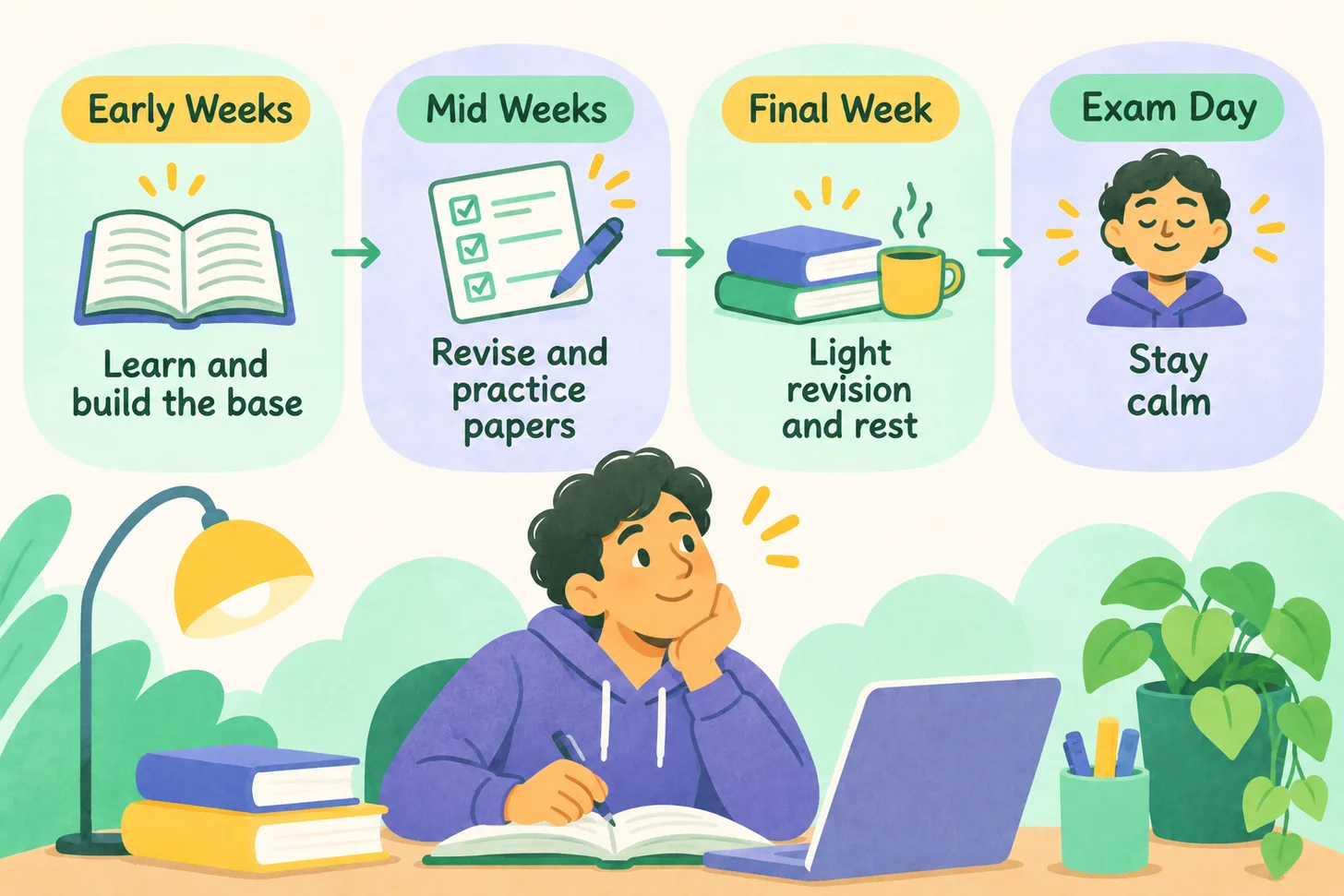
The weeks before: study smart, not endless
Most Indian students study for hours and still feel underprepared. That is usually not a time problem. It is a method problem. Two methods have more research behind them than almost anything else in the learning literature.
Spaced repetition. Hermann Ebbinghaus’s forgetting curve research showed that we lose most new information within hours if we do not revisit it. Revisiting at spaced intervals, a day later, three days later, a week later, cements it. This is why last-minute cramming feels productive and then evaporates in the hall.
Active recall. A 2006 study by Roediger and Karpicke found that students who tested themselves on material remembered far more than students who re-read the same material the same number of times. Close the book. Try to say the answer out loud or write it. Then open the book. That gap, where your brain searches, is where learning happens.
A simple weekly structure that works:
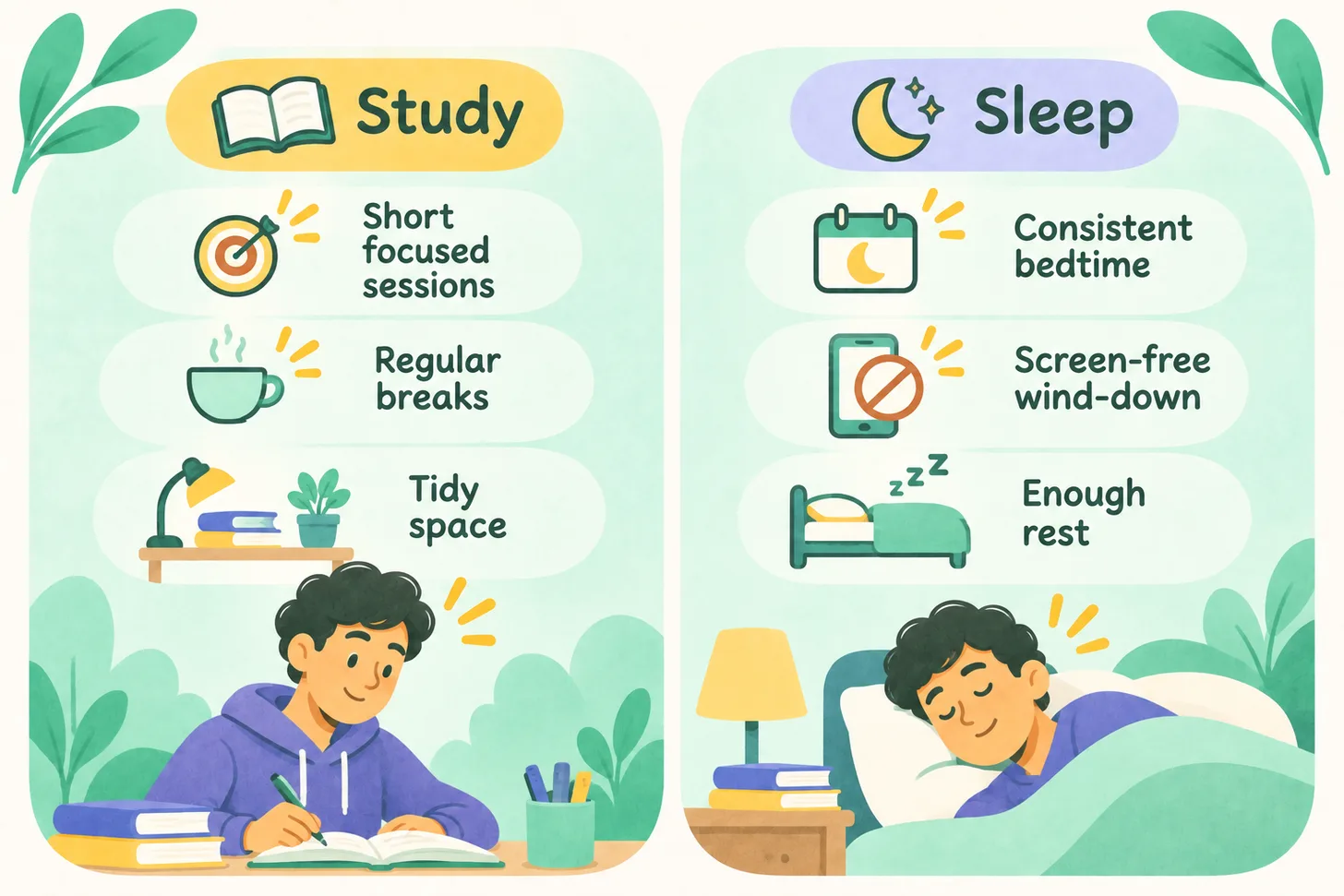
- 25 minutes focused study, 5 minutes break (Pomodoro). Phone in another room.
- End each session with 5 minutes of recall, no book open.
- Revisit yesterday’s material for 10 minutes before starting today’s.
- Protect 7 to 9 hours of sleep. Memory consolidation happens in sleep. An all-nighter is not a trade-off; it is a loss.
- 20 minutes of movement a day, walk counts. Movement raises BDNF (a brain-growth protein) and lowers cortisol.
- Caffeine before noon only. Coffee at 6 pm steals your 11 pm sleep, and the sleep debt loop is the single most common thing we see in exam-stressed students.
- Stay in touch with one or two people who know what you are going through. Isolation makes anxiety louder.
The honest 80 percent rule. You will not cover 100 percent of the syllabus. No one does. The second one looks like preparation and performs like a guess.
In short: spaced repetition plus active recall beats re-reading. Sleep is not optional, it is part of studying.
The night before the exam
The night before is where most students accidentally sabotage themselves. Here is a routine that works.
- Review summaries only. No new chapters. Opening a new topic the night before trains your brain to associate the exam with unknown territory.
- Pack your bag, lay out your clothes, charge your phone, keep your admit card and ID in one place. Reducing morning decisions reduces morning panic.
- Eat a proper dinner. Your brain runs on glucose. Skipping dinner because you are “too nervous to eat” leaves you running on empty for the paper.
- 7 or more hours of sleep. If your mind races, try the physiological sigh: two short inhales through the nose, one long exhale through the mouth. Repeat for two minutes. It is one of the fastest ways to drop the nervous system.
- Avoid the group chat where everyone is comparing prep. That conversation has never once helped anyone sleep.
In short: the night before is for rest and summaries, not new material and not comparison.
Exam morning: setting your body up right
- Breakfast with protein and complex carbs. Eggs and roti. Poha with peanuts. Idli with sambar. Avoid sugar-only breakfasts that spike and crash.
- Light movement if you have time. Even five minutes of stretching helps.
- One coffee if you normally drink coffee. Not two. The extra one you think will “wake you up” usually just makes your heart race, which the brain reads as fear.
- Reach the centre 20 minutes early. Arriving late is a nervous-system disaster. Decision stress drops the moment you are seated.
- Two minutes of box breathing or physiological sigh before you walk into the hall. Try the tool below.
A moment to breathe
Follow the circle. Breathe in, hold, breathe out, then hold. Four counts each. Stay as long as you like.
In short: feed the brain, calm the body, arrive early. The paper has not started yet; you can still set your state.
During the exam: if panic hits
Panic in the hall is more common than you think. The feeling is terrifying: the mind goes blank, hands shake, the question stops making sense. Here is what to do.
One-minute reset: 4-7-8 breathing. Inhale through the nose for 4 counts, hold for 7 counts, exhale slowly through the mouth for 8 counts. Repeat three times. The long exhale is the key: it switches the body from the sympathetic (fight-or-flight) side to the parasympathetic (rest) side.
Physiological sigh. Two short inhales through the nose, one long exhale through the mouth. Do this five times. Faster than the 4-7-8 and useful when you only have a few seconds.
Grounding, if the panic feels like floating. Look around and name 5 things you can see, 4 you can touch, 3 you can hear, 2 you can smell, 1 you can taste. This is the 5-4-3-2-1 technique. It brings a dissociating mind back into the room.
Skip and come back. Hard question? Mark it, move on. Spending 15 minutes on one question is how students lose the paper. Momentum matters more than order.
Water sip. A sip of water is a small reset for the body and buys you ten seconds to re-read the next question slowly.
One sentence to say silently: “I do not need to know everything to pass well.” You almost never do.
In short: one breath pattern, one grounding move, one rule to skip. Three tools, and most panic attacks pass inside two minutes.
After the exam: resist the post-mortem
The temptation after a paper is to walk out and immediately ask friends what they wrote for question 12. Do not do this. It is the single worst thing for your mood and your performance on the next paper.
- Walk away from the group. Headphones on if you need to.
- Eat something. Hydrate.
- Rest for an hour. Lie down. Scroll if you must, but do not touch textbooks for at least two hours.
- Start prep for the next paper only after you have had food and rest.
- If a parent asks “how was it”, a simple “it was okay, I will know when the results come” is a complete answer. You do not owe anyone a post-mortem.
In short: your work for that paper is done. Comparing answers only poisons the next paper.
When exam stress tips into something more
Everyday exam stress is uncomfortable but moves. Clinical exam anxiety does not move. If you are seeing any of the following, please read this as a nudge to talk to a therapist, not as a judgement.
- Panic attacks severe enough that you cannot enter the exam hall
- Thoughts of suicide or self-harm, even if they feel “small”
- Weeks of insomnia, not just the night before
- Dependence on caffeine beyond three cups, or taking sleep aids to switch off
- Vomiting, chest pain, or shaking that lasts hours before every exam
- Family conflict that is escalating around your marks and feels unsafe
- A feeling that your worth as a person is tied to this one result
Any of these signals is a reason to reach out, not to push through. Help works best when you ask early.
Where to get help in India
- It supports student mental health specifically.
- NIMHANS Project YUVA. NIMHANS runs student-focused mental health programmes; worth looking up if you are in Bengaluru or want tele-consult.
- School and college counsellors. Many institutes have one. Use them. They are there for exactly this.
- GoodLives. We offer student-friendly rates for online therapy with licensed Indian counsellors who understand exam pressure in the Indian context. See our pricing page.
The honest truth about exams
Here is what no one in the group chat will say out loud. Exams measure a slice of what you know on one day. They do not measure how kind you are, how creative you are, how good a friend you are, how much you have endured to even sit for this paper. They are a filter, not a verdict.
Students who do well in life after exams are not always the ones with the highest ranks. They are the ones who learnt how to recover: from a bad paper, a dropped year, a surprise result. If this exam goes well, celebrate. If it does not, you have more options than your current panic is letting you see. Re-attempts exist. Alternative paths exist. Your life is bigger than this one score.
That is not a soft-focus line to make you feel better. It is the pattern across the thousands of Indian students we have seen over the years at GoodLives.


Share your thoughts