
What this blog includes
- Ten common communication barriers, named honestly, not softened
- Why the fight repeats, and the attachment or trauma layer underneath
- Evidence-based tools that actually move the needle, from Gottman to NVC to EFT
- What this often looks like in Indian homes, with hierarchy and big silences
- Red flags that mean it is more than a communication problem
You know the moment. You open your mouth, nothing comes out that lands the way you meant it, and ten minutes later one of you has walked into the next room. By midnight neither of you can remember what started it.
If any of that sounds familiar, you are in a very big club. On GoodLives, trusted by 500K+ people, communication barriers in relationships is one of the most common reasons couples and families reach out to a verified, RCI-registered psychologist. The patterns are real, well mapped, and workable.

What are communication barriers in a relationship, really?
A communication barrier is a repeating pattern that stops two people from hearing each other, even when they both want to. It is not about a bad day or a bad word. It is a worn-in groove the two of you keep sliding into, often faster than you can catch.
Most of them are learned. From our parents, our first partners, our first few jobs. So they can be unlearned too, slowly, with practice.
In short: a barrier is a habit, not a trait. Habits move.
Why does the same fight keep happening?
Here is the part most listicles skip. A lot of what we call a communication problem is actually an attachment problem, a trauma response, or a boundary problem in disguise. The surface looks like “we cannot talk”. The engine room is older.
If one of you shuts down when things get tense, that is often the body’s old survival move, not a plan to hurt you. If the other pushes harder to get a response, that is often an older fear of being left, not a wish to control.
Naming which layer is yours is half the repair. The other half is the tools below.
In short: before you fix the words, notice the layer underneath them.
Ten common communication barriers in relationships
Most of what shows up in a couple’s or a family’s week falls into one of these ten. Many relationships have two or three running at once. The point is not to diagnose each other. It is to spot the shape so you can name it in the moment.
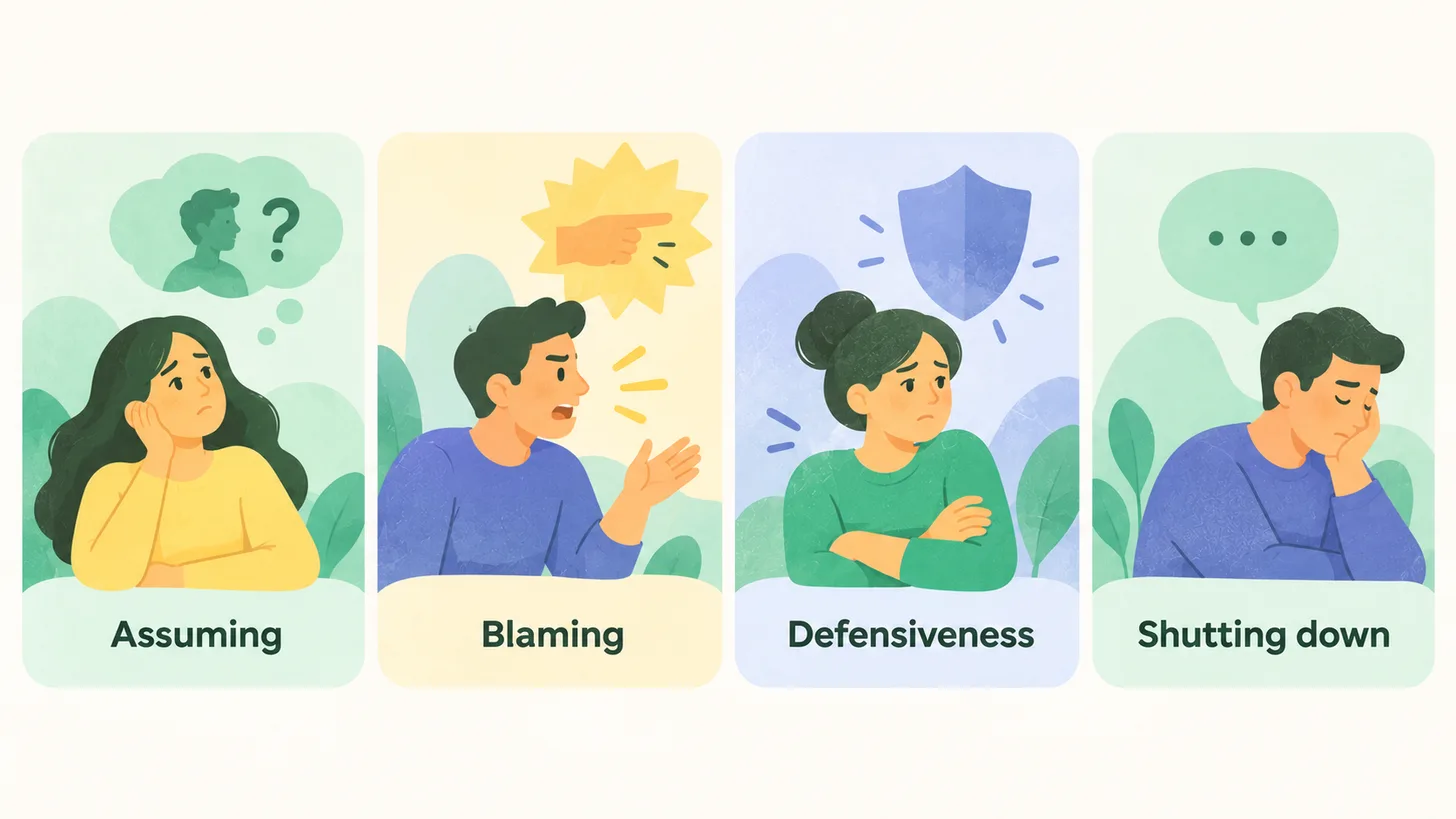
Mind-reading expectations. The quiet belief that if they loved you, they would just know. They do not know. Nobody does. This is one of the fastest ways to feel unseen on repeat.
Stonewalling. Going silent or walking away in the middle of a hard talk. Often it is the body’s try to not say something cruel. It still lands as rejection. The Gottman Institute’s research finds stonewalling is one of four patterns that can predict divorce with roughly 93 percent accuracy.
Criticism. Going at the person, not the behaviour. “You never help” instead of “I felt alone with the dishes last night.” One Gottman “horseman”, and one of the easiest to swap once you catch it.
Contempt. Mockery, eye-rolls, name-calling, sarcasm with a sting. Gottman calls contempt the most toxic of the four horsemen, and the strongest single sign a relationship may end. Both people usually feel it in the room.
Defensiveness. Meeting any complaint with a counter. “Yes, but you also do this.” Another horseman. It protects you in the moment, and keeps the fight running for the hour.
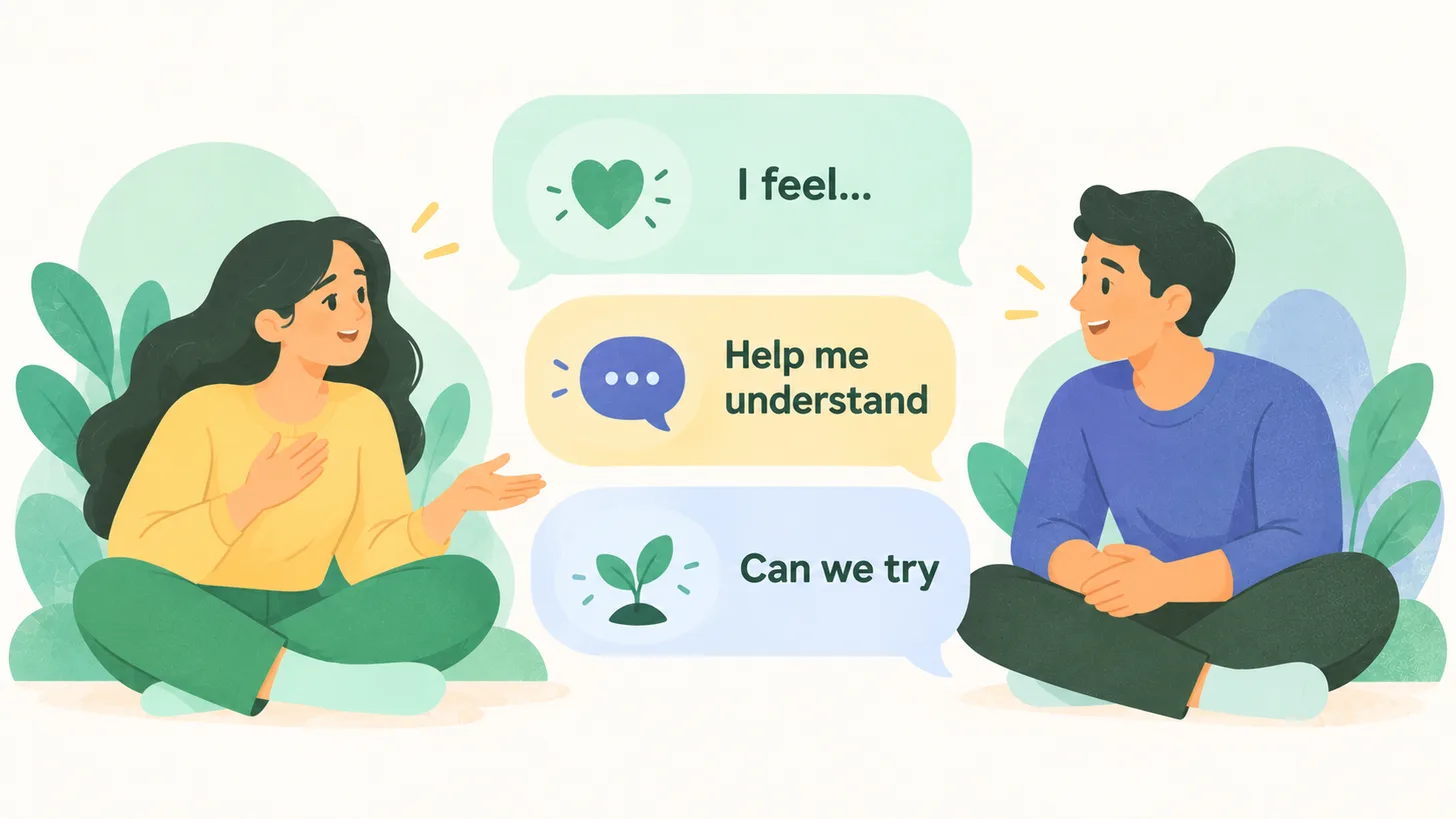
Breakdown of nonviolent communication. Rosenberg’s four-step frame of observe, feel, need, request collapses into blame. You say “you are being distant” instead of “when the phone comes out at dinner, I feel small, can we try phones away?”. More on Nonviolent Communication by Marshall Rosenberg.
Attachment style mismatch. One partner anxious, one avoidant. One wants to talk it through now, one needs an hour. Neither is wrong. Without a plan, both get louder in opposite directions. More on attachment issues and styles.
Different styles of showing love. Not every mismatch is a love-language label. One of you may show care through small acts, the other through long talks. Both are real. Neither is the full story.
Trauma triggers. A tone of voice, a slammed cupboard, a certain word, and one of you is suddenly not in this room but in an older one. It looks like a communication breakdown. It is a nervous system doing an old job.
Cultural and generational silence. In many Indian homes, you did not talk back to a parent, and parents did not talk feelings with each other. “Big silences” are inherited. They are not personal failure.
In short: there are more shapes to this than “we fight”. Noticing the shape is the first move.
What works: evidence-based ways through
The good news is that this is one of the most researched areas in couple and family therapy. The tools below have real data behind them. Most are learnable in a few months of steady practice.
The Gottman method. Built from decades of lab work with real couples. It swaps the four horsemen for softer counters, teaches small daily “bids for connection”, and holds a 20-minute cooldown when either body is flooded. Many couples therapists in India are trained in Gottman Level 1 to 3.
Nonviolent communication (NVC). Rosenberg’s four-step frame of observe, feel, need, request. Awkward at first. It clicks with practice. Useful for people who grew up turning feelings into complaints.
Emotionally Focused Therapy (EFT). Sue Johnson’s model works on the attachment layer, not just the words. It helps the anxious partner feel safe and the avoidant partner stay present. When the same fight keeps running and words alone are not moving it, EFT is the frame many therapists reach for.
Imago therapy. Harville Hendrix’s dialogue, where one partner mirrors back what the other said before replying. Slow. Sometimes hard. Very helpful for couples who talk over each other.
DBT interpersonal skills. Marsha Linehan’s DEAR MAN, GIVE and FAST scripts give you set lines for a hot moment. Useful for individuals as much as couples.
Pause and repair. When your heart rate crosses roughly 100 beats per minute, your brain is in survival mode. No useful talk is happening. Gottman found this holds across hundreds of couples. Twenty minutes, phones away, come back.
“I-statements”, done well. “When X happens, I feel Y, because of Z.” It feels formal. It works because it moves the line from blame to information.
Active listening with reflection. Say back what you heard before you reply. Not word for word. The feeling under it. “So the thing that stung was that I did not say thank you in front of your mother.” Yes. Now you can reply.
If the storm is loud right now and words are not going anywhere, pause here for a slow minute before you read on.
A moment to breathe
Follow the circle. Breathe in, hold, breathe out, then hold. Four counts each. Stay as long as you like.
In short: the tools are not a trick. They are a muscle you train on calmer days so they are there on the loud ones.
CTA Learn these tools together, with support. A verified psychologist can help the two of you practise Gottman, EFT or NVC in your own weeks and your own words. English, Hindi and more Indian languages. Button: Match Me with a Therapist
What this looks like in Indian homes
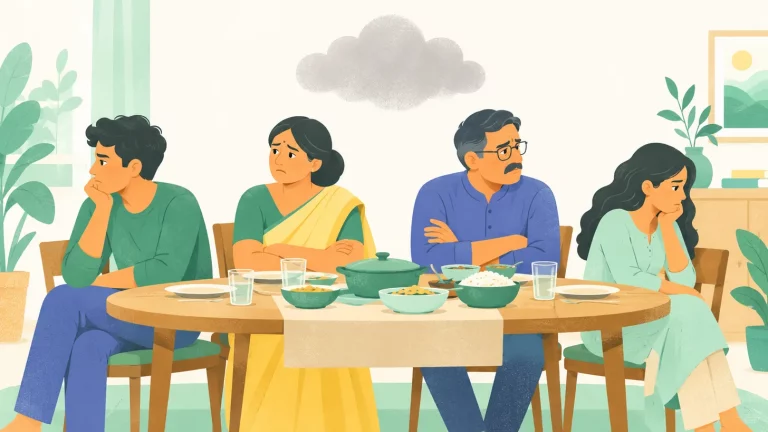
In many Indian families, the barrier is not “we fight too much”. It is “we do not talk about this at all”. Our hierarchies make honest talk harder in set ways. Noticing them is kinder than fighting them.
You do not talk back to a senior. Parents, parents-in-law, elder siblings. Dissent felt like disrespect, so most of us learned to swallow it. In marriage, the swallow goes on until it does not.
Triangulation through a third person. Instead of telling your partner, you tell their sister, who tells their mother, who tells them. The message arrives, slightly bent, and nobody owns it.
Code-switching in close moments. English for work and apologies, Hindi or your home tongue for warmth and anger. One partner reaching in English, the other in Marathi, both feeling the other is cold.
The “big silence”. Weeks of not naming the hurt, hoping it fades. It rarely does. It builds and comes out at the worst moment, often at a wedding.
Male emotional vocabulary limits. Many Indian men were never given words for sadness, fear or shame. “Theek hai” (I am fine) is often the only reply they have. The fix is not to shame them for it. It is to help them find more words.
In short: the Indian version of this needs India-first tools. Western scripts translated word for word do not always land.
Red flags: when it is more than a communication problem
Some patterns are not a barrier to work on together. They are harm. Please read this part slowly if any of it is familiar.
Weeks of silent treatment used as punishment. Shouting, name-calling, or steady verbal abuse. Whole topics avoided for years, so the relationship shrinks to small talk. Talking only through a third person because you cannot be in the same room. Feeling unsafe in a conversation, even when nothing has been thrown yet.
If one or more is familiar, couples therapy may not be the right first step. Sometimes individual therapy is safer. Sometimes the honest answer is that this relationship cannot carry what it is carrying. Read toxic relationship: signs and how to leave safely for the longer version.
In short: barriers are repairable. Harm is not a barrier.
When to talk to a therapist about this
Not every rough patch needs a therapist. Some of this is a season you walk through, with sleep, one honest week, and a plan. A few patterns are worth getting help with sooner, because they get more costly the longer they run.
It is worth talking to a couples or family therapist when the same fight runs every few weeks without new ground, when one of you is often stonewalling or using contempt, or when you have started to avoid whole subjects.
Individual therapy first can help when the layer under the words is attachment, trauma, or an older family pattern. Many Indian couples do a mix. One person starts, then both. There is no one right order. Read more on trust issues in a relationship if a breach is also in the picture.
Communication is a muscle, not a trait. Trainable. Also, honestly, some matches cannot work. Both are okay to know.
In short: go when the pattern starts costing you sleep, work or safety.
FAQ
What are the main barriers to communication in a relationship?
How can I fix communication issues in my marriage?
What is the number one predictor of divorce?
Can therapy really help with communication problems?
What are the 4 horsemen of communication?
Why do we always argue about the same thing?
Can poor communication end a relationship?
Where to go from here
Slow is the pace that works. One honest conversation. One week of practice. Help is there when you want it. You do not have to be in crisis to see a therapist, and you do not have to agree on everything to try.
In short: the first session is the smallest commitment.
This post is for information only and is not a substitute for professional care. If you are struggling, please speak to a qualified mental health professional.


Share your thoughts