

What this blog includes
- The WHO’s 2019 definition of burnout and how it is different from a hard week
- Why work stress in India has its own specific triggers
- The early, middle and late signs most of us miss
- What chronic work stress does to your body and mind
- Six recovery levers, and when to see a therapist
Something feels off, and you can’t name it. Monday starts tired. Your inbox follows you to dinner. A small Slack ping makes your chest tighten. You are reading this between tabs, hoping it is just a phase. You are not being dramatic.
In India, work stress and burnout are now so common that most of us have normalised them. The first step is naming what we are actually dealing with. GoodLives has worked with people living with this exact feeling, and the honest truth is simple: it responds to care, not willpower.
What burnout actually is, and why it is not just a bad week
The World Health Organization classified burnout as an occupational phenomenon in its ICD-11, released in May 2019.
It has three parts: deep exhaustion, mental distance from your job or feelings of negativity and cynicism about it, and a drop in how well you do your work. All three, not any one on its own.
Burnout is not a mental illness in the WHO’s framing. It is a response to chronic workplace stress that has not been managed well. That matters, because it tells you where the lever is. The problem is not inside you alone. It is the shape of the work, the hours, the boundaries, and sometimes a workplace that was never going to let you rest.
Work stress and burnout in India often get merged in daily speech. One honest way to tell them apart: stress is the feeling of too much, and you can still picture a weekend fixing it. Burnout is the feeling of nothing left, and the weekend does not touch it.
In short: stress passes with sleep and a Sunday off. Burnout does not. If a holiday ends and you feel the same within forty-eight hours, you are not just stressed.
Why work stress and burnout in India feel the way they do
Our stress has an Indian shape. The Factories Act, 1948 caps weekly hours at forty-eight (see the Act on India Code). On paper, that is one law.
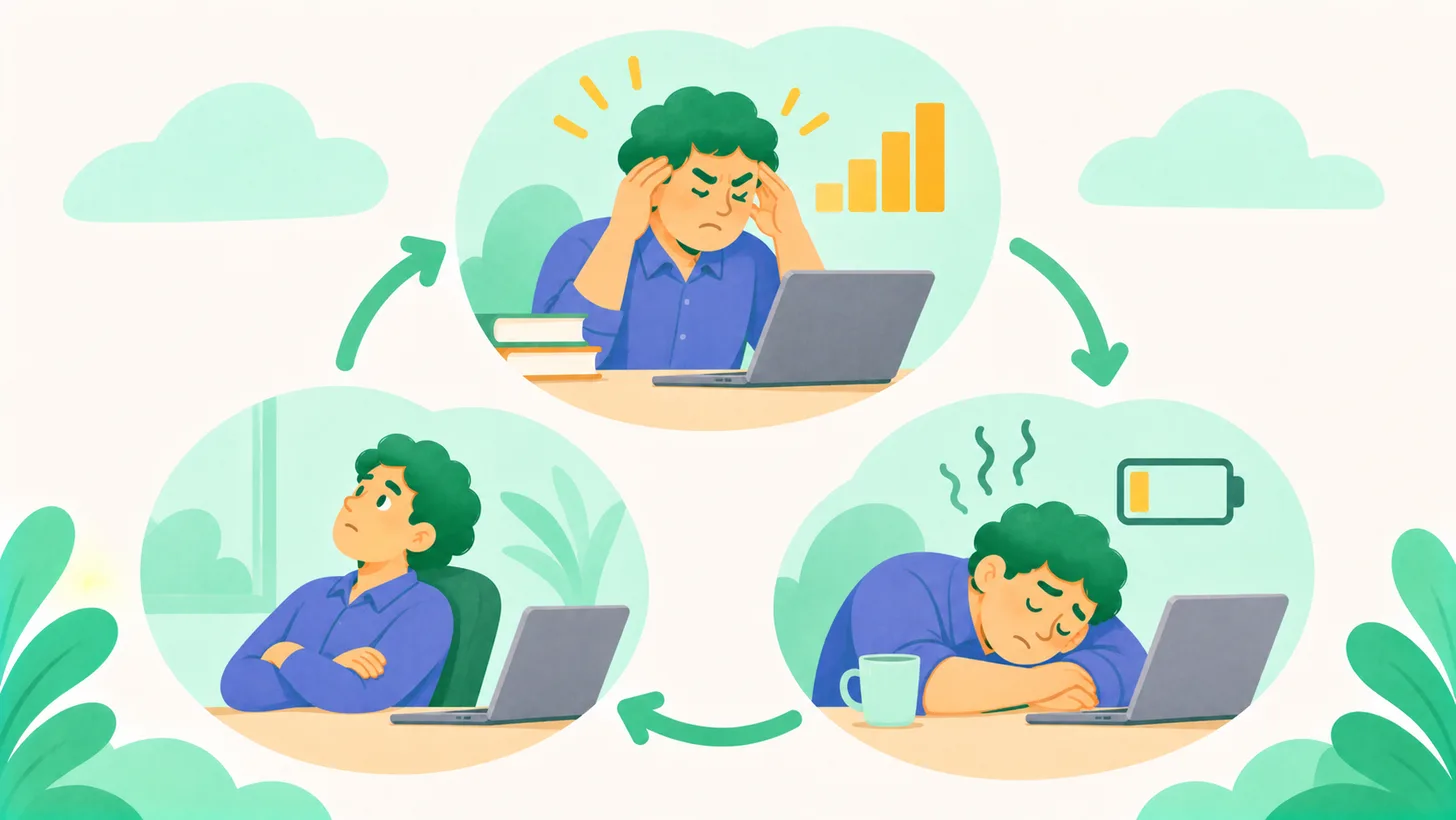
In practice, most white-collar jobs in metros run longer, especially in IT, BPO, consulting and startups. There is no legal right to disconnect in India yet, so an 11 pm Slack ping is not technically a problem anywhere official.
Then there is the commute. If you live in Gurgaon and work in Noida, or in Thane and work in Lower Parel, you have added two hours of standing and signal-watching to your day before any work begins. That is not resting time. It is more work, with worse air.
Nuclear families in metros mean less automatic support. Your parents may be in a different city. Your partner is also working through burnout. Weekends go to chores you did not have as a 22-year-old because your mother did them. The old joint-family cushion is thinner.
Hustle culture does the rest. Founder posts call sleep a tax. Managers mistake exhaustion for commitment. The 9-9-6 phrase came from China, but a quieter version runs here. Rest reads as weakness in rooms that reward visible overwork.
In short: the specific triggers are long hours, no right-to-disconnect, two-hour commutes, thinner family support and a culture that calls exhaustion dedication. Your body is responding to all of it at once.
The early, middle and late signs of burnout most of us miss
Early signs are mostly physical and easy to explain away. You sleep but wake tired. Headaches on Monday morning. Shoulders that stay up near your ears. A short fuse with your partner. Caffeine that stopped working. You are irritable about small things like a lift that stops on every floor.
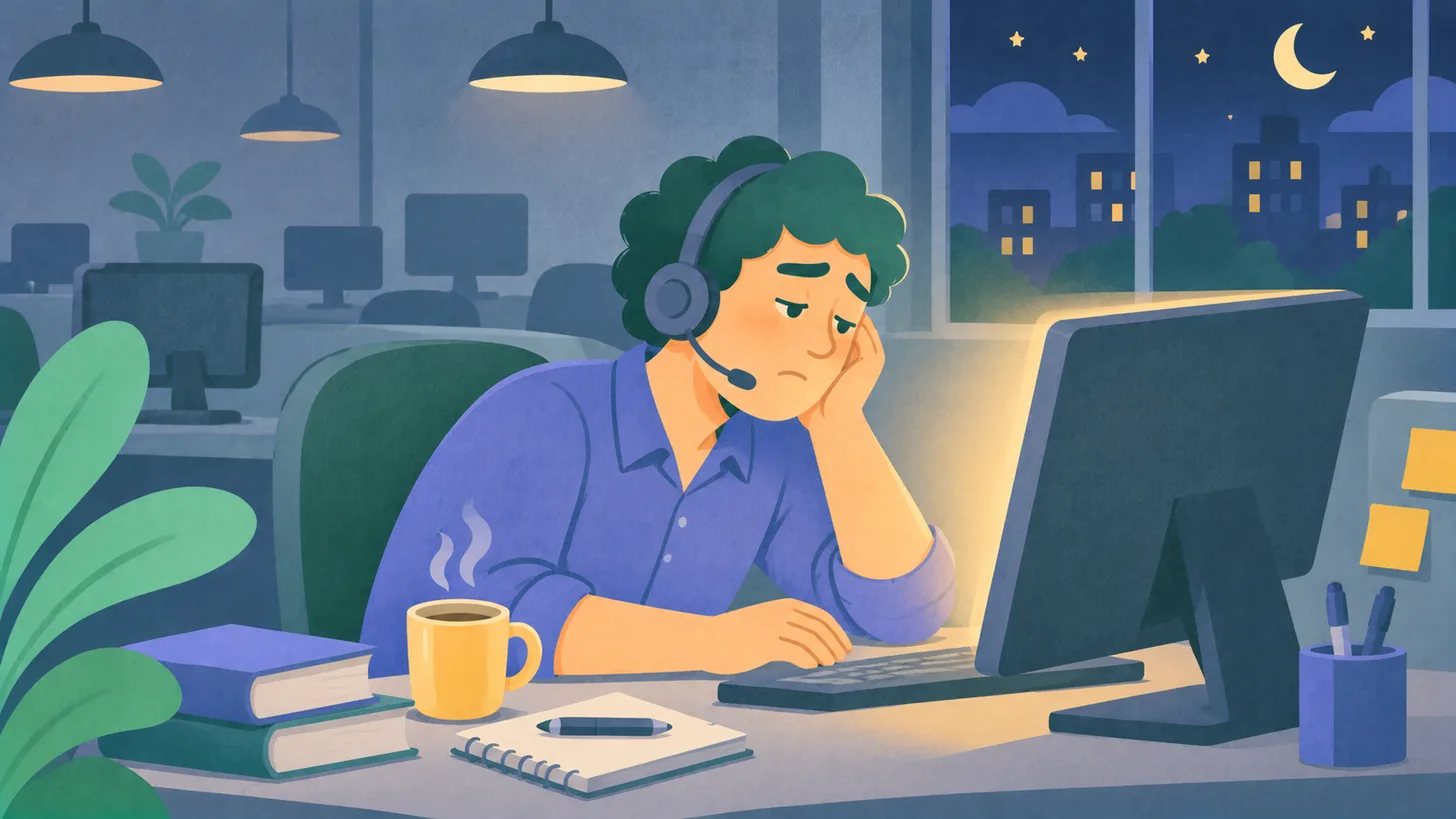
Middle signs are emotional. Work you used to care about feels pointless. You start the day already annoyed. Small feedback feels like criticism. You take longer to reply to messages because every reply feels heavy. You open your laptop and lose twenty minutes to nothing.
Late signs are structural. You cannot imagine another year of this. You dread Sunday evening by Friday afternoon. You call in sick with a body ache that is also something else. You find yourself crying in the bathroom at the office or on a Zoom you muted. You consider quitting weekly, without a plan.
If three of these have been true for most days of the last three months, burnout is a reasonable word for what is happening. You are not weak. You are a person whose body has run out of a buffer it needed.
In short: physical signs come first, emotional signs follow, structural signs come last. Three or more, most days, for three months, is the honest line.
What chronic work stress does to your body
Your body is not separate from your work schedule. The nervous system reads a late-night email the same way it reads a loud noise in the house, with a small hit of cortisol. Daily, that hit changes things.
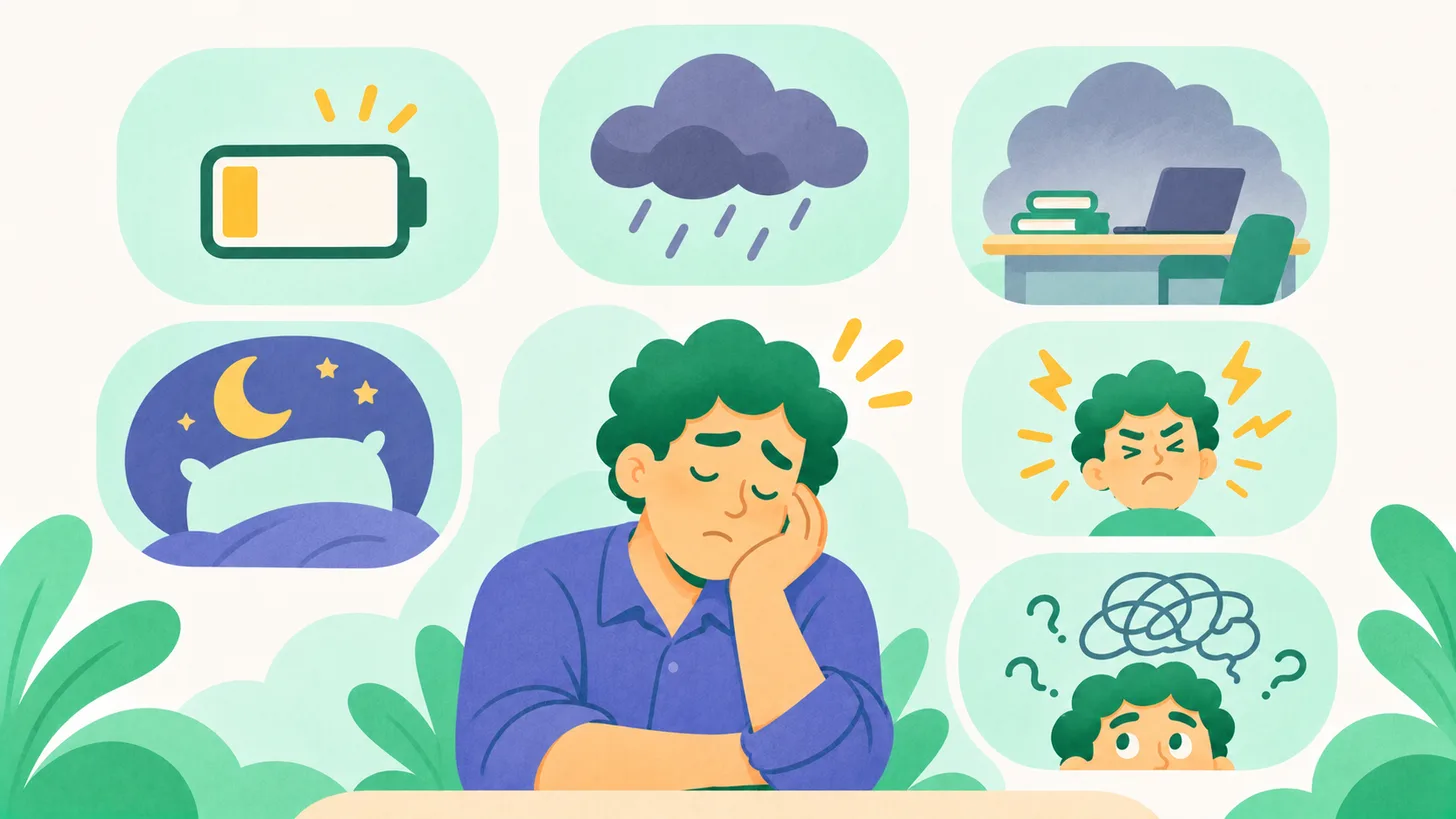
Sleep becomes shallow. You fall asleep late and wake at 4 am. Digestion slows. You get a cold more easily. If you had migraines, they come more often.
The American Psychological Association has long documented that chronic stress is linked to cardiovascular problems, sleep disruption and weakened immune response. None of this is instant. It builds.
By the time your resting heart rate is high and you are catching colds every month, your body has been asking you to stop for a while.
There is a second body signal most of us miss. You stop feeling hungry at mealtimes and feel ravenous at 10 pm. You crave sugar in the afternoon when you used to crave a walk. Your appetite is not broken. It is being overwritten by cortisol and sleep debt.
In short: sleep, immunity, digestion and heart health are the first things to flag chronic work stress. If three of these have shifted in the last six months, your body is already telling you.
What chronic work stress does to your mind
Mentally, work stress does three things that are easy to miss until they stack. First, it narrows your attention to the task in front of you. That looks like focus. Over months, it looks like you cannot read a book or finish a conversation without your mind drifting to work.
Second, it builds a quiet anxiety baseline. You feel the chest-tight hum of thakavat (a deep, bone-level exhaustion) even on a Saturday. You check email at the dentist. You feel guilty for watching a show. Your body thinks it is on, long after your calendar says you are off.
Third, if it continues, work stress and burnout in India can tip into clinical anxiety or depression. The marker is not that you feel sad some days.
It is that most days, for two weeks or more, you lose interest in things that used to help, you cannot sleep or you sleep too much, and you feel flat or hopeless. If that is where you are now, this is where self-help stops being the only answer.
In short: narrowed attention, a steady anxiety hum, and a possible slide into clinical anxiety or depression. The last one needs more than rest.
Resting is not lazy: the reframe most of us need
Here is a sentence you may have been avoiding. Rest is work. In a body that has been running on cortisol for months, lying down for a weekend without guilt is a hard thing.
You will feel bored and twitchy. You will think of five emails you could send. Your fingers will reach for your phone. That is not evidence that rest does not work. That is the first forty-eight hours of coming down.
A lot of us grew up reading rest as what you earn after you deserve it. In an office culture that rewards reply speed over output, that framing calcifies. The honest reframe is simpler. Rest is the thing that makes the next week of work possible. Without it, you do not get hard work. You get present work, which is not the same.
You don’t have to be in crisis to take a day off. You don’t have to earn a nap. A short walk at 4 pm is work your body is doing for you, not time stolen from a task.
In short: rest is not a reward for exhaustion. It is the maintenance that lets you work at all. Treat it like a meeting you cannot move.
Six levers that actually help you recover
No single tool fixes burnout. These six do most of the lifting when used together over six to twelve weeks. Start with one. Add another when the first feels less effortful.

Sleep. A consistent sleep window matters more than a weekend lie-in. Pick a wake-up time first and work backwards to a bedtime that gives you seven to eight hours. For two weeks, keep it even on Saturday.
Boundaries. One hard boundary, written on your calendar. Not “I will try to log off at 7”. A specific one, like “no laptop after 9 pm on weekdays”. The specific one holds, the vague one breaks on Tuesday.
Physical rest for your nervous system. Breathing is the fastest switch you have for a tight chest. Two minutes of slow four-count box breathing in the Uber or at your desk lowers your heart rate without anyone noticing. If you want, try it now with this.
A moment to breathe
Follow the circle. Breathe in, hold, breathe out, then hold. Four counts each. Stay as long as you like.
Social contact without the agenda. One meal a week with someone who does not work at your office, where you do not talk about your office. This sounds small. It is not.
Movement, not fitness. A twenty-minute walk after work, with your phone in your pocket, is more useful than a hard gym session you dread. Movement counts even when it is not performance.
A meaning check. Once a month, write one line about what you actually care about at work and what you are doing to serve it. If the gap is big and growing, burnout is being fed by the mismatch, and the fix is partly design, not just rest.
Breathing lowers your heart rate in two minutes. A therapist helps you figure out which specific triggers at work keep setting it off, and what to do about the ones you cannot change alone.
In short: sleep, boundaries, nervous-system rest, social contact, movement and meaning. Six levers, used together, over weeks, not days.
Should you talk to your manager, HR, or neither?
A fair conversation with a good manager can shift a workload inside a week. A fair conversation with a wrong manager can mark you as a complainer for a year. The honest answer depends on what you have seen them do with other people’s workload complaints before.
Try the manager route first if two things are true. Your manager has, at any point, moved a deadline for someone else’s wellbeing. And you can name one specific change you want, like “I need Thursdays as a no-meeting day” rather than “I feel overwhelmed”. A clear ask is easier to say yes to than a feeling.
Go to HR when the problem is structural or when the manager is the problem. In many Indian companies, HR has an employee assistance programme (EAP). If your HR portal mentions MindPeers, YourDOST, 1to1Help, Amaha or GoodLives, you likely have therapy credits already. Ask what is in your plan before you pay out of pocket.
If neither feels safe, that is also information. A workplace that cannot hear a workload concern will not fix a burnout. In that case, the lever is your own choices, not a conversation at the office.
In short: manager first if there is a track record. HR for structural problems or EAP access. If neither route is safe, trust that signal.
Should you leave the job, or stay and recover?
This is the question most of us hold at 2 am and never ask out loud. Here is a straight way to think about it.
Stay and recover when the job itself is good but one project, one manager or one quarter has pushed you into burnout. You can picture a version of the role that is still worth doing, and the people above you can imagine a slower version of this quarter.
Leave when the burnout is structural. The hours, the culture, the expectations are the role, not an accident. You have had the conversation and nothing changed. Your body feels worse six months in than at month one.
Delay the decision when you are inside the first six weeks of a bad patch, when a holiday has not yet happened, or when you are also in a mental-health dip you have not yet addressed. Burnout and depression often look alike at 11 pm. Treating one as the other costs you a job you did not need to lose.
Not every burnout needs a resignation. Not every job you love is worth your health. Both can be true.
In short: stay and recover when the burnout is a quarter, leave when it is the role. Delay the decision when the body or the mind has not been looked at yet.
When self-help is not enough: what a therapist can do that an app cannot
Breathing exercises for stress will take the edge off. A walk and a boundary will help you sleep. These are real tools and worth using. They do not, on their own, address the loops that got you here.

If sleep is still broken after a month of fixing hygiene, if you are starting to cry at small things, if you dread a Monday on a Friday afternoon, this is where a human helps more than a technique.
A therapist, usually using Cognitive Behavioural Therapy (CBT) or a similar structured approach, helps you name the thought patterns that keep setting off your nervous system at work. They trace them back to specific triggers in your week, and build small, repeatable changes you can test.
CBT is a short, structured therapy that teaches you to spot and reframe anxious thoughts. It is not an insight-collecting exercise. It gives you something to try by Thursday.
Under the Mental Healthcare Act, 2017, every Indian has a right to access mental-health services.
Most health insurance policies now cover psychiatric treatment, following IRDAI’s 2018 circular that treated mental illness on par with physical illness. If you are not sure what your plan covers, ask HR.
GoodLives matches you with a verified psychologist, often within twenty-four hours, in your language. For what a first session looks like, see our pricing page.
In short: when sleep, boundaries and breathing have been tried for a month and the baseline has not moved, a therapist is the next lever. Not before, not after everything is unbearable.
button: Book a Session
This post is for information only and is not a substitute for professional care.
Related reads on GoodLives


Share your thoughts