

What this blog includes
- What OCD actually is, in plain words, and how it is different from being neat
- The common OCD symptoms you can notice in thought and in action
- Six honest types of OCD, including Pure-O and scrupulosity
- How OCD is treated in India, from ERP to medication to newer options
- When to reach out, and how to find care that actually fits
If you have been Googling “ocd symptoms” late at night, half-sure the thoughts in your head mean something is wrong with you, you are in the right place. What you are feeling has a name, and plenty of people in India have been there.
GoodLives has been trusted by 500K+ people across therapy, workshops and awareness programmes, and holds a 5 Google rating.
The most common line we hear from readers is “I thought I was just being too careful, or too religious, or going mad.” You are not any of these. OCD is a specific condition. It is treatable, more than most people in India realise.
What do OCD symptoms actually feel like?
OCD is a loop between two things. An obsession is an unwanted thought, image or urge that will not leave. A compulsion is the thing you then do, in your head or with your hands, to make the feeling go away. The relief lasts a few minutes. Then the thought is back, often louder.
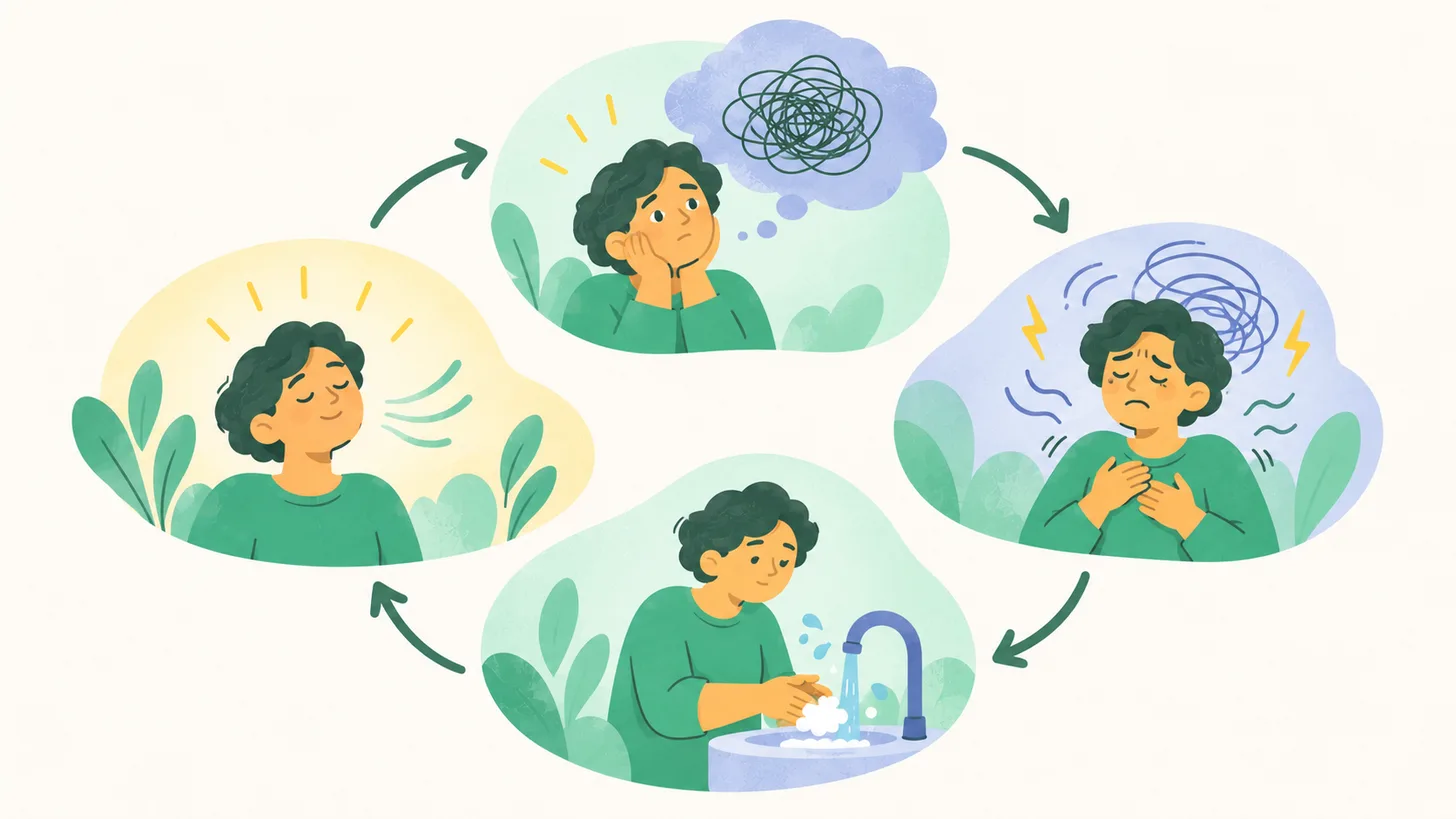
The clinical definition sits in the DSM-5-TR, which lists OCD as the presence of obsessions and/or compulsions that take up more than an hour a day, or cause real distress and interference, and are not better explained by substances or another condition. Source: American Psychiatric Association, DSM-5-TR summary.
The feeling is specific. You wash your hands, then you remember you touched the tap, so you wash again. You lock the door, you walk away, your chest tightens, you walk back to check. You pray, and halfway through you lose the word, so you start again. The brain is sending a false alarm, and the compulsion is the thing you do to switch off the alarm. The alarm comes back because the switch does not work on the alarm, only on the volume.
In short: OCD is a loop of unwanted thoughts and the behaviours you do to quiet them; the behaviours bring brief relief, and that is why the loop keeps running. If you want a plain-language starting point before a clinic visit, our OCD self-check walks through the common patterns.
How is OCD different from being neat and tidy?
OCD is not a love of order. Enjoying a tidy desk, lining up your shoes or alphabetising your books is a preference, not a disorder. OCD is not about neatness. It is about a feeling of wrongness that you cannot ignore until you have done the thing that makes it feel right.
What people often mean when they say “I am so OCD about this” is usually either a strong preference, a careful habit, or at times OCPD, which stands for obsessive-compulsive personality disorder. OCPD is a separate pattern of rigidity and perfectionism without the intrusive thoughts and ritual relief.
The clearest giveaway is distress. OCD hurts. If a person tidies a shelf and feels satisfied, that is not OCD. If a person tidies a shelf, cannot stop at nine, and feels dread until the shelf is exactly how it was last Tuesday, that is closer.
The confusion is costly. It makes people with real OCD feel like they are overreacting. It also makes real OCD invisible when a friend jokes about being “so OCD” at work.
In short: OCD is not neatness; it is a loop of intrusive thoughts and ritual relief that causes real distress, and OCPD is a different pattern altogether.
What are the main types of OCD?
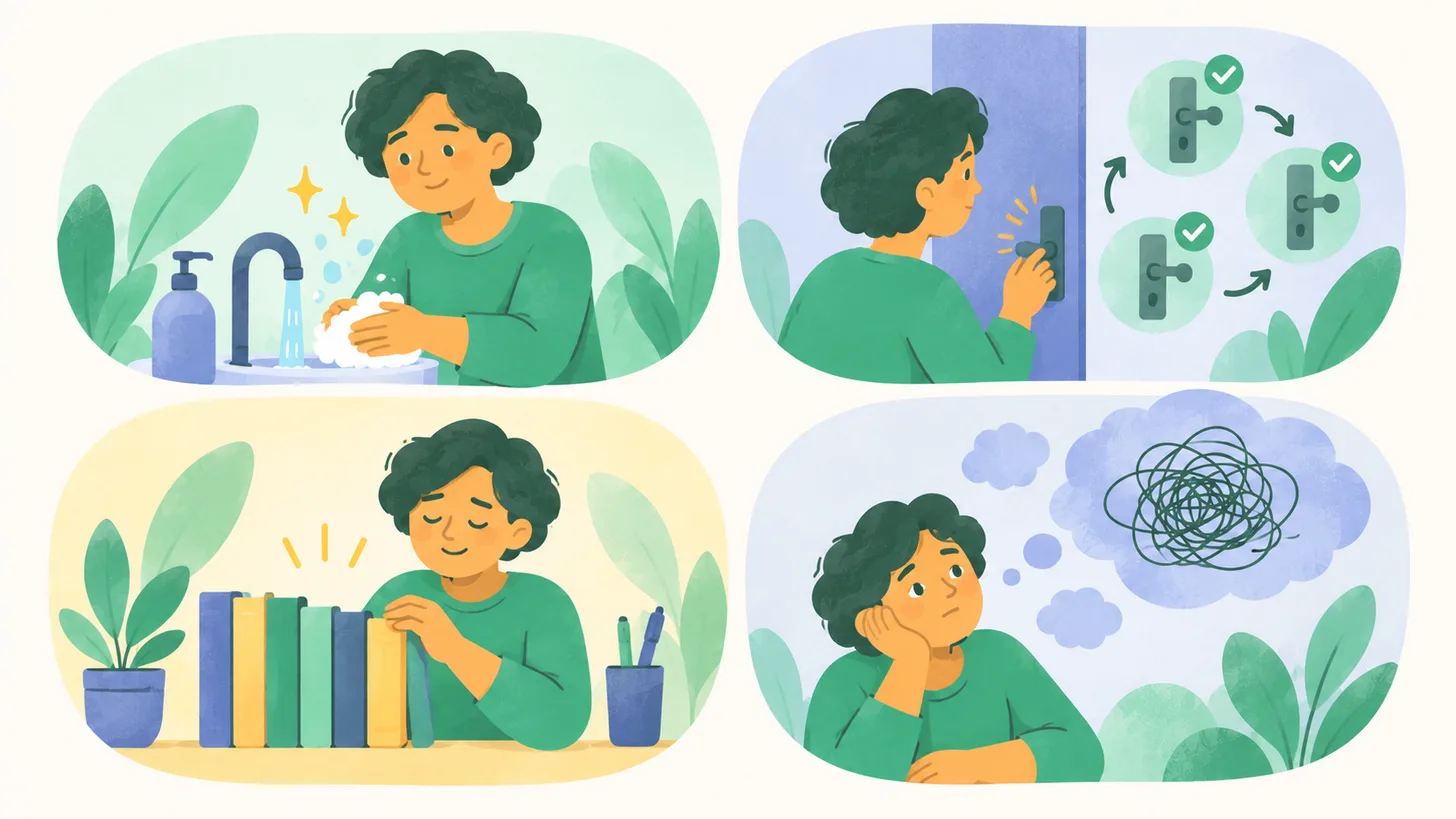
OCD does not look the same in every person. Clinicians usually describe six to seven honest subtypes, grouped by the kind of thoughts and the kind of rituals that follow them. Most people with OCD recognise more than one. The subtype matters because it decides where exposure work begins.
Contamination OCD
The intrusive thought is about germs, dirt, chemicals or illness. The ritual is washing, cleaning or avoiding touch. Doorknobs, taps, buses, hospitals and shared food can become triggers. Hands can crack from washing. The pandemic made this subtype louder for a lot of readers in India.
Checking OCD
The intrusive thought is “did I lock it, did I switch it off, did I send that message right”. The ritual is checking, re-checking, and asking someone else to check. Doors, stoves, electrical sockets and text messages are common. People often leave home late because the loop ran one more time.
Symmetry and ordering OCD
The intrusive thought is a “just right” feeling. Something is off. The ritual is adjusting, aligning or counting until it feels right. The person often cannot say why four is wrong and five is right. Only the body knows.
Harm OCD
The intrusive thought is a fear of hurting someone the person loves, or a stranger, by accident or on purpose. The ritual is avoidance, mental review and confession. Harm OCD is ego-dystonic, which is the clinical word for a thought that goes against who you are. If you are having these thoughts and they terrify you, that is the point. You are not dangerous. You have a condition.
Sexual and relationship OCD
The intrusive thought is a doubt about sexual orientation, attraction, or whether you really love your partner. The ritual is mental checking, scanning for feelings, and asking for reassurance. This subtype is often invisible from the outside and comes with heavy shame. It is still OCD, and it still responds to the same treatment.
Religious OCD and scrupulosity
The intrusive thought is moral or religious: a fear of sinning, of being impure, of a prayer not done correctly. The ritual is purification, confession or repeated worship. Scrupulosity is common in India because our daily life carries real ritual, from puja to washing before meals, and OCD can hide inside what looks like devotion. The giveaway is distress and the sense that the ritual never settles.
Pure-O
Pure-O stands for mostly mental compulsions. The rituals are inside the head: counting, mental review, silent repetition, reassurance from the self. People with Pure-O often say they do not have OCD because nothing shows. They do. The International OCD Foundation lists Pure-O as a recognised presentation. Source: IOCDF, types of OCD.
In short: OCD comes in several honest flavours, from contamination to Pure-O; the content of the thoughts changes, the loop and the treatment stay the same.
Why is harm OCD different from a risk of violence?
Harm OCD is one of the most misunderstood subtypes, and the misunderstanding costs people years of silence. The thought in harm OCD is the opposite of what the person wants. The thought is unwanted, intrusive, and terrifying to the person having it. That is why they are reading this page, not acting on it.
If you have thoughts like these, please know two things. One, you are not alone, and the shame around it keeps most people quiet for years. Two, a specialist in ERP can walk you through this safely without putting a knife in your hand or a child in the room. The treatment is specific and it works.
In short: harm OCD is an unwanted, ego-dystonic thought that goes against the person’s values; it is not psychosis, it is not a predictor of harm, and it is treatable.
Why does OCD stay hidden for years in Indian families?
OCD is both more common and more hidden in India than many of us realise. Global lifetime prevalence sits at around 1 to 3 percent, and the World Health Organization lists OCD among the leading causes of disability worldwide. The challenge in India is not whether OCD exists here. It is whether it gets named.
Three things make this worse here.
- Religious rituals mask the symptom. A reader washing before every prayer looks devout. A reader repeating a mantra until it feels right looks faithful. The symptom hides inside what the family praises.
- The family becomes part of the loop. A parent who answers the fifth “did I lock the door” is helping that night and keeping the OCD alive for the year. This is called family accommodation and it is one of the hardest things to unwind.
- Primary care is thin. Most Indian GPs are trained for a short visit and a prescription. Spotting an obsession under a compulsion needs more time than the queue allows.
If any of this reads like your life, please know you are not slow and you are not weak. You walked a long way with a false map. The next part is about getting a better one.
In short: OCD is common and treatable in India, but ritual, family support and short clinic visits can keep it hidden for years; the fix is a specific kind of therapy, named below.
How is OCD treated in India?
OCD responds to treatment. For most people, the first and best choice is a specific therapy called ERP, which stands for Exposure and Response Prevention. It was developed by Edna Foa and Michael Kozak and it is still the gold standard. In studies, around 70 to 80 percent of people who complete a full course of ERP see meaningful improvement. Source: IOCDF on ERP.
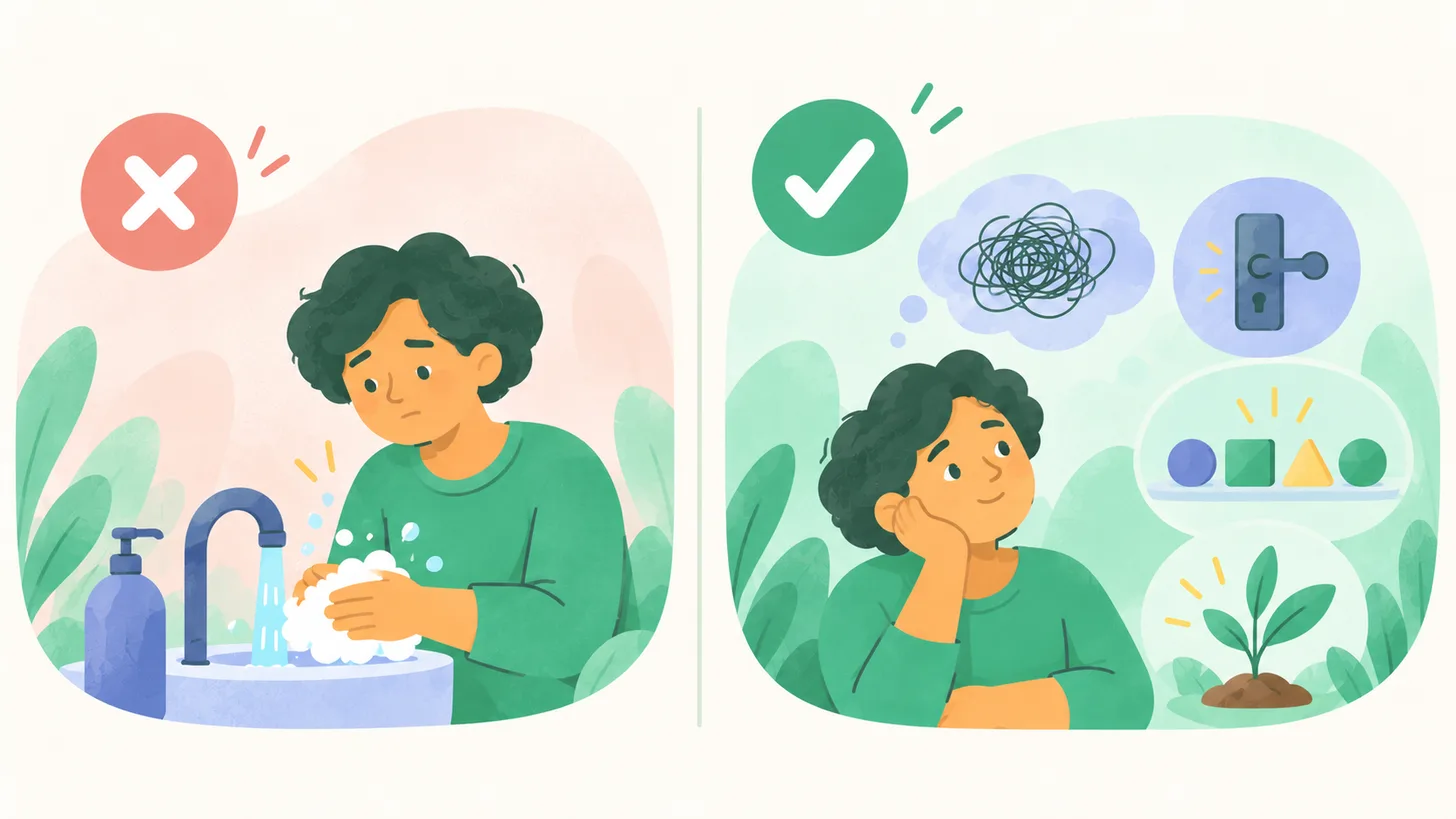
ERP works by walking the person into the thing they fear, in small steps, without the ritual. If the fear is contamination, you touch the doorknob and you do not wash. If the fear is harm, you sit with the thought and you do not confess or seek reassurance. The anxiety climbs. Then, without the ritual, it falls on its own. The brain slowly learns that the alarm is false. A full course is usually sixteen to twenty sessions. It is harder work than most talk therapy. It is also the only therapy with strong evidence for OCD.
Other therapies that help, often alongside ERP.
- ACT for OCD (Acceptance and Commitment Therapy), developed by Steven Hayes and adapted for OCD by Michael Twohig, teaches a reader to let the thought be present without arguing with it, while living the day they want to live.
- I-CBT (Inference-Based Cognitive Behavioural Therapy) works on the specific “logic” of OCD, where the person treats an unlikely thought as a real possibility. Some readers who did not respond to ERP respond to I-CBT.
- MBCT and plain CBT help for the depression and anxiety that often come with OCD, but they are not the main treatment for OCD itself.
Medication. If a psychiatrist suggests it, the usual class is SSRIs (selective serotonin reuptake inhibitors), the same class used for depression, often at higher doses and over a longer time. SSRIs for OCD can take ten to twelve weeks to show their effect, which is why many people stop too early. We do not name specific drugs in this blog because the right drug for you is a decision for a psychiatrist, not a search engine. NIMHANS clinical practice guidelines on OCD spell out the dosing in more detail.
Newer options for severe or treatment-resistant OCD, available in India at a few centres.
- TMS (Transcranial Magnetic Stimulation), approved by the US FDA for OCD, is offered at some private centres in Indian metros.
- Deep Brain Stimulation (DBS) is a last-resort surgical option for very severe, treatment-resistant OCD. NIMHANS Bengaluru and AIIMS Delhi have published on it.
In short: OCD care in India is layered. ERP is the backbone, ACT and I-CBT add alternatives, SSRIs help where needed at higher and longer doses, and TMS or DBS exist for the hardest cases.
What are the honest limits of OCD treatment?
You might be worried that treatment will somehow make the thoughts worse before it makes them better. The honest answer is yes, for the first few weeks of ERP, which asks you to sit with the discomfort you have spent years avoiding, without the ritual that usually lowers it. A good therapist expects this and will not push harder than you can hold. Reading on your own will not fix OCD on its own, and that is not a judgement; the loop needs a trained second person to break.
Medication alone is usually not enough. SSRIs lower the volume of OCD for many people, but the loop often continues underneath. Some weeks it feels like real progress; some weeks it does not. That is normal, not failure. The combination of a therapist and a doctor, used together, has the strongest evidence.
Not every therapist in India does ERP. Many well-meaning therapists trained in general CBT or in talk therapy will try to help with reassurance and insight, which can make OCD worse. If you book a session with us or anywhere else, please ask the therapist two specific questions. Do you do ERP for OCD? How many clients have you treated with it? A short, honest answer is a good sign.
A real cost. ERP can be exhausting, and some weeks feel like going backwards. If what you need right now is simply to sleep and get through the day, a session on Friday is not the fastest tool.
In short: ERP works but it is hard, medication alone is usually not enough, and not every therapist in India is trained in ERP, which is why asking two specific questions upfront matters.
When should you reach for urgent help?
OCD becomes an emergency when a person is at risk. Please read this part even if you think it does not apply. OCD and depression travel together often, with roughly 40 percent of people with OCD also having depression at some point. If the loop has worn you down to a place where any of the lines below feel true, you need help this week, not next month.
- You are having thoughts of ending your life, or feel the days are not worth it any more
- Scrupulosity has stopped you from leaving the house, bathing or sleeping
- A new parent in your home is caught in harm OCD and the thoughts about the baby are scaring them
- A family member has stopped eating, working or sleeping because the ritual takes the day
What to do, in order. Tell one person in the room. If you are not safe where you are, go to the nearest hospital emergency or call 112.
The Mental Healthcare Act, 2017 protects your right to urgent care, and no public hospital in India can refuse treatment because of a mental health condition. Attempting suicide is not a crime under this law. You are allowed to ask for help.
Button: Book a Session
She is not a clinician; the clinical sources for this guide are the DSM-5-TR, NIMHANS, the International OCD Foundation and the Mental Healthcare Act, 2017.
This post is for information only and is not a substitute for professional care. If you are struggling, please speak to a qualified mental health professional.




Share your thoughts