
What this blog includes
- The plain FOMO meaning, with the 2013 research that first named it
- Where FOMO shows up in Indian lives, from weddings to startup rounds to dating apps
- FOMO meaning in Hindi, and why the feeling has always been with us
- When FOMO is normal, and when it starts hurting sleep, money and relationships
- What actually helps, including JOMO, digital boundaries and a small gratitude step
You put your phone down after thirty minutes of scrolling. Your friend posted from a trip. Someone you went to college with is launching a company. Another friend is engaged. You feel strangely tired. You feel like you are behind in a race nobody told you had started.
That feeling has a name. It is more common than you think, and the research on it is honest. GoodLives is trusted by 500K+ people, and the fear of missing out comes up often, usually sitting under anxiety or low mood. This piece sits in our psychology terms hub and connects to our anxiety guide for India.
What does FOMO actually mean?
In plain words, FOMO is the worry that others are having rewarding experiences you are missing out on, and the pull to stay connected so you do not miss any more.
Psychologist Andrew Przybylski and his team gave FOMO its first academic definition in a 2013 paper in Computers in Human Behavior. They described it as “a pervasive apprehension that others might be having rewarding experiences from which one is absent”. That line still frames how researchers study FOMO today.
Three forces sit under it.
- Social comparison. We measure our lives against the lives we can see, and we can see a lot now.
- Loss aversion. A missed experience feels bigger than an experience we had and forgot. The pain of missing out is sharper than the pleasure of showing up.
- A deep need to belong. Humans grew up in small groups where being left out was unsafe. The brain still reacts to a group chat you were not added to the way it would once have reacted to a village moving on without you.
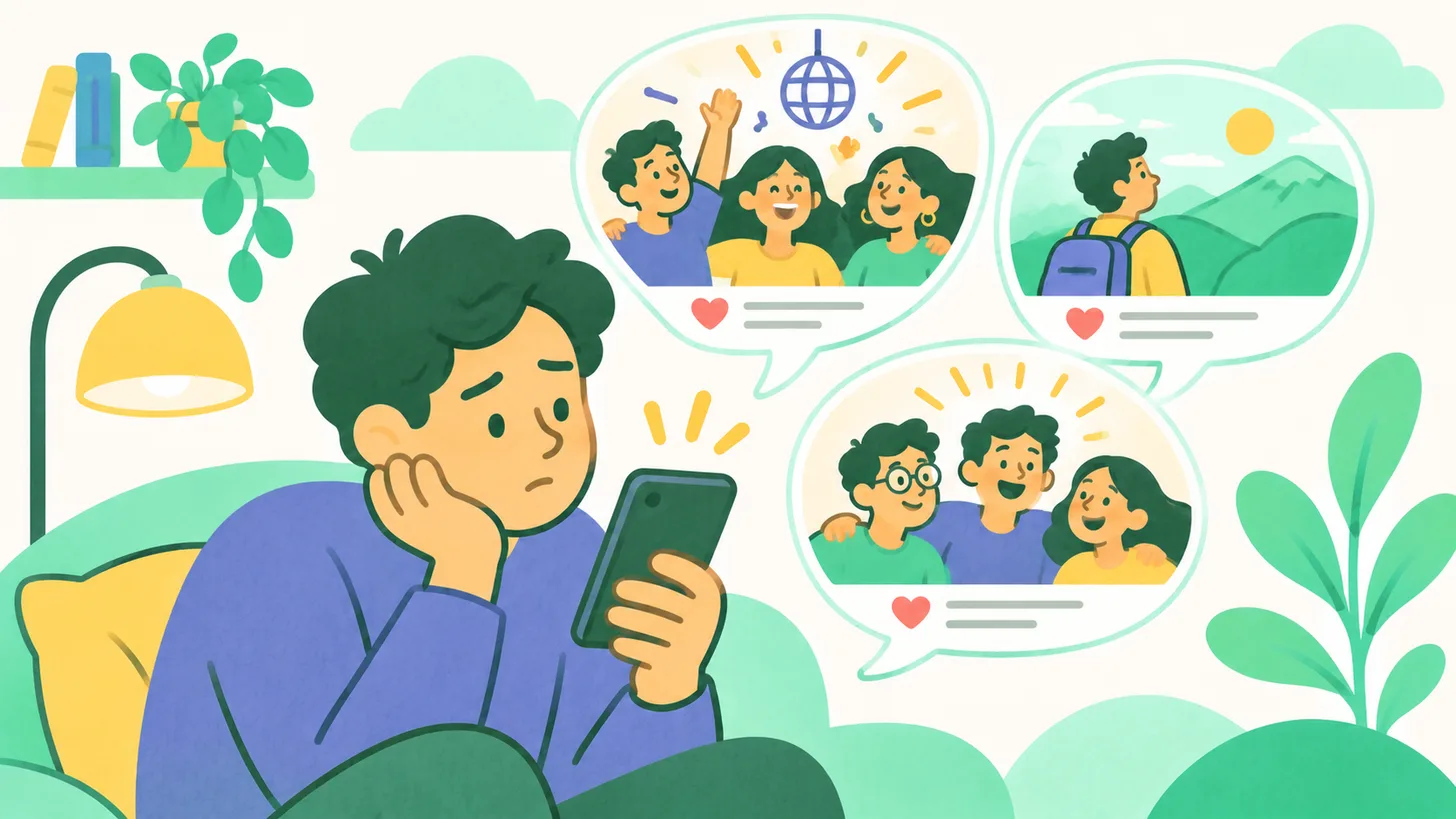
In short: FOMO is not vanity. It is a social-wiring reflex, named and measured only in the last decade.
Why FOMO feels so loud in 2026
The feeling is not new. The volume is.
Social media gives you a highlight reel of hundreds of people at once, edited to look effortless. Smartphones mean the feed never closes. Advertisers have learned to sell with FOMO (“only 2 left”, “72 people are looking at this”). Group chats keep the social hum running past midnight.
The brain was built for a village of 150. It is now trying to keep up with a village of 15,000, half of them posting from somewhere nicer than your sofa. That mismatch is where FOMO lives.
If what you need right now is a lighter feed and an early night, that is enough. Not every bout of FOMO needs therapy. The India National Mental Health Survey by NIMHANS flagged how everyday stress patterns, poorly addressed, can grow into anxiety and depression over time, and that is the honest reason to notice this one early.
In short: The feeling is ancient. The tools pointing it at you are new.
Where FOMO shows up: six contexts most of us know
FOMO rarely stays in one place. It leaks into money, work and love. These are the forms it most often takes.
- Social-media FOMO. Watching a friend’s trip, a wedding, a milestone, and feeling smaller for it. The commonest kind, and the easiest to underestimate.
- Career FOMO. A junior from college gets a promotion or founds a startup. You start wondering if the job that felt right last month is still the right one.
- Relationship FOMO. You see couples online who look happy. You open a dating app and keep swiping, half-believing a better match sits two profiles away.
- Investment and crypto FOMO. The sharpest and most expensive. Buying at the peak because everyone else seems to be, selling at the bottom because they all seem to.
- Travel FOMO. Mostly driven by Instagram. The pull to book a trip you cannot afford because your feed says you should.
- Learning FOMO. Should I do that course, that MBA, that certification? The feeling that one unopened tab holds the thing that would change everything.
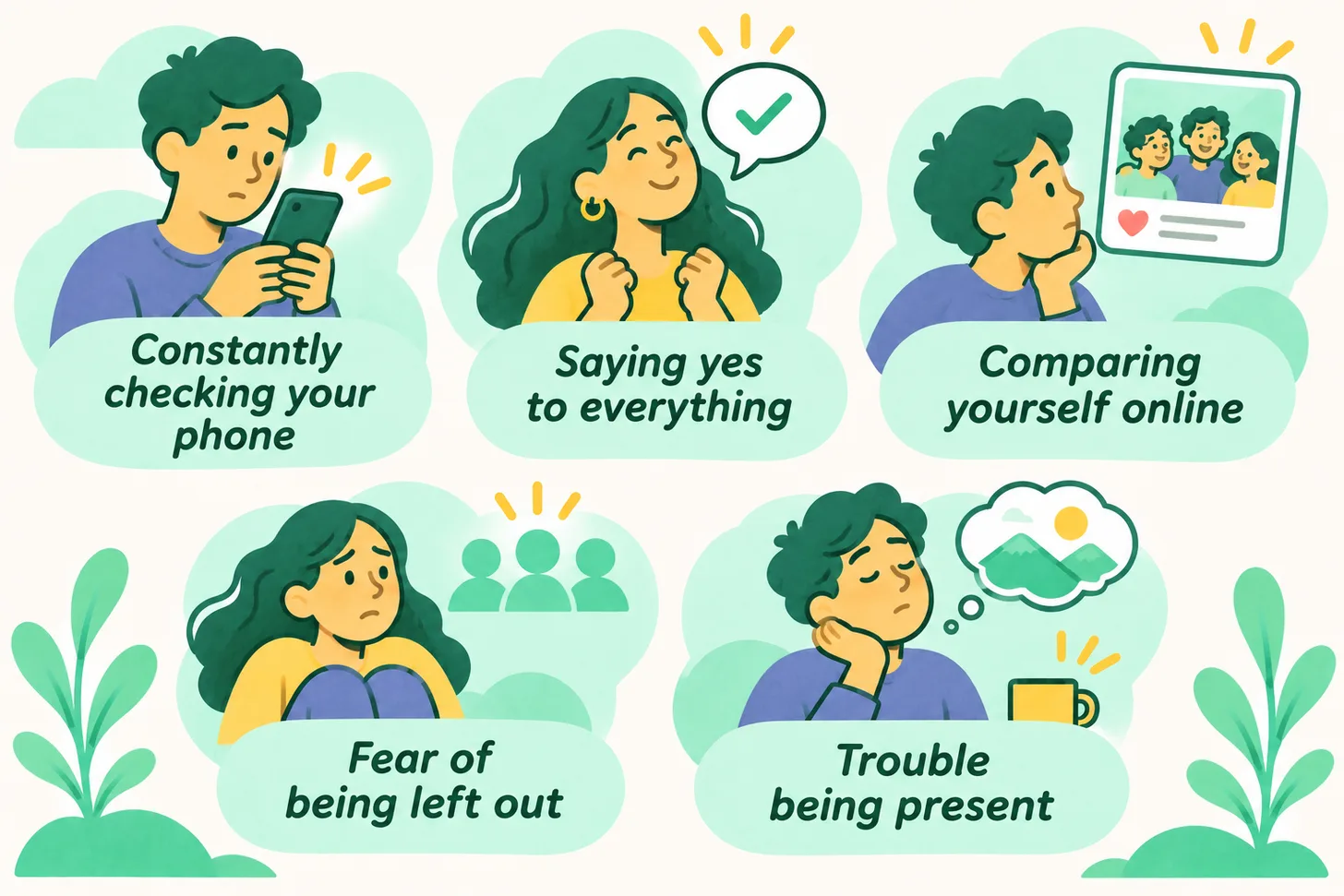
In short: FOMO is one feeling wearing many outfits. Naming the context is the first step to answering it.
FOMO in India: weddings, ranks and leaving the country
Indian FOMO has its own flavours. Noticing them helps.
- Wedding and engagement FOMO. Shaadi season on Instagram can be heavy. Watching cousins and school friends get married while you are still figuring your life out is a real strain.
- Startup and funding FOMO. A friend raises a seed round. Another launches a product. You read it on LinkedIn at midnight and your own good job starts feeling slow.
- NRI and abroad FOMO. Schoolmates posting from the US, UK, Canada, Dubai or Germany. The feeling that staying in India is a quieter life than the one you were meant to live.
- Rank FOMO. CA, JEE, UPSC, CAT. The scoreboard is public, the comparisons are family-wide, and the feeling of being behind can last for years.
- IIT and IIM alumni FOMO. A WhatsApp group where every other message is an exit, a round, a promotion, a Harvard admit.
- Family-function FOMO. Not being there for a cousin’s wedding, a Diwali gathering, a hospital visit. The guilt side of FOMO.
If any of those lists made your chest tighten a little, you are not weak. You are reading a feed that was built to do exactly that.
In short: FOMO in India wears Indian clothes. The social fabric is tighter here, which can make the pull harder, not easier.
FOMO meaning in Hindi: *chhoot jaane ka darr*
Hindi does not have one neat word for FOMO, but it has the feeling. The closest phrase is chhoot jaane ka darr (the fear of being left out). You can also hear it in log kya kahenge (what will people say) and piche reh gaye (we got left behind). These are the oldest cousins of FOMO. The feed just gave them a new address.
In short: FOMO is new. The feeling it points at is not.
When FOMO is normal, and when it is not
Everyone feels FOMO sometimes. That is not a problem. The question is whether it has started running the day.
Normal FOMO looks like.
- A quick dip after seeing a post, that lifts within a few minutes.
- A small nudge to make plans, text a friend, book the trip.
- A twinge that fades once your phone is in another room.
FOMO that is asking for attention looks like.
- Checking your phone every ten to twenty minutes, even when nothing is happening.
- Scrolling past the point where you still enjoy it, often into the night.
- Spending money or saying yes to things to keep up, not because you want them.
- Sleep breaking because of the feed. Mornings starting with a scroll before coffee.
- Feeling flat or anxious for hours after social media, with no clear reason.
- A low, steady “everyone else is doing better” voice that will not leave.
In short: Occasional FOMO is social wiring. Constant FOMO is a signal from the body that something needs looking at.
What actually helps (and why “just delete Instagram” is not enough)
Deleting apps for a weekend helps a little. The pull comes back the week after. The research points at a few things that work better, together.
JOMO: the joy of missing out. The counter-move to FOMO is not stoicism. It is a quiet reframe. The evening in with a book, the Saturday that nobody posted, the small life well lived. JOMO works because it treats missing out as a choice, not a loss.
Digital boundaries that fit a real week. The ones most people manage.
- One hour a day of scrolling, not three. Set a timer, not an intention.
- Phone out of the bedroom at night. A cheap alarm clock does the rest.
- Grayscale screen for a week. The feed loses most of its pull.
- Notifications off for Instagram, LinkedIn and WhatsApp groups you do not need.
- One weekly “no feed” morning. Walk, cook, read.
A comparison audit. Not a cleanse, an audit. Spend ten minutes noticing which accounts leave you flatter than before you opened the app. Mute or unfollow those. Keep the ones that leave you lighter.
Gratitude, done small. Writing three small, true good things from your day shifts attention from what is missing to what landed. Psychologist Robert Emmons, who has studied gratitude for decades at UC Davis, has found this small practice is linked to better mood and wellbeing over time. His work is summarised by Greater Good at Berkeley. It is not a cure. It is a cheap, honest counter to FOMO’s “nothing I have is enough” story.
If you want, take one minute with this before you read on.
Even on hard days, a few small things hold up.
Let's find three. It takes about a minute, and it never leaves your device.
Three good things
Take them one at a time. Small really counts here. If a prompt doesn't fit, swap it for another.
Your good list for today
Noticing good things doesn't cancel the hard parts. It just gives them some company.
Come back tomorrow and add three more.
This stays on your device. Nothing is saved or sent.
Values clarity. Knowing what you actually want in the next year makes other people’s choices less threatening. If startups are not your path, a friend’s funding round stops feeling like your failure.
Mindfulness, used as a tool, not a lifestyle. Dr. Judson Brewer at Brown University has studied how noticing an urge without acting on it slowly weakens the loop that drives it. He writes about this as “unwinding anxiety”. The move is small. Feel the FOMO, name it, put the phone down for one minute, then decide.
Offline social contact. Digital social is not the same food. One slow coffee with a friend does more for FOMO than a hundred swipes through theirs.
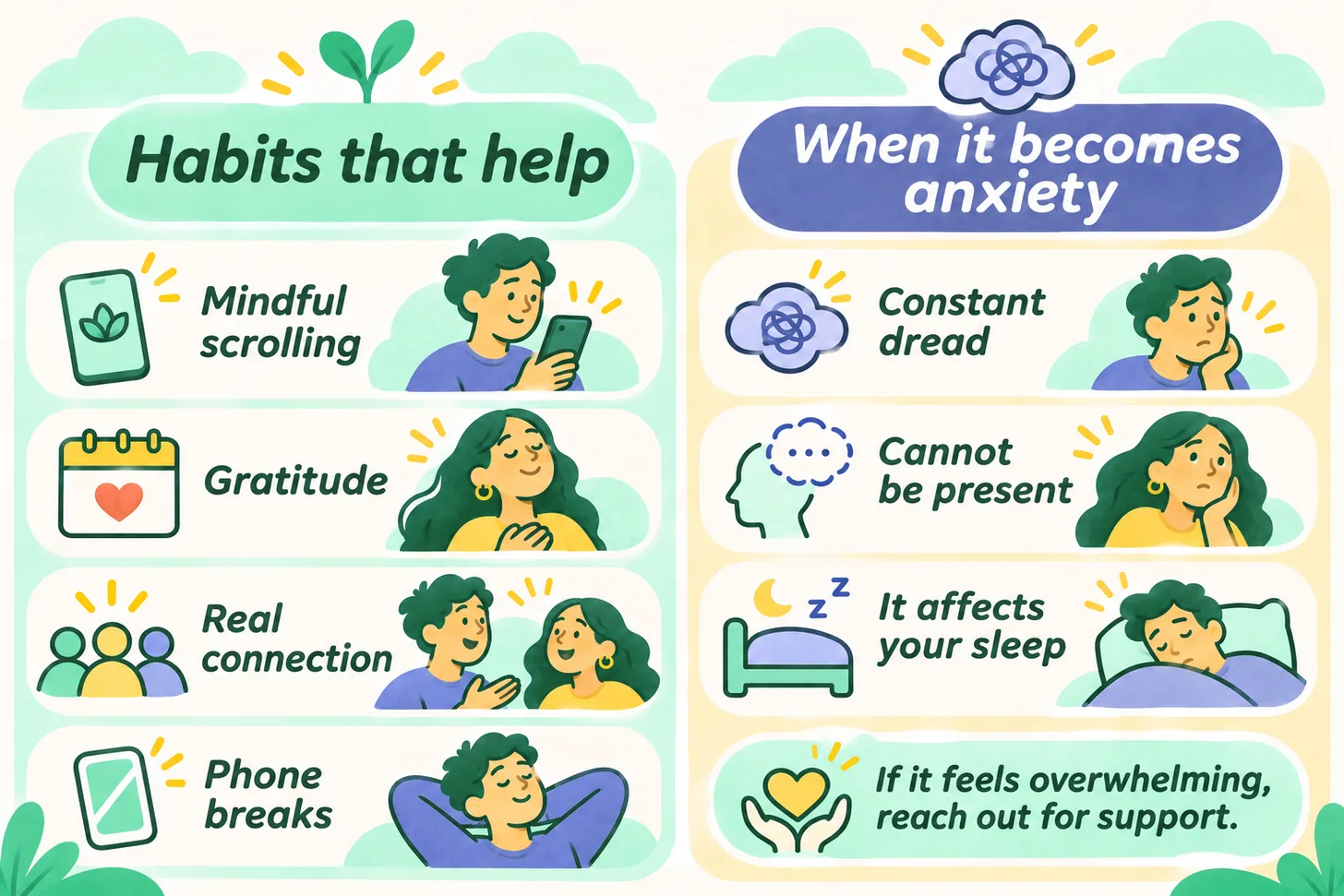
In short: FOMO lifts when attention moves from the feed to your own life, in small, repeatable ways.
When FOMO is a sign of something bigger
Most FOMO is not an emergency. Some FOMO is a signal that something underneath needs care.
Treat the following as reasons to talk to a therapist.
- Scrolling for three or more hours a day on most days, with no joy in it.
- Sleep breaking because of the phone, for weeks.
- Panic feelings, racing heart, dread when you open social apps.
- Spending beyond your means to keep up with others.
- Thoughts of “I am falling behind in life” that will not quiet, or thoughts of self-harm.
- A low mood that lasts most of the day, most days, for two weeks or more.
In the research, high FOMO scores track with higher anxiety, lower mood and lower life satisfaction. The honest reading is that FOMO is often a cover feeling. Underneath it there is sometimes an anxiety pattern, a low mood or an older story about not being enough.
A therapist helps with the underneath. CBT works on the “everyone is doing better” thoughts. Mindfulness-based cognitive therapy works on the urge-and-scroll loop. Behavioural activation gets you back into your own week.
In short: FOMO is natural. Constant FOMO is a signal. Treat the signal, not the Instagram feed.
Closing
FOMO is not weakness. It is a very old feeling, meeting a very new feed, and losing some of the time. The move is not to delete every app. The move is to notice when the feeling is running your evening, and to come back to the small life you actually have.
Tonight, do one small thing. Put the phone in another room for one hour. Write three honest good things from the day. Message one person a real sentence, not an emoji.
When you are ready, book a 50-minute session with a verified psychologist on GoodLives. English, Hindi and more Indian languages. Start when it feels right.
This post is for information only and is not a substitute for professional care.
—


Share your thoughts