
What this blog includes
- The real sapiosexual definition and where the word came from
- What the 2018 research actually found
- What sapiosexual attraction looks like day to day
- The honest critique: ableism, elitism, and the India context
- When “sapio” is a cover for avoidance
You have probably met the feeling before you met the word. Someone makes a thought you had not had, and something shifts. Later you say, “I don’t know, something about the way they think.” That is what people point at when they say sapiosexual.
GoodLives therapists sit with questions like this every week, and we are trusted by 500K+ people in India. The language of attraction is a soft place we meet ourselves. It is worth getting right, especially when you are also thinking about healthy relationships and how yours work.
What does sapiosexual mean?
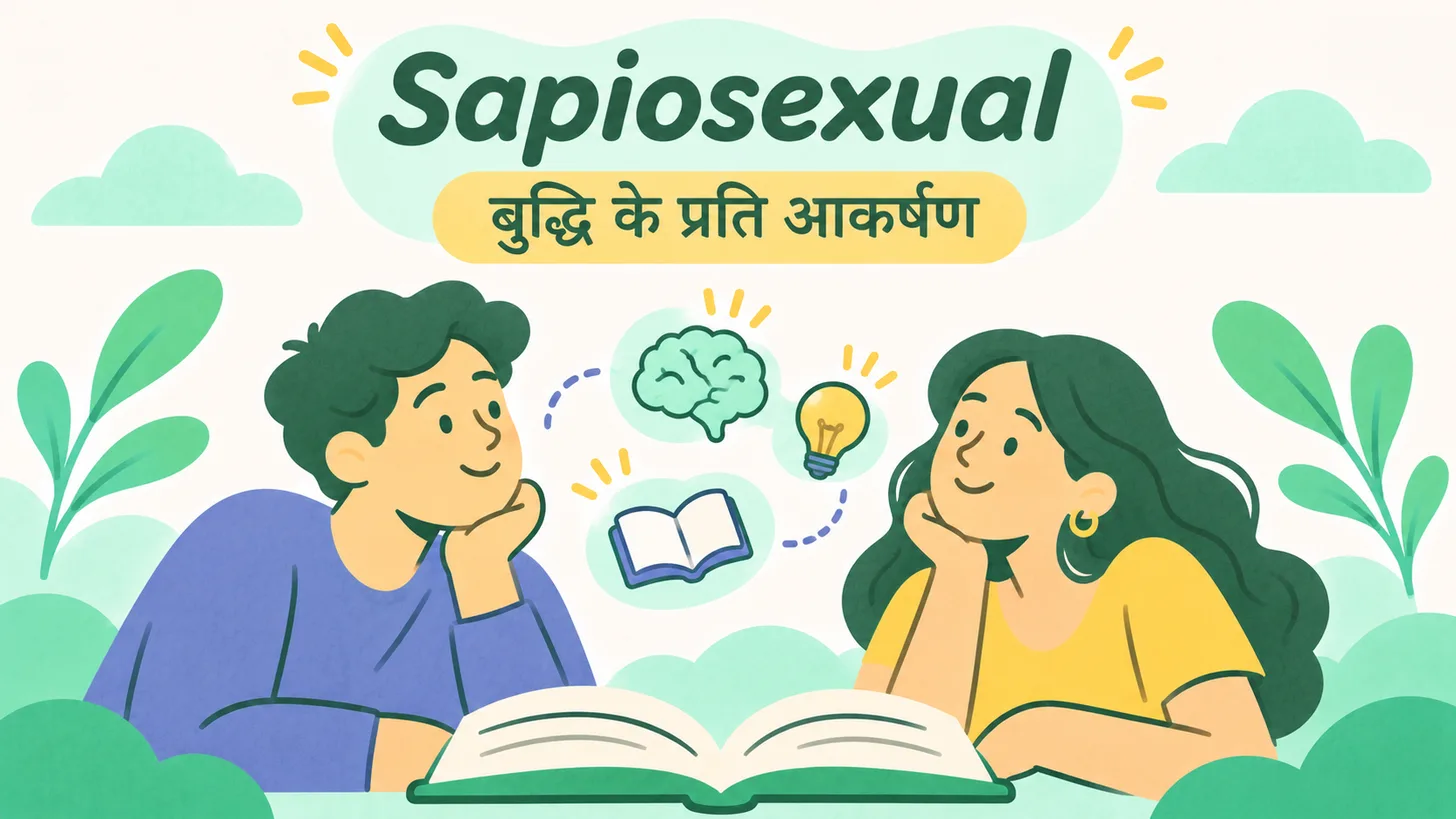
Sapiosexual means a person mainly drawn to intelligence. Qualities like curiosity, wit and depth of thought pull them first, before looks. The word comes from the Latin sapiens, meaning wise or thinking.
The term was coined in 1998 by Darren Stalder (also known on LiveJournal as “wolfieboy”) for his own attraction pattern. It entered dictionaries around 2004. It became mainstream in 2014 when OkCupid added it as a profile option, per Merriam-Webster’s entry on sapiosexual.
For many people, this is just the honest word for how attraction already works. The slow burn. The long chat. The pull that shows up once someone shows how they think.
In short: sapiosexual is a word for attraction that starts in the mind. It names a real pattern, and the word is barely two decades old.
Is sapiosexual a clinical orientation?
No. Sapiosexual is not listed in any clinical framework. It is not in the diagnostic manuals psychologists use, it is not part of the Kinsey scale, and the American Psychological Association does not treat it as a recognised orientation.
What it is: a self-named attraction pattern. People use it the way they might say “I am into musicians”. It sits alongside any standard orientation. A person can be sapiosexual and straight, bi, pan, gay, or on the asexual spectrum.
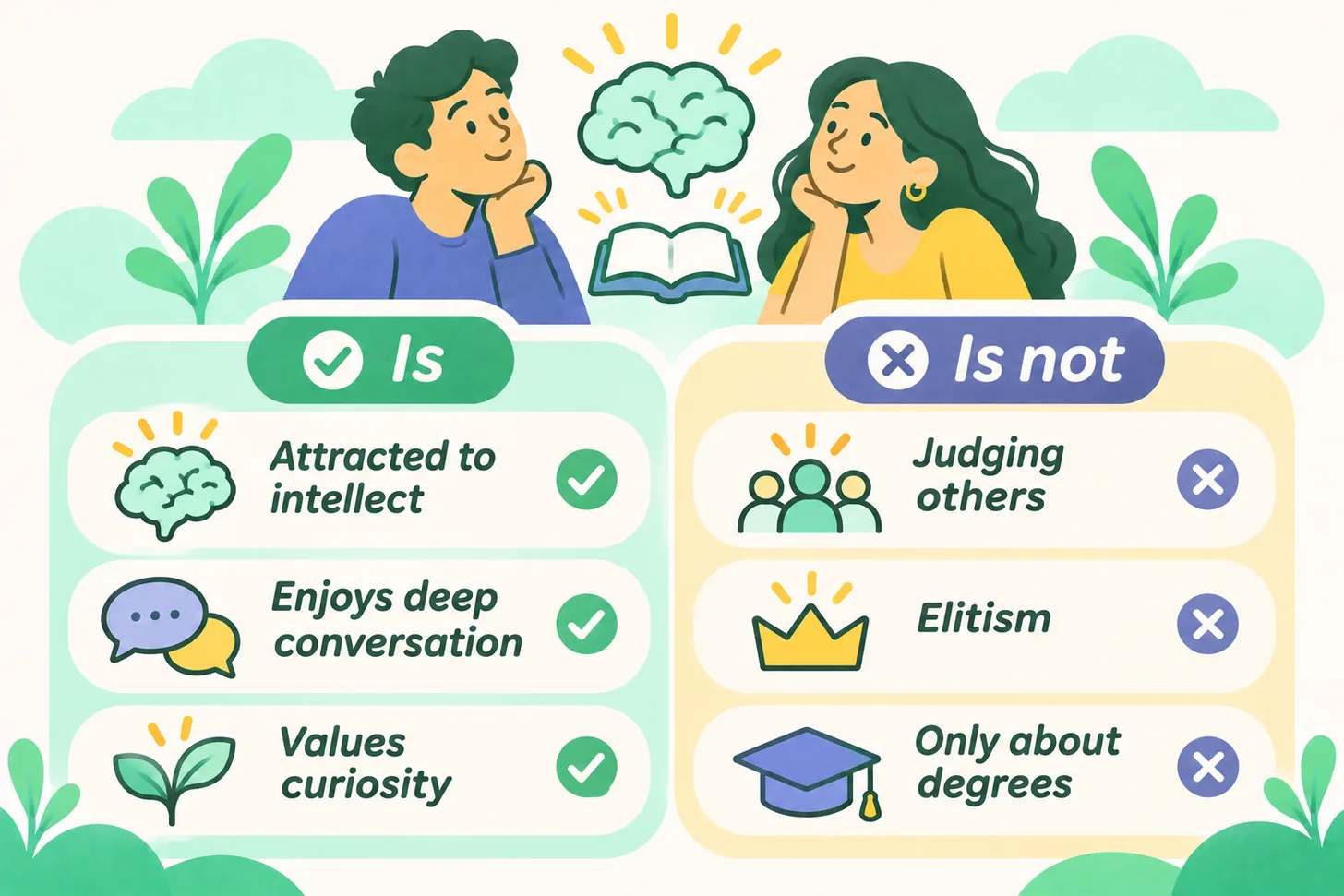
Sapiosexual also overlaps with demisexuality, where attraction forms only after an emotional connection. The two are not the same. Sapiosexual turns on the mind. Demisexual turns on the bond.
In short: sapiosexual is a preference the community has named, not a clinical category. Calling it an “orientation” is popular, but the stricter word is pattern.
What does sapiosexual attraction look like day to day?
It looks like the chat being the thing. On a first date, the pull is less about the shirt and more about the sentence the person just finished. The ways it tends to show up:
- Drawn to how someone thinks before how they look
- Deep conversation works as the main form of flirting
- Dry banter is the romantic currency, even on a Tuesday
- Mental qualities get valued: curiosity, humour, articulation
- Physical attraction often turns up after mental attraction is set
For many sapiosexual people, the pull feels like a slow build. Someone goes from “nice to meet you” to “I need to see you again” over three chats, not three glances.
Example: Picture Rohan on a second date. The first was fine, the person was good-looking, the chat was polite. On date two, they argued cheerfully about a book neither had finished. Walking back, he realised he was very attracted to someone he had felt neutral about on Friday.
In short: sapiosexual attraction is a shape, not a volume dial. The thing that pulls is the mind at work, and the body often follows later.
What did the 2018 research say about sapiosexuality?
Honestly, less than the word suggests. The main paper is Gignac, Darbyshire and Ooi, “Some people are attracted sexually to intelligence,” in the journal Intelligence in 2018. They surveyed 383 adults on partner traits and attraction to different IQ levels.
What they found:
- Attraction to intelligence peaked at a partner IQ of about 120, the 90th percentile
- Ratings dropped a little between IQ 120 and 135, the 99th percentile
- A respondent’s own IQ did not predict how sapiosexual they were
- Women were slightly more likely than men to report the pattern
The paper backs a “threshold” idea rather than a straight line. Most people find intelligence attractive up to a point. If you wanted a study that proved sapiosexuals are a clear group, this one is not it.
In short: real research exists, and it is more careful than the dating-app version of the word. For most people, “very attractive mind” tops out short of genius.
What is the honest critique of sapiosexuality?
The word has a reputation problem, and some of it is earned. Three critiques come up again and again:
- The ableism critique. When intelligence is the main thing that counts, people with cognitive disabilities and less schooling can get written off by design.
- The elitism critique. “Sapio” on a dating app often reads as a status filter, which is preference, not orientation.
- The measurement critique. We often read articulation and English fluency as “smart”, and miss other kinds of intelligence.
In India, the layer underneath is sharper. English-medium schooling, access to coaching, and the degree you could or could not afford all map onto what reads as “intelligent” on a date. Caste and class shape who learned to argue in English at sixteen.
A preference that filters for “well-read” can quietly filter for privilege. None of this means sapiosexual preferences are bad. It means it is worth asking what you really mean by “intelligence”. Specific qualities (curious, funny, open to changing their mind) are more useful than the general word.
In short: sapiosexuality is a real preference pattern for many people. It can also be ableism or elitism in dress-up. Both can be true at once.
When is “sapio” a cover for avoidance?
Sometimes. For some people, “I am only drawn to intelligence” is a polished way of saying “I rarely let myself be drawn to anyone”. If every real person falls short of the mental partner you are picturing, the problem is not the dating pool. It is the picture.
Signs to watch for, gently:
- You feel unsafe around pure physical attraction
- You use “they are not smart enough” to leave early, often
- You put the bar high enough that no real person clears it
- The connection stops working when the other person wants to be close in a non-intellectual way
That pattern can be an avoidant attachment style wearing an orientation hat. It is very common and it is not a character flaw. It is often what we learned in a family where ideas felt safer than feelings.
In short: real sapiosexual attraction opens you up. If your version keeps shutting you down, it is worth looking at with a therapist in India whose job is to help.
What tends to work if you identify as sapiosexual?
Four small moves make a real difference.
- Say what you mean. “Curious, open to new ideas, dry humour” tells a date more than “I like smart people”
- Find spaces where the trigger shows up: book clubs, debate societies, museum walks
- Stay open to attraction from a different angle. The slow burn is a shape, not a rule
- Check your assumptions. The person you dismissed as not sharp enough: were they not sharp, or did they just not perform it the way you were trained to spot?
In short: the aim is not to defend “sapiosexual” like a label. The aim is to meet real people without the filter doing all your dating for you.
FAQ
Is sapiosexual a real sexual orientation?
Can you be sapiosexual and straight, gay or bisexual?
What is the difference between sapiosexual and demisexual?
Is being sapiosexual elitist or ableist?
Where did the word sapiosexual come from?
Should I put “sapiosexual” on my dating profile?
Does being sapiosexual mean I need therapy?
This post is for information only and is not a substitute for professional care.


Share your thoughts