
What this blog includes
- The common family conflicts in Indian homes, named plainly
- Why Indian family conflict feels heavier than it looks on the surface
- The red flags that mean this is harm, not conflict, and who to call
- What therapists actually do with family problems, and the frameworks they use
- When family therapy helps, when individual therapy fits better
You know the feeling. The family WhatsApp group pings at 11 pm and your shoulders go up. A relative asks when you are getting married, having a baby, buying a house, and the dinner goes quiet. You walk away from the same fight you walked away from last year, with the same knot in your stomach.
Family problems and conflict in India are rarely only about the thing you are fighting about. They sit on top of culture, money, hierarchy and izzat (honour, what people will say).
GoodLives is India’s online therapy platform, trusted by 500K+ people, and family dynamics are one of the most common reasons people book a first session. You are in a very ordinary spot. There is help, and some of it does not need you to drag the whole family into it.
Why does family conflict in India feel so much heavier than it looks?
Because the fight is not only with your parents or in-laws. It is with a script.
A collective-culture script that says the family is the unit, not the individual, and that keeping the peace is more valuable than naming the problem. The script is quiet most days. On the big days (a wedding, a career change, a boundary you draw) it gets loud, and the people around you repeat the line it hands them.
That script carries three loads at once. There is hierarchy of respect, where disagreeing with an elder can feel like disloyalty.
There is izzat, the running tally of what the neighbours and extended family will say. And there is money, often shared across generations, often spoken about only when something breaks. One conversation can touch all three.
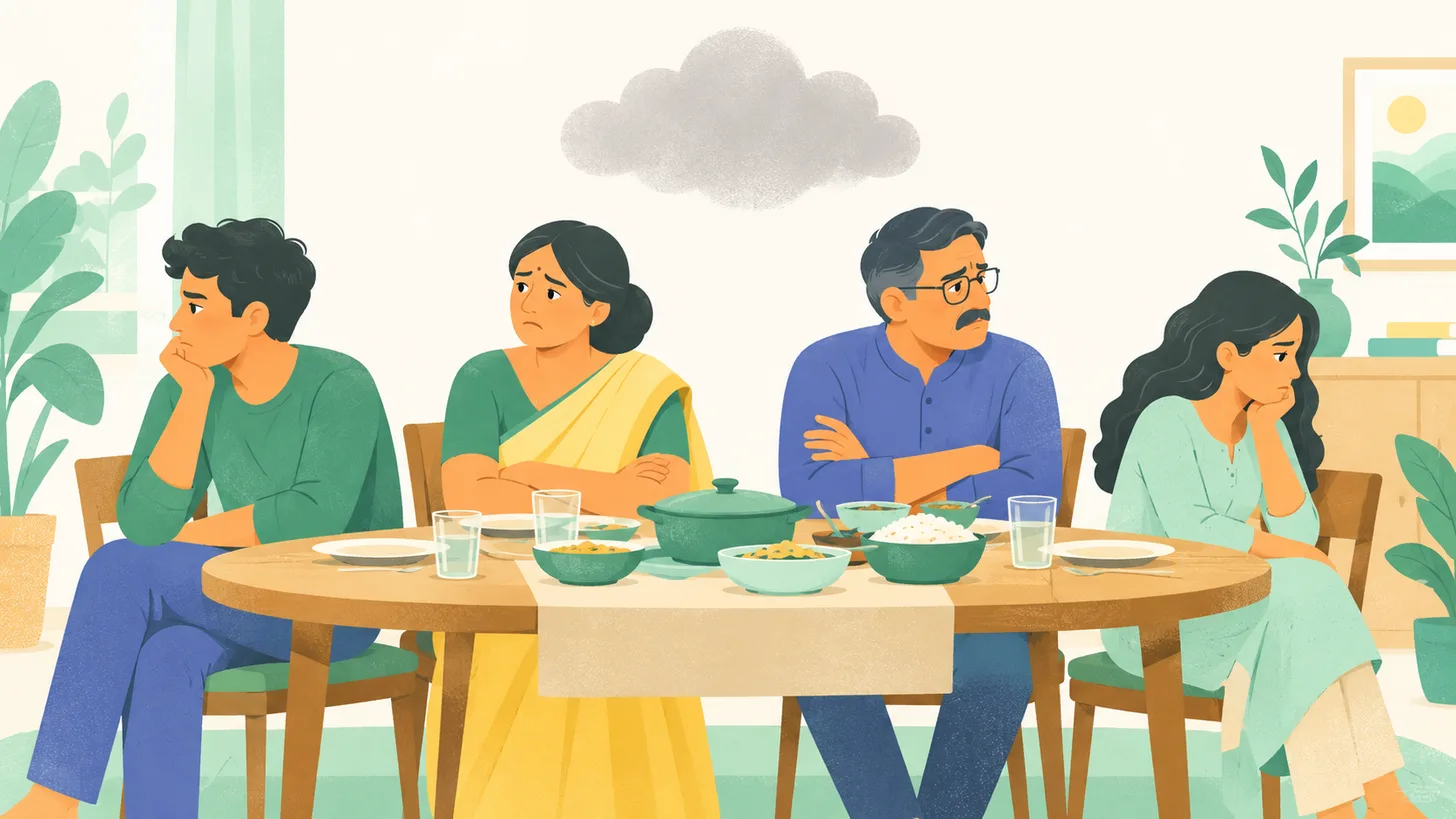
Western family-therapy writing often starts from the individual and works outward. In South Asian families, the family is the starting point and the individual is the second question. Both can be true at once.
You can love your family and need distance from a specific pattern inside it. Culture does not usually give us the words for that. Therapy, done well, does.
In short: Family conflict in India sits on culture, hierarchy and shared money. It is loud at the big moments and quiet the rest of the year. Naming the layers is the first thing that helps.
What are the common family conflicts in Indian homes?
Most of what we see in therapy intake calls at GoodLives sits inside the same handful of patterns. Yours is probably in here. If it is not named, it still counts. The point is to stop treating your pattern as a personal failing and start seeing it as a known shape.
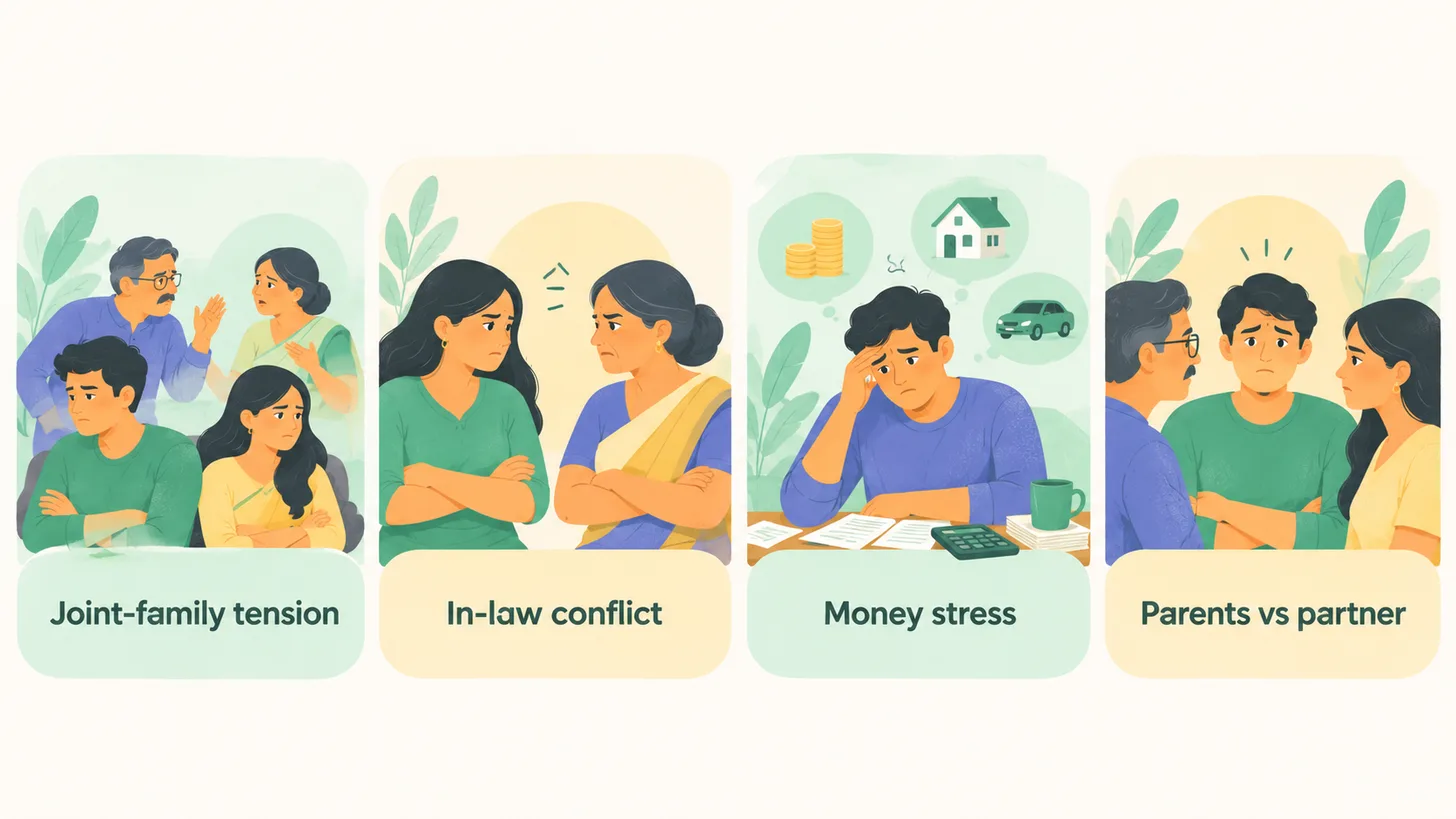
Joint-family vs nuclear-family roles. Who provides for whom, when, and for how long. One sibling living with ageing parents while the others send money or do not. The oldest son being asked to carry what used to be shared.
In-law dynamics. The classic mother-in-law and daughter-in-law pattern is a cliché because it keeps happening. The underlying issue is usually power: whose home is this, whose rules apply, who speaks for the son or husband caught in the middle.
Parent-adult-child boundaries. When your parents ask about your career, marriage, money and religion the way they did when you were sixteen. The ask is often love. The impact is control.
Sibling rivalry. Especially around parental attention, property and inheritance. Fights that were put down in childhood become legal disputes in your thirties.
Caregiver burden. One sibling (often the eldest daughter, often unpaid) carrying ageing or ill parents while the others visit on holidays. This is a mental-health issue, not a logistics issue.
Money. Joint accounts, business loans, property paperwork, a family member who borrowed and did not return. Money is where unspoken resentment finally gets a number.
Child-rearing differences. Grandparents and parents disagreeing on food, screens, discipline, school, religion. Nobody has a bad intention. Everyone is parenting a child who gets caught in the middle.
Interfaith, inter-caste, LGBTQIA+ coming out, divorce. Family responses to a choice that steps outside the script. The grief of being misunderstood by the people who are supposed to know you first.
Mental-health disclosure. Telling your parents you are seeing a therapist, taking medication, or that you are struggling. For many Indian readers, the family is the first wall between them and help.
In short: You are not inventing the pattern. These are the common conflicts in Indian families, and each one has specific tools that help.
What makes Indian family conflict distinct from what you read online?
Four things, and they matter when you look for help. Most self-help on the open web is written for a Western nuclear family. Lifting those scripts straight into an Indian home misses the point.
Family comes first by default. In collective-culture research (Jagdish Dalal, Celia Falicov), the individual is embedded inside the family, not separate from it. Advice that assumes you can simply cut off a parent lands wrong. You can change how much contact, which rooms you fight in, and what you argue about today.
Hierarchy of respect is real. Pushing back on an elder is culturally forbidden in many homes. Therapy does not ask you to abandon that respect. It asks you to find a way to disagree inside it. The DEAR MAN script from Dialectical Behaviour Therapy (a common skill set in anxiety and relationships work) is a useful place to start.
Marriage is a family union. For many Indian couples, the marriage is not only two people. It is two families. Couples therapy often has to make space for in-laws, siblings and parents in the room, not only the two partners. A therapist trained in South Asian family work knows this.
Caste and community pressure. On interfaith, inter-caste, LGBTQIA+ and divorce choices, the pressure is not only from the four walls of your home. It is from relatives, neighbours and the WhatsApp forwards your family reads. Your therapist should not be surprised by that, or quietly judging it.
In short: The map matters. A therapist who understands the South Asian family can tell you what to try first. A therapist who does not may push you toward solutions that break the thing you are trying to protect.
When has family conflict crossed into harm? The red flags you must not ignore
Some things stop being conflict and start being harm. These are not grey areas. If you are reading this and any of the lines below are happening in your home, please call one of the helplines at the top of this piece before you keep reading.
If you are a woman in India in any of these situations, the 181 Women Helpline is 24/7. The National Commission for Women’s complaint cell takes online complaints. iCall at 9152987821 is a free counselling line (Mon to Sat, 8 am to 8 pm) if you want to talk it through before you decide.
None of these calls obliges you to file a complaint. You can speak, be believed, and then decide what you want to do.
Honesty move: If someone in your home is being hurt or made afraid tonight, a therapy session on Friday is not the fastest tool. Please call the number that matches what is happening and then come back to this page tomorrow.
In short: Harm is different from conflict. It needs legal and crisis support, not only therapy. Help is free, 24/7, and does not need your family’s permission.
What actually helps with family problems and conflict?
Therapists have been working with families for seventy years. The usable ideas are fewer than the open web suggests. Here are the ones that come up again and again, in plain language.
Family systems (Murray Bowen). The idea that a family is a system, not a set of individuals. When one person changes, the system changes. Bowen’s work gave therapy the concept of differentiation: being connected to your family and still being your own person. Not either, both.
Structural family therapy (Salvador Minuchin). Looks at the invisible rules in the family (who speaks for whom, who is allowed to decide what). Rebuilds those rules so the right people are in the right roles. Useful where one parent speaks for a grown adult child, or where a child has been pushed into a parent-like role.
Experiential family therapy (Virginia Satir). Focuses on feelings, communication patterns and self-worth inside the family. Useful when the words in the house have gone flat and nobody says what they mean.
Multicultural family therapy (Celia Falicov). The map that comes closest to Indian families, because it starts from culture, migration and extended-family networks instead of the Western nuclear ideal.
Non-violent communication (Marshall Rosenberg). A four-step script: observation, feeling, need, request. Useful for the fight that happens every Diwali.
DEAR MAN (DBT). Describe, express, assert, reinforce, mindful, appear confident, negotiate. A seven-step script that fits a hard conversation with a parent or sibling. The research base is strongest for people with intense emotions and relationship distress.
Harriet Lerner’s work on anger (The Dance of Anger). For women in particular, a careful look at how we are taught to swallow anger and what happens to our bodies when we do.
In practice, a GoodLives therapist will usually combine two or three of these, not pick one from a textbook. The frameworks are the vocabulary. The work is the week between sessions.
In short: The useful ideas are specific and well-tested. A good therapist uses them as a starting point, not a script, and keeps checking what fits your family.
What can you do this week, before anyone else is involved?
Family conflict can take years to shift. One week does not fix it. One week can lower your reactivity, so the next conversation is a little better than the last one. Try one of these.
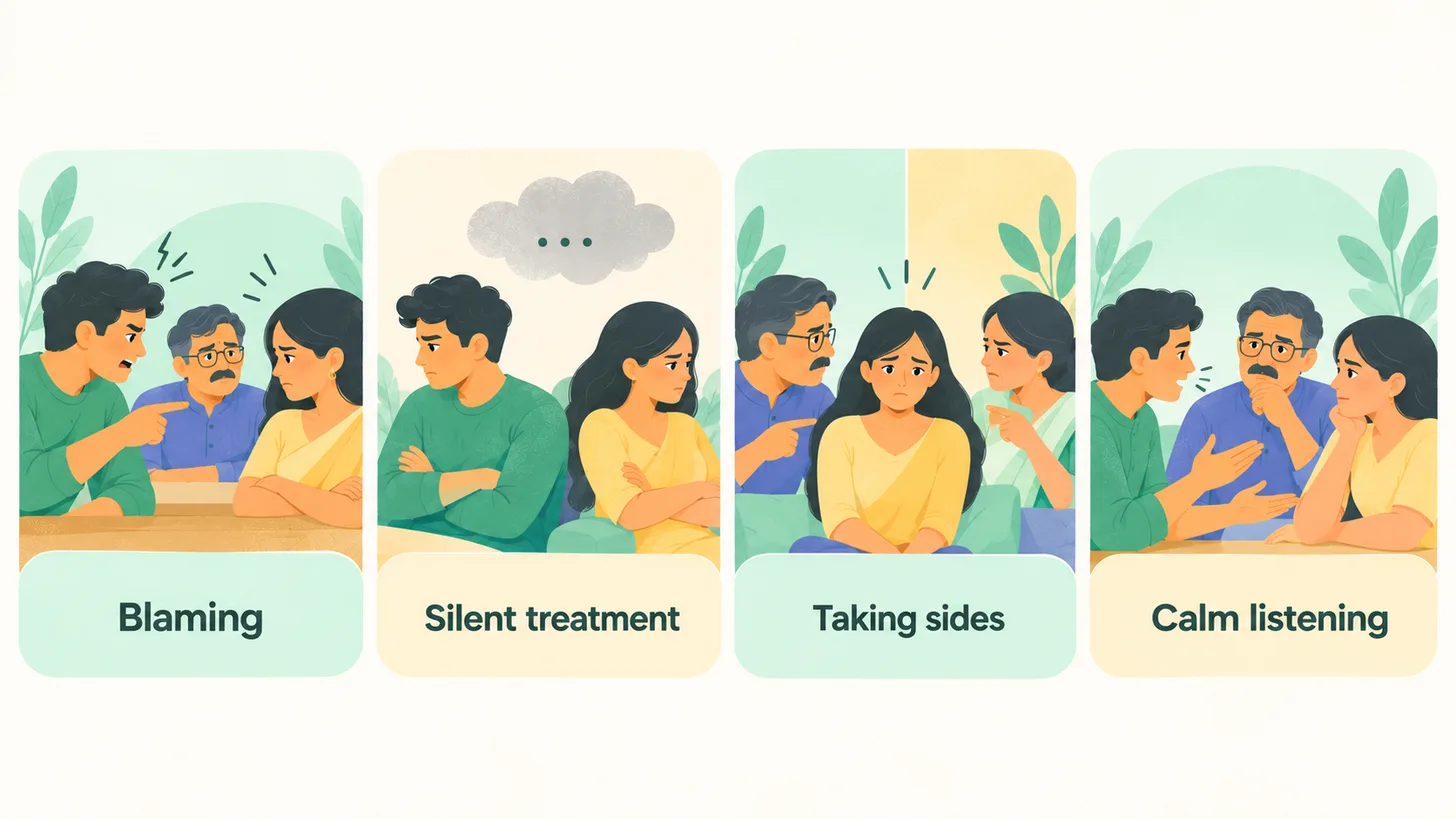
In short: Lower the heat first. Change what you can this week. Leave the rest for a longer conversation, with support.
CTA If a specific family pattern is wearing you out, a therapist can help you name it and plan the next step. GoodLives matches you with a verified psychologist in your language, often within 24 hours. English, Hindi and more Indian languages. Button: Book a Session
Should you see a family therapist or an individual therapist?
Both help. They do different work. The honest answer is that most people in India start with individual therapy, because getting the whole family into a room is hard, and because you can only control what you bring.
In short: Start with the therapist who will see you this week. The right therapist is the one you will keep going back to.




Share your thoughts