
What this blog includes
- What free online therapy in India covers, honestly, and what it does not
- The free national helplines that will pick up tonight
- Low-cost paths most Indians have not heard of yet
- How to tell a safe low-cost therapist from a red flag
- When free is the right next step, and when paying for one session is worth it
What you are feeling is not an overreaction. Googling for free therapy at a hard hour is a reasonable, careful thing to do.
GoodLives has been trusted by 500K+ people across therapy, workshops and awareness programmes, and holds a 5 Google rating. We talk to Indians every day who want help but cannot start at full price, and we think the honest answer helps more than a glossy one.
Here it is. Free online therapy in India mostly means helplines, crisis lines, short-term listening and government services. Weekly 50-minute sessions with the same psychologist for three months are almost never free. That is not a flaw in you. That is how care in India is funded.
What does “free online therapy in India” actually look like?
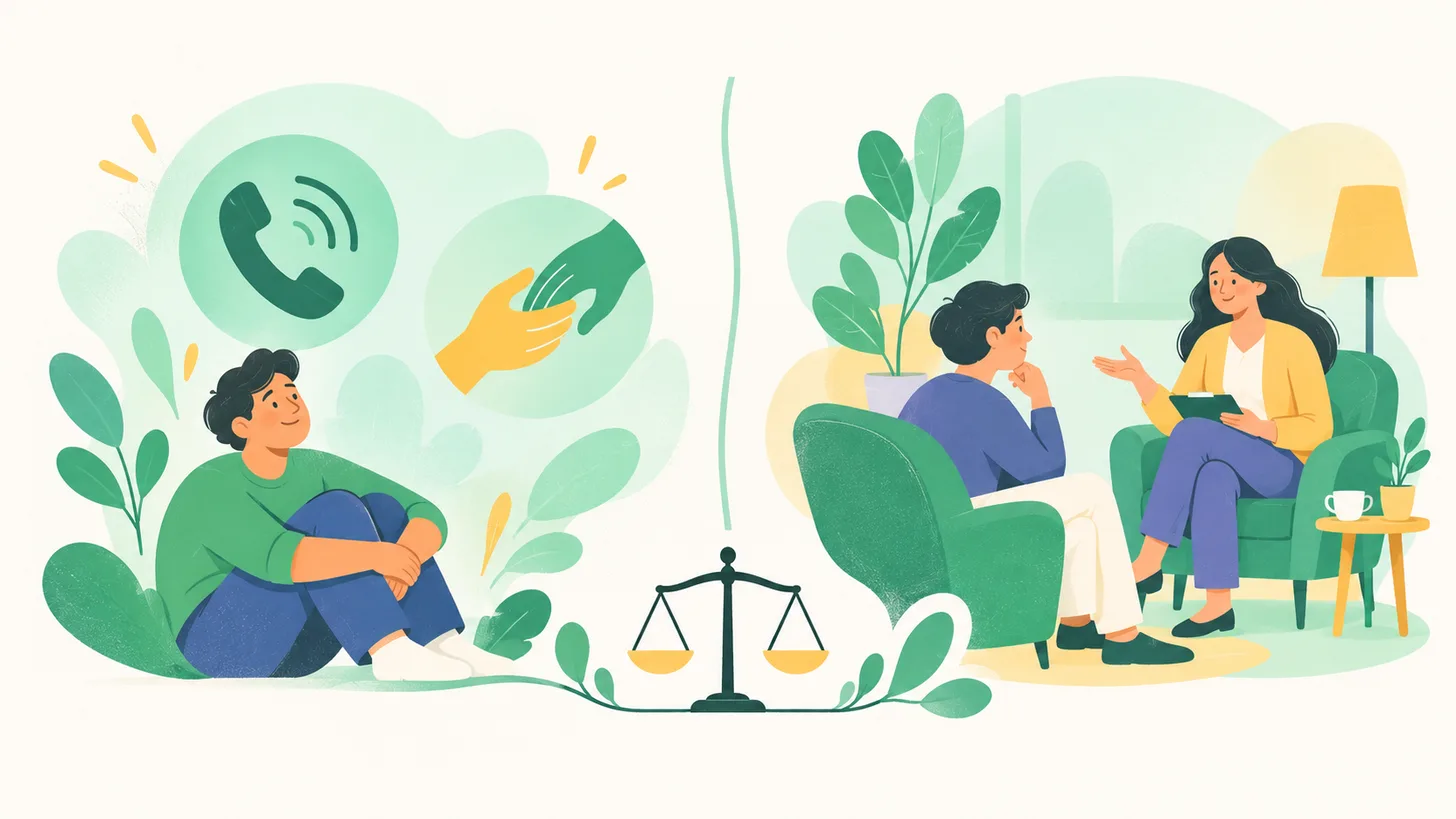
Free online therapy in India usually means one of four things: a government helpline, an NGO or university listening line, a workplace EAP (free for employees), or a short-term NGO programme. All real. None is a weekly standing appointment with the same therapist for six months.
The word “therapy” does a lot of work in these searches. A clinical therapy relationship is weekly, tracks progress with a plan, and often lasts months. A helpline call is one conversation. Both help different things.
In short: free in India mostly means free now, free once, free for employees, or free because the state funds it. Weekly therapy with one named psychologist is almost always paid.
Which free helplines in India actually pick up?
These five numbers are the ones we would call ourselves, in order, on any given night. All free. The first two are the fastest to reach.
- Run by TISS Mumbai.
A call to any of these costs nothing from an Indian mobile number, and you can speak in Hindi, English, or another regional language. You do not have to say your full name or be in a crisis to call.
In short: these are not a last resort. They are the fastest free trained ear in India tonight.
Where else does free online counselling in India come from?
Beyond helplines, three paths offer real free support if you qualify. Most people do not know they exist.
The first is employer EAPs (Employee Assistance Programmes). If your company has one, you usually get a set number of free sessions a year, confidential from HR by design. One line to HR works: “Does our health benefit include counselling sessions?”
If work itself is the pressure, our guide on online counselling for work stress walks through the choice.
The second is NGO and university-based support. The Mariwala Health Initiative lists free and low-cost services across India. Several Indian universities offer short-term counselling to students and sometimes to the public.
The third is peer-support communities like Narcotics Anonymous India or nonprofit-run groups. Peer support is not therapy. It is a specific tool for specific problems.
In short: free online counselling in India usually finds you through your workplace, your campus, or an NGO that has decided to fund it.
Why is most sustained weekly therapy not free?
A good psychologist in India has done a two-year master’s, often an M.Phil., and is registered with the Rehabilitation Council of India (RCI). A weekly 50-minute session for 20 weeks is twenty hours of trained time. Someone has to pay for that.
Free helplines are funded by the government and NGOs. Weekly private therapy is funded by the person who shows up. When free covers your situation, use free. When the pattern is bigger than one call, plan for one paid session a month, or budget for sliding-scale care.
What affordable paths exist when free is not enough?
Affordable in India sits between free and full-fee, and it has three honest shapes.
Government hospital psychiatric OPDs are the biggest underused option. AIIMS, NIMHANS and most state mental hospitals run outpatient departments where assessment is free or nearly free, and basic medication is heavily subsidised. Waits can be long. Clinical quality is often excellent.
Trainee and intern therapist platforms offer sessions in the INR 300 to 800 range (as of November 2026). The therapist does supervised practice hours under a senior clinician, a normal part of training. Ask on the intake call: “Who is your clinical supervisor?”
Sliding-scale therapy means a therapist offers you a lower fee based on income. Many Indian psychologists quietly do this. You have to ask. One line works: “My budget is X per session. Do you have sliding-scale slots?” A no is not a judgement.
If you prefer Hindi, our guide on online counselling in Hindi covers language-fit therapists. For anxiety or low mood, online therapy for anxiety and the depression guide for India go deeper.
When you are ready, you can also book a session on GoodLives. Share your budget on the intake form, and we will match you with a verified psychologist in that range, in your language.
Book a Session When you are ready, book a 50-minute session with a therapist on GoodLives. English, Hindi and more Indian languages. Start when it feels right.
In short: between a free helpline and a full-fee weekly plan sit three real paths: government OPDs, supervised trainee therapists, and sliding-scale slots.
How do you pick a safe low-cost therapist?
The lower the price, the more you want to verify a few basic things. These take about ten minutes.
- RCI registration number. Any clinical psychologist in India should have an RCI licence number. You can search the public RCI register by name.
- A clear supervisor if the therapist is a trainee or intern. The answer should name a senior clinician and a weekly or fortnightly meeting.
- A short free intake call. Fifteen minutes to say what you want help with and hear how they would work. If no intake is offered, ask.
Red flags that mean you should stop, even if the price is tempting:
- No credentials shared, or vague ones like “wellness practitioner” with no RCI number.
- A cure promise. “I can cure your anxiety in four sessions” is not something a trained psychologist will say.
- Religious or magical framing as the main treatment. Faith can be part of your care, not a substitute for a trained psychologist.
- Pressure to commit to a long package before a first session.
- Cash only, no receipt. You want a paper trail, however small.
In short: low-cost does not have to mean low-safety. One short call and one RCI check sort out most of the risk.
When is free the right step, and when is paid worth it?
Free is often enough when you need to talk right now, in a one-off hard moment, or when you need to understand whether what you are feeling is a question for a therapist at all. Not every anxious week needs a weekly therapist.
Paid is usually the right call when a pattern has lasted months, when self-help has not moved the dial, or when a specific condition is involved (OCD, trauma, bipolar, eating patterns). The online counselling hub is a reasonable next page.
If you have tried one therapist and it did not work, pause before trying another. A bad fit is a real thing, not a verdict on therapy.
In short: free is right for a hard night and a careful question. Paid is right for a pattern that has outlasted self-help.
This post is for information only and is not a substitute for professional care. If you are struggling, please speak to a qualified mental health professional.

Share your thoughts